
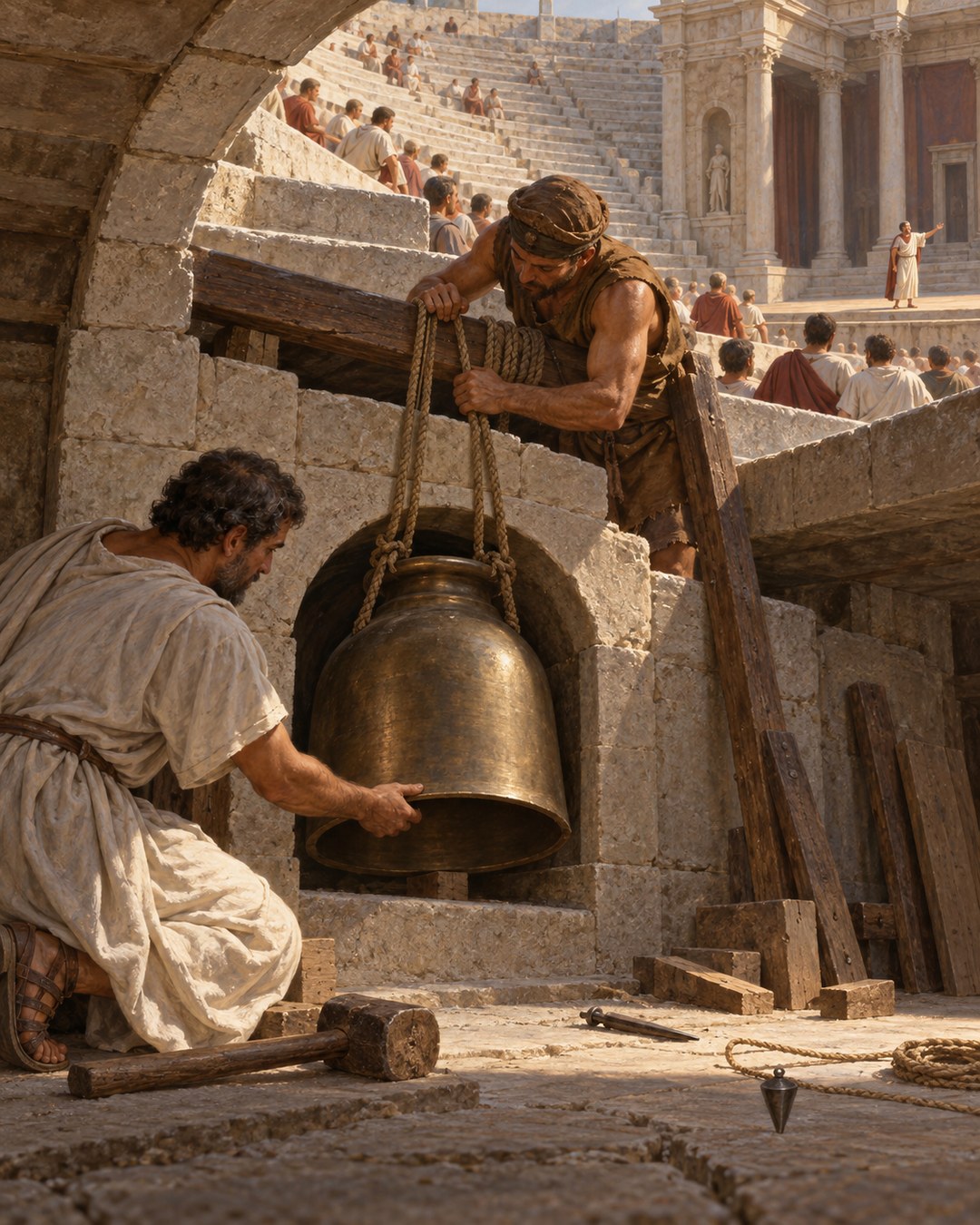
An actor spoke from the center, and empty bronze waited beneath the seats.
Vitruvius wanted each vessel tuned, inverted, isolated from the wall and opened toward the row below. The arrangement was precise because the problem was physical.
When theatre builders replaced resonant timber with stone, they gained permanence but lost a material that answered the voice.
Stone Changed the Acoustic Problem
A Roman theatre had to carry speech across distance without microphones or electronic reinforcement. The audience did not hear an abstract performance. It heard pressure waves shaped by a stage, doors, seating, bodies, wind and every surface between actor and listener.
Vitruvius understood sound as motion spreading in circular waves. A voice issued from the stage and expanded outward until architecture reflected, absorbed or redirected it. The theatre therefore had to be designed as an acoustic instrument as well as a place to sit.
Wood helped. Vitruvius points to Rome’s public wooden theatres, whose abundant boarding was naturally resonant. Singers with the lyre could turn toward folding stage doors when they wanted reinforcement in a higher key. The building’s joinery participated in the performance.
Masonry, stone and marble behaved differently. They offered stability, scale and public grandeur, but Vitruvius did not consider them resonant in the same useful way. A monumental theatre could make the very material that proclaimed civic investment harder for a voice to animate.
His response was not to cover every surface with metal. He proposed selected cavities placed inside the seating structure. Each one would answer only when sound reached the frequency for which it had been made.
This distinction separates the device from a speaking tube or a simple echo chamber. The vessels did not carry words directly from an actor’s mouth. They received energy from a voice already moving through the theatre and returned a sympathetic response.
The idea belonged to a broader Roman habit of matching materials to a mechanism. Vitruvius replaced unreliable stretched lines with water when wind disturbed a level. In the theatre, he tried to restore resonance with shaped voids when solid construction removed it.
Every Vessel Needed Air around It
Vitruvius begins with bronze. The vessels had to be proportioned to the size of the theatre and fashioned to produce notes related by fourths, fifths and, across the system, a double octave.
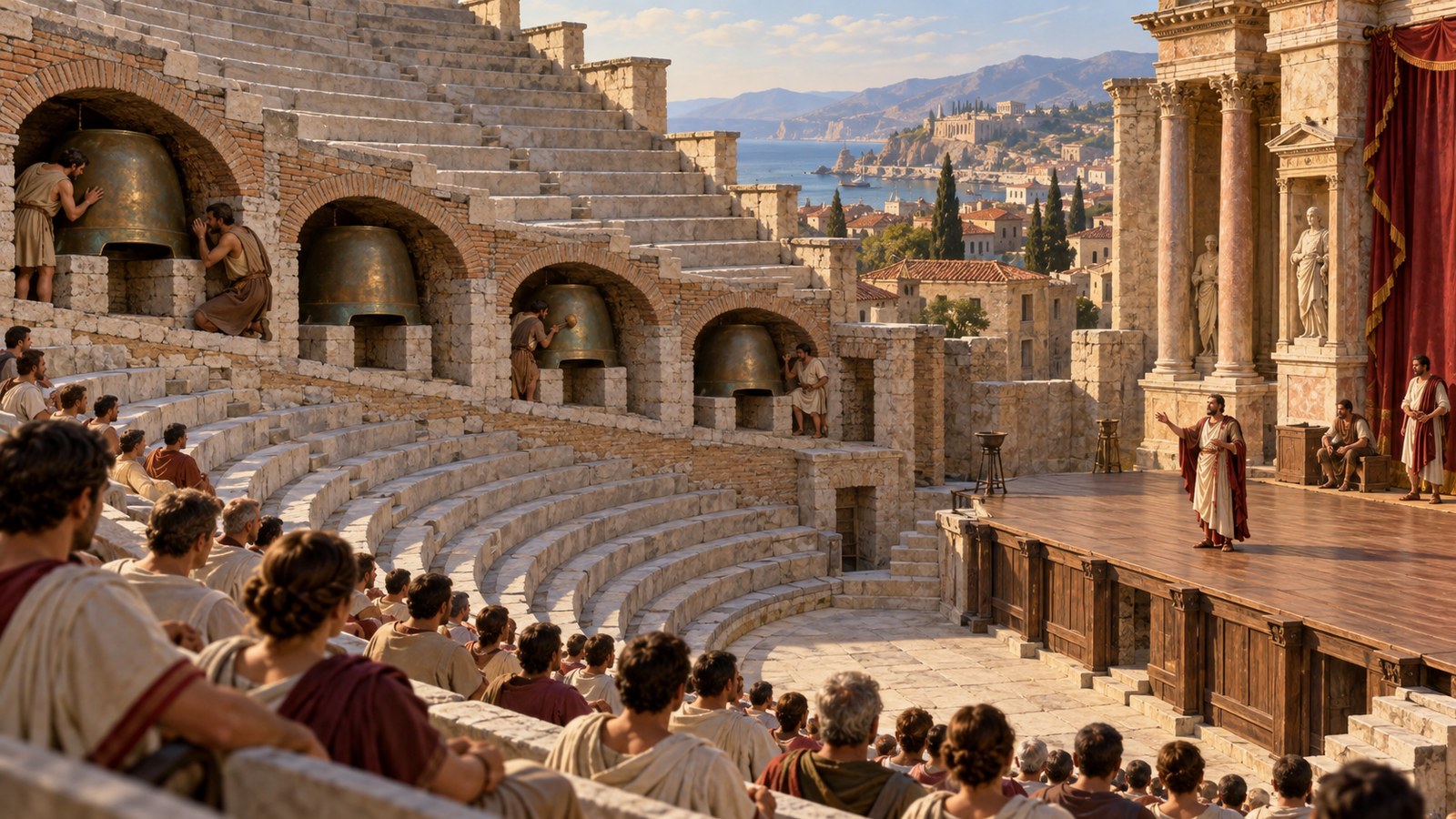
They were placed in arched niches between the seats. A vessel could not touch the wall. Clear space had to remain around its sides and above its top.
That clearance protected vibration. If bronze pressed against masonry, energy could pass into the surrounding structure or be damped at the contact point. An isolated shell had more freedom to answer at its own pitch.
Orientation was equally deliberate. Each vessel sat upside down. On the side facing the stage, a wedge at least half a foot high supported it. Opposite the niche, the seat surface below received an aperture two feet long and half a foot deep.
The arrangement joined cavity, opening and direction. The stage voice approached from one side; the niche exposed the resonant volume toward listeners through the other. An upside-down vessel was therefore not discarded storage. Its mouth and hollow body formed part of an installed acoustic assembly.
The wedge did more than keep the rim off the floor. By lifting the stage-facing side while leaving the vessel inverted, it preserved an unobstructed mouth and a repeatable orientation. Installation geometry was part of tuning in use, not a detail left to whichever laborer carried the bronze into the niche.
Vitruvius gives thirteen niches for a smaller theatre, with twelve equal spaces between them. The central and paired vessels were assigned pitches according to a musical system rather than distributed as identical pots.
The number did not mean that an audience heard thirteen obvious metallic notes after every line. Vitruvius says the voice striking the cavities would increase in clarity and awaken a harmonious note in unison with itself. Reinforcement, not percussion, was the intended result.
Builders still needed good placement. A beautifully tuned vessel buried without a clear opening, jammed against a wall or aimed away from useful sound would fail as surely as a badly laid channel. The specification ties musical theory to construction tolerances.
A Large Theatre Became a Map of Intervals
For a larger theatre, Vitruvius divided the height into four parts and installed three horizontal ranges of niches. The lowest served the enharmonic system, the middle the chromatic and the highest the diatonic.
Within each range he assigned named pitches from the ends toward the center. Fourths linked many neighboring positions. Some central positions remained empty because his harmonic system supplied no suitable natural concord there.
The plan treated the cavea as a vertical and horizontal map. A listener did not need to know the Greek pitch names. The architect did. Theory determined which vessel belonged in which cavity long before an audience judged whether an actor sounded clear.
That division of knowledge mattered. Bronze founders had to shape responsive vessels. Builders had to preserve niche dimensions and clearance. Musicians or trained testers had to recognize pitch. The finished effect depended on crafts that could fail separately.
Vitruvius directs anyone seeking an easier path to a musical scheme attributed to Aristoxenus. Architecture borrowed an organized language of intervals rather than relying only on a builder tapping jars until something sounded pleasing.
The result was ambitious, but Vitruvius does not claim that every theatre followed it. He admits that he cannot name one at Rome equipped this way. Examples belonged to districts of Italy and to numerous Greek states.
Lucius Mummius provided one material trace in Roman memory. After destroying Corinth, he brought its bronze theatre vessels to Rome and used money from their sale for a dedication at the temple of Luna. The objects entered Rome as captured metal rather than as a working acoustic installation.
That afterlife is revealing. A vessel could be engineering in its niche, booty in transit and bullion when sold. The same bronze changed meaning when removed from the system that made its hollow useful.
Clay Let Smaller Towns Buy the Principle
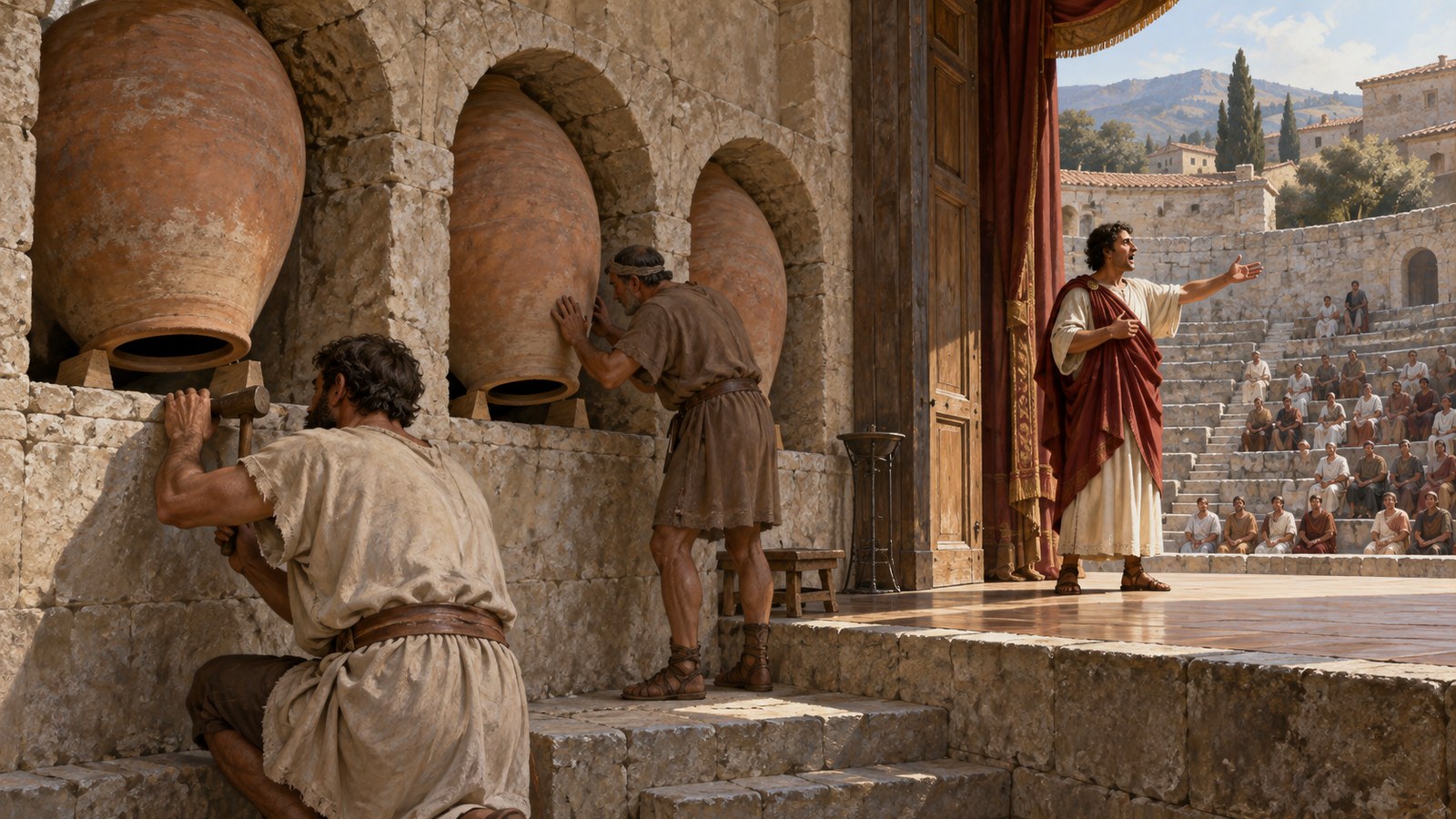
Bronze was not the only option. Vitruvius says architects in small towns sometimes lacked the means for metal vessels and selected large clay jars with similar resonance.
The substitution preserved the mechanism while changing cost and material. A clay jar could still enclose air, vibrate and respond at a useful pitch if chosen and arranged carefully.
It also demanded caution. Pottery varied with clay, wall thickness, firing and shape. Two jars that looked alike might not answer identically. Selection by sound was as important as visual fit.
Vitruvius reports that these cheaper installations produced very advantageous results. His language does not prove modern measured performance, but it does show an ancient designer distinguishing a functional requirement from a prestigious material.
The point was not “bronze” for its own sake. The point was resonance at selected intervals, maintained by clear space and connected to the theatre through controlled openings.
Roman theatre design already coordinated sightlines, stairs, social seating and stage geometry. The seating plan made civic rank visible; the hidden jars addressed what all those ranked spectators could hear.
An audience might never see the devices. Their work happened behind the stone surface, where voids and vessels corrected a consequence of monumentality.
That is the most useful way to understand Vitruvius’s proposal. It was not a magical Roman loudspeaker and not proof that every ancient theatre had secret bronze under its seats.
It was a disciplined attempt to make a permanent stone building recover one acoustic behavior of wood. The actor supplied the voice. The architect arranged which empty spaces would answer.
Sources
Vitruvius, On Architecture, book 5, chapter 5.