
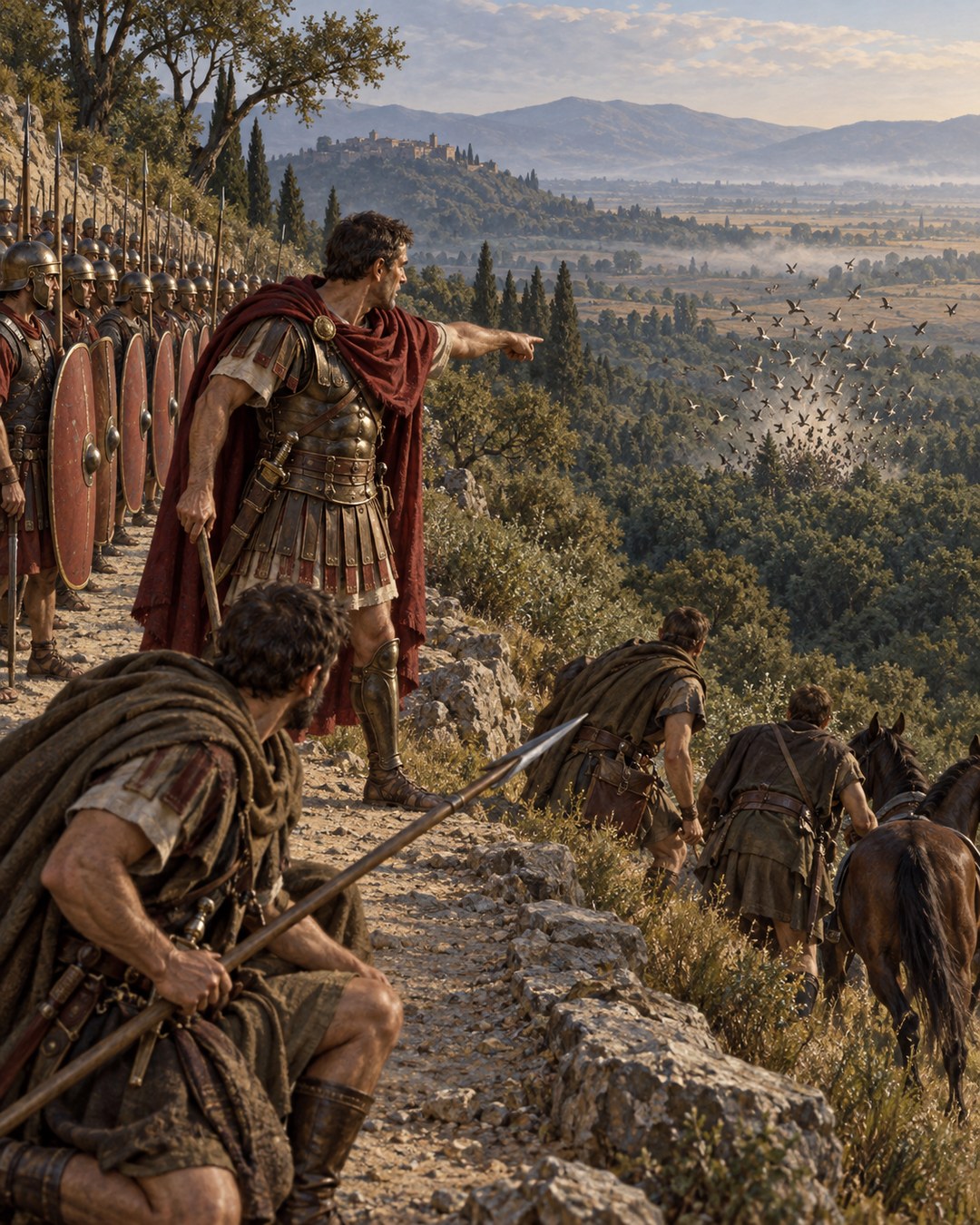
The army had not entered the plain when the forest moved first.
A great flock rose at once from one distant patch of trees near Vetulonia. The consul Aemilius Paulus stopped treating the slope below as empty ground and sent scouts toward it.
They found ten thousand Boii waiting for the Romans to come down.
A Disturbed Canopy Broke the Landscape’s Calm
Frontinus places the episode during an Etruscan war. Paulus was preparing to send his army from higher ground into a plain near Vetulonia, exactly the kind of transition in which a marching column could lose the advantage of seeing ahead.
The first warning was not a weapon, voice or visible warrior. It was a flock of birds rising from a forest at a distance.
One bird taking flight would have meant little. Frontinus stresses two features that made this movement different: the birds looked startled, and they rose at the same time in great numbers. The signal lay in concentration and timing.
Paulus could not see through the canopy. What he could see was the canopy’s reaction to something beneath it.
That distinction matters. Birds were not reporting an order of battle. Their sudden departure showed that a place which appeared quiet had just been disturbed on a scale large enough to alarm many animals together.
The army’s planned descent supplied the danger. If the forest concealed nothing, a delay cost time. If it concealed an organized force, continuing on the expected line could place the Romans where that force wanted them.
Frontinus says Paulus inferred treachery. The word fits an ambush because the visible ground offered one account—an ordinary forest beside a plain—while the birds suggested another.
Roman commanders repeatedly had to read traces that enemies did not intend to leave. Marius used wind, distance and an army’s morning routine to make exhaustion arrive before battle. Paulus faced a smaller clue, but the same practical problem: terrain only becomes useful when its effects are noticed before commitment.
Scouts Turned an Alarm into a Count
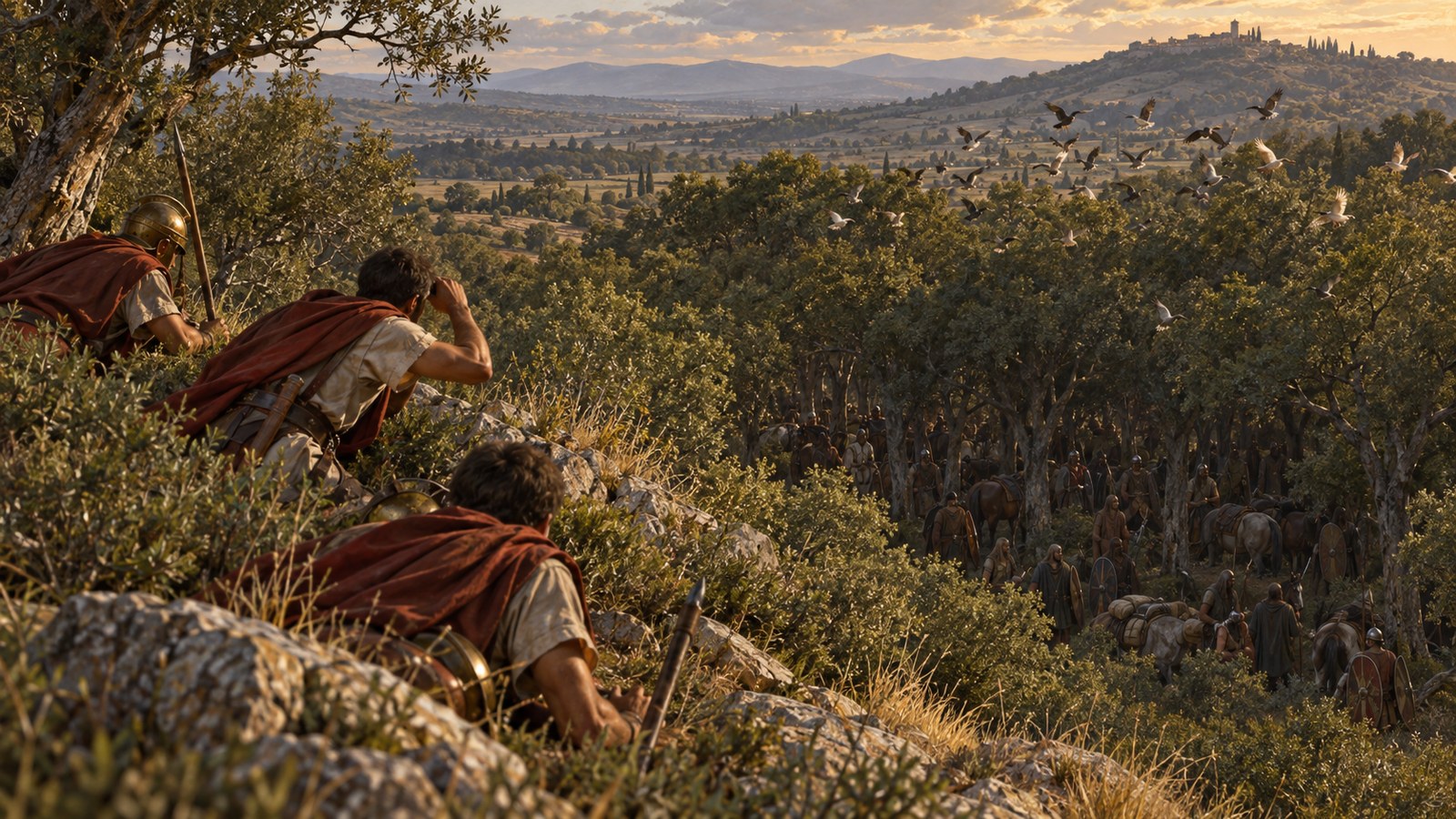
Paulus did not charge the forest because birds had flown. He sent scouts ahead.
That step separates observation from confirmation. The flock justified investigation, not certainty. A predator, travellers or some other disruption might also have driven birds upward.
The scouts supplied what the sky could not. They discovered the hidden people, their purpose and their scale.
Frontinus gives the number as ten thousand Boii. Whether read as an exact tally preserved by tradition or as the ancient author’s measure of a very large force, it changes the decision completely. This was not a few skirmishers screening the road.
The Boii were lying in wait at the point where they expected the Roman army. Their concealment depended on an asymmetry: they could prepare around Paulus’s likely movement while remaining unseen from his line of approach.
The scouting report reversed that asymmetry. The Romans now knew where the Boii were, while the concealed force still organized itself around the assumption that its location was secret.
Paulus’s restraint was therefore active, not passive. He held the main body back long enough for a smaller group to approach, inspect and return.
The decision also protected the army from overreacting to an ambiguous sign. Soldiers did not need to turn every rustle into panic. A commander could recognize an anomaly, assign a bounded test and wait for evidence proportionate to the risk.
That procedure made the flock operationally valuable. Without scouts, the birds were only a warning. With scouts, they became the beginning of a chain that led from disturbance to location, number and intent.
The Ambush Fixed the Boii to One Expected Route
An ambush gains force from prediction. The hidden side chooses where the other side will appear, arranges men around that point and waits for movement to enter a prepared space.
The Boii had made that investment near the Roman descent. Their concealment, concentration and patience all assumed that Paulus would continue on the line already visible to them.
Discovery did not merely cancel the trap. It exposed how much the trap depended on one future.
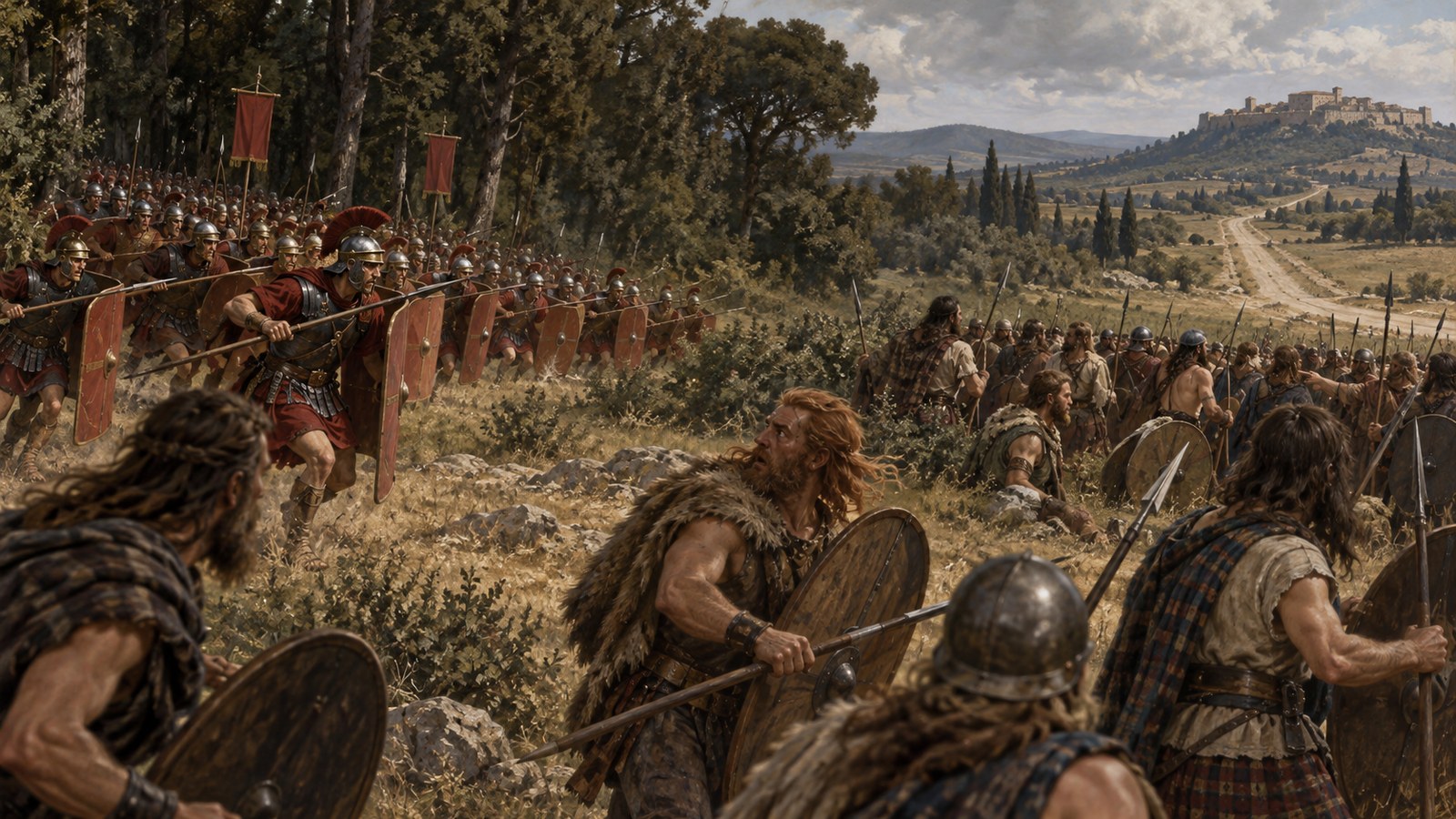
Frontinus says Paulus sent his legions against the Boii from a different point. The concise sentence contains the reversal. The force that expected to strike an approaching column had to respond to an attack arriving outside its chosen angle.
This is not a story of birds winning a battle. Paulus needed soldiers able to change direction, scouts able to report accurately and officers able to move the legions without announcing the new approach too soon.
It is also not evidence that Roman armies possessed a mystical language of animal signs in this moment. Frontinus describes a material inference: many startled birds left a specific forest, scouts checked the place, and armed men were there.
The archive contains a colder coastal variation on unexpected approach. Iphicrates prepared selected men to move through winter water around a guarded defile. Paulus did not ask troops to survive that physical ordeal. He used information to make a different route decisive.
The Boii’s number increased both danger and rigidity. Ten thousand men could dominate the intended killing ground, but keeping so many hidden meant choosing cover broad enough to hold them and a target line predictable enough to justify the concentration.
Frontinus Preserved a Method, Not the Battle Noise
Frontinus wrote collections of stratagems to give commanders examples they could adapt. His account is correspondingly compressed.
He does not preserve the scouts’ names, the time they needed, the exact Roman formation or a casualty list. He moves through four durable stages: planned descent, startled flock, scouting discovery, attack from an unexpected point.
That compression warns against filling the forest with invented dialogue or pretending we can reconstruct every movement. It also exposes the mechanism unusually clearly.
The critical decision came before contact. Paulus allowed a small irregularity in the environment to interrupt the momentum of a large army.
Marching plans create pressure to keep moving. Men have been ordered, units aligned and a destination selected. A distant flock can seem too slight to disrupt that machinery.
Yet the cost of checking was limited compared with the cost of descending into ten thousand concealed opponents. Good reconnaissance did not require omniscience. It required recognizing when the apparent landscape no longer deserved trust.
The episode also joins natural observation to institutional action. Paulus saw the birds, but scouts tested the inference and legions acted on the result. No part alone was sufficient.
Frontinus’s number also changes how the first sight should be understood. A great simultaneous takeoff did not reveal ten thousand individuals, but it was consistent with disturbance spread across a substantial concealed position. The scouts converted that broad environmental footprint into a human count and a tactical purpose.
There is a useful asymmetry in the timing. The Boii needed to remain still until the Roman column entered the prepared point. The birds reacted before that chosen moment, forcing hidden men to leave evidence simply by occupying and disturbing the forest. Concealment from Roman eyes did not mean concealment from every living thing around them.
Had he ignored the flock, concealment might have held. Had he assumed too much without scouts, he might have redirected an army on a false alarm. Had he learned the truth but attacked on the expected road, the Boii could still have used their prepared position.
Instead each response matched the information available at that stage. Notice. Verify. Re-route. Strike where the waiting force had not arranged to receive an attack.
The forest betrayed no plan in words. It showed a disturbance. Paulus’s advantage came from refusing to demand that the first clue provide the entire answer.
Sources
Sextus Julius Frontinus, Stratagems, book 1, section 2.7.