
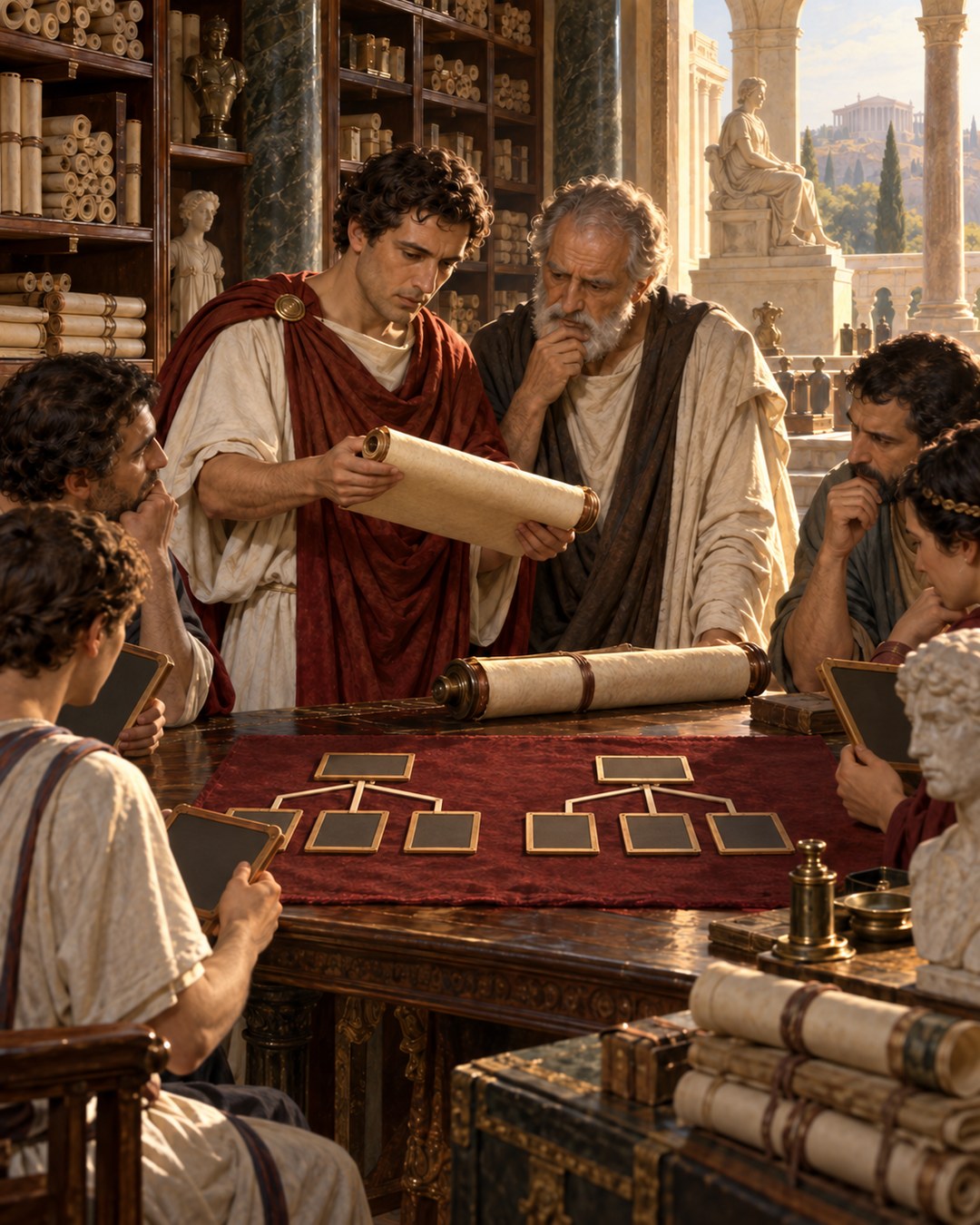
A book arrived in the imperial palace library with what seemed like a useful label: Marcus Cato Nepos.
The name did not solve the identity. It created a family problem.
Sulpicius Apollinaris had to split one famous lineage into two branches before the book could return to the right man.
The Roll Looked More Precise Than It Was
Aulus Gellius places the scene in the library of the Palace of Tiberius. He and friends were sitting with Sulpicius Apollinaris when a volume bearing the name Marcus Cato Nepos was brought to them.
The group immediately asked who that Marcus Cato was. “Cato” narrowed the field only slightly. “Marcus” repeated within the family, while Nepos could encourage a reader to think first of a grandson.
A young man offered a confident answer. He made the author a grandson of Cato the Censor through the censor’s son and then treated him as the father of the later Cato who killed himself at Utica.
The answer sounded orderly. Cato the Censor stood at the top, a grandson occupied the middle, and Cato of Utica followed below. Cicero’s praise of the Utican Cato called him the censor’s great-grandson, which seemed to support the sequence.
Apollinaris did not attack the young reader’s learning. Gellius remembers him correcting the mistake quietly and mildly. The problem was not that the reader knew no names. He knew enough names to build the wrong line.
This is what made the library question difficult. A famous ancestral name could circulate on speeches, biographies and books while several descendants held offices under nearly identical names.
The physical roll offered an attribution, not a modern identity record. To test it, the readers had to turn from the label to marriages, mothers, generations, magistracies, provinces and deaths.
Roman memory often condensed a family into one celebrated figure. Cato the Censor’s plain houses and old age made him an especially durable moral image. That fame increased the risk that later Catos would be arranged around him too simply.
Two Mothers Created Two Timelines
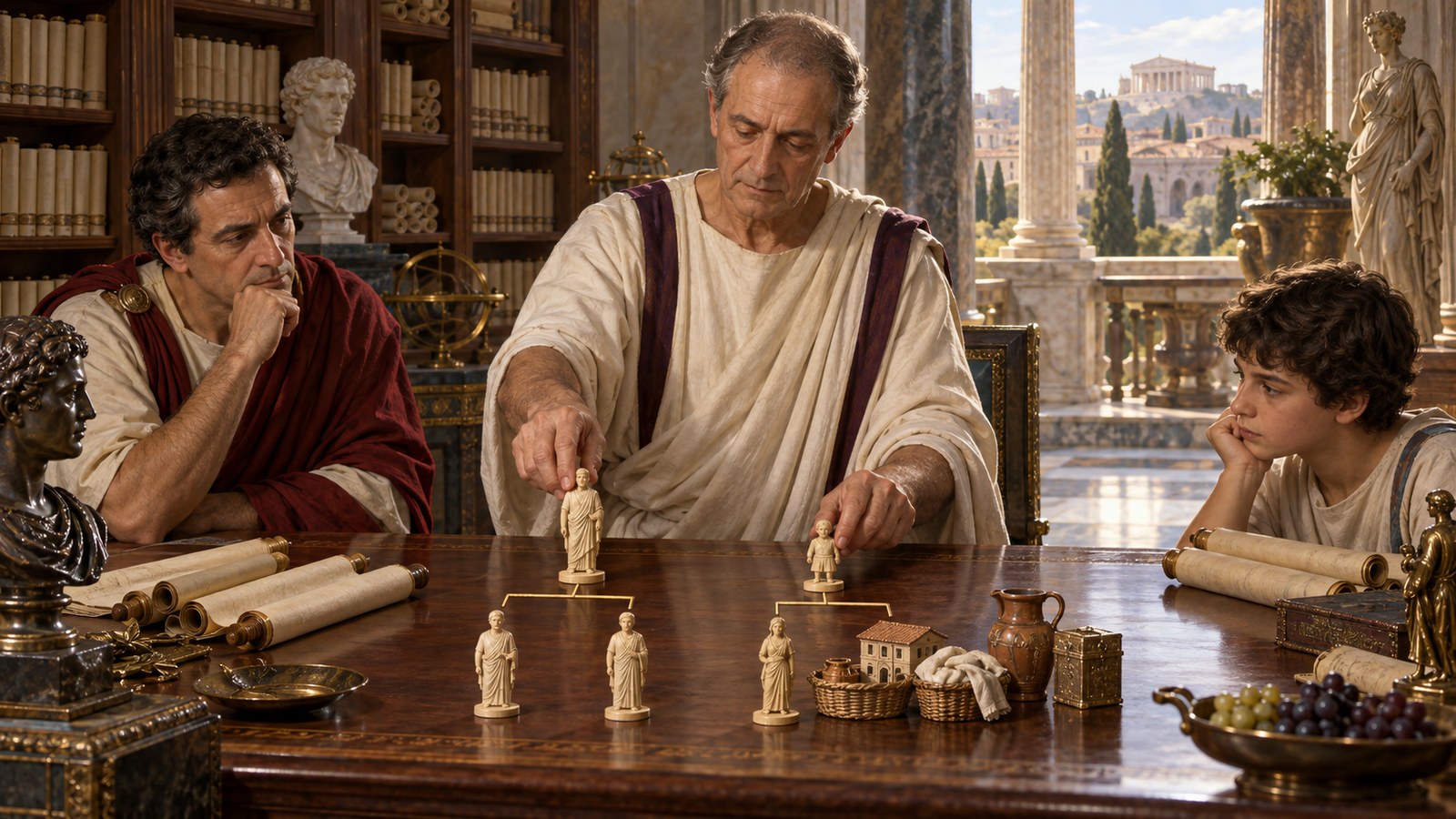
Apollinaris began with the fact that Cato the Censor did not have only one relevant line of descent.
He had two sons, born to different mothers and at very different times. The age gap was not incidental. It made descendants who occupied the same genealogical level belong to noticeably different historical moments.
The elder son was already a young man when his mother died. Cato, by then advanced in age, married the young daughter of his client Salonius.
That marriage produced another Marcus Cato. He was called Salonianus from Salonius, his maternal grandfather.
The maternal name marked the younger branch, but only if a reader knew why it existed. Without the marriage and age difference, repeated male names could still collapse the two lines.
Apollinaris therefore treated genealogy as chronology. The younger son arrived near the end of the censor’s life, so his descendants necessarily belonged later than the corresponding descendants of the elder son.
A family tree drawn only by degrees—son, grandson, great-grandson—would hide that difference. A family tree supplied with ages, marriages and careers revealed it.
The correction also restored women to an account that repeated male names tended to flatten. The two mothers separated the branches. Salonius’s daughter gave the younger son both his place in time and the surname by which his line could be followed.
This did not make Roman naming transparent. It supplied one thread that had to be combined with several others.
Offices and Provinces Identified the Writer
The elder son of Cato the Censor died while praetor-elect, before his father. Gellius says that he left admirable works on law.
From him descended the Marcus Cato whose book prompted the discussion.
This grandson was an orator of some ability. His speeches, Gellius says, followed the manner of his famous grandfather. Literary resemblance therefore belonged inside the attribution problem: the later man wrote in a style associated with the family’s dominant ancestor.
His public career supplied firmer coordinates. He became consul with Quintus Marcius Rex, travelled to Africa during that consulship and died there.
Those details attach a repeated name to a sequence that another Cato could not occupy casually: particular colleague, office, province and death.
The line continued, but not toward Utica. This consul had a son named Marcus Cato who served as curule aedile and praetor, then went to Gallia Narbonensis and ended his life there.
Africa and Narbonensis pulled the elder branch away from the neat genealogy proposed by the young reader. The son of the book’s author had his own offices and destination. He was not Cato of Utica.
The method resembles the scrutiny needed when many plays circulated under Plautus’s name. Ancient scholars tested a large attributed corpus instead of accepting every familiar label. Here the object was a family rather than a dramatic canon, but the warning was similar: a name on a work began inquiry; it did not end it.
Apollinaris’s reconstruction joined texts to careers. The speeches said something about style, while magistracies and provinces fixed which life could have produced them.
Utica Belonged to the Younger Branch
The younger son, Cato Salonianus, had two sons named Lucius and Marcus.
That Marcus became tribune of the commons and died while a candidate for the praetorship. He, not the consul from the elder line, fathered Cato of Utica.
Cicero was therefore correct to call the Utican Cato a great-grandson of Cato the Censor. The mistake lay in assuming that every grandson standing between those generations was the same grandson.
The correct route passed through Salonianus, the son born late to the censor’s second wife, and then through Salonianus’s son the tribune.
Apollinaris emphasized dates as well as pedigree. Because Salonianus was born near the end of his father’s life, the younger branch ran later than the elder branch. Readers could see the difference in the speech before them once they knew to look for it.
Chronology became a filter against an attractive but impossible identification. A man’s office and death could not be shifted merely because his name fitted a desired family slot.
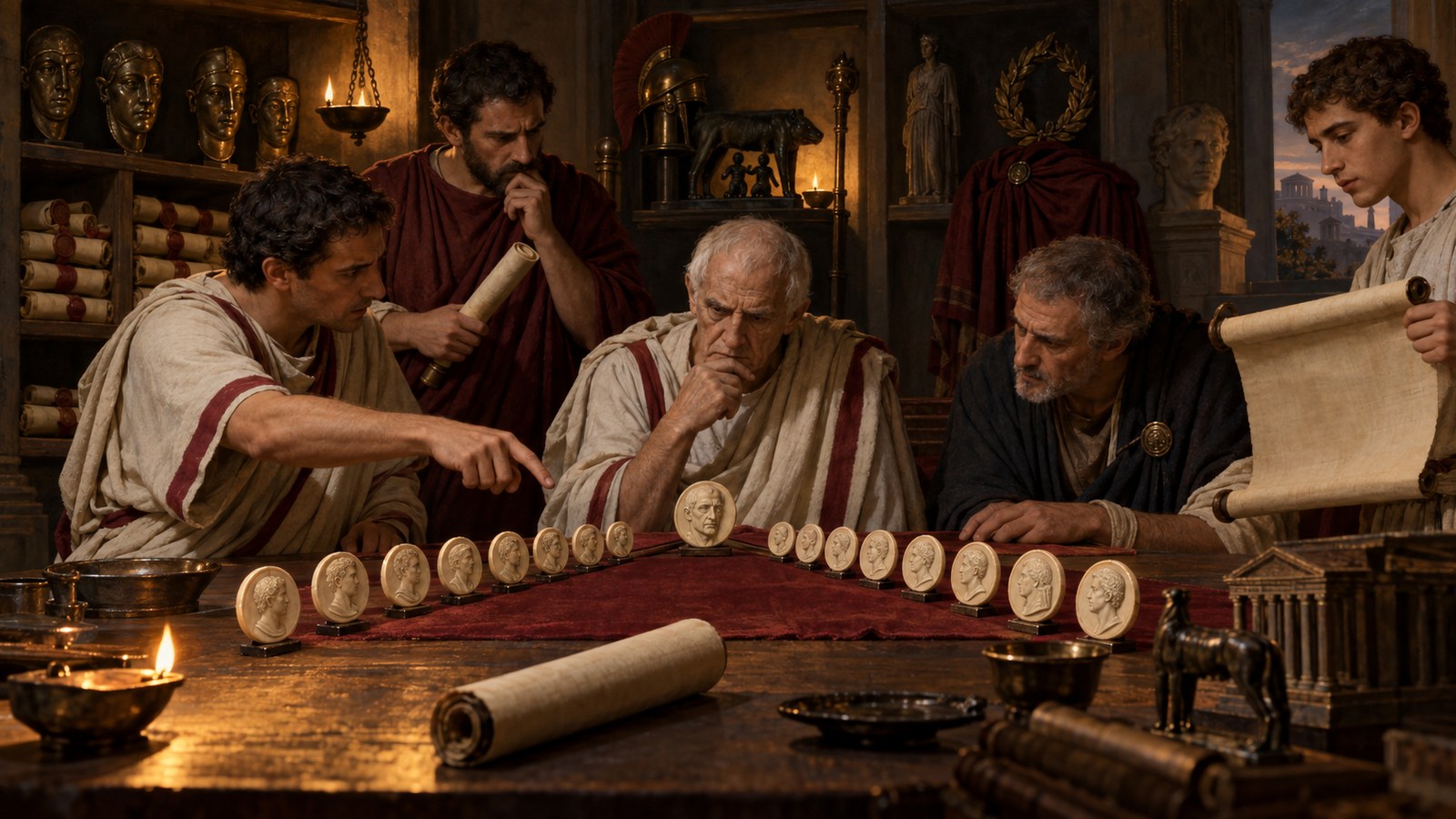
Gellius did not ask his audience to accept the correction on tone or reputation. He says that the group later found Apollinaris’s account confirmed when they consulted funeral eulogies and a genealogy of the Porcian family.
Those records created a second evidentiary layer. The conversation generated a hypothesis; family documents tested it.
The palace library scene preserves scholarship as a social act. A book arrives. One reader proposes. Another distinguishes. The group checks.
It also shows why Roman biography cannot be reconstructed from famous names alone. The family repeatedly produced a Marcus Cato, yet mothers, offices, provinces and deaths made each life distinct.
The roll’s label was not useless. It was incomplete. Only after the two branches had been separated did “Marcus Cato Nepos” identify an author rather than an ancestral echo.
The correction depended on several independent kinds of detail. Kinship established possible relationships. The second marriage explained why two sons of one father belonged to sharply separated generations. Public offices placed descendants within civic careers. Africa and Gallia Narbonensis distinguished the ends of two lives. The manner of the surviving speeches connected the writer to his grandfather without making the men identical.
Even the failed first answer remains instructive. The young reader had remembered Cicero’s statement that Cato of Utica was a great-grandson of the censor. What he lacked was the branching structure between those endpoints. One true relationship did not validate every link inserted beneath it.
Apollinaris corrected that structure before Gellius and the others returned to documentary checks. Their later consultation of funeral eulogies and the Porcian genealogy mattered because it could have contradicted an elegant reconstruction. Instead it confirmed the two lines. The episode makes verification visible: labels supplied a question, chronology constrained the answer, and separate family records closed the case.
Sources
Aulus Gellius, Attic Nights, book 13, chapter 20.