
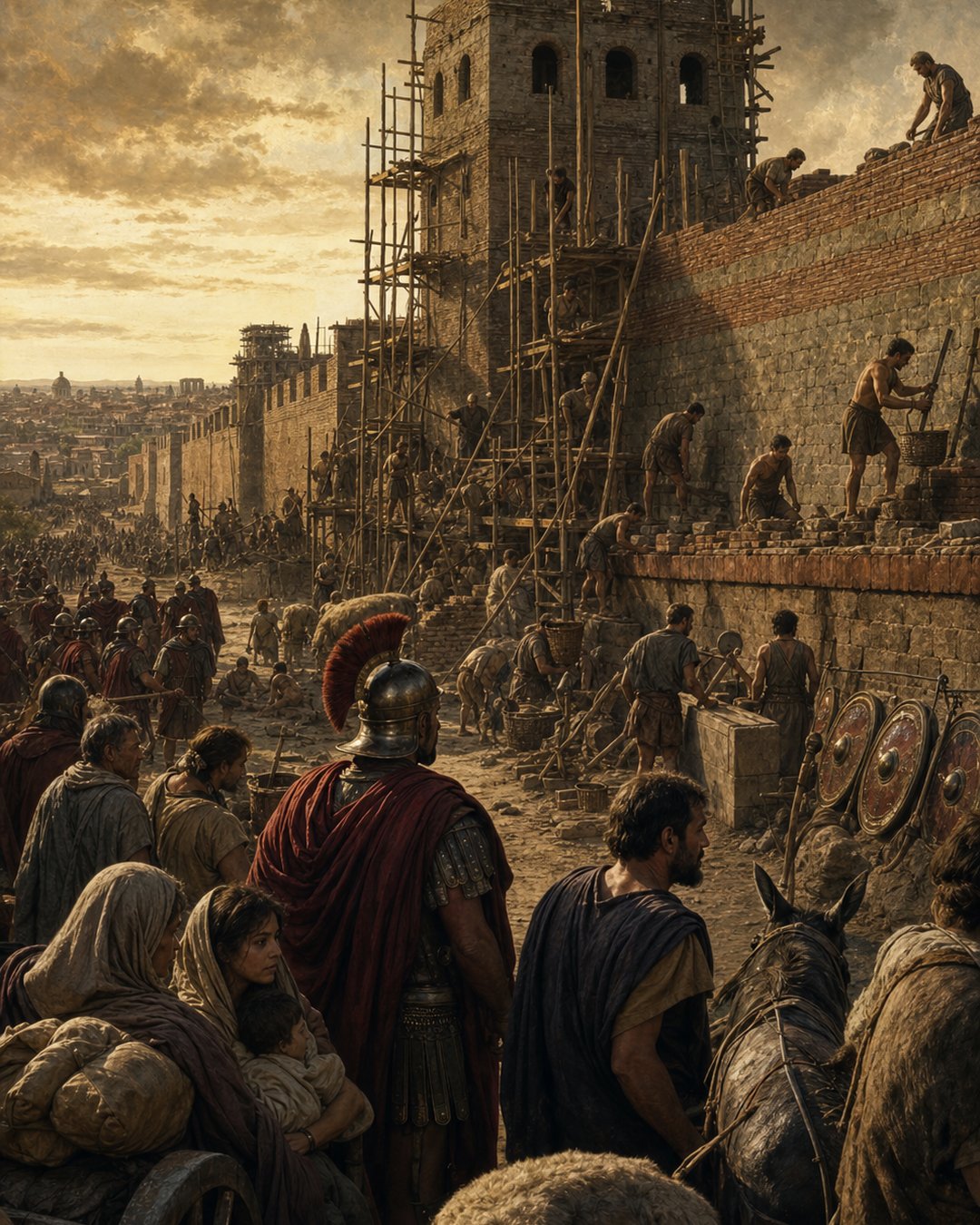
A wall is never only a wall around a capital. It is a confession in stone and brick. When Aurelian began building a new defensive circuit around Rome in the 270s CE, the city received more than fortification. It received a visible admission that the old confidence had changed.
For centuries, imperial Rome could imagine distance as defense. Armies, provinces, roads, rivers, and frontiers were supposed to keep danger away from the capital. The Aurelian Walls did not deny Roman power, but they changed its posture. They made caution permanent.
The crisis age reached the city’s imagination
Aurelian ruled in the third century, a time of rapid emperors, frontier pressure, breakaway regimes, invasion scares, and military emergency. He was an energetic restorer, but restoration itself reveals the problem. Something had to be restored because confidence had cracked.
The threat of groups such as the Juthungi in Italy made the old assumption harder to maintain. Rome was still symbolic center of the empire, but symbols do not stop raiders. A city that had once felt protected by its own greatness now needed a circuit that guards could patrol.
The new circuit made fear measurable
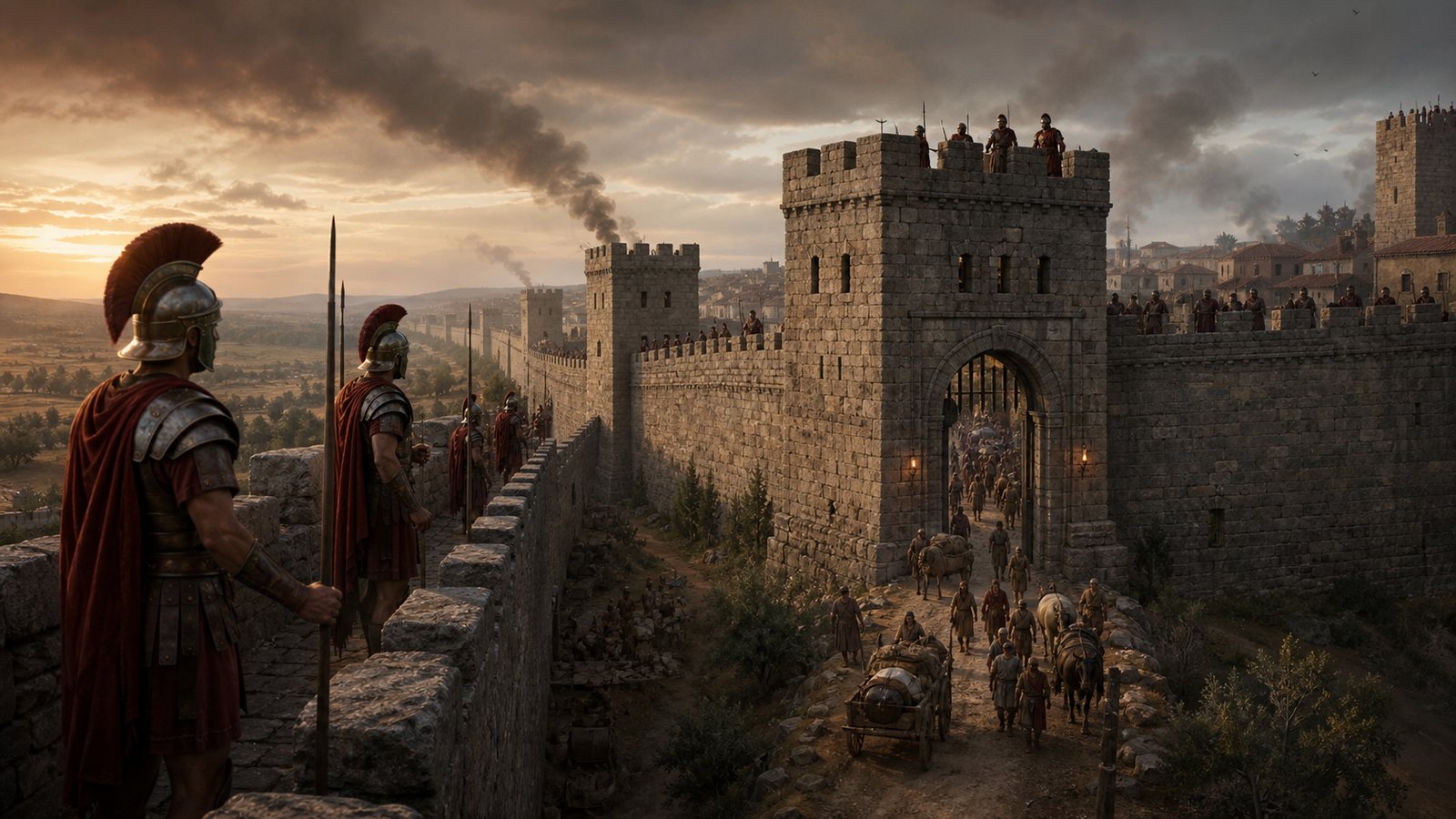
The Aurelian Walls ran for roughly nineteen kilometers and enclosed a far larger urban area than the older Servian Wall. That number matters because scale was part of the message. This was not a token barrier around a ceremonial core. It was a major project around the living imperial city.
Building quickly required practical choices. Existing structures were incorporated in places. Gates, towers, barracks, and stretches of brick-faced concrete turned urgency into architecture. The result was not a philosophical essay about decline. It was a line that workers, soldiers, animals, and carts had to negotiate.
A gate changes how a city feels
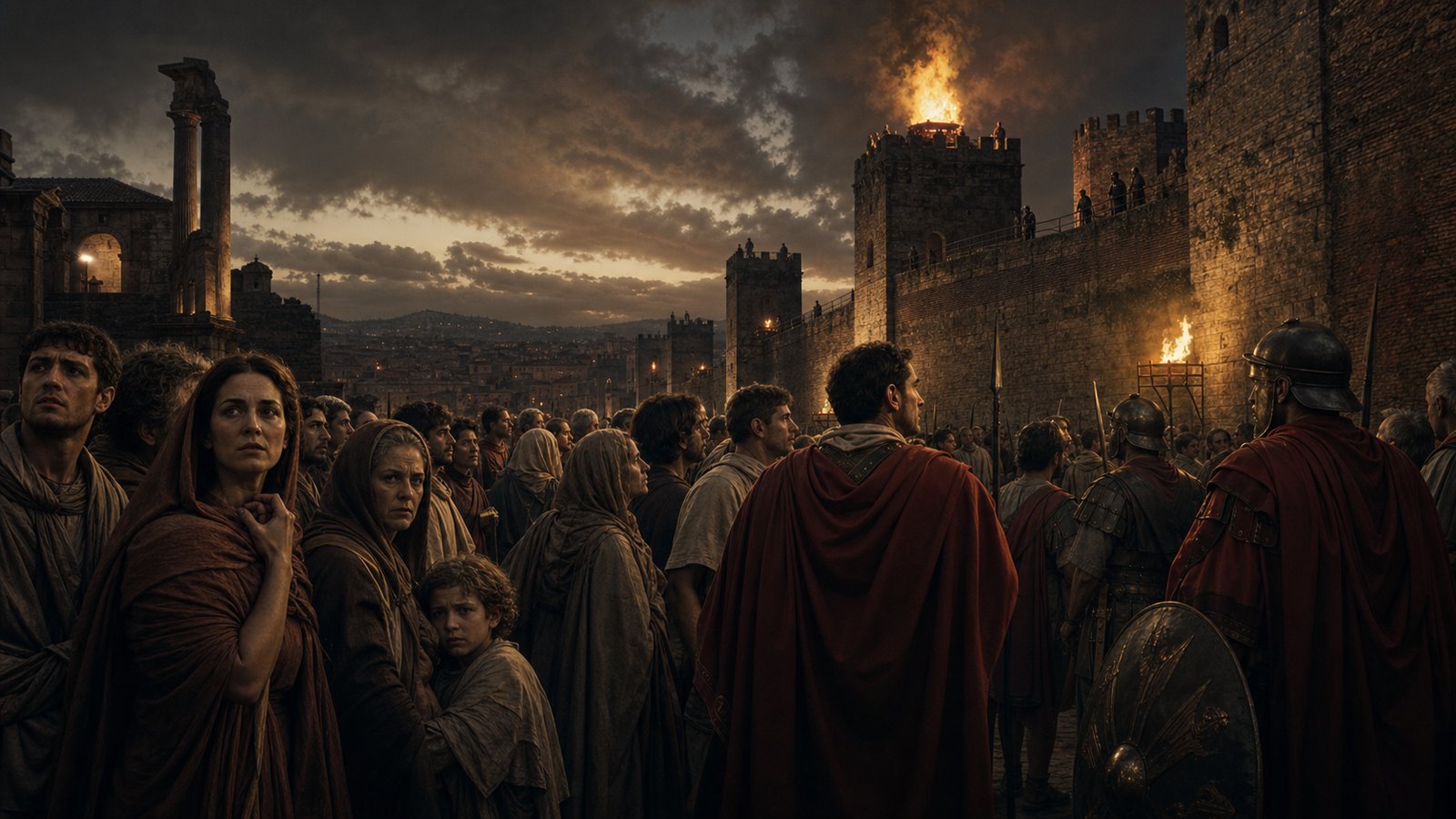
A defended gate makes entry visible. People who passed through the Aurelian circuit encountered a new kind of threshold: guarded, narrowed, watched, and militarized. Rome had always had boundaries, but this boundary spoke in the language of emergency.
The experience mattered for citizens as much as enemies. Walls tell inhabitants that protection exists, but they also remind them protection is necessary. A watchtower reassures and unsettles at the same time. It says someone is looking out because there is something to look for.
Aurelian did not make Rome weak
It would be too simple to treat the walls as proof that Rome had suddenly collapsed. Aurelian was one of the emperors who pulled the imperial system back together. He defeated enemies, recovered breakaway territories, and tried to restore coherence. The walls belong to that active response, not to passive surrender.
But active response is still response. The capital’s new fortification showed that imperial strength now had to include defensive realism. Rome could still command armies, mint coins, and stage ceremony. It also had to build against the possibility that danger might reach the outskirts.
The old city was wrapped in a new message
Rome’s monuments remembered conquest. Arches, columns, temples, and forums spoke of victory, piety, administration, and public generosity. The Aurelian Walls spoke a harsher dialect. They told the same city that survival required vigilance.
That contrast is what makes the walls historically powerful. They did not erase triumphal Rome. They surrounded it. A person walking near the circuit could inhabit two stories at once: the ancient capital of empire and a vulnerable city preparing for impact.
Later repairs proved the wall’s importance
The Aurelian circuit remained important after Aurelian. Later emperors, including Honorius, strengthened it. That afterlife shows that the project was not a temporary panic quickly forgotten. Once Rome accepted this defensive skin, future rulers kept returning to it.
The wall became part of the city’s identity. It shaped movement, defense, memory, and maps. A crisis measure turned into permanence, which is often how institutions reveal their significance. What begins as emergency becomes ordinary because the danger it answered never fully disappears.
The meaning of Rome moved inward
The deepest change was psychological. Before the walls, Rome could present itself as the city to which roads led and victories returned. After the walls, it was also a city that had to protect its own edges. The capital remained special, but special no longer meant untouched.
That is why Aurelian’s Walls changed the meaning of Rome. They made vulnerability public without making resistance impossible. They showed a city learning that power sometimes survives not by pretending danger is far away, but by admitting danger might come close and building accordingly.
The wall also changed how time felt. Earlier Roman confidence looked outward toward campaigns and frontiers; the Aurelian circuit forced attention back to the city perimeter. Patrols, gates, and repairs made defense a recurring activity rather than a distant story told about armies elsewhere.
Its speed is part of the drama. A carefully planned monument can pretend to be timeless, but an urgent wall reveals pressure. Incorporating existing structures was sensible engineering, yet it also gives the circuit the character of a city improvising with what it already had. Rome was not designing a perfect symbol. It was answering a problem.
Citizens did not need strategic briefings to understand the change. They could see scaffolding, hear work, watch materials arrive, and pass through new constraints at the gates. The capital’s altered mood became a daily experience for anyone who moved between city and countryside.
The wall therefore belongs to the history of emotions as well as military architecture. It registered anxiety in a form that later generations inherited. Even when immediate danger passed, the circuit remained, teaching inhabitants to remember that the city had once felt exposed enough to wrap itself in brick.
That is the harder meaning of Aurelian’s project: not that Rome was finished, but that Rome had become more honest about risk. The empire could still recover, but recovery now included watchtowers. The capital’s greatness had to share space with guarded gates.
The project also changed how later crises would be imagined. Once a defensive circuit existed, future rulers could strengthen, repair, and rely on it rather than pretend the capital needed no shell. The wall created a new default: Rome was still Rome, but it was now a city whose safety could be engineered at its edge.
That edge made politics concrete. A tax demand, a labor order, a supply convoy, and a guard post all became part of one visible answer to fear. The wall was therefore not only military hardware. It was an administrative act stretched around the city, asking thousands of daily movements to pass through its lesson. That lesson was repeated whenever a cart slowed at a gate, a guard looked outward, or a resident saw the skyline interrupted by towers and understood that the capital had learned to watch its own approaches.
Sources & Further Reading
- Britannica, Aurelian Wall
- LacusCurtius, Walls of Rome
- Britannica, Aurelian
- Rome Art Lover, Aurelian Walls
- Sovrintendenza Capitolina, Mura Aureliane
- Cambridge Ancient History, Crisis of Empire summary
- Historia Augusta, Life of Aurelian
- Oxford Classical Dictionary, Rome city
- LacusCurtius, Murus Aurelianus
- Cambridge Core, Roman Urbanism