
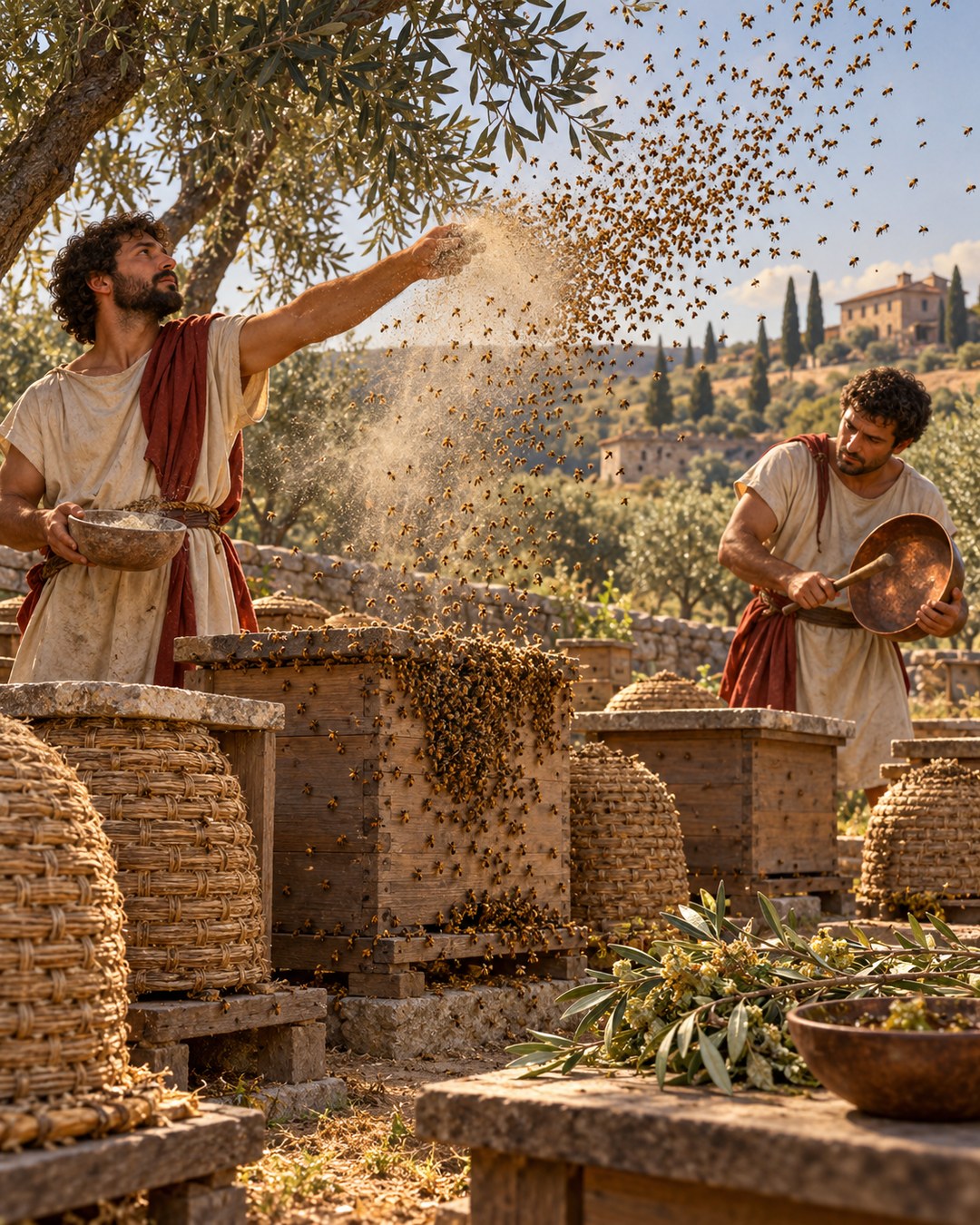
A Roman beekeeper could hear a colony preparing to leave. Varro says the bees first hung together at the entrance like a cluster of grapes. When departure began, their united buzzing sounded to him like soldiers breaking camp. The keeper’s chance to act lay between those signals and the swarm’s disappearance.
His response used no single trap. Dust was thrown into the flying mass while a copper vessel was beaten. A nearby landing place had already been smeared with bee-made bait and aromatic balm. Once the shaken swarm settled there, light smoke drove it into a new hive prepared with the same attractive substances.
The sequence transformed movement into capture by changing one condition at a time. Warning signs supplied time. Dust and noise interrupted flight. Scent offered a focal point. Smoke completed the transfer. A swarm that looked uncontrolled could be redirected because its stages were observable.
The hive announced departure before the sky filled
Varro describes swarming as the departure of mature young bees to found another colony. His political metaphor is Roman, but the husbandry depends on concrete behaviour. Several days beforehand, especially in the evening, many bees intertwined at the entrance and hung there like grapes.
The cluster mattered because it appeared before the decisive movement. A keeper who noticed it could ready a clean hive, choose a landing branch or surface, gather bait, and keep dust, copper, and smoking material close. Preparation reduced the need to improvise while thousands of insects were airborne.
A second signal came through sound. Bees about to leave, or already beginning to go, buzzed loudly together. Varro compares them to soldiers breaking camp. The simile gives motion to the noise: this was not the steady activity of foragers entering and leaving, but a whole community shifting at once.
The first bees out did not immediately vanish. They circled near the old hive while waiting for the rest to assemble. That pause created the keeper’s narrow window. Acting too early would disturb ordinary hive life; acting too late would mean chasing a coherent swarm already committed to another destination.
Reading a living process resembles the timed judgments used elsewhere in Roman production. The hoe test for slaked lime also asked a worker to recognize readiness from behaviour rather than from a fixed calendar. In both cases, craft began with noticing a transition.
Dust and struck copper broke the swarm’s momentum
When the bees rose, Varro told the keeper to throw dust over them and beat a copper vessel at the same time. He presents the combination as frightening the swarm into collecting at a chosen nearby place.
Dust made the air and the insects’ surfaces suddenly less comfortable. Copper supplied a hard repeated noise that competed with the swarm’s own buzzing. Varro does not isolate which stimulus did the most work, and the passage should not be converted into modern entomology. Its importance is procedural: the keeper deliberately interrupted flight before asking the bees to settle.
The action also had to remain controlled. Dust thrown wildly could obscure the keeper’s view, while striking copper without a prepared landing point would merely add disturbance. The method depended on the next stage already being ready.
Roman farm writing often presents tools as ordinary objects given specialized timing. A copper vessel was not purpose-built beekeeping machinery. In this moment it became part of a capture system because its sound could be produced instantly and repeatedly beside the hive.
The keeper’s body stood inside the mechanism. One hand or assistant scattered dust, another struck copper, and everyone had to track the direction in which the swarm condensed. Success depended on coordination rather than on an enclosure that operated unattended.
Wind and distance could erase the opportunity quickly. Dust had to reach the moving cluster, copper had to sound while the bees still hovered near the parent hive, and the baited surface had to be close enough to become an immediate alternative. The sequence was effective only as a compact performance. Its materials were simple; synchronizing them was the skilled part.
Scent turned one branch into the preferred landing place
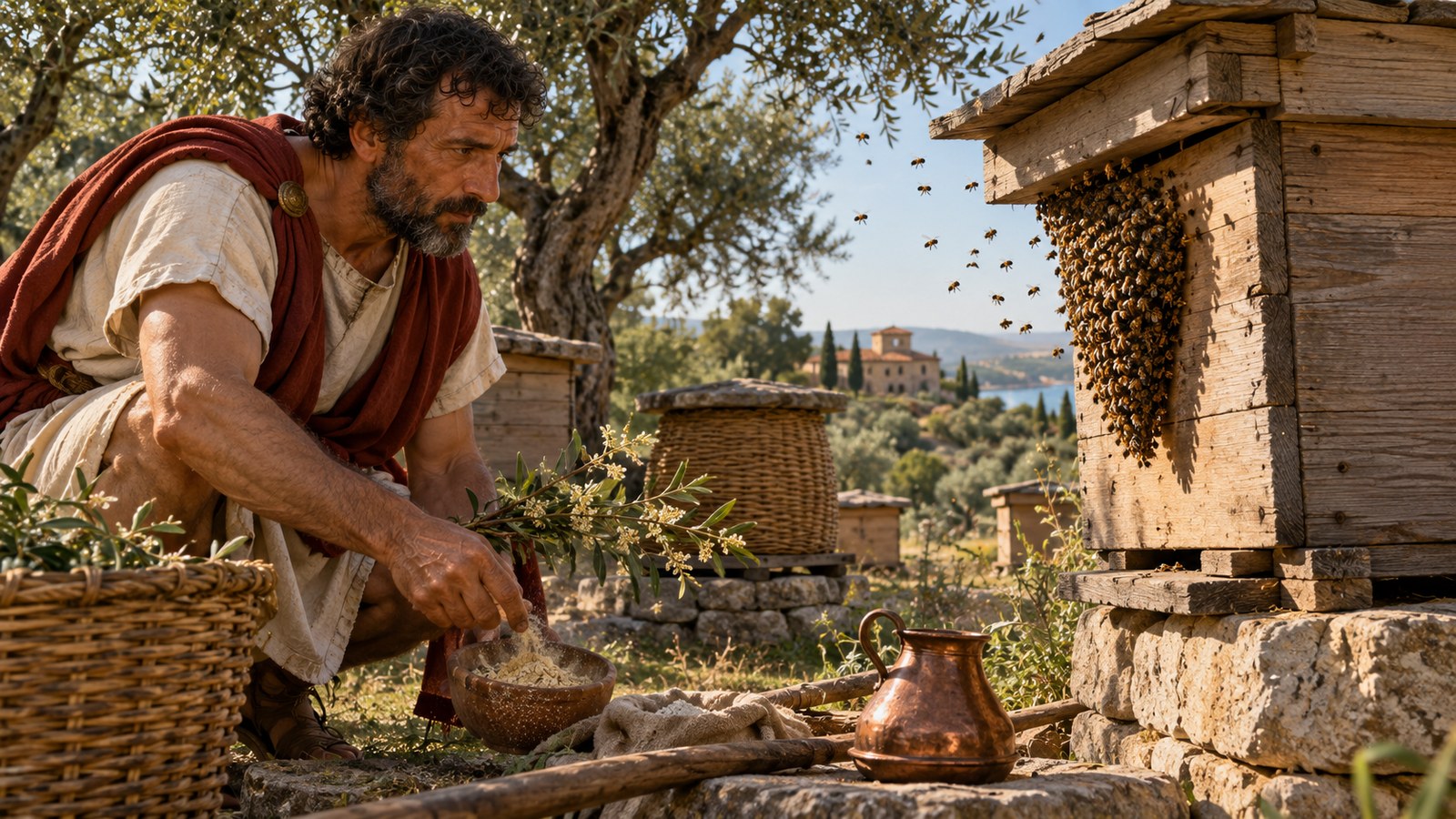
Disturbance alone could not tell the bees where to go. Varro’s chosen surface was smeared with erithacen, bee balm, and other substances in which bees delighted. He elsewhere describes erithacen as a bee-made material used around the cells and believed to attract a swarm.
The bait created a sensory contrast. Among many branches, walls, and roofs, one nearby place carried familiar hive-associated odours. The keeper did not need to seize the airborne mass. He made a destination more acceptable while dust and noise made continued flight less attractive.
Proximity mattered. A landing point close to the parent hive preserved the brief assembly window and allowed the next hive to be brought near after the swarm had settled. A distant lure would surrender control to wind, terrain, and whatever other cavities the bees encountered.
Varro’s wider transfer advice follows the same logic. A hive receiving bees should be rubbed with balm and supplied with pieces of comb near its entrances. An empty home might drive the colony away. Scent brought the bees close; visible provisions helped persuade them to remain.
This was not abundance for display. A little familiar comb acted as evidence that the destination could function immediately. The keeper prepared continuity between old and new homes even while directing a rupture between the colony and its parent hive.
The logic differs from using honey to preserve food inside Roman jars. There honey served as a barrier around another substance. Here products of the hive became signals that shaped the behaviour of the producers themselves.
Light smoke completed the move without finishing the work
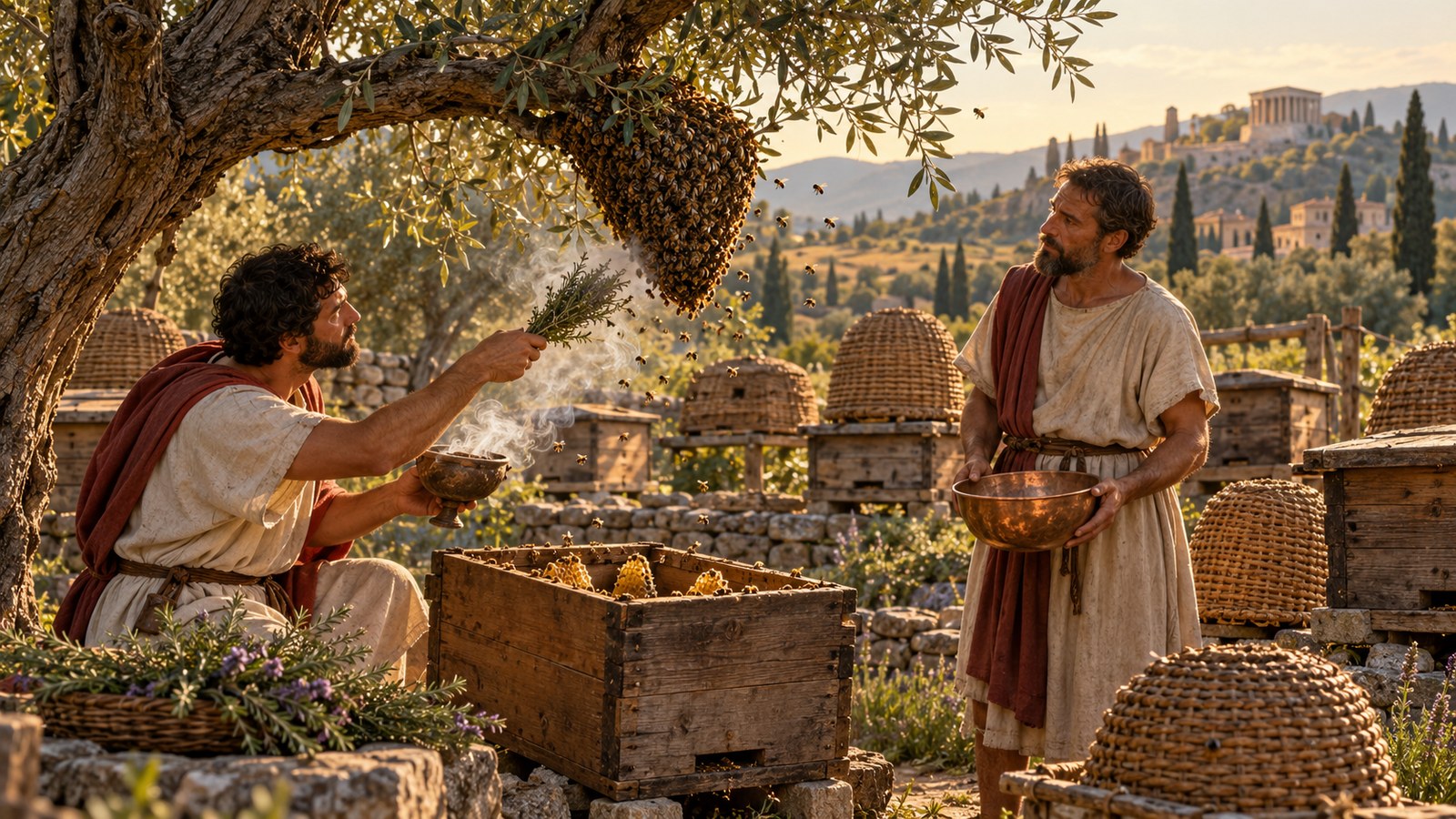
Once the bees collected on the baited place, the keeper set a prepared hive nearby. Its interior carried the same attractive smears. Light smoke was then blown around the cluster, compelling the bees toward the entrance.
The adjective matters. Varro describes a directed nudge, not a fire beneath the colony. Too much smoke or heat could scatter or injure the insects the keeper hoped to retain. The final pressure had to be strong enough to move the cluster and mild enough to leave the hive as refuge.
Varro claims that a swarm introduced this way settled cheerfully and could prefer the new home even when it stood beside the parent hive. Whether every transfer succeeded so neatly is doubtful, but the claim identifies the standard: capture was not complete when bees crossed the entrance. They had to remain.
Retention linked swarm management to later harvest. A beekeeper who took every comb of honey risked desertion. Varro reports advice to leave at least a tenth, and at the final harvest to reserve as much as two-thirds for winter when the hive was full. A colony gained through careful capture could still be lost through greedy extraction.
The swarm sequence therefore began and ended with restraint. The keeper waited for genuine signs before intervening, used a prepared destination rather than chasing at random, applied light smoke rather than destructive force, and left stores so the colony could survive after the profitable season.
Dust and copper noise make the episode dramatic, but they were only the middle beat. The deeper skill was arranging signs, substances, objects, and timing so that every stage made the next one possible. Roman beekeeping captured a moving colony by giving it somewhere better to stop.
Sources
Varro, On Agriculture, 3.16.