
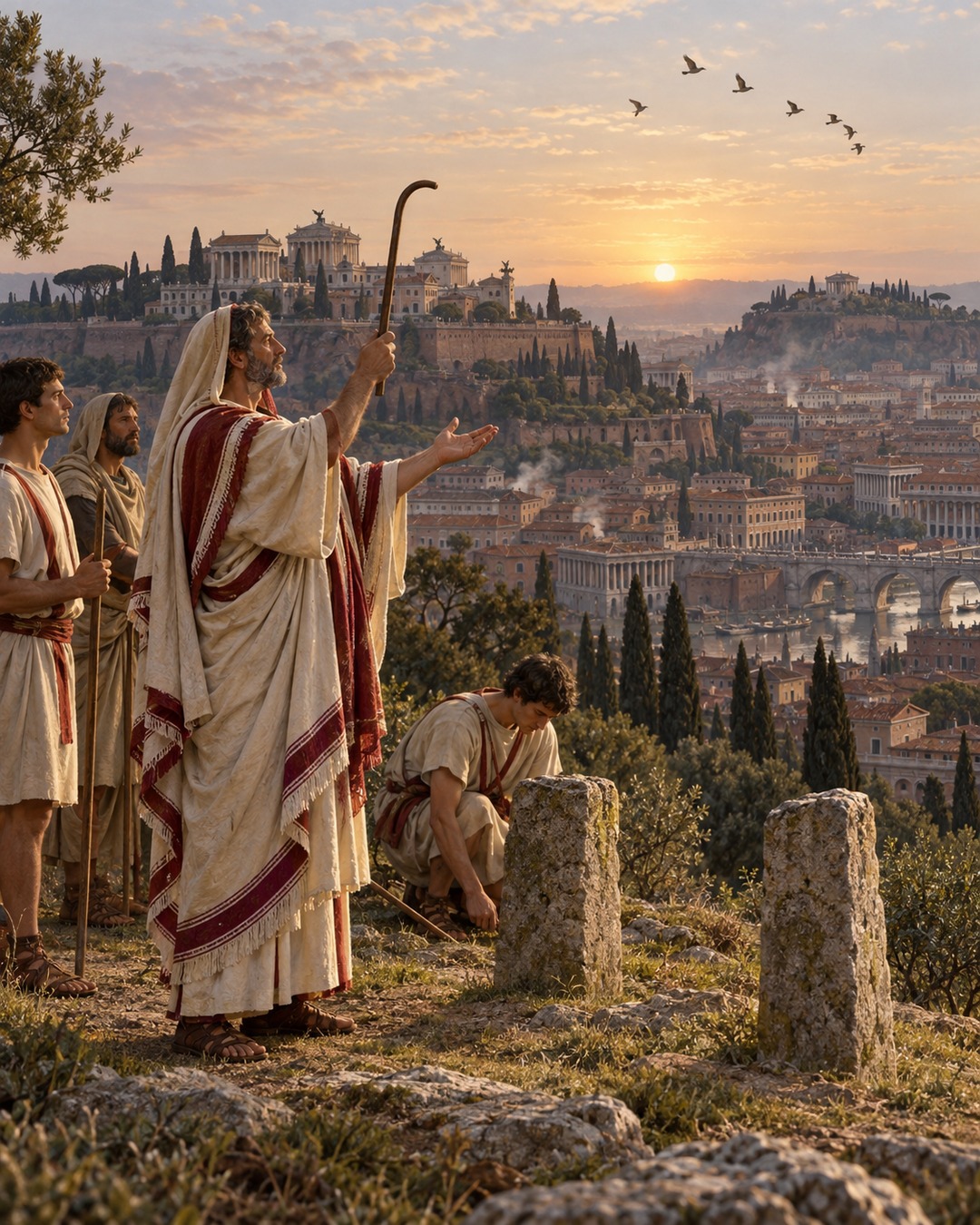
The Aventine could be crowded with Roman life and still stand outside Rome’s sacred line. Aulus Gellius calls the hill neither remote nor unfrequented. It was visibly part of the capital. Yet for generations the pomerium curved past it, leaving one of the seven hills beyond the formal limit of the city’s auspices.
The explanation Gellius preferred came from Rome’s foundation contest. Remus had watched for birds on the Aventine and received an unfavourable result, losing the augural struggle to Romulus. Later rulers who enlarged the sacred boundary allegedly continued to exclude the hill because those birds had marked it as ill-omened.
This was not a normal wall. The pomerium defined where a particular religious and civic order applied. It could expand when Roman power conquered territory, yet it did not automatically follow houses, roads, or population. The Aventine exposes the difference between the city people used and the city the augurs recognized.
The line around Rome was not its masonry
Gellius begins with a definition attributed to Roman augurs. The pomerium was a space within the rural district, designated around the circuit of the city, marked by fixed bounds, and forming the limit of the city auspices. Its function was jurisdictional and ritual before it was defensive.
A stone wall answered an enemy’s approach. The pomerium answered a different question: where did the auspicial space of the city begin and end? The two lines might run near each other, but one should not be reduced to the other.
The earliest boundary was attributed to Romulus and placed around the foot of the Palatine. That small circuit suited the foundation story of a first settlement. As Rome grew, later extensions enclosed other heights, showing that sacred geography could change without ceasing to claim ancient authority.
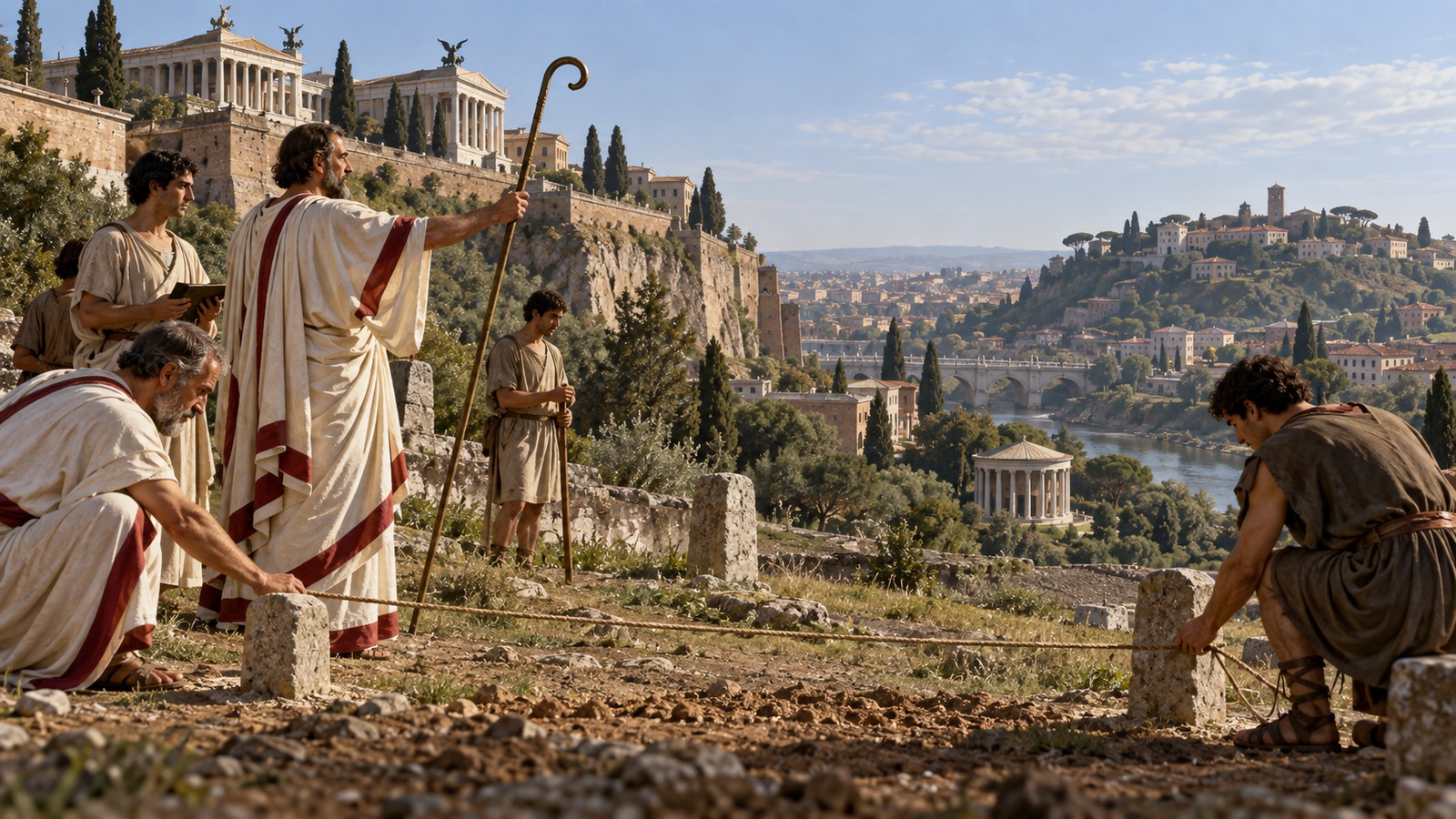
Fixed markers made the invisible rule legible. A person crossing the boundary could not rely on a gate tower alone to know what had changed. The line required remembered points and official knowledge. Its power came from shared recognition that the same ground belonged to a different civic-religious space on either side.
Rome used boundary objects elsewhere to turn land into law. Roman boundary stones made fields political by attaching authority and sanction to surveyed positions. The pomerium worked at the scale of the capital and bound its markers to auspices rather than ownership alone.
Conquest earned the right to enlarge sacred space
Gellius says that someone who increased the domain of the Roman people with land taken from an enemy possessed the right to extend the pomerium. Expansion therefore translated victory abroad into a changed sacred map at home.
The rule joined military achievement to religious honour. A successful commander did not simply add suburbs because streets had spread. He claimed that Rome’s public power had grown enough to justify redrawing the line inherited from earlier generations.
That right also explains why extensions were remembered by ruler. Servius Tullius, Sulla, and Julius Caesar each appeared in the historical argument. Their political circumstances differed, but each became a reference point in the sequence of people who might have included the Aventine and did not.
Growth was selective. New territory outside Italy could justify movement of a line inside Rome, yet a nearby inhabited hill did not enter by default. The mechanism was symbolic rather than geometrically proportional. Conquest supplied authority; augural tradition shaped the route.
This selectivity preserved continuity while allowing change. If every extension erased the old logic, the pomerium would become an ordinary administrative perimeter. If it could never move, it would cease to reflect Roman claims of expansion. The institution survived by presenting innovation as a licensed continuation.
Public religion often worked through such controlled procedures. a pig and prescribed prayer opened sacred groves because entry was not treated as ordinary movement. At the pomerium, the same habit of procedural distinction governed a whole urban landscape.
Remus lost twice: first the contest, then the hill
The puzzle was obvious to Gellius. Six hills stood within the boundary. The Aventine alone remained outside, despite being close and busy. Pure topography could not explain the omission, so antiquarians looked backward to the foundation contest.
Messala reported several proposed reasons, but approved the one involving Remus. On the Aventine, Remus sought signs about founding the city. The birds were unpropitious, and his augury proved less successful than Romulus’s. The hill therefore carried the memory of a failed claim.
In the tradition quoted by Gellius, later extenders treated that result as durable. They excluded the Aventine because inauspicious birds had made it ill-omened. An event from mythical time shaped the route taken by officials centuries later.
The mechanism did not require every Roman to fear the hill. People could live, trade, worship, and travel there. The exclusion applied to its position in the formal sacred scheme. Ordinary use and ritual status occupied the same landscape without matching.
This is why “outside Rome” can mislead. The Aventine was outside one defining line, not absent from the urban community. A resident could look down on the capital, walk into its streets, and participate in its economy while living beyond the perimeter of city auspices.
The birds also kept political rivalry alive in space. Romulus’s Palatine became the core of the earliest pomerium. Remus’s Aventine remained exceptional. Every later explanation of the boundary retold victory and defeat without rebuilding the brothers’ contest.
Augury in Roman memory could produce consequences far beyond the original moment. the whetstone test associated with Attus Navius likewise turned a sign into a durable argument about religious authority. On the Aventine, the medium was not a miraculous cut but an inherited absence on the city map.
Claudius finally brought the Aventine inside
Exclusion was long-lived, not permanent. Gellius reports finding an early commentary that said the deified Claudius admitted the Aventine and honoured it with a place within the pomerium.
The language of admission matters. The hill had not moved, and its population did not suddenly make it urban. What changed was official recognition. A new act placed old ground inside the auspicial boundary.
Claudius’s decision demonstrates that tradition could be revised through the same kind of authority that had preserved it. The Remus story explained prior choices, but it did not operate as an unbreakable natural law. An emperor with the right to extend the line could choose a different conclusion.
The change may have altered how Romans narrated the seven hills. Before inclusion, the familiar image of a seven-hilled city sat awkwardly beside an auspicial boundary containing only six. After Claudius, symbolic number and ritual map aligned more neatly.
Gellius does not describe protests, ceremonies, or the exact survey in this chapter, so those details should not be invented. His evidence supports a narrower sequence: ancient definition, repeated extension, conspicuous Aventine exclusion, a foundation-era explanation, and eventual Claudian inclusion.
That sequence is enough to show the pomerium as an active institution. It preserved memories, rewarded conquest, distinguished civic spaces, and remained open to authoritative revision. Its line was fixed at any given moment but historically mobile.
The Aventine’s story therefore resists a simple opposition between myth and administration. Remus’s birds mattered because later officials used the story to interpret a legal-religious boundary. Claudius mattered because imperial action could redraw that interpretation on the ground.
For centuries, a person climbing the Aventine crossed ordinary streets toward an extraordinary edge. The hill was Roman in population, architecture, and daily life, yet separate in the map of auspices. One failed watch for birds had become a reason for where sacred Rome stopped.
Sources
Aulus Gellius, Attic Nights, 13.14.