
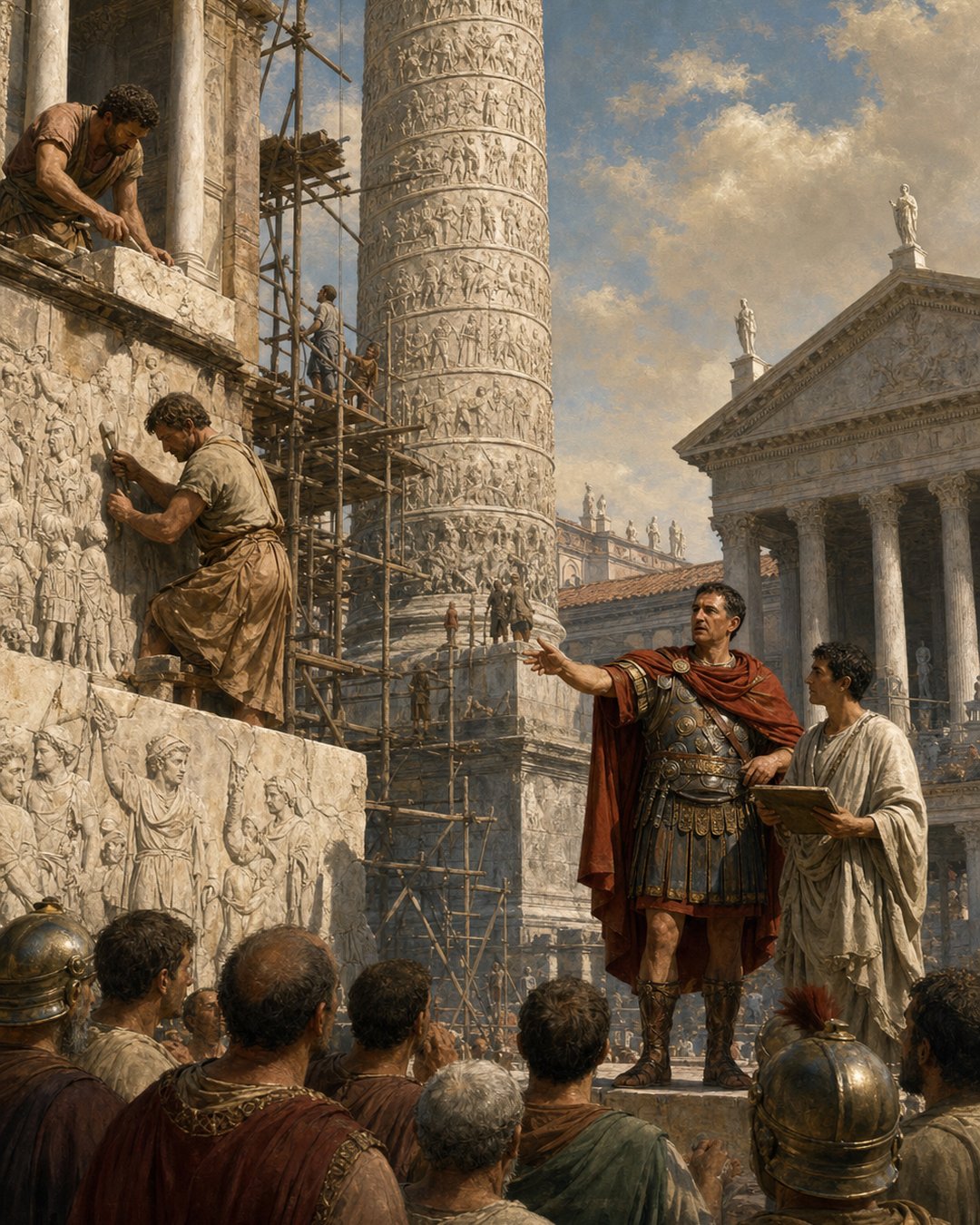
Trajan’s Column did something a battlefield could not do. It brought a distant war back to Rome and made it stand in public, carved in stone, visible to people who had never crossed the Danube or heard a Dacian horn. The monument did not simply announce that Trajan had won. It offered a way to look at victory, scene after scene, as if order itself had climbed upward around a marble shaft.
Dedicated in 113 CE, the column commemorated Trajan’s Dacian wars with a spiral frieze of more than 150 scenes. That number matters because the monument was not only a symbol. It was a sequence. It made imperial war readable by turning campaign, labor, discipline, enemy, emperor, and aftermath into a public visual argument.
A distant campaign needed a Roman audience
Most Romans could not verify a frontier war directly. They depended on messengers, rumor, coins, ceremonies, and official display. Dacia lay beyond the everyday imagination of the city. Trajan’s Column narrowed that distance by translating campaign experience into a form that could be visited in the Forum.
Cassius Dio records the broad drama of Trajan’s Dacian wars and Decebalus’s defeat, but stone did different work from prose. A reader needed literacy and access to a text. A passerby needed eyes, curiosity, and time. The column made imperial victory part of the city’s shared visual weather.
The spiral turned conquest into sequence
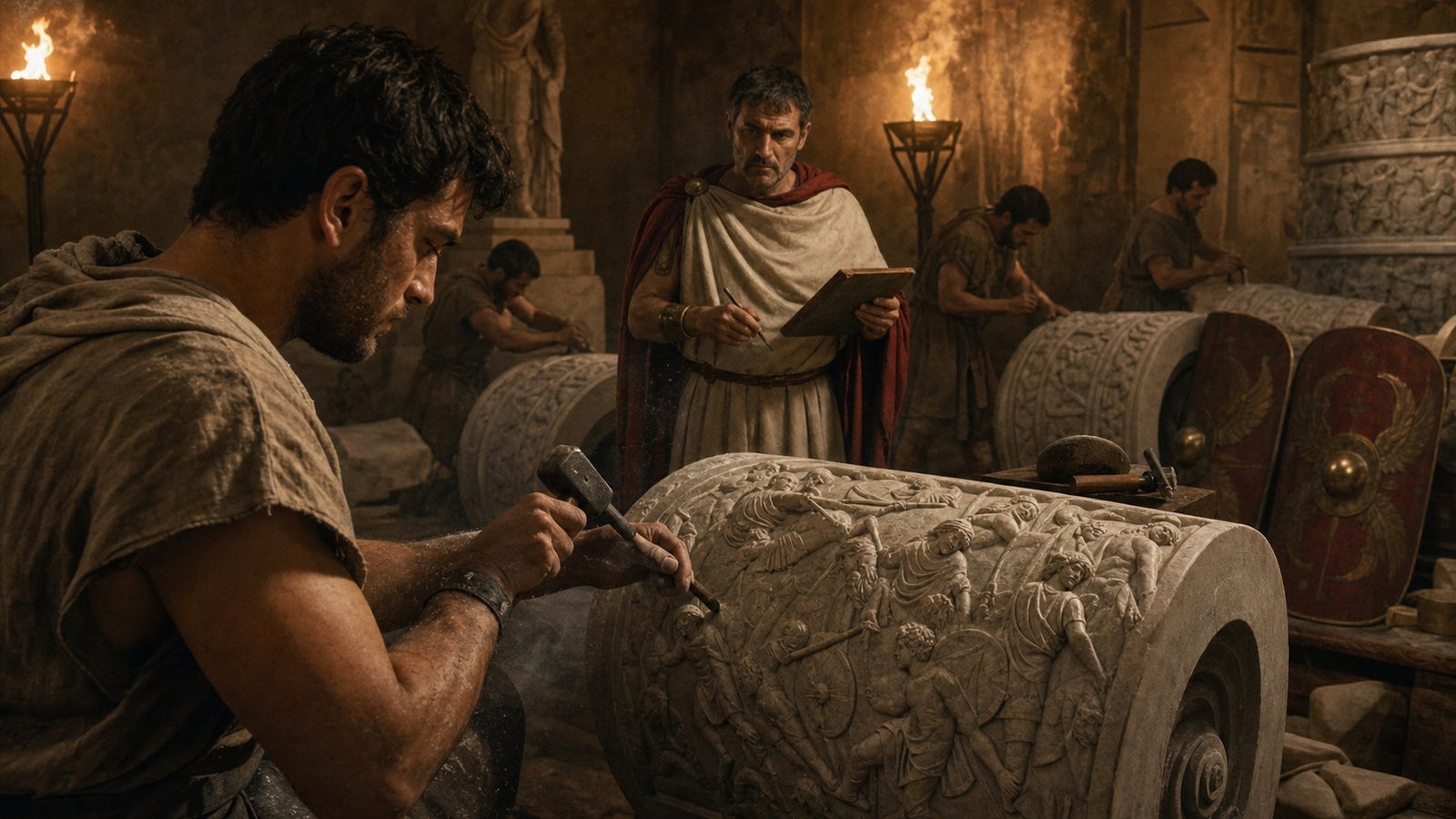
A single statue can say “victory.” A spiral can say “this is how victory happened.” The frieze moves through marching, building, sacrifice, speeches, crossings, negotiations, fighting, submission, and death. It organizes war as a chain of purposeful acts rather than a burst of violence.
That order was political. If viewers saw Roman soldiers constructing camps, roads, and bridges, they saw more than bravery. They saw method. The army was presented as a disciplined machine that could build civilization into hostile ground before, during, and after combat.
The emperor appeared as organizer, not only fighter
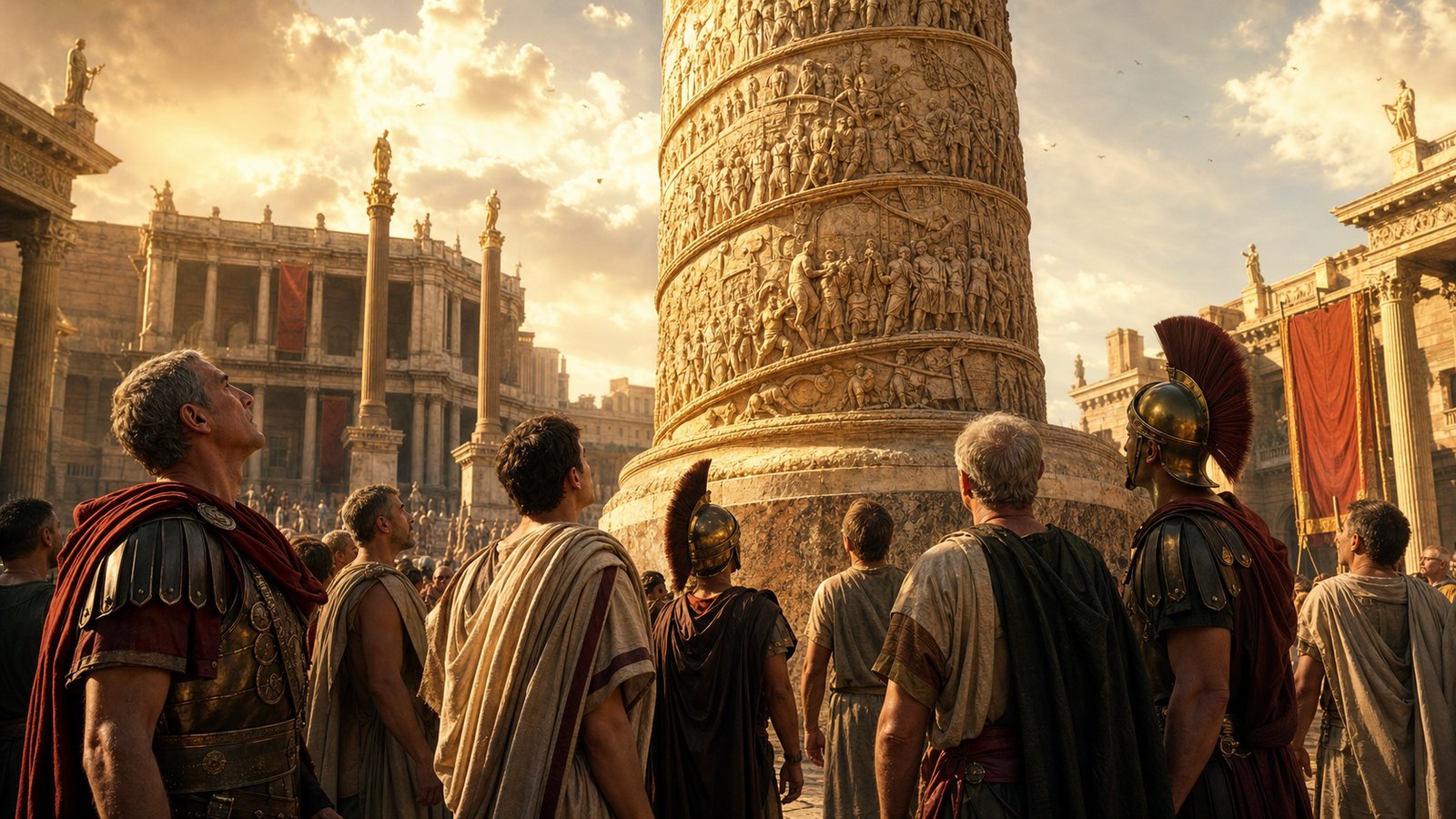
Trajan appears repeatedly in the relief, but the monument does not need him to swing a sword in every scene. His authority is often shown through presence: receiving reports, addressing troops, overseeing sacrifice, accepting submission. The emperor is the figure who makes the campaign coherent.
That kind of image suited imperial power. Rome did not want an emperor who looked merely reckless. It wanted one who commanded ritual, logistics, discipline, and victory. The column let Trajan be everywhere without becoming frantic. He stands inside the story as the mind of the war.
Labor made victory feel deserved
One of the column’s strongest messages is the amount of work Roman soldiers perform. They dig, carry, build, row, march, guard, and fortify. Marble bodies lean into tasks that are not glamorous, and that is precisely the point. Victory is made to look earned.
This matters because Roman empire depended on repetition, not only heroism. A bridge built in enemy country could be as important as a charge. A camp laid out correctly could be as political as a speech. The column teaches viewers to admire the ordinary labor that made extraordinary conquest possible.
The monument joined memory to burial
The pedestal of the column eventually held Trajan’s ashes. That detail turns the monument from a public war narrative into a personal and dynastic memorial. The emperor’s body, Rome’s forum, and the carved Dacian campaign became parts of one memory system.
A visitor did not encounter a neutral archive. The setting itself guided interpretation. Between libraries and public architecture, the column said that this war belonged in Rome’s official memory. It was not just something that had happened. It was something the city was meant to remember correctly.
Stone made the official story durable
The column did not tell every truth about war. It did not give the defeated equal control over the story, and it transformed suffering into imperial pattern. That is why it is so revealing. The monument shows how Rome wanted war to be understood: organized, pious, disciplined, and crowned by submission.
This is why Trajan’s Column made war readable. It did not merely decorate a forum. It arranged the campaign into a visual lesson that Romans could walk around, point at, and remember. A battlefield ended far away. In Rome, the war kept climbing in stone, teaching victory to anyone who looked up.
The placement between libraries sharpened the effect. The column was a monument of images, but it stood near buildings associated with texts, records, and learned memory. A Roman did not need to separate picture from archive. Both forms could help claim that the emperor’s war had become part of the city’s official knowledge.
The physical act of viewing also mattered. The relief was too high to inspect every detail comfortably from the ground, which makes the monument less like a modern comic strip and more like an overwhelming public record. Viewers could follow portions, recognize repeated scenes, and absorb the pattern even when individual figures escaped the eye. The height made the story feel larger than any single spectator.
There is a human scene hidden inside that experience. Imagine a veteran pointing out a bridge scene to a child, a clerk recognizing the emperor’s sacrifice, or a provincial visitor measuring Roman confidence in marble. The monument created opportunities for guided memory: people could tell the story while standing under the story.
The carved soldiers also made discipline beautiful. Their repeated camps, shields, standards, boats, and tools gave the army a rhythm. Violence appears, but it is framed by preparation. That balance flattered Rome because it suggested that conquest came from order more than chaos.
For the defeated Dacians, the story was less generous. They appear as worthy enough to magnify Roman victory, but not free enough to define their own loss. That imbalance is part of the column’s purpose. It makes imperial memory legible by deciding whose viewpoint becomes public stone.
The result was a monument that could survive political weather. Emperors changed, tastes changed, and the city changed around it, but the column kept presenting Trajan’s war as a sequence of Roman competence. Its durability turned a specific campaign into a permanent lesson about how empire wanted to see itself.
The repeated scenes also restrained the fantasy of effortless conquest. They reminded viewers that war meant boats, roads, timber, discipline, councils, standards, supply, ritual, and exhaustion. That detail made the imperial claim stronger because it did not rest on one impossible moment. It made victory look like a process Rome knew how to repeat across landscapes, languages, rivers, and generations.
Even the marble dust of the carving belongs to the story. Artisans had to translate reports, sketches, conventions, and ideology into bodies that could be recognized from below. Their labor turned imperial memory into a craft object, not just an order from the palace.
Sources & Further Reading
- Trajan’s Column in Rome
- Britannica, Trajan’s Column
- Trajan’s Column in Rome, Frieze
- Cassius Dio, Roman History, 68
- Trajan’s Column in Rome, Pedestal
- Trajan’s Column in Rome, Scenes
- Britannica, Apollodorus of Damascus
- Oxford Classical Dictionary, Trajan’s Forum
- Cambridge Core, Roman Art and Imperial Ideology