
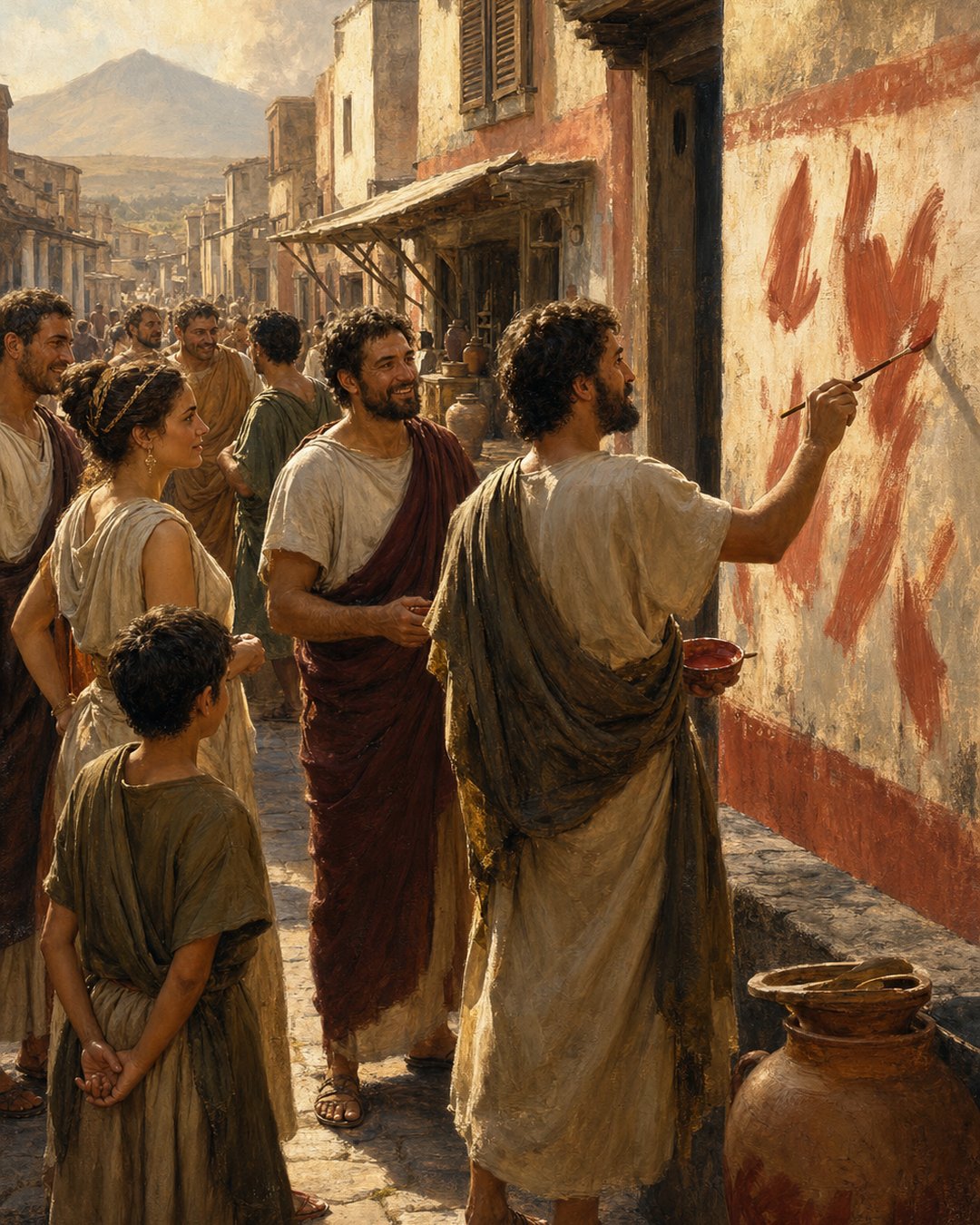
Pompeii’s election notices are easy to miss because they are not grand monuments. They were paint on walls: public recommendations written across streets, shopfronts, house fronts, and busy corners. Yet those painted lines reveal a political world that was not confined to marble forums or senatorial speeches.
The eruption of 79 CE froze a town where local politics had been made visible at street level. The notices show candidates, supporters, trades, households, and reputations competing for attention. Roman politics was not only what powerful men said in Rome. It was also what a neighborhood saw when it walked past a wall.
Local office made ambition practical
Pompeii’s campaign notices supported candidates for municipal offices such as duumvirs and aediles. These were not emperors, consuls, or generals. They were local officeholders who mattered because streets, markets, buildings, games, legal business, and civic order mattered.
That scale is important. Local ambition could be intensely serious precisely because it was close. A candidate did not need to control an empire to shape daily civic life. Election writing made that ambition public, asking neighbors to recognize a man as worthy of trust.
A wall could become a recommendation
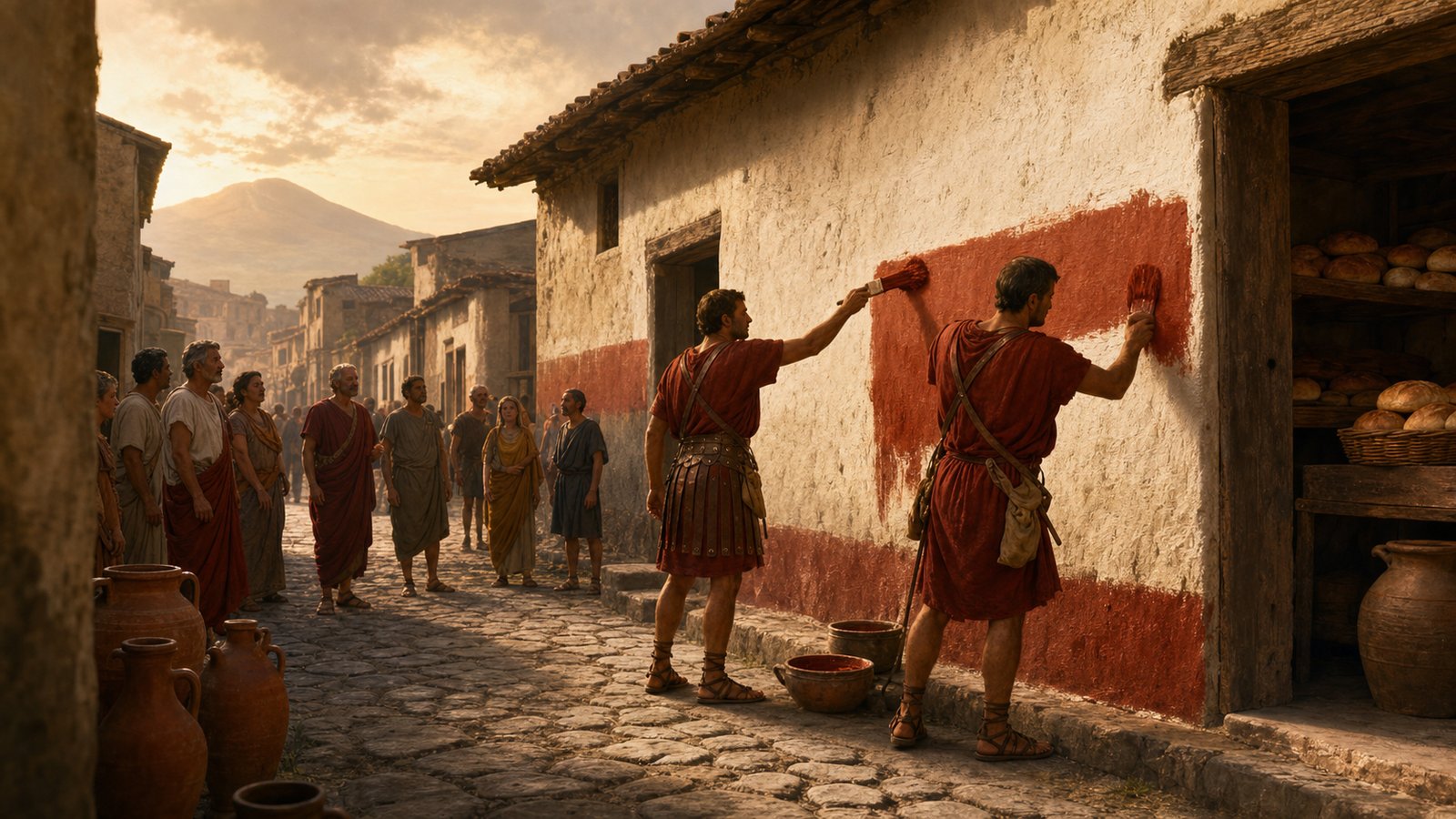
The notices often used formulaic language, but formula does not mean emptiness. A repeated phrase helped viewers understand the message quickly: this person is being recommended, and these supporters want you to know it. The wall turned political endorsement into an object in the street.
That gave politics a physical setting. A voter might pass the same notice on the way to a bakery, workshop, shrine, or fountain. The campaign did not wait in a formal assembly. It met people in the routine path of the town.
Supporters mattered as much as candidates
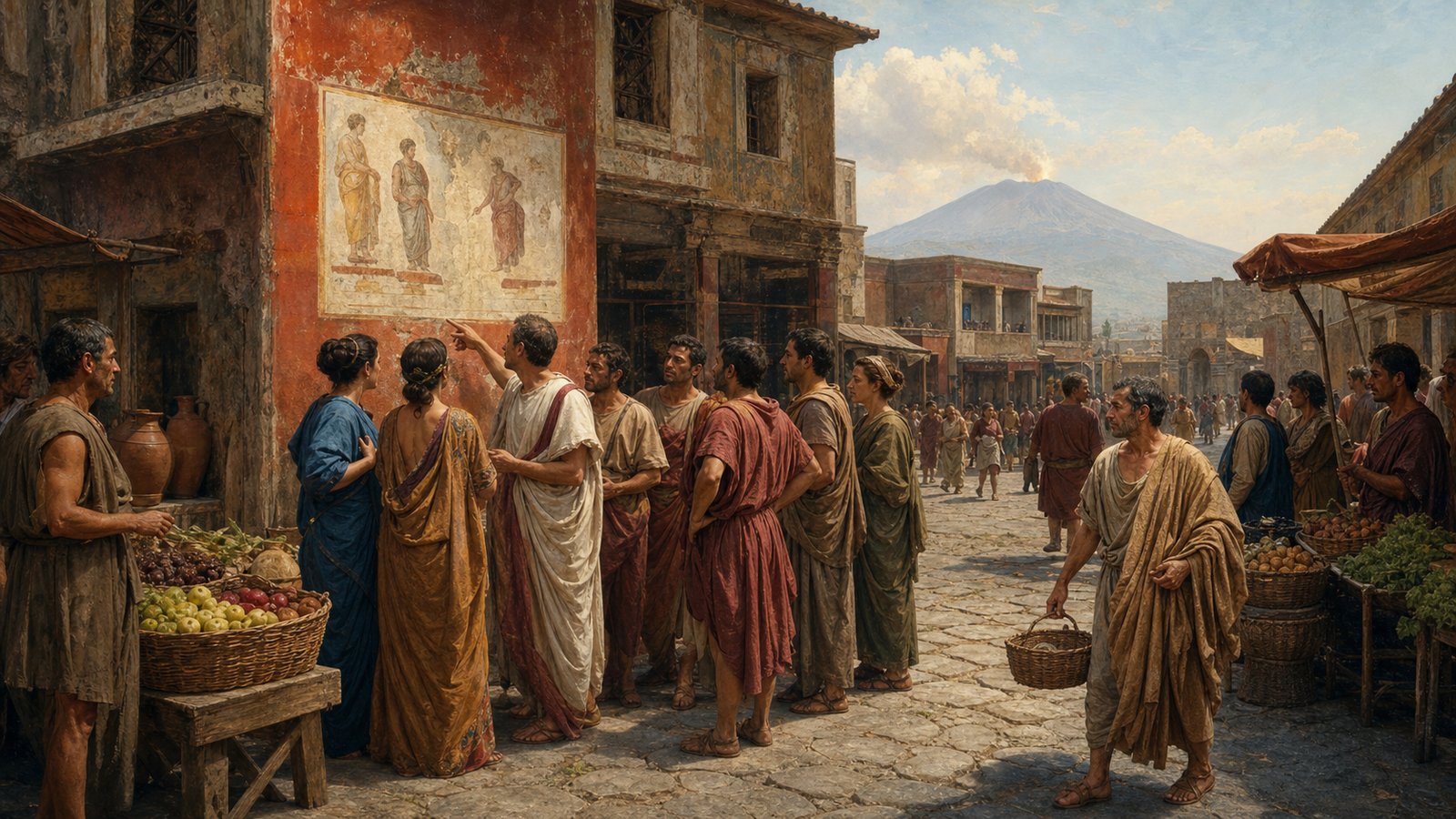
Many notices are revealing because they name or imply supporters. A recommendation carried social weight. If a trade group, neighbor, household, or recognizable person backed a candidate, the public could measure the candidate through those relationships.
This is one reason Pompeii feels so alive politically. The notices make politics look like a network of endorsements rather than a private choice inside a voter’s head. Reputation moved through names, occupations, friendships, obligations, and public visibility.
Women’s endorsements complicate the story
Some Pompeian election notices include women as endorsers, even though women could not hold municipal office or vote in the same formal way as male citizens. That fact does not make Pompeii secretly democratic. It shows that influence could operate outside the narrow legal act of voting.
A named woman on a wall could still carry reputation, household visibility, social connection, or business presence. The notice reminds us that Roman politics was broader than the official rules alone. Public influence could reach into spaces where formal rights did not.
Street writing made politics noisy
Pompeii’s walls held many kinds of writing: jokes, advertisements, boasts, declarations, and election appeals. Political notices existed in that crowded visual environment. They competed with ordinary life rather than floating above it.
That noise is part of the evidence. A campaign message beside a shopfront or street corner had to live with dust, footsteps, sellers, animals, clients, and gossip. Politics had sound, smell, and movement around it. The wall did not isolate the message. It embedded it in daily traffic.
The eruption preserved a civic mood
Pliny the Younger’s letters about Vesuvius describe catastrophe from outside Pompeii, but the walls preserve a different kind of evidence: the unfinished normality of local civic life before disaster. The notices were not painted for archaeologists. They belonged to a town expecting tomorrow.
This is what Pompeii’s election notices reveal about Roman politics. They show that public life depended on visibility, recommendation, local honor, and street-level persuasion. Rome’s empire was vast, but politics could still be as immediate as red paint drying on a Pompeian wall.
The notices also warn against imagining Roman politics as only a contest of speeches by famous men. In Pompeii, persuasion could be short, repeated, and attached to a building. The effect depended on public recognition: people knew the street, the house, the shop, the supporter, or the family name.
A wall notice could therefore make reputation portable. A candidate’s qualities were not proven in the painted line itself; they were borrowed from the people and groups willing to recommend him. That is why even formulaic endorsements are valuable evidence. They show the social machinery behind a local election.
The physical labor of painting matters too. Someone mixed pigment, chose a visible wall, reached a height, formed letters, and risked annoyance from rivals or property owners. Campaign communication was not effortless. It required hands, timing, access, and permission or boldness.
The survival of the notices also lets us see political time. They were temporary messages meant for an election season, not permanent inscriptions meant for centuries. Their accidental preservation makes the evidence intimate. We catch politics while it was still fresh, competitive, and unfinished.
For ordinary inhabitants, those walls helped turn voting into conversation. A baker might see which candidate a neighbor favored. A client might notice a patron’s preference. A woman whose name appeared in support could make influence visible without holding office. The town became a map of recommendation.
That public map could include tension. Endorsement implied opposition, and a crowded wall could reveal rivalry as much as consensus. Roman local politics was not merely civic harmony. It was managed competition over honor, office, services, and memory.
The notices are small because municipal politics was close to daily life. That closeness makes them important. They show Rome’s political culture at the scale of doorways, workshops, corners, and reputations, where empire met the ordinary act of asking neighbors to choose.
They also reveal a politics of presence. A supporter did not need a long argument if a name on a wall reminded everyone of credit, favors, kinship, business, or civic standing. The message worked because the town supplied the context. Paint was only the visible surface of relationships that already existed.
The walls therefore make Pompeii feel less like a dead city and more like an interrupted campaign. Some notices may have been fresh, others fading, some placed where traffic made them valuable. Their survival lets us see a town still negotiating honor and office when disaster fixed its ordinary ambitions in ash.
That combination of formula and locality is the real lesson. Roman political language could be conventional, but it gained force from exact streets, exact supporters, exact offices, and exact neighborhoods. The empire’s public culture was built from those local repetitions, one painted appeal at a time, in places where voters and nonvoters alike could see who wished to be counted, remembered, trusted, and discussed before the next day’s business began in streets where every familiar face changed the meaning of the paint.
Sources & Further Reading
- PompeiiinPictures, Electoral Notices
- Smithsonian Magazine, Pompeii Election Graffiti
- Pliny the Younger, Letters 6.16
- Pompeii Bibliography and Mapping Project
- Oxford Classical Dictionary, duumviri
- Women and Electoral Politics in Pompeii
- Ancient Graffiti Project
- Pompeii Sites, Archaeological Areas
- Cambridge Core, Local Politics in Pompeii