
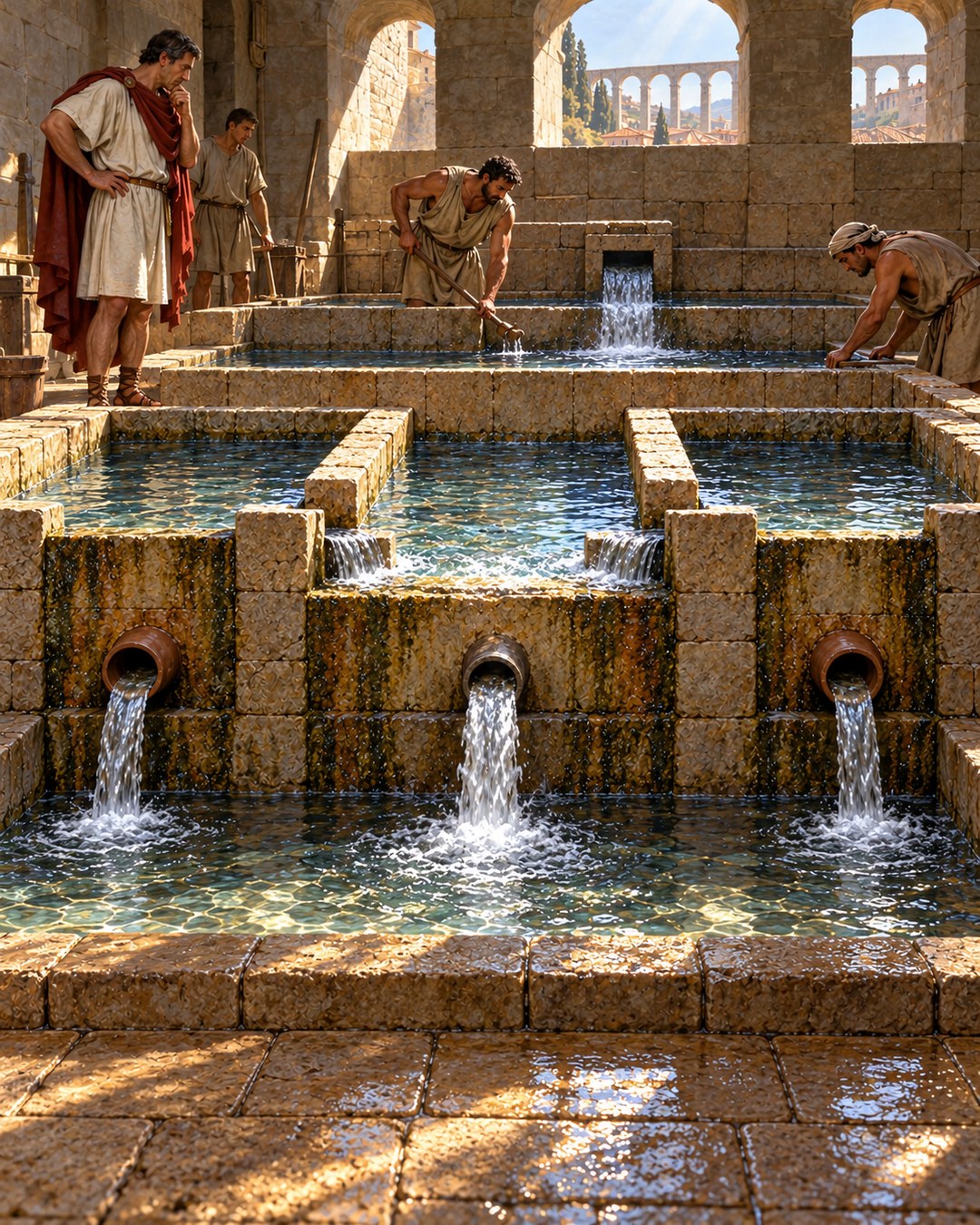
At the edge of a Roman city, water met a choice built in stone. Vitruvius did not send one undivided main toward every fountain, bath, and wealthy doorway. He placed a reservoir by the walls, attached three receiving cisterns, and arranged their outlets so that overflow from the outer compartments entered the middle one.
The middle supply belonged to public fountains. Another served baths, and a third served private houses. The distinction mattered because the tank did more than divide volume. It turned a civic priority into plumbing: water for public use was not supposed to disappear because household customers drew too much.
Money completed the design. Private connections paid rent, and Vitruvius assigned that income to maintaining the aqueduct. The city therefore linked access, revenue, and repair at the same junction where moving water became an urban service.
The city wall changed transport into allocation
Before water reached the reservoir, it had already crossed a landscape. Vitruvius lists three conveyance methods: built channels, lead pipes, and earthen tubes. Each demanded different construction, yet every route ultimately had to deliver a controlled flow to the city.
For a masonry channel he gives a minimum gradient of half a foot over one hundred feet. Too little fall risked stagnation; careless steepness could make the flow difficult to govern. The route needed a measured descent rather than a vague downhill tendency.
He also wanted the channel roofed so that sunlight touched the water as little as possible. The cover protected the supply before it entered crowded streets. Long-distance movement was therefore treated as a continuous built environment, not merely a trench between spring and wall.
At the boundary stood the castellum, the distribution reservoir. This was the point where one incoming resource became several named obligations. The architecture had to make those obligations legible to builders and durable after the designer left.
The shift resembles the tests Vitruvius proposed before accepting a spring. Testing decided whether water should enter the system. The castellum decided what happened after the accepted supply arrived.
Equal openings did not mean equal claims
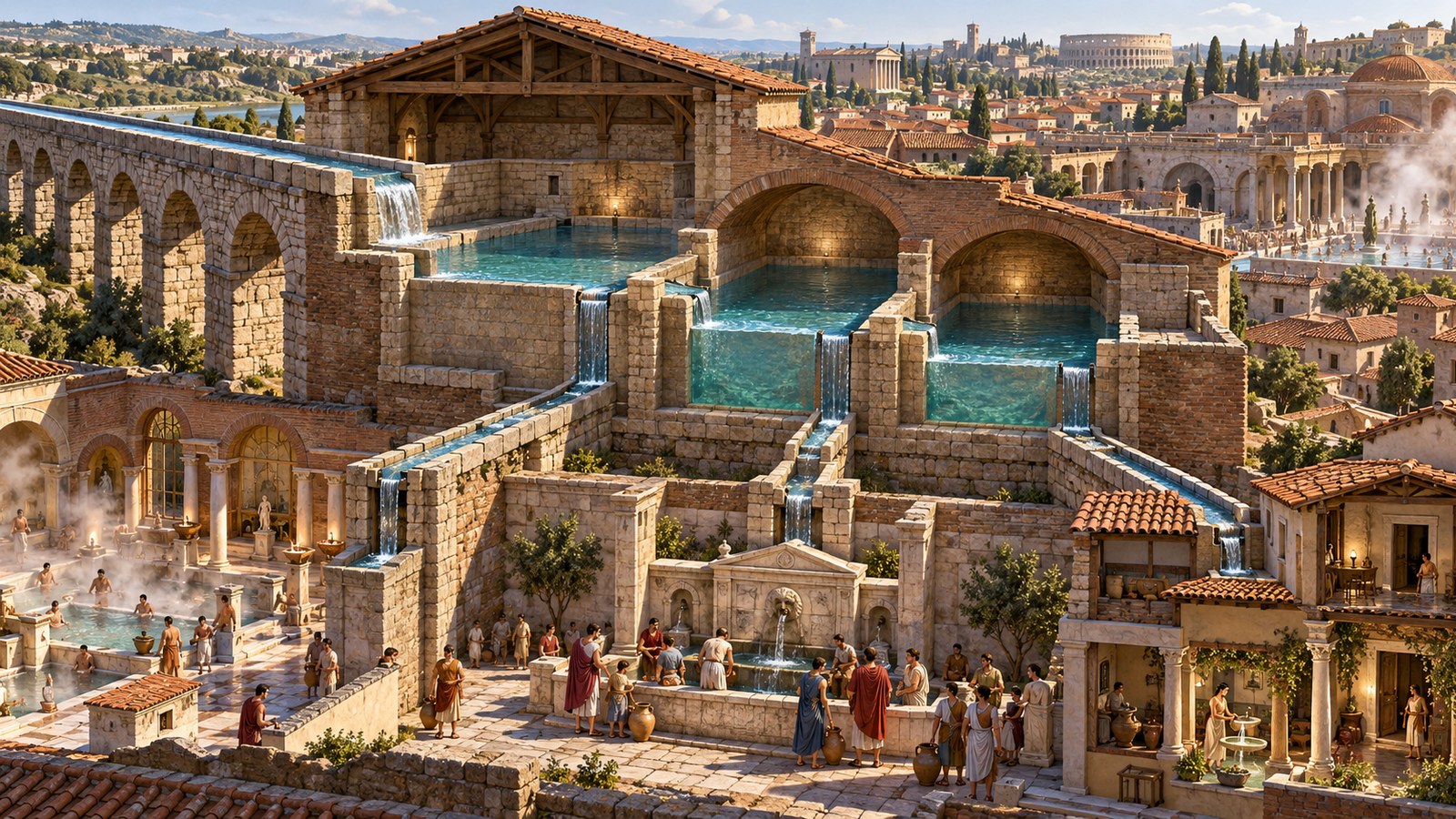
Vitruvius specifies three pipes of equal size at the reservoir, but the surrounding geometry created priority. The outer compartments overflowed toward the middle. Equality at the openings therefore did not flatten the civic ranking of the destinations.
The middle cistern fed fountains. These outlets mattered to residents who had no private pipe and to anyone collecting daily water in a vessel. A dry fountain was not a small inconvenience hidden inside one property; it was a public failure visible in the street.
The bath branch had a different civic role. Baths consumed substantial quantities and could return annual revenue. Their place in the scheme recognized both public use and an institution capable of supporting municipal finances.
Private houses occupied the third branch. A household connection offered convenience and status, but Vitruvius did not allow that convenience to become the first claim on scarcity. The physical arrangement was meant to keep the common supply from being diverted away.
This hierarchy gives more precision to the public work performed by Roman street fountains. A fountain could serve a neighborhood only if upstream construction protected its share before water vanished into competing pipes.
Overflow made a policy operate without a speech
A written rule can be ignored at the point of distribution. Vitruvius instead proposed a tank in which rising water enacted the rule. Once the outer sections reached their designed level, their excess moved toward the central fountain supply.
The arrangement did not eliminate officials, inspection, leakage, or illegal tapping. It did, however, reduce dependence on a fresh discretionary decision every time flow changed. Masonry and pipe height carried part of the administrative burden.
The word “overflow” is important. Public security did not come from an infinite source. It came from directing surplus within a finite system. The device assumed variation and attempted to make the consequences of that variation predictable.
Maintenance crews could also read the structure. Three branches gave faults a location: an obstruction or leak could be associated with fountains, baths, or private supply rather than disappearing inside one tangled distribution line.
The reservoir made governance inspectable. Levels, outlets, and branches could be observed, even if the water itself continued underground beyond the walls.
Private convenience helped finance common repair
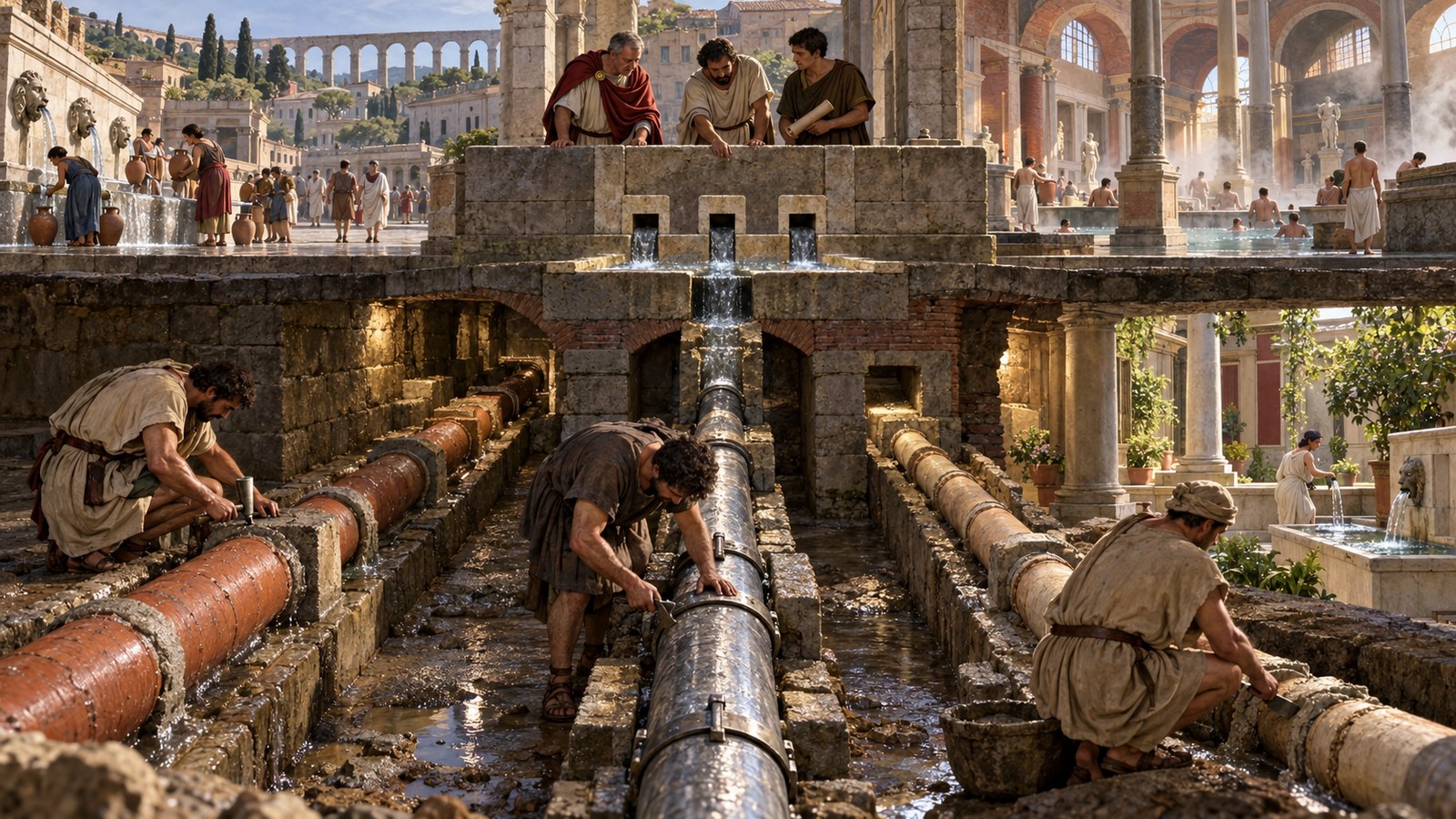
Vitruvius assigns rent from private water users to aqueduct maintenance. This is not a passing financial detail. Channels, tunnels, roofs, reservoirs, and pipes all deteriorated. A supply without a repair budget would slowly lose the priority that its first construction expressed.
Householders receiving a private branch paid for an exceptional convenience. Collectors then directed that payment back toward the shared system. The arrangement joined a narrow benefit to a broad expense.
Bath revenue appears beside this logic. Baths were not simply drains on supply; they could contribute annually to the community. Water moved through institutions that had economic as well as sanitary and social consequences.
The tunnel instructions show the scale of the obligation. When hills intervened, builders had to preserve the fall underground. Shafts at intervals of one hundred and twenty feet gave access to a hidden route. Every such section represented future inspection and repair as well as initial excavation.
No tank could guarantee fair administration forever. Connections could be altered and officials could neglect collection. Vitruvius’s importance lies in making the intended relation explicit: public fountains protected by layout, private service charged, and the charge reserved for keeping the whole conduit alive.
The design also separated entitlement from proximity. A mansion beside the reservoir did not become the natural owner of the arriving stream merely because its wall was close. The route to a private courtyard remained one designated branch among three, while the fountain branch represented users scattered far beyond the distribution building.
That distinction changes how the aqueduct should be pictured. Monumental arcades are only the long approach. The civic meaning of the system emerged at smaller junctions where flow was measured, redirected, sold, and preserved. A spectacular bridge could carry water across a valley, but a modest tank decided whether a resident actually found water at the street basin.
Vitruvius writes prescriptively, so his chapter is not proof that every Roman city installed this exact triple arrangement. It is evidence for an architectural ideal and for the administrative problems a Roman designer expected: competing destinations, unequal vulnerability, recurring repair costs, and the temptation to let private demand consume public capacity.
Those limits make the description more useful, not less. Instead of treating “Roman aqueduct” as one uniform achievement, the tank invites questions at each site. Where did the incoming channel end? How many outlets existed? Which were higher or lower? Could overflow cross between compartments? The physical remains must answer before the Vitruvian model is applied.
It also asks historians to distinguish supply from service. A city might possess abundant incoming water yet distribute it badly. Capacity at the source, integrity along the channel, and fairness at the castellum were separate achievements, each capable of failing while the others still looked impressive.
The three cisterns reveal Roman infrastructure as an argument about order. Water arrived as a single flow, but the city did not encounter it as a single undifferentiated commodity. Stone compartments asked who must receive it, who could pay for extra access, and how tomorrow’s repairs would be funded. The answer was built where the aqueduct crossed from landscape into civic life.
Sources
Vitruvius, On Architecture, 8.6.