
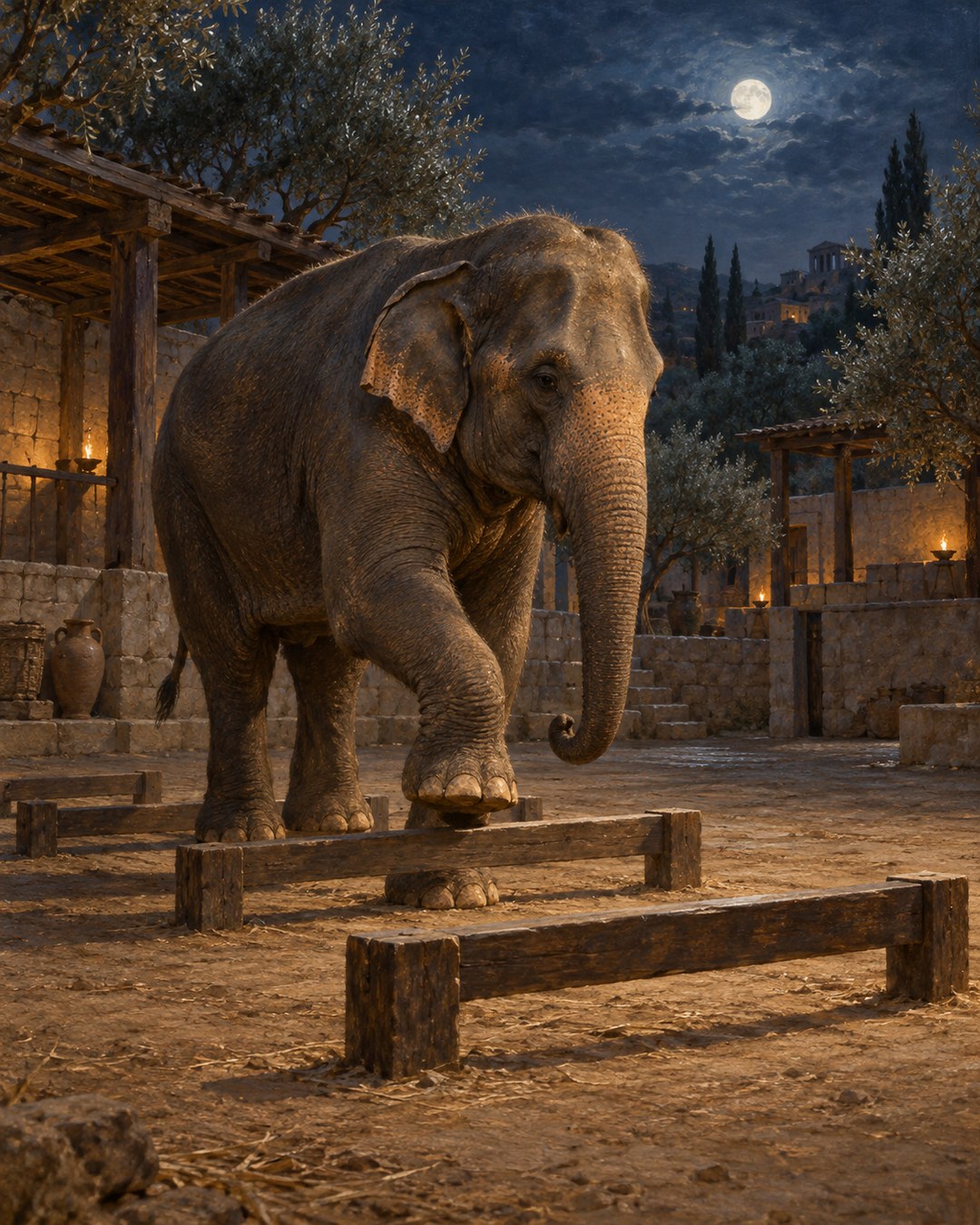
Pliny the Elder’s elephant waited until night to repeat a lesson it had failed by day. The detail appears in the opening of Natural History Book 8, where elephant behaviour stands at the boundary between animal observation and moral portrait.
Pliny did not describe the exact exercise. He cared about the motive he assigned to rehearsal. The animal practised privately because it was ashamed of difficulty. Training had created more than a remembered command: it had created an audience, a failure, and an attempt to return better prepared.
That claim cannot be tested like a modern experiment. It tells us how a Roman encyclopaedist interpreted animal skill. In his account, memory, obedience, ambition, bodily technique, and social feeling belonged to one picture of intelligence.
A lesson became evidence because it continued after the trainer left
Training normally reveals an animal through a human command. A handler gives a signal and the elephant answers. The night anecdote changes the direction of proof. The command is absent, yet the task continues.
Pliny’s elephant carries the problem away from the formal lesson. Repetition after dark turns a performed trick into evidence of memory. The animal does not merely react to a cue; it preserves an unfinished demand.
The missing description of the task prevents confident reconstruction. It may have involved movement, balance, handling, or a staged display, but Pliny does not tell us. Images and retellings should not invent a named routine.
What he does preserve is the contrast between public difficulty and private work. Day belongs to instruction and failure. Night belongs to voluntary repetition. The next successful performance, if one followed, would hide the rehearsal that made it possible.
Pliny labels the motive shame. That is stronger than saying the animal was conditioned. Shame requires awareness of having fallen short before others, and the choice to move practice beyond their gaze.
The story sits far from the practical problem of unloading elephants backward from a ship. There, handlers adapted movement to fear and unstable footing. Here, Pliny made the elephant adapt its own schedule to a difficult lesson.
The anecdote also differs from the elephant that traced Greek letters for spectators. Lettering presents a finished marvel. Night practice asks what happened before polished performance became possible.
Memory tied commands to duties rather than isolated tricks
Pliny says elephants understand the speech of their own region and obey commands. His phrasing imagines communication embedded in place: an elephant trained under one set of human sounds learns that practical vocabulary.
He also credits them with remembering duties they have learned. “Duties” makes training sound like a continuing office rather than a momentary response. The animal is expected to retain a role across time.
Memory therefore links one day to another. A difficult action remains available for rehearsal at night because instruction has left a durable trace.
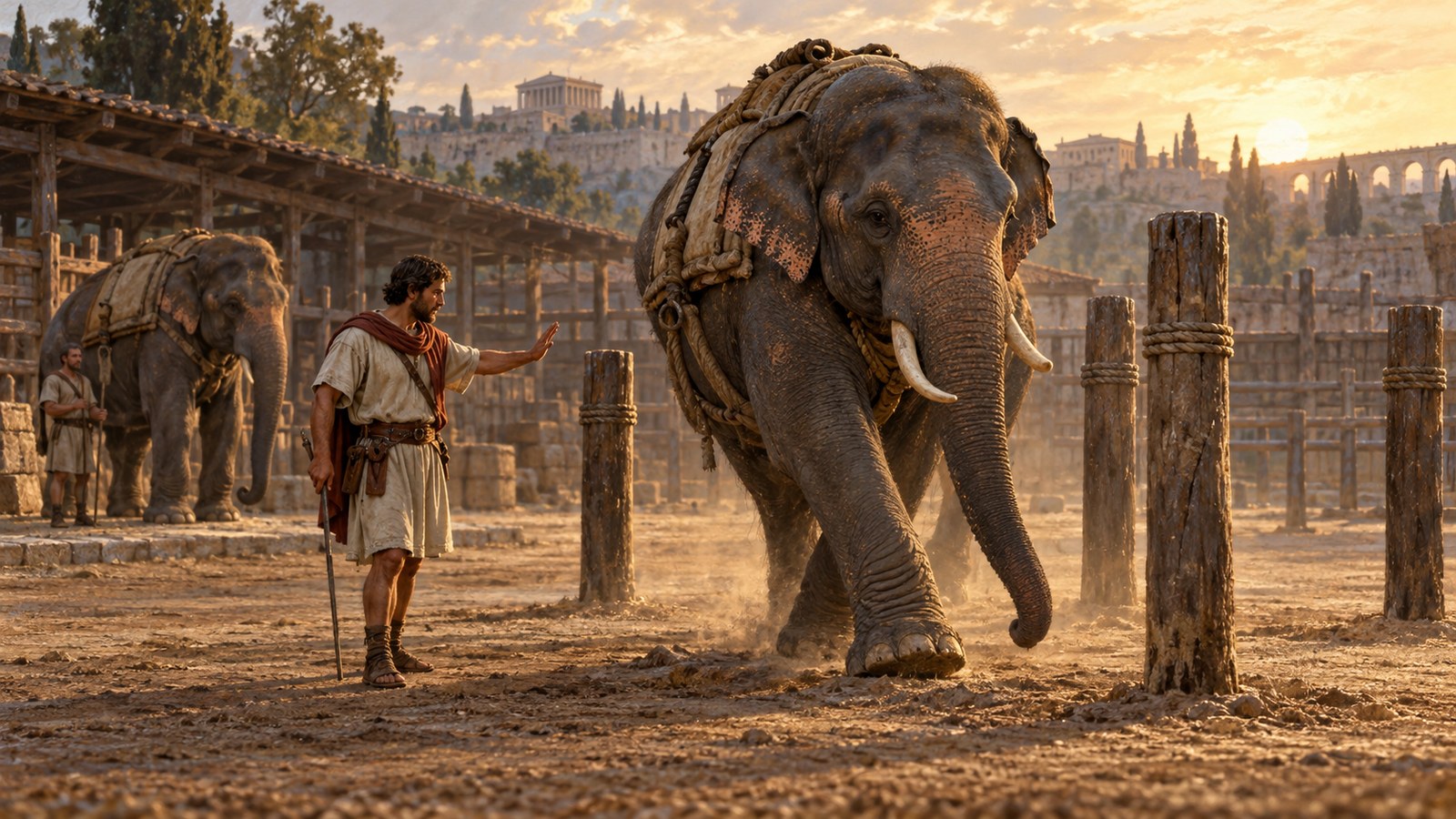
Pliny surrounds this capacity with moral terms. Elephants desire affection and glory; they possess, in his account, honesty, prudence, equity, and reverence. The list does not separate cognitive ability from character.
The vocabulary also changes the meaning of error. A creature praised only for strength can fail by tiring. A creature credited with prudence can fail by misunderstanding, forgetting, or hesitating. Pliny’s framing gives the difficult lesson an intellectual and reputational cost.
That cost explains why the location of rehearsal matters. Night removes the immediate social pressure without removing the task. The elephant, as Pliny imagines it, creates a private interval in which correction is possible before public judgement returns.
The account does not identify a reward waiting at dawn. Its emphasis is internal continuity: yesterday’s command remains active without a fresh order. That is the point at which obedience begins to look, to Pliny, like disciplined learning.
Modern readers should keep a distance from that vocabulary. Pliny collected reports, marvels, and interpretations under the authority of natural history. His elephant is both animal and mirror for qualities Roman readers admired in people.
Yet the list clarifies why shame belongs in the chapter. An animal that can seek glory can also experience a failed performance as a loss of standing. Private rehearsal repairs the social wound.
Praise and punishment matter within such a model because the learner reads more than physical pressure. It reads approval, command, expectation, and rank. Pliny’s account asks the reader to imagine a mind working inside a disciplined body.
The trunk turned a vulnerable crossing into controlled breathing
Pliny’s picture of intelligence is not confined to staged lessons. He says elephants swim well despite their mass and use the trunk above water to breathe.
The trunk changes the geometry of a crossing. Most of the body can remain submerged while the airway reaches the surface. Size that looks incompatible with deep water becomes manageable through one flexible organ.
This is bodily problem-solving rather than imitation of a trainer. Breathing, direction, and endurance have to remain coordinated while the river conceals the animal’s bulk.
Pliny also reports social assistance, with larger animals supporting smaller ones during difficult movement. Whether every detail reflects direct observation or transmitted report, the pattern he draws is cooperative rather than solitary.
That cooperation complicates the image of the lone pupil practising after dark. Elephant intelligence appears at several scales: memory within one animal, communication with handlers, and support within a group.
The tusks add a different kind of self-awareness. Pliny says elephants understand that people prize the ivory. When tired or threatened, an animal may protect that valuable part by burying it.

The report gives the elephant knowledge of human appetite. Its body contains something other creatures want, and defensive behaviour responds to that danger.
Across lesson, river, and tusk, Pliny repeatedly interprets action as foresight. The elephant remembers what must be done, understands what must remain above water, and protects what attracts violence.
Pliny’s admiration made observation inseparable from judgement
Book 8 opens with the largest land animal because scale attracts attention, but Pliny quickly moves from size to mind. Wonder becomes ethical comparison.
The elephant’s virtues resemble those expected of an honourable person. It remembers duty, responds to glory, respects order, and is capable of reverence. Such language elevates the animal while quietly testing humanity against it.
Night practice is the perfect miniature for that method. A simple behavioural report becomes a story about discipline. The darkness protects the animal from embarrassment and exposes, to the reader, a capacity for self-correction.
We do not know who claimed to see the rehearsal, how darkness allowed observation, or how the motive was inferred. Those questions belong in any responsible reading. The anecdote’s evidentiary chain is invisible.
That uncertainty does not make the passage useless. It shows the kind of explanation Pliny found persuasive and worth preserving. Repetition without command suggested memory; concealment suggested shame; later competence suggested effort.
The article is therefore not a claim that Roman natural history discovered modern animal psychology. It is a close reading of one ancient model of learning.
The model has a sharp social insight. Finished skill can erase its own history. Spectators see the command obeyed and call the result natural talent. Pliny’s night scene puts hidden labour back into the performance.
The elephant becomes remarkable not because it never fails, but because difficulty continues to matter after the audience and trainer have gone. In Pliny’s telling, intelligence is what carries an unfinished lesson into the dark.
Sources
Pliny the Elder, Natural History, Book 8, chapters 1–3.