
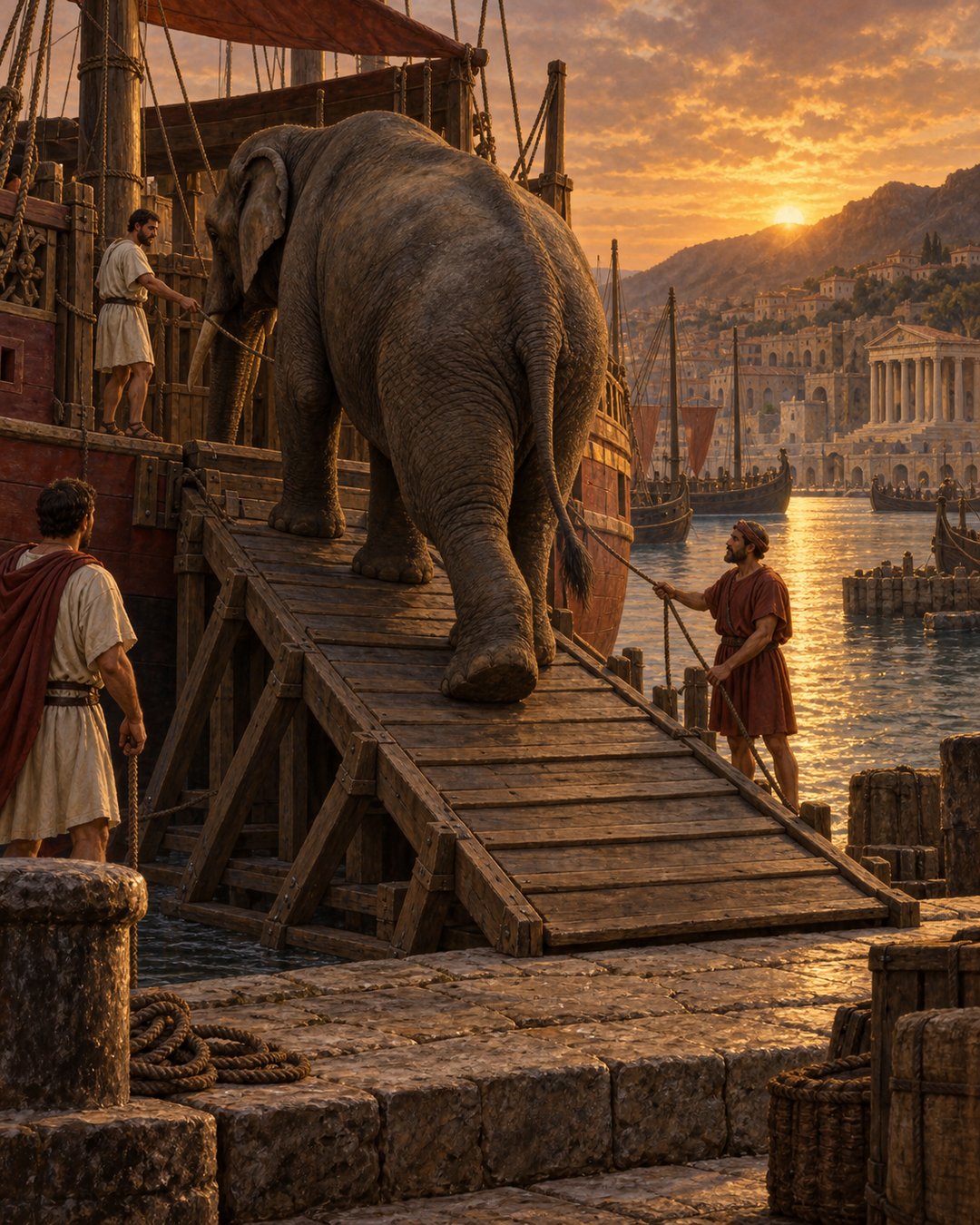
The ship had reached Puteoli, but the hardest part of the elephant’s voyage was still suspended above the water. A long timber platform joined vessel to shore. Pliny says the animals were terrified by the distance laid out in front of them.
They did not make the structure shorter. They turned around. Moving backward, the elephants descended without facing the full length of the path, giving themselves what Pliny called a false estimate of the distance.
The anecdote is not a cargo manifest or a harbor engineer’s drawing. It is a Roman story about animal intelligence. Yet its drama depends on a practical problem: how to persuade immense, frightened bodies to cross the narrow threshold between ship and land.
A Sworn Return Came Before the Voyage
Pliny opens Book 8 by placing the elephant nearest to human beings in intelligence among land animals. He credits it with understanding language, obeying commands and remembering duties it has learned. Modern readers do not need to accept every claim as zoology to recognize the argument he is building. Each reported action becomes evidence of a mind capable of judgment.
One maritime example turns handling into a promise. Pliny says elephants were believed to understand another’s religious obligation so well that they refused to embark for an overseas journey before the mahout swore that they would return.
The source marks this as belief, and the wording matters. We cannot recover an elephant’s private expectation or prove that it interpreted an oath as a Roman witness did. What Pliny preserves is the explanation people gave for a successful act of loading: the handler’s words changed refusal into movement.
The oath also gives the animal a future beyond the ship. Embarkation was not presented as submission to force without end. The promise supplied a route back, even if the elephant could not inspect a schedule or destination. In Pliny’s moralized natural history, trust begins where immediate vision cannot reach.
That story differs from Pompey’s failed attempt to bring four elephants through a triumphal gate. There, built space physically defeats ceremonial planning. In the embarkation report, the barrier lies in willingness, and the handler overcomes it through a sworn assurance rather than by enlarging an opening.
Transporting an elephant by sea required far more than one sentence, of course. Pliny gives no dimensions for a vessel, quantities of fodder or fastening plan in this passage. His focus is narrower: before the technical operation could proceed, a relationship between animal and handler had to carry it across the first threshold.
Puteoli Presented a Different Kind of Fear
The second maritime scene comes later, in Pliny’s chapter on elephant docility. Its attribution is unusually specific. Mucianus, whom Pliny identifies as a three-time consul, said that he had witnessed elephants being landed at Puteoli.
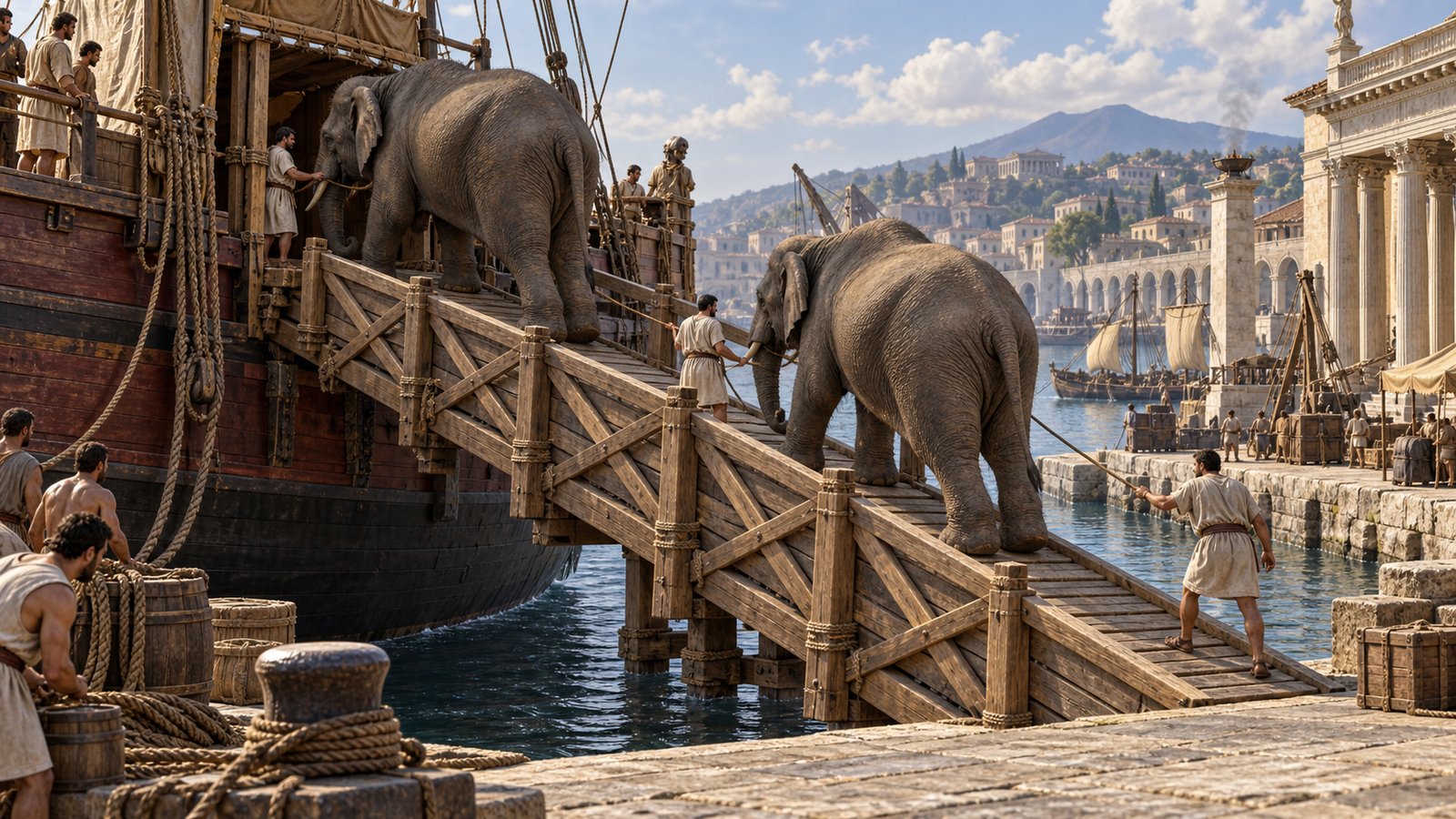
This time the journey was already behind them. The animals had entered the ship and crossed the water. Their problem was the exposed connection to shore. Pliny describes a platform extending from vessel to land and says its length terrified them as they were compelled to leave.
Puteoli gives the anecdote a working harbor rather than a fabulous edge of the world. A vessel had to meet a quay or beach through a temporary structure capable of taking concentrated weight. Handlers had to move animals from a shifting hull onto supported planks and then toward solid ground.
The text does not tell us the platform’s measurements, construction sequence or slope. Those details should not be invented from the single word. But the fear attributed to the elephants makes its length central. However sturdy it appeared to people, the crossing looked wrong to the animals expected to use it.
Pliny says they were compelled to leave the ship, so the episode was not a display of complete freedom. Human direction remained present. Yet compulsion alone did not erase perception. The handlers still needed the elephants to place one foot after another on a route the animals distrusted.
The scene makes maritime logistics depend on behavior. A ship could survive its voyage and arrive on schedule, while unloading stalled because living cargo evaluated the last few metres differently from its keepers.
Backward Steps Changed the Visible Distance
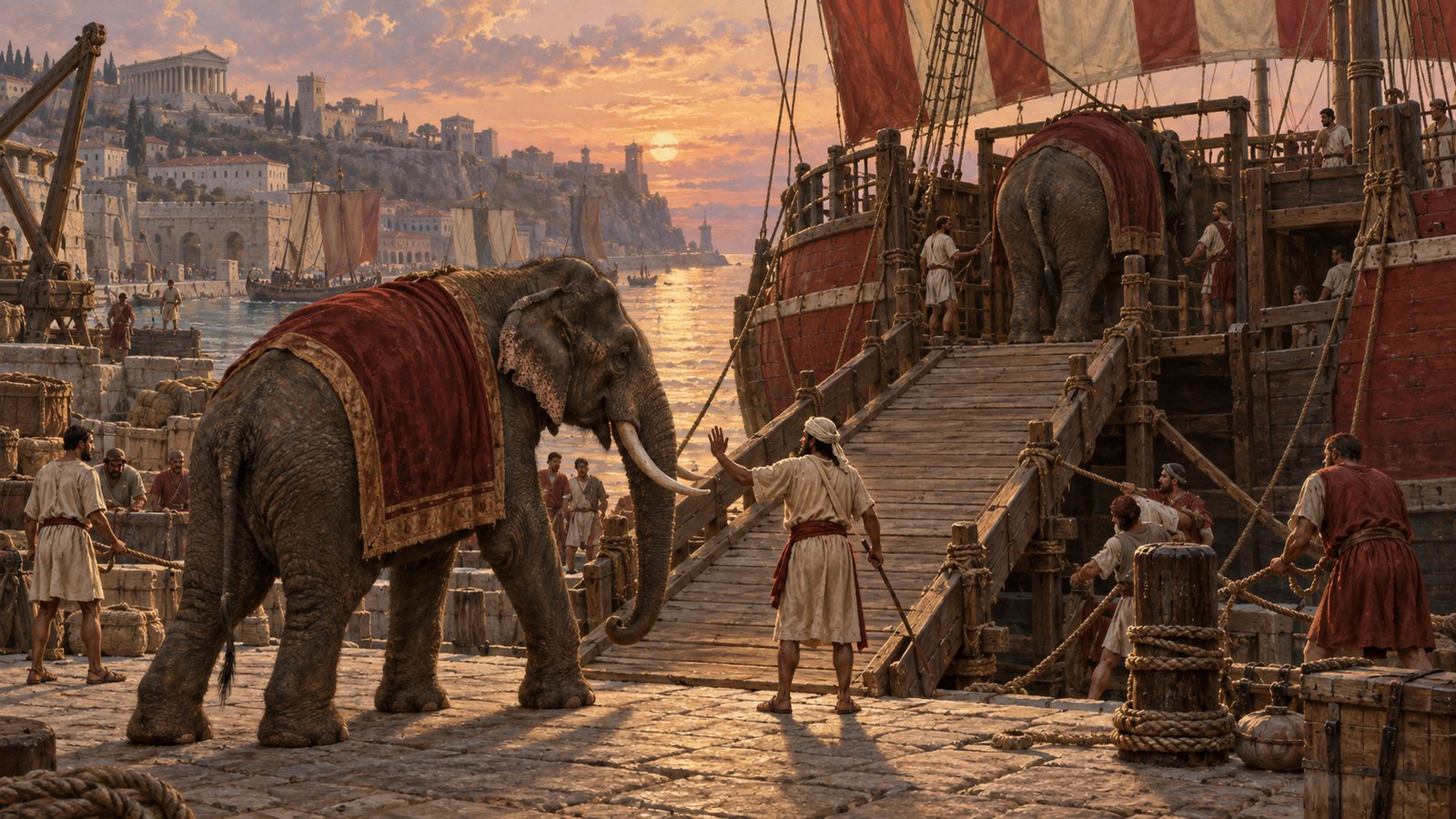
The elephants’ solution was to walk backward. Pliny interprets the movement as self-deception: by reversing their bodies, they formed a false estimate of the distance. The platform remained long, but it no longer stretched forward through their field of attention.
That distinction gives the anecdote its force. No worker dismantled the bridge and no ship moved closer while the animals watched. A change in orientation altered the problem enough for movement to continue.
Backward travel demanded its own kind of trust. The elephants could not inspect each coming step in the ordinary forward direction. They depended on footing, balance and guidance while the secure shore approached from behind. Pliny presents that trade as preferable to confronting the whole exposed span at once.
We should be careful with the phrase “false estimate.” It belongs to the author’s interpretation of behavior, not to an experiment measuring what the animals saw. The observable core of the report is more modest: frightened elephants faced away from the long platform and walked down backward.
Pliny used a related training story, examined in the account of an elephant tracing Greek letters, to let disciplined repetition stand for intelligence. At Puteoli, there is no writing performance. Intelligence appears as adjustment under pressure: the animal changes how it encounters a frightening space.
The backward descent also reverses the usual visual hierarchy of arrival. A grand animal does not stride proudly into port. It backs cautiously toward safety. That physical awkwardness makes the report memorable because successful handling looks like accommodation rather than domination.
Natural History Made Logistics a Test of Character
Taken together, the embarkation oath and the Puteoli landing place language and perception on opposite sides of a sea journey. Before boarding, a promise about return answers refusal. After arrival, a backward orientation answers fear of visible distance.
Both stories are shaped by Pliny’s purpose. He is collecting marvels of elephant intelligence and docility, not writing a manual for shipmasters. The reader receives selected moments in which animal conduct seems to approach deliberation, memory or trust.
That literary frame does not make the transport setting incidental. The stories work because ships create abrupt transitions. An elephant must leave familiar ground, enter a confined human structure and later cross another artificial path back to land. Each stage asks the handler to manage more than weight.
The source also distributes authority carefully. The mahout can swear; attendants can compel; Mucianus can claim the status of eyewitness; Pliny can decide what the movement means. The elephant cannot narrate its own reason, so human observers turn posture and refusal into a story about thought.
For that reason, the safest historical claim is not that every transported elephant required an oath or always descended in reverse. It is that Roman readers were offered these explanations, and that the explanations made animal cooperation central to maritime movement.
Puteoli’s platform becomes a small machine for revealing that idea. Timber and bracing carry the physical load, but they do not finish the operation. The crossing succeeds only when the animals can be persuaded to enter the space the structure provides.
Pliny’s elephants therefore arrive without conquering their fear. They alter its scale. Facing the ship, stepping backward and refusing the sight of the whole drop, they turn one impossible-looking distance into a sequence of reachable steps.
Sources
Pliny the Elder, Natural History 8.1 and 8.3.