
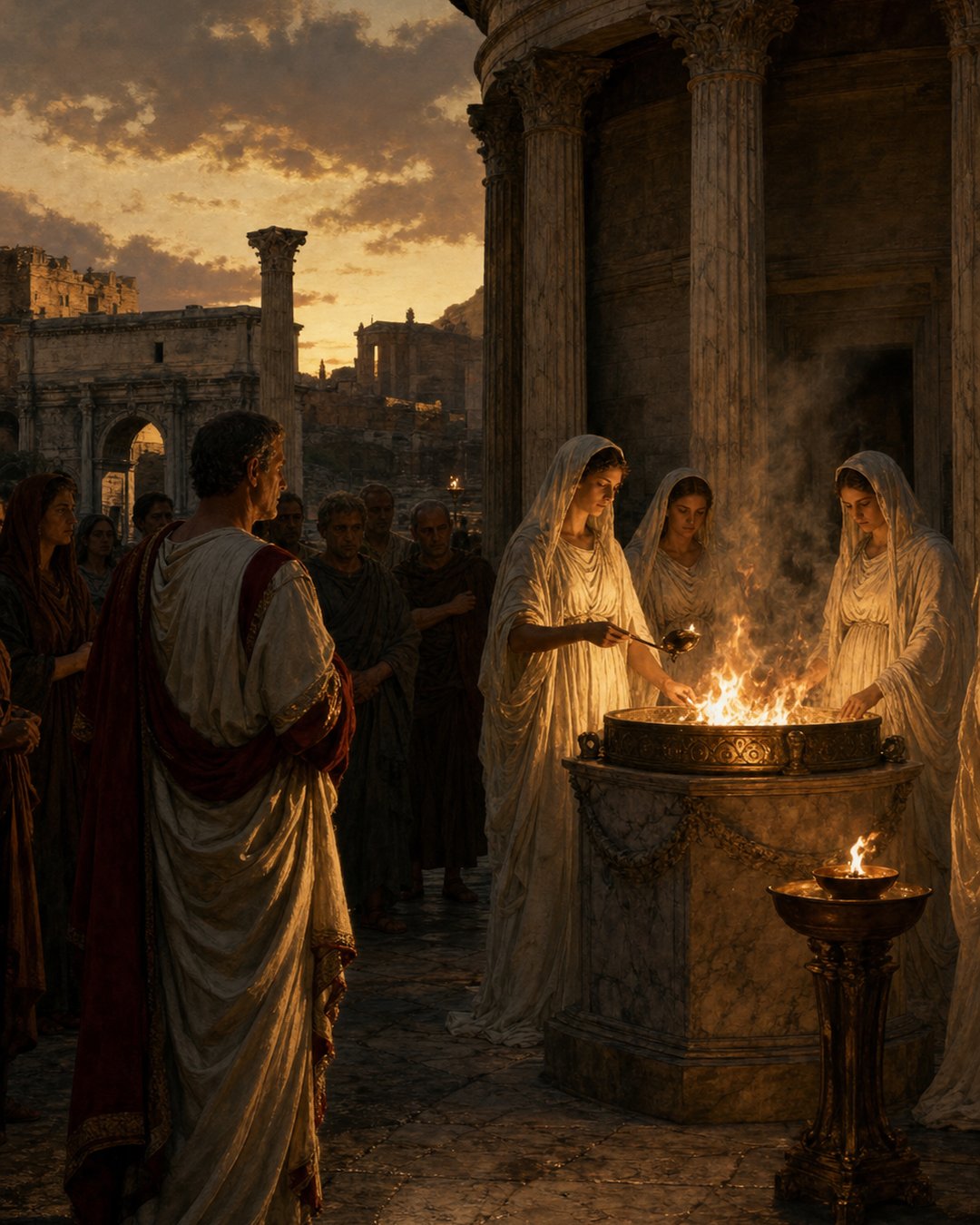
The Vestal Virgins made Roman protection visible through something deliberately small: a fire that had to keep burning. Armies could march, magistrates could speak, and emperors could boast, but the hearth of Vesta suggested a deeper security. If the flame still lived, Rome could imagine itself still ordered.
That is why the Vestals mattered far beyond ceremonial decoration. Their work joined household symbolism to state survival. Six women, selected for a life of public ritual, made the city feel protected by keeping watch over a sacred center that Romans treated as a sign of continuity.
A public hearth made the city feel like a household
Vesta was the goddess of the hearth, and the hearth was one of the most familiar images of stability in Roman life. A family fire suggested food, warmth, ancestry, and continuity. Rome enlarged that idea into a civic symbol by placing a sacred hearth near the center of public life.
The Temple of Vesta stood in the Forum, close to law, memory, business, and ceremony. That location mattered. The flame did not hide in a remote sanctuary. It burned where the city could imagine its own life gathered into one visible point.
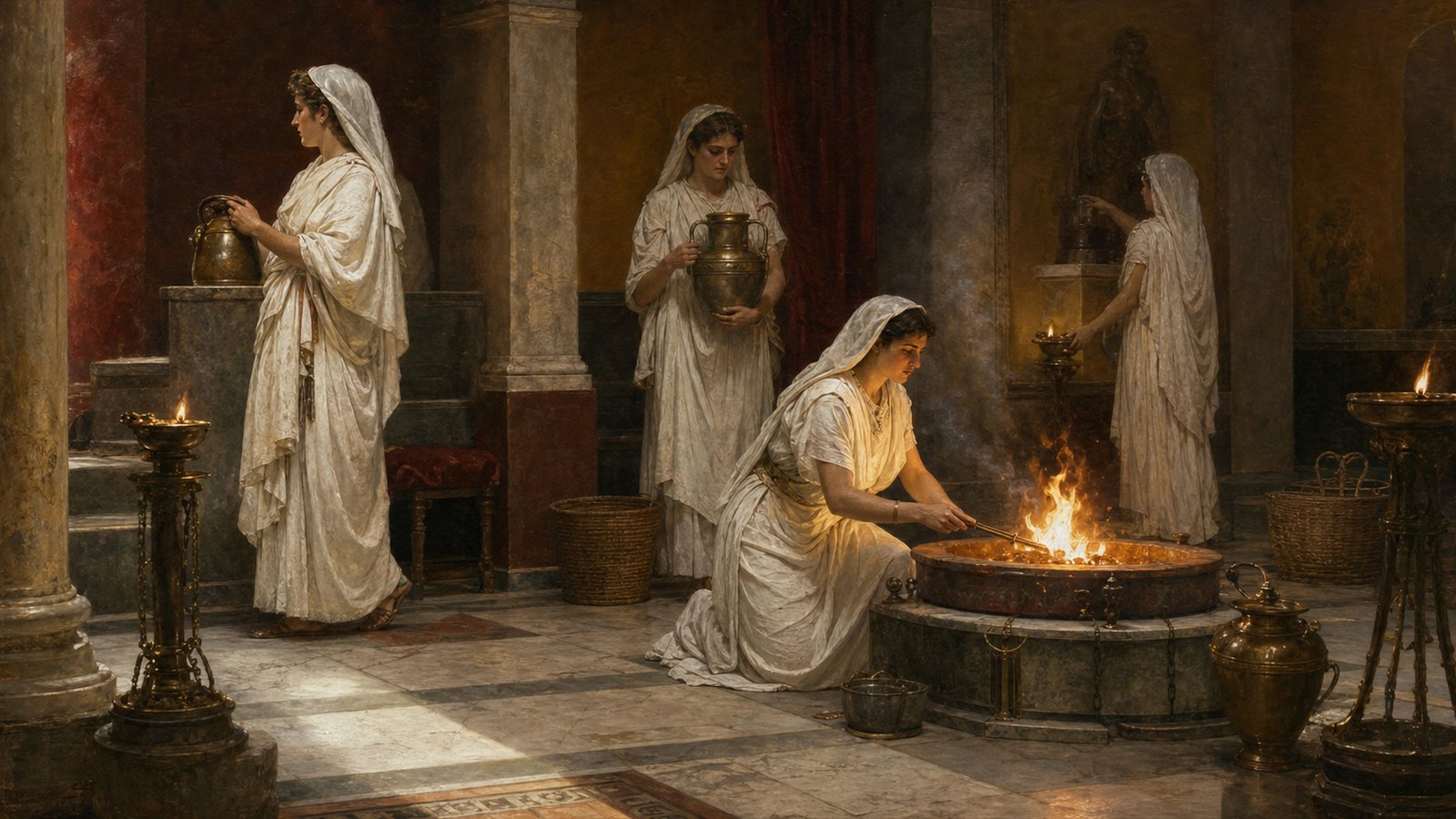
Six priestesses carried an unusual authority
The Vestal college traditionally numbered six. Their public position was extraordinary because Roman women usually lived under sharper limits on formal power. Vestals occupied a special religious category, marked by privilege, visibility, and severe expectation.
That combination gave them weight. A Vestal was not a magistrate, soldier, or senator, yet her service touched the safety of the state. Rome made room for female religious authority when that authority was framed as chastity, ritual discipline, and protection of the civic hearth.
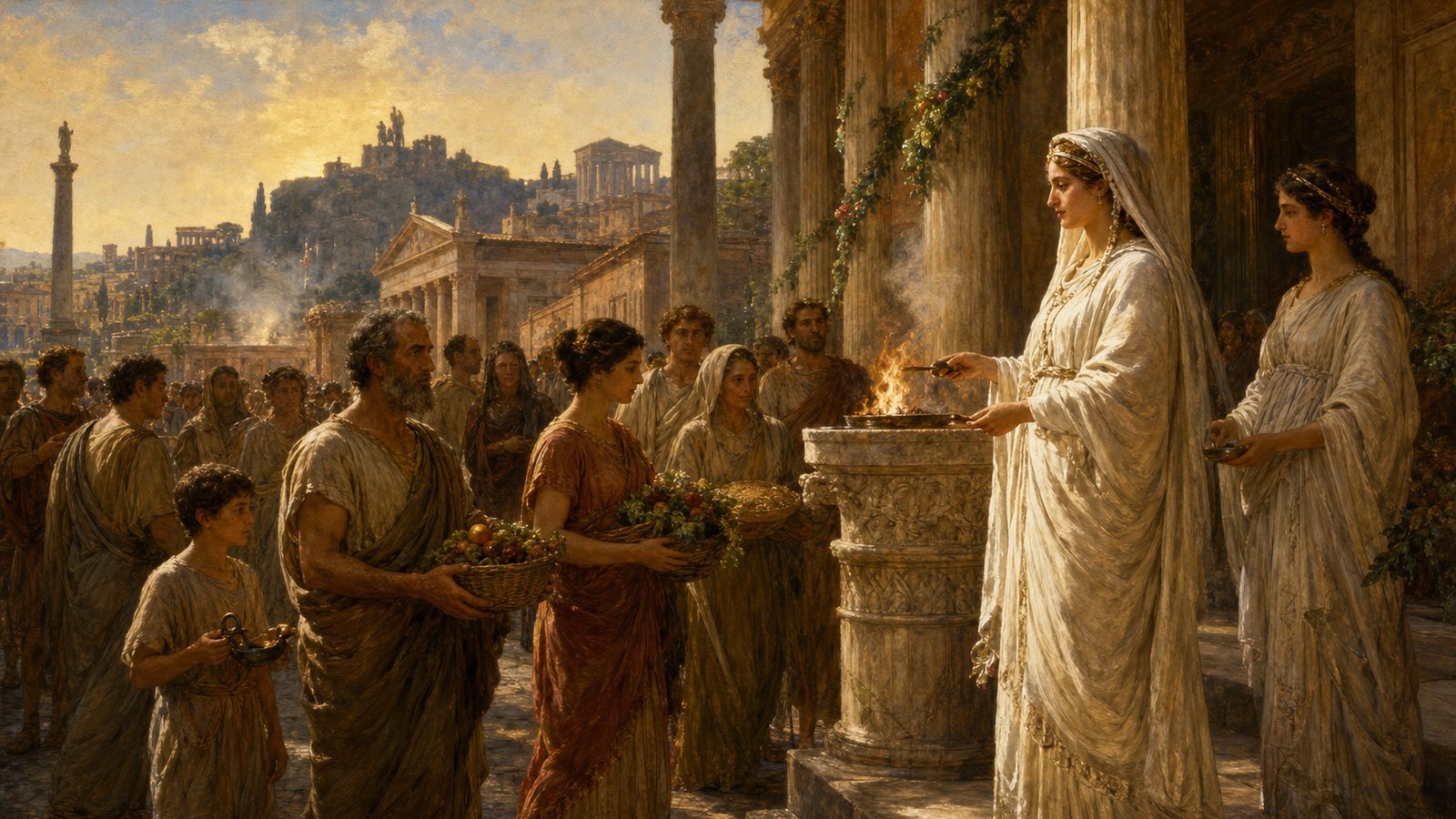
Thirty years turned service into a life
Plutarch describes Vestal service as a thirty-year commitment: years of learning, years of performing, and years of teaching. Whether every detail worked exactly as later writers imagined, the number shows how Romans pictured the office. This was not a seasonal role. It consumed a life.
The length of service helped create trust. The sacred fire was not tended by casual volunteers. It was guarded by women whose bodies, time, habits, and reputations were made part of the city’s religious machinery. Protection depended on repetition.
The flame made failure frightening
The fire’s extinction was treated as a serious religious failure because it suggested more than bad housekeeping. If the public hearth went out, the visible sign of Roman continuity had broken. People could read misfortune into ash.
The punishments attached to Vestal failure show the same intensity. Ancient sources describe terrifying penalties for a Vestal who violated her vow. The harshness is not evidence of calm confidence. It reveals how much symbolic pressure Rome placed on these women and on the purity of the rite.
Privilege and danger belonged together
Vestals enjoyed honors and freedoms that made them stand apart. They could appear publicly with dignity, hold respected places at ceremonies, and receive forms of independence unusual in Roman society. Their privilege was real.
Yet the privilege was inseparable from risk. Rome honored the Vestals because it needed them to embody trust. When that trust seemed threatened, the city could turn violent in the name of restoring sacred order. Protection had a human cost.
The protected thing was Rome’s confidence
The Vestals did not stop fires in every house or enemies at every frontier. Their work protected something less material but politically powerful: the belief that Rome had a sacred center, watched carefully and renewed every day.
This is why Vestal ritual mattered. The flame translated anxiety into routine. Citizens could look toward the Forum and believe that somebody was keeping the city’s oldest promise alive. The priestesses protected Rome by making continuity something people could see.
The scene also explains why the Vestals could be both visible and set apart. They were public figures, but their authority depended on distance from ordinary family roles. Rome used that distance to make them seem available to the whole community rather than to one household alone.
Ovid’s treatment of Vesta in the Fasti keeps returning to the hearth as a sacred center. That poetic imagination fits the political use of the cult. A hearth gathers people without needing a speech. It makes belonging feel older than argument.
The sensory details were simple and powerful: heat, smoke, lamplight, white veils, polished vessels, and the smell of offerings. Roman religion often worked through such repeated acts. Belief was not only an idea; it was a pattern of sights and gestures that trained the city to remember itself.
The Vestals also remind us that Roman protection was never purely military. A legion could guard a road, but a ritual could guard confidence. Rome needed both because empire depended on public belief as well as force.
That confidence could be fragile. Bad omens, military defeats, fires, plagues, and scandals all made Romans search for signs that the relationship between city and gods had been disturbed. The Vestals stood near that anxious search.
Their authority therefore had a double edge. It elevated women in a rare religious office, but it also made their bodies and reputations bear the weight of communal fear. The city’s protection was imagined through disciplined service, public honor, and the threat of exemplary punishment.
The sacred fire worked because it was ordinary enough to understand and solemn enough to fear. Anyone knew what a hearth meant. Rome’s political genius was to turn that domestic image into a civic signal, then assign its care to priestesses whose lives made the signal believable.
When Romans passed through the Forum, the flame was not just a religious object. It was a small daily answer to a large civic question: is Rome still Rome? As long as the fire burned, the city could tell itself yes.
The number six also helped make the college memorable. Rome did not imagine an anonymous crowd around Vesta. It imagined a small, watched, named group whose continuity could be followed across generations. When one Vestal completed her years and another entered service, the office itself survived the change, just as the flame was supposed to survive the passing of individual hands.
The thirty-year span gave the ritual a human timescale. A girl chosen for service could become a senior religious figure while consuls, generals, and fashionable causes changed around her. That slow rhythm made the cult look older and steadier than ordinary politics, which was exactly why Roman anxiety could gather around it in moments of crisis.
The public hearth also made protection feel shared. No single family owned the flame, and no single faction could claim it without damaging its meaning. In a city often divided by status, patronage, and ambition, Vesta offered an image of common continuity. The image was idealized, but ideals are powerful when a community needs a symbol to stand above quarrels.
Sources & Further Reading
- Britannica, Vestal Virgins
- Smith Dictionary, Vestales
- Plutarch, Numa, 10
- Plutarch, Numa, 9-10
- Parco archeologico del Colosseo, Temple of Vesta
- Livy, History of Rome, 8.15
- Ovid, Fasti, 6