
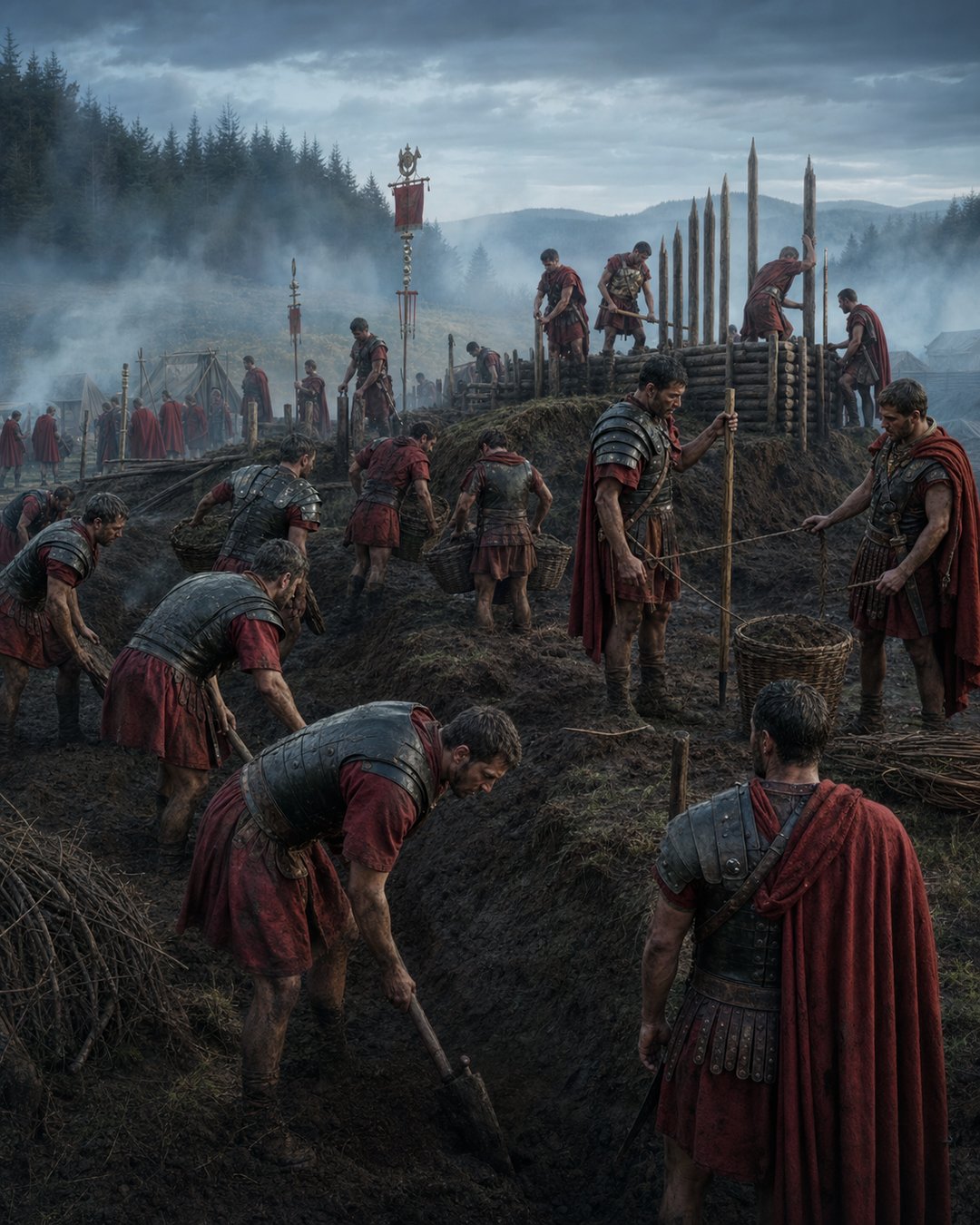
A Roman frontier was not made permanent by drawing a line on a map. It became convincing when soldiers dug ditches, raised gates, stored grain, repaired barracks, wrote rosters, and woke up to the same guarded landscape day after day. The fort was the frontier’s daily proof.
That is why Roman forts made frontiers feel permanent. They turned military presence into routine. A fort did not merely wait for attack. It organized movement, supply, authority, and memory in a place where empire needed to look as if it intended to stay.
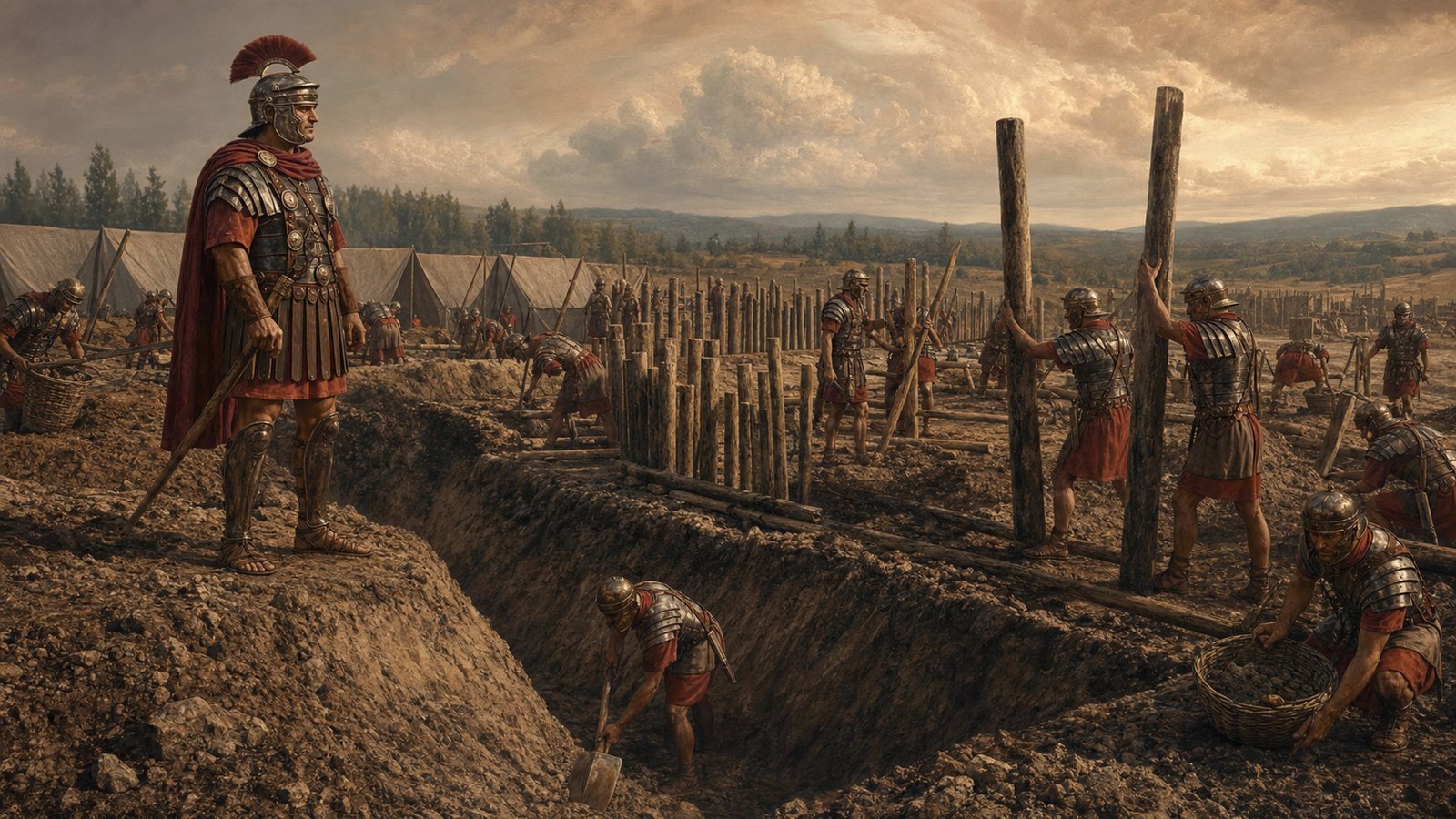
A ditch could be a political statement
Roman camps and forts relied on practical features: ditches, ramparts, gates, roads, and ordered interiors. Those features protected soldiers, but they also announced discipline. A landscape with a fresh ditch and measured gate no longer looked untouched. It had been given Roman shape.
Vegetius treats military order and camp practice as central to army life. That emphasis matters because a frontier fort was not only a shelter. It was a repeated act of organization made visible in earth, timber, stone, and spacing.
Layout made power legible
The internal plan of a fort helped soldiers know where to sleep, drill, report, store supplies, and receive orders. Headquarters, barracks, granaries, workshops, and roads created a miniature world of command. The layout taught everyone where authority lived.
That legibility mattered to civilians too. Traders, local communities, envoys, and laborers encountered a place designed around hierarchy. Even before a soldier spoke, the gates and streets explained that this was Roman-controlled space.
Routine was stronger than spectacle
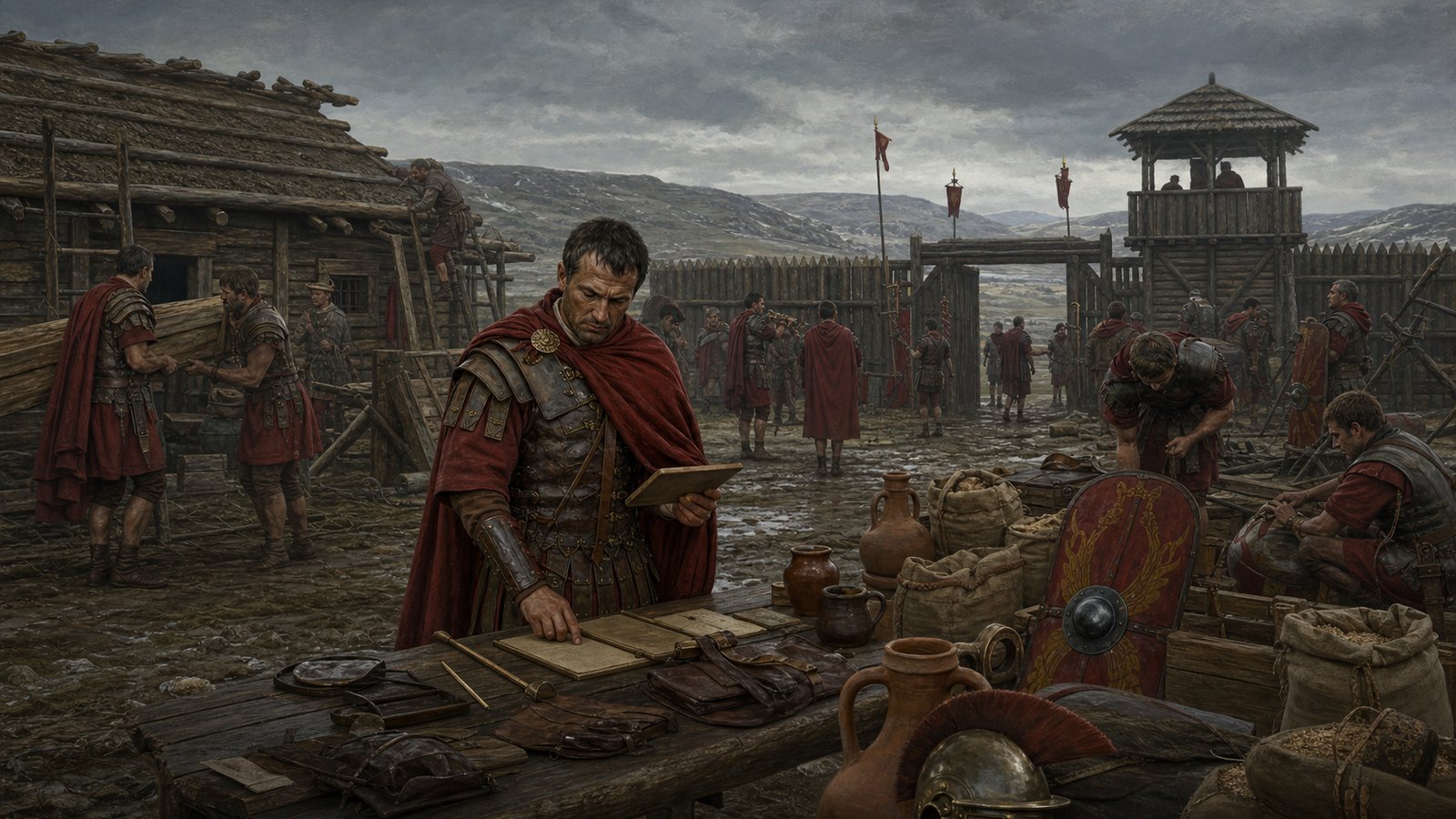
Battles made memorable stories, but most frontier power was routine. Guards changed shifts. Tools were repaired. Grain was counted. Animals needed fodder. Letters moved. Pay, punishment, leave, and supply all had to be managed.
The Vindolanda tablets are so valuable because they preserve that ordinary machinery. Invitations, lists, reports, and requests reveal a frontier made from administration as much as from weapons. The fort endured because paperwork and habit kept rebuilding it.
Roads connected forts into a system
A single fort could watch a crossing or hold a local position, but roads and neighboring posts turned forts into a network. Movement between them made reinforcement, messages, patrols, and supply more reliable. The frontier became a chain of places rather than an isolated gamble.
Hadrian’s Wall shows the principle clearly with forts, milecastles, turrets, and gates distributed across a militarized landscape. The system did not remove uncertainty, but it made uncertainty manageable by breaking it into watched segments.
The fort changed life around it
A fort attracted people who were not soldiers: traders, families, craftsmen, transport workers, and local intermediaries. Settlements could grow outside the walls. Markets followed pay. Information followed roads. The military site became an economic and social presence.
That presence could be useful, disruptive, or resented. For local communities, the fort meant opportunity and surveillance at once. Roman permanence was not only a wall; it was the way a garrison began to shape nearby routines.
Permanence had to be rebuilt every day
No fort was permanent by magic. Timber rotted, ditches slumped, roofs leaked, supplies spoiled, and soldiers rotated. The appearance of permanence came from repeated maintenance. Rome had to keep choosing the frontier by repairing it.
This is why forts are such strong evidence for empire. They show Roman power at work after the parade ended. A frontier felt permanent when people could see the same gates, roads, watchmen, stores, and orders surviving another morning.
Tacitus’s account of Agricola repeatedly links campaigning with forts, roads, and pressure on local populations. That combination helps explain the Roman habit. Conquest was not complete when an enemy retreated. It needed places from which authority could return.
The sensory world of a fort was not glorious in a simple way. It smelled of damp timber, leather, smoke, animals, cooking grain, metalwork, and latrines. Those details made empire physical. Soldiers did not inhabit an abstract border; they inhabited a working compound.
The fort also managed time. Watches divided the night, orders divided the day, and calendars divided supply expectations. Such rhythms turned dangerous geography into scheduled obligation. The army made the frontier feel governable by making it repetitive.
Even a temporary marching camp carried this logic. The act of measuring, digging, posting guards, and arranging tents told soldiers that order could be created almost anywhere. A more permanent fort extended that confidence across seasons.
For commanders, the fort was a tool for memory. Stores could be counted, personnel tracked, messages filed, repairs assigned, and discipline enforced. Without such records, a frontier dissolved into episodes. With them, it became an administrative problem Rome believed it could solve.
For local people, the fort’s permanence might feel different. A gate could mean protection from raiders, but it could also mean taxes, requisition, surveillance, forced labor, or a reminder that an outside power had settled nearby. The same ditch could promise safety and domination.
That double meaning is why the fort mattered politically. It did not simply defend Rome from the frontier. It helped produce the frontier as a Roman category, a place where movement was watched, loyalty tested, and ordinary life adjusted to the rhythm of a garrison.
The strongest image is not a battle line but a work party at dawn. Men lift stakes, sharpen tools, clear drains, and check stores while smoke rises from cooking fires. Nothing dramatic has happened yet, and that is the point. Roman power often lasted because it made occupation routine before crisis arrived.
A fort also created a horizon of expectation. If the gates were repaired this year, the road cleared next year, and the granary filled before winter, everyone nearby learned that Rome was planning beyond the next campaign season. Permanence was a promise made through maintenance.
The watchtower made that promise visible from a distance. It told travelers and neighbors that someone was looking, recording, and ready to send word along the road. Surveillance did not have to be constant to be effective; it had to be believable enough that people adjusted behavior before a patrol appeared.
The fort’s most important weapon may have been that belief. Soldiers still needed swords and shields, but the deeper frontier system worked when routines became assumptions. People expected the gate to open, the roster to be checked, the road to carry orders, and the garrison to still be there tomorrow.
The material traces also helped Rome remember its own decisions. A rebuilt ditch showed that somebody had allocated labor. A stocked granary showed that transport had arrived. A repaired barrack roof showed that winter had been anticipated. Each ordinary repair converted imperial intention into something people could touch, count, and resent or rely on.
This helps explain how a fort could make even a contested frontier feel settled before it truly was. It gave soldiers a home, officials an address, merchants a destination, and local people a fixed point around which to negotiate, avoid, complain, trade, or comply. The walls enclosed more than troops; they enclosed a schedule for Roman return.
Sources & Further Reading
- Vegetius, Epitome of Military Science, 3
- Smith Dictionary, Castra
- Vindolanda Tablets Online
- British Museum, Vindolanda tablets
- English Heritage, Roman Forts
- English Heritage, Hadrian’s Wall
- Vindolanda, Roman Fort and Settlement
- Tacitus, Agricola, 20-23
- Cambridge Core, Frontiers of the Roman Empire
- Vegetius, Epitome of Military Science, 1