
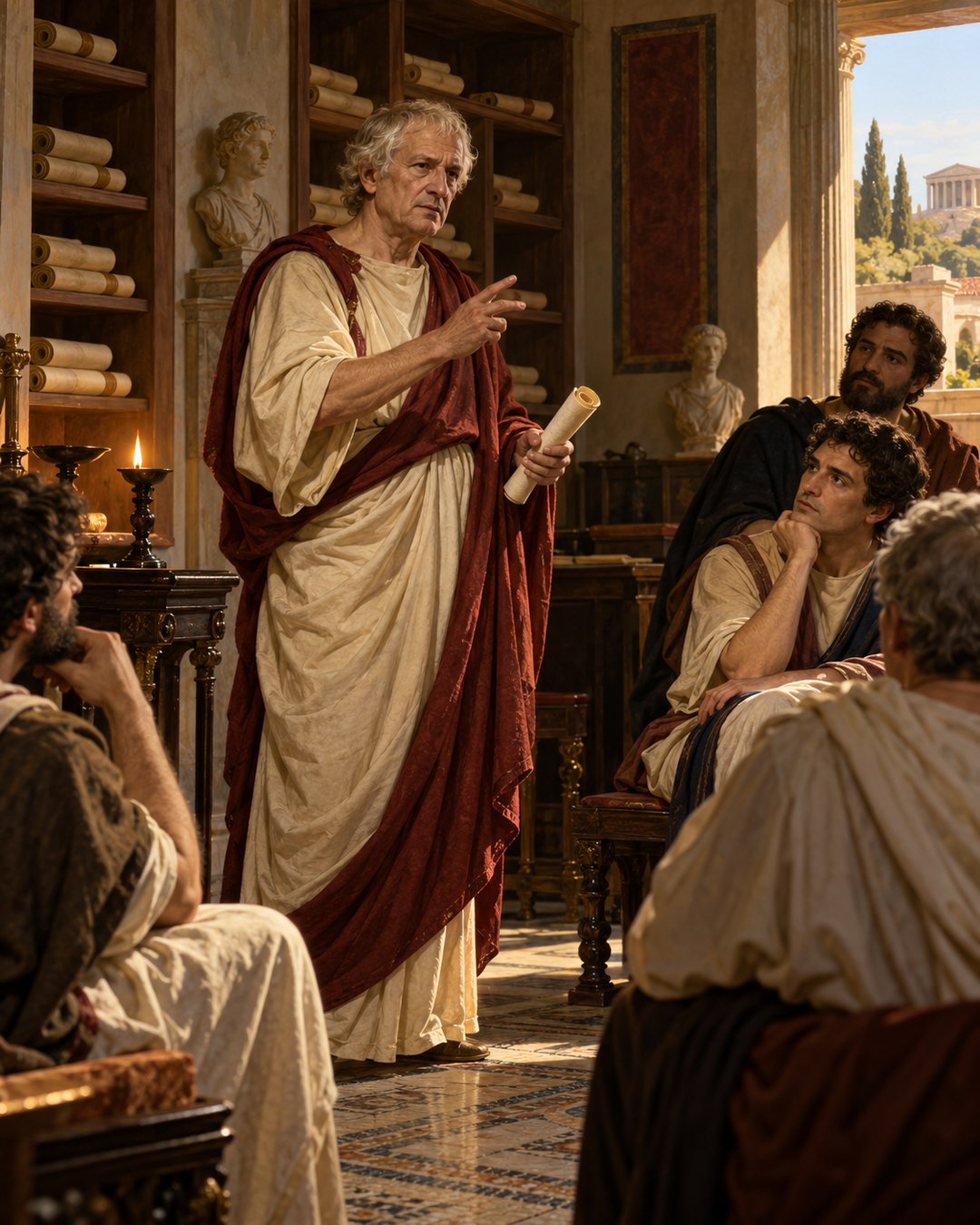
Seneca could dismiss a line before slower readers had finished explaining it. In a lost book of the Moral Epistles, he mocked Ennius for calling Cethegus the people’s chosen flower and the “marrow of persuasion.” He then mocked Cicero for admiring the verse.
Aulus Gellius did not answer with reverence alone. He framed a question about method: when does a sharp verdict become evidence, and when does ridicule merely outrun interpretation?
The disagreement is valuable because neither writer arrives without style. Seneca’s contempt is compact and memorable. Gellius’s rebuttal is patient and selective. The reader must judge not only Ennius, but two different ways of judging him.
Gellius refused a verdict on the whole author
The chapter begins with disagreement about Seneca himself. Some readers found his prose commonplace, his learning ordinary, and his flashes of vehemence or cleverness empty. Others admitted roughness in diction but credited his knowledge and the seriousness with which he attacked contemporary vice.
Gellius reports both camps before stating his own scope. He will not pass judgment on Seneca’s complete talent or every work. He will examine particular opinions about Ennius, Cicero, and Virgil.
That narrowing is more than courtesy. A global reputation can settle a local question too quickly. If Seneca is declared brilliant, every sneer may look decisive. If he is declared worthless, no criticism needs an answer.
Gellius instead isolates claims that can be inspected. Which passage did Seneca quote? What did he say was wrong with it? Did the language deserve ridicule in its setting?
The method complements Castricius weighing Gracchus’s sentence after its rhythm charmed the room. Castricius suspends a famous orator’s authority. Gellius suspends a famous critic’s authority.
Both exercises delay applause or contempt until the object has been separated from the prestige of the speaker.
Three strange words became the prosecution
Seneca’s target included lines by Ennius about Cethegus, a public figure of an earlier age. The verse called him the chosen flower of the people and the marrow of persuasion.
“Marrow” makes the metaphor physically dense. Persuasion is imagined as having an inner substance, and Cethegus embodies that substance. The phrase is bold enough to sound comic when detached from its poetic world.
Seneca calls the verses absurd and wonders how eloquent admirers could rank them among Ennius’s best. His surprise becomes part of the argument: the words should supposedly defeat themselves as soon as a cultivated ear hears them.
He then widens the attack. Cicero had cited the lines favourably. Seneca suggests that Cicero praised Ennius partly to protect his own verse from judgment.
The move is rhetorically efficient. A peculiar phrase discredits Ennius; Cicero’s approval then discredits Cicero; Cicero’s own writing returns as supposed evidence that bad taste reproduces itself.
But efficiency creates a burden. The critic must show that the metaphor fails in its poem, not merely that it sounds unusual in prose or in a later literary fashion.
Roman readers regularly encountered inherited language that had aged unevenly. As the older double force of “honour” demonstrates, strangeness can mark historical distance rather than simple incompetence.
Mockery made agreement feel like explanation
Seneca’s attack gains force through escalation. He does not say only that he dislikes the phrase. He calls the verse absurd, expresses amazement at its admirers, and makes Cicero’s praise evidence against Cicero.
This structure rewards a reader who already shares the taste. Each additional joke feels like confirmation, although all may depend on the first unproved reaction.
Gellius responds in kind at moments, calling one of Seneca’s comments very foolish. That sharpness means his chapter is not a neutral modern review. It is an ancient counterattack with its own loyalties and temperature.
The useful distinction lies in his declared procedure. He quotes the disputed judgments and treats them as claims about identifiable passages. The argument can therefore be tested rather than accepted as a performance of superior taste.
A critic’s wit can create the same illusion that rhythm created for Castricius’s pupils. The ending lands, the audience enjoys the confidence, and a judgment seems to have acquired weight through delivery.
That does not make ridicule illegitimate. A precise joke can expose a real mismatch. The question is whether the analysis survives when the laughter stops.
Gellius’s preserved disagreement invites exactly that pause.
Ancient criticism was already arguing about context
The chapter prevents a simple picture in which Romans unanimously revered their classics. Ennius could be canonical enough for Cicero to praise and strange enough for Seneca to mock. Seneca himself could be admired as a moral critic and dismissed as affected.
Those crossed reputations matter because literary history is not a straight vote from primitive taste toward refinement. Every generation inherits old language, new fashions, admired authorities, and incentives to display independence from them.
Seneca’s position gains drama from rejecting approved examples. Gellius’s position gains drama from defending careful reading against a fashionable sneer. Both gestures are social as well as analytical.
Gellius’s initial restraint remains the strongest feature. He does not need Seneca to be wholly bad in order for a particular criticism to fail. Nor must every line of Ennius be excellent because one criticism is inadequate.
This claim-by-claim approach protects readers from reputational chains. Cicero’s approval cannot prove Ennius good. Seneca’s mockery cannot prove Cicero foolish. Gellius’s anger cannot settle Seneca. Each link requires its own evidence.
The lost portions and quoted fragments also impose limits. We do not possess every context Seneca’s twenty-second letter once supplied. Gellius selects the material for his answer. A responsible reading can describe that contest without pretending to restore the absent document completely.
What survives is enough to reveal the mechanism of fast criticism. Choose a phrase that sounds vulnerable, detach it, intensify the audience’s reaction, then make anyone who admired it share the embarrassment.
Gellius slows that mechanism by naming his scope and reopening the quotation. His own prose can be combative, but his structure insists that the object return before the verdict becomes final.
Seneca’s insult remains memorable. Gellius’s challenge is whether memory has mistaken sharpness for demonstration.
The metaphor of persuasion’s marrow also deserves the basic fairness Gellius demands. Marrow was imagined as the concentrated substance inside a body. Calling an orator its equivalent makes him not merely persuasive but the inner density of persuasion. A later reader may still dislike the phrase, yet its logic is recoverable. Oddness alone is not absence of meaning.
Cicero’s praise then becomes evidence about reception rather than a certificate of quality. It shows that a major Roman orator could hear force where Seneca heard absurdity. The disagreement should enlarge the question: were the readers responding to different standards, periods, genres, or expectations? Seneca’s joke closes those routes; Gellius reopens them.
The chapter’s best lesson is therefore procedural. Quote enough to identify the object, distinguish personal taste from demonstrated defect, and keep a judgment proportionate to the passage examined. Gellius does not always meet a modern ideal of calm criticism, but his announced limits prevent one disliked sentence from swallowing an entire writer.
His opening survey of Seneca’s mixed reputation serves the same discipline. Praise and blame are both admitted as evidence of disagreement, not converted into a vote. By refusing to decide the whole author first, Gellius keeps the individual quotation available for a judgment that can be revised.
Sources
Aulus Gellius, Attic Nights 12.2, discussing Seneca’s criticism of Ennius, Cicero, and Virgil.