
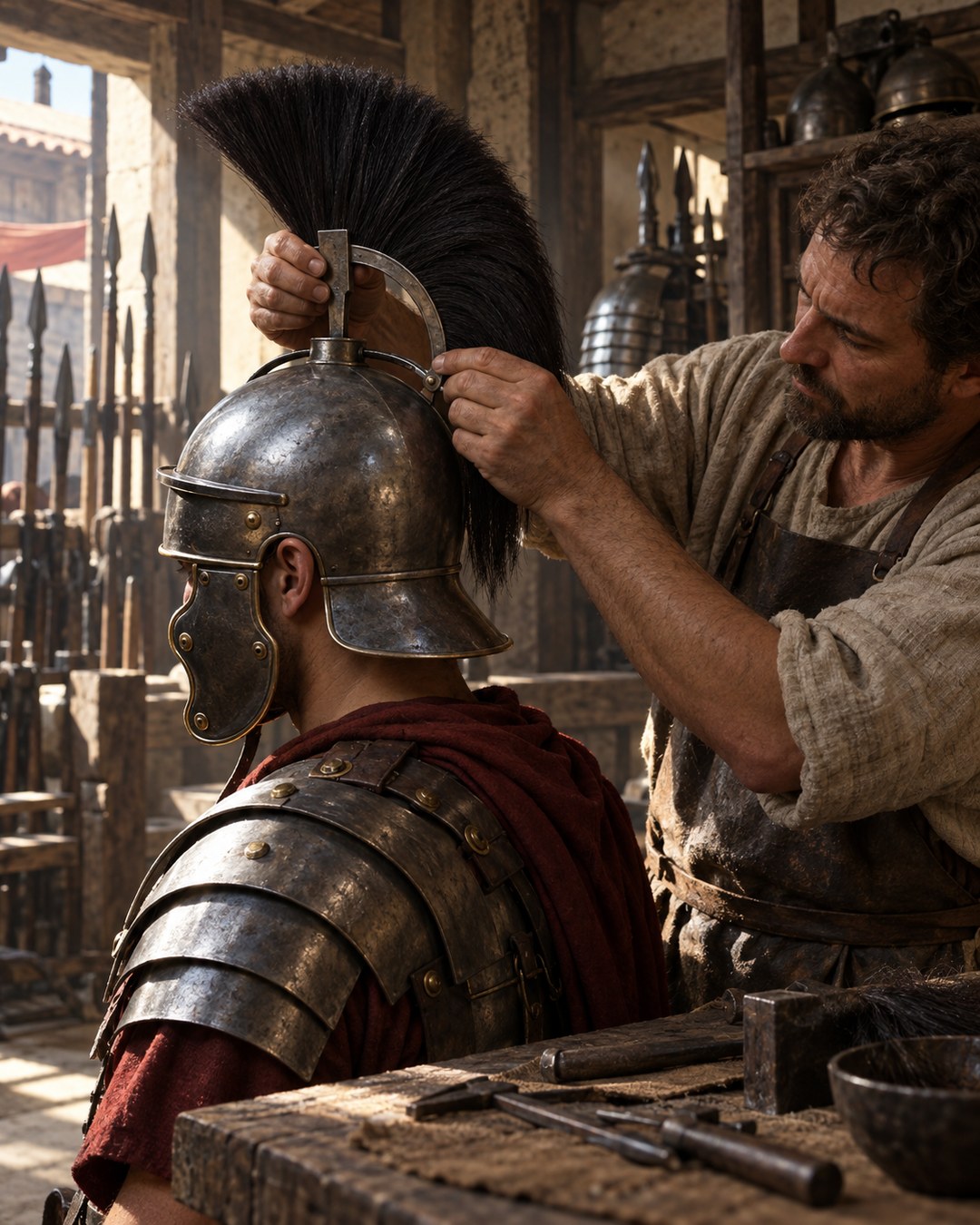
The most theatrical part of a Roman helmet depended on a piece of iron shorter than a finger. London Museum preserves a crest support dated to AD 40–140. It is only 71 millimetres long, yet its three-part geometry carried the material that made a soldier appear taller and more imposing. The surviving object shifts attention away from the plume itself and toward the practical question beneath it: how do you keep hair or feathers steady above a curved metal bowl?
The answer was not to make the display permanent. One tongue entered a socket in the crown. Two other arms turned across the helmet and followed its curve. The crest could therefore be stabilized when appearance mattered and removed when it did not. This was equipment for controlled display, not a decorative burden that had to accompany every use of the helmet.
The Small Iron Part at the Crown
The museum identifies the object as an iron helmet crest support for a Roman soldier. Its date range, AD 40–140, places it in the early imperial period. The whole fitting measures 71 millimetres; the shaft alone is 33 millimetres long and 9 millimetres wide. These are modest dimensions for a component whose visual effect extended far beyond itself.
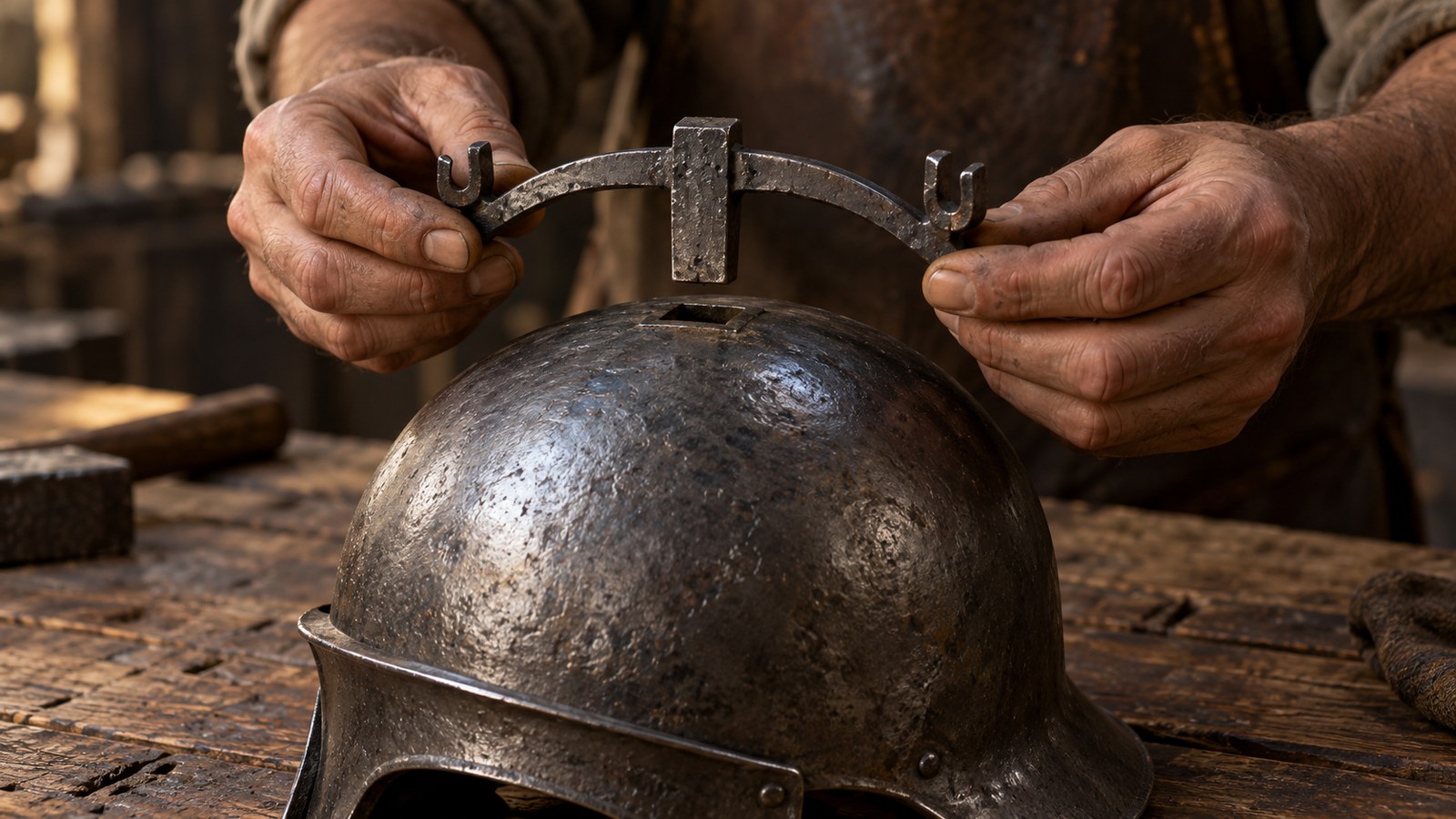
The fitting began with a central tongue. That tongue slotted into a socket at the top of the helmet. Its upright section was rectangular rather than round, a form that gave the inserted piece defined faces inside the opening. The object was not simply a nail driven through the bowl. It was a shaped connector designed to meet another shaped part.
That distinction matters when reading military equipment. A helmet can survive while the soft crest disappears, leaving an empty socket that looks incidental. The support shows that the opening belonged to a small assembly. Like the fastenings discussed in Roman artillery’s rope mechanism, the least spectacular component can explain how the visible system worked.
Three Arms Solved a Curved Problem
Above the central tongue, two arms ran perpendicular to it. They did not remain straight. Each curved to fit the shape of the helmet bowl. The museum describes this arrangement as giving the crest optimum stability. That phrase can be understood mechanically: insertion held the fitting at the centre, while the side arms spread support across the curved surface.
The ends reveal how the crest itself was received. The arms were U-shaped, and their tops curled outward. They were therefore not merely braces pressed against the helmet. They formed holders for the crest material. A single upright would have concentrated the entire load at one point. The paired arms created more than one place of contact and helped keep the display aligned across the crown.
The fitting’s small size makes the solution unusually legible. There is no need to imagine a hidden frame extending across the whole helmet. A central shaft, two transverse arms, and curled tips performed separate jobs. The tongue connected support to helmet. The curves matched the bowl. The U-shaped ends received the material. Each bend belongs to the same stability problem.
This is also why the piece should not be mistaken for a fragment that happened to fork. The geometry is directional. One element points down into the crown; the other two turn across it. Their relationship makes sense only when the helmet is treated as the base of a taller, temporary structure.
The measurements sharpen that reading. A 33-millimetre shaft accounts for nearly half the fitting’s total length, leaving the remaining iron to form the transverse support and its curled receivers. The 9-millimetre shaft width also rules out an imagined monumental bracket. Stability came from placing a small piece accurately at the crown and distributing the crest across shaped contacts, not from adding a large mass above the soldier’s head.
The fitting therefore preserves a sequence of assembly. The support first met the crown socket through its rectangular upright. Its curved arms then settled against the bowl rather than floating above it. Finally, hair or feathers entered the U-shaped holders. Reading those contacts in order explains why the object has three directions at once: downward for attachment, sideways for bracing, and upward for the visible crest.
A Crest Was Performance Equipment
The museum says Roman helmet crests were made from hair or feathers and were intended to make soldiers look more impressive. Neither material survives like iron, but the support records what those perishable additions demanded. Hair and feathers supplied height and movement; the fitting supplied restraint. The visual effect depended on both.
“Impressive” does not have to mean ornamental in the modern sense of an unnecessary flourish. In a military setting, controlled appearance could communicate order, rank, readiness, or ceremony. The object record does not assign this particular support to a named soldier or unit, so its exact social message remains unknown. What the iron proves is narrower and firmer: somebody engineered a stable mounting for a display meant to alter how the wearer looked.
The contrast with other forms of Roman military visibility is useful. An eagle standard represented a unit and could become an object of extraordinary loyalty, as explored in why Roman eagles carried more than material value. A helmet crest worked at the scale of the body. It enlarged the outline of one wearer. The support translated that ambition into a physical connection only a few centimetres long.
Because the material stood above the head, even slight movement would have been magnified at the top. The two curved arms did not suppress the life of hair or feathers, but they kept the base from wandering. The desired impression began with motion and height; the credible impression required a crest that did not slump away from its mounting.
Detachable Changed When the Height Existed
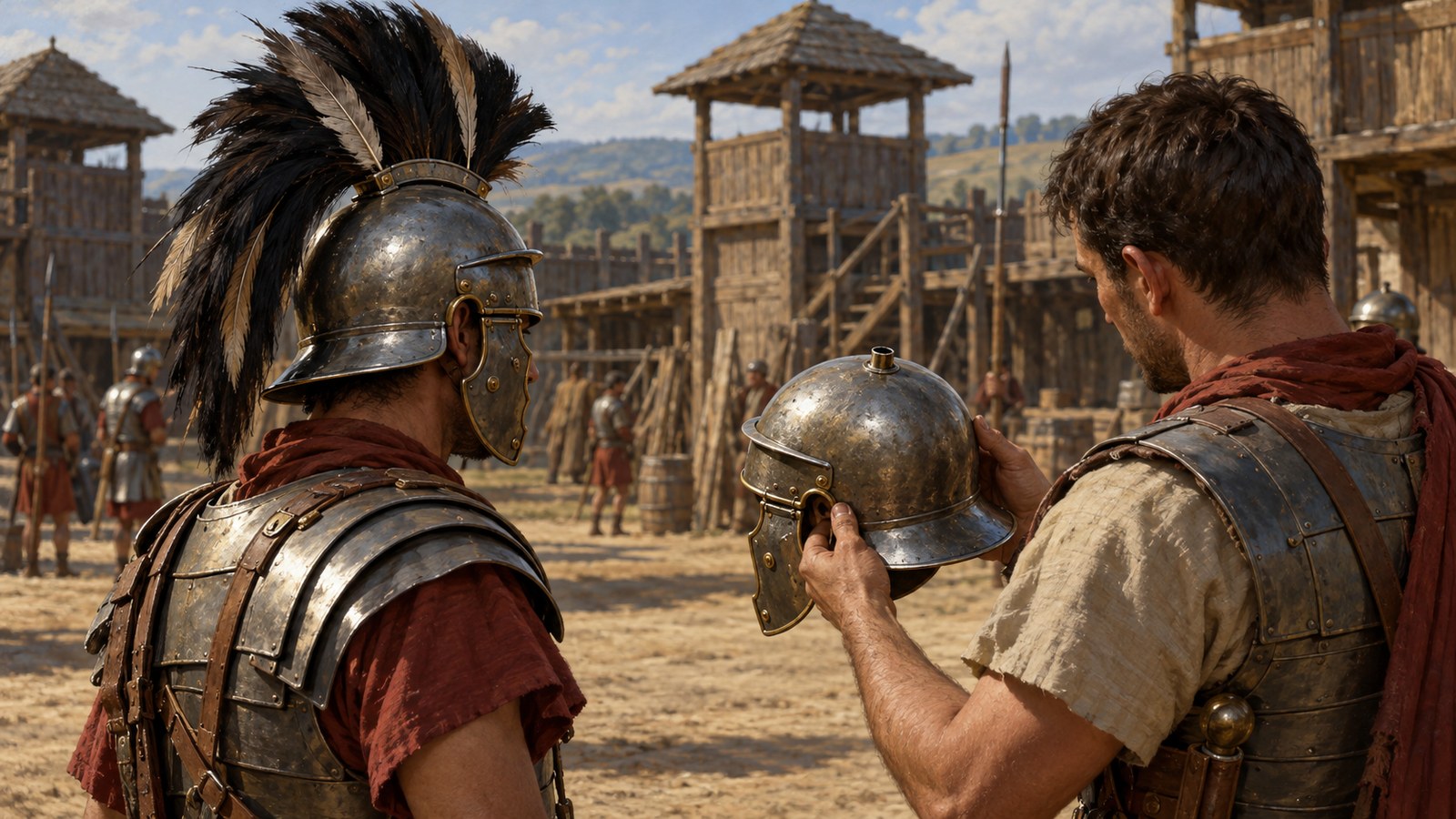
The final detail is the most revealing: the crests had to be detachable because they were not worn for battle. The support therefore belonged to a helmet with more than one visual state. With the fitting and crest in place, the wearer gained height and presence. With them removed, the same crown could return to a lower, less encumbered form.
That separation protected function from display. Hair or feathers projected above the strongest part of the helmet and could catch on surrounding objects. The museum does not list every reason for removing them, so it would be wrong to invent a complete battlefield manual from this single fitting. The direct evidence is enough: battle did not require the crest, and the mount allowed it to come off.
Detachment also changed the life of the object. The iron support could be stored, fitted, and removed independently. A damaged crest did not necessarily make the helmet unusable, and an uncrested helmet did not cease to be a helmet. The system divided a durable protective bowl from a perishable visual addition. That division is visible in the surviving connector even though the hair or feathers are gone.
The surviving iron is thus evidence for absent organic material without pretending to restore its exact colour or arrangement. The record permits hair or feathers, not a named plume pattern. It permits an impressive effect, not a specific rank. Keeping those limits matters: the support can explain the architecture of display even when it cannot identify the wearer or reproduce the crest that once occupied its curled arms.
Roman military images often preserve the silhouette and encourage us to treat it as fixed. This 71-millimetre object argues for a more precise reading. The tall profile was assembled. Its stability came from three shaped arms. Its materials were mixed: hard iron below, hair or feathers above. Most importantly, its presence was conditional. The soldier’s impressive height could be installed for one setting and removed for another.
Sources
London Museum, “Helmet crest holder” collection record.