
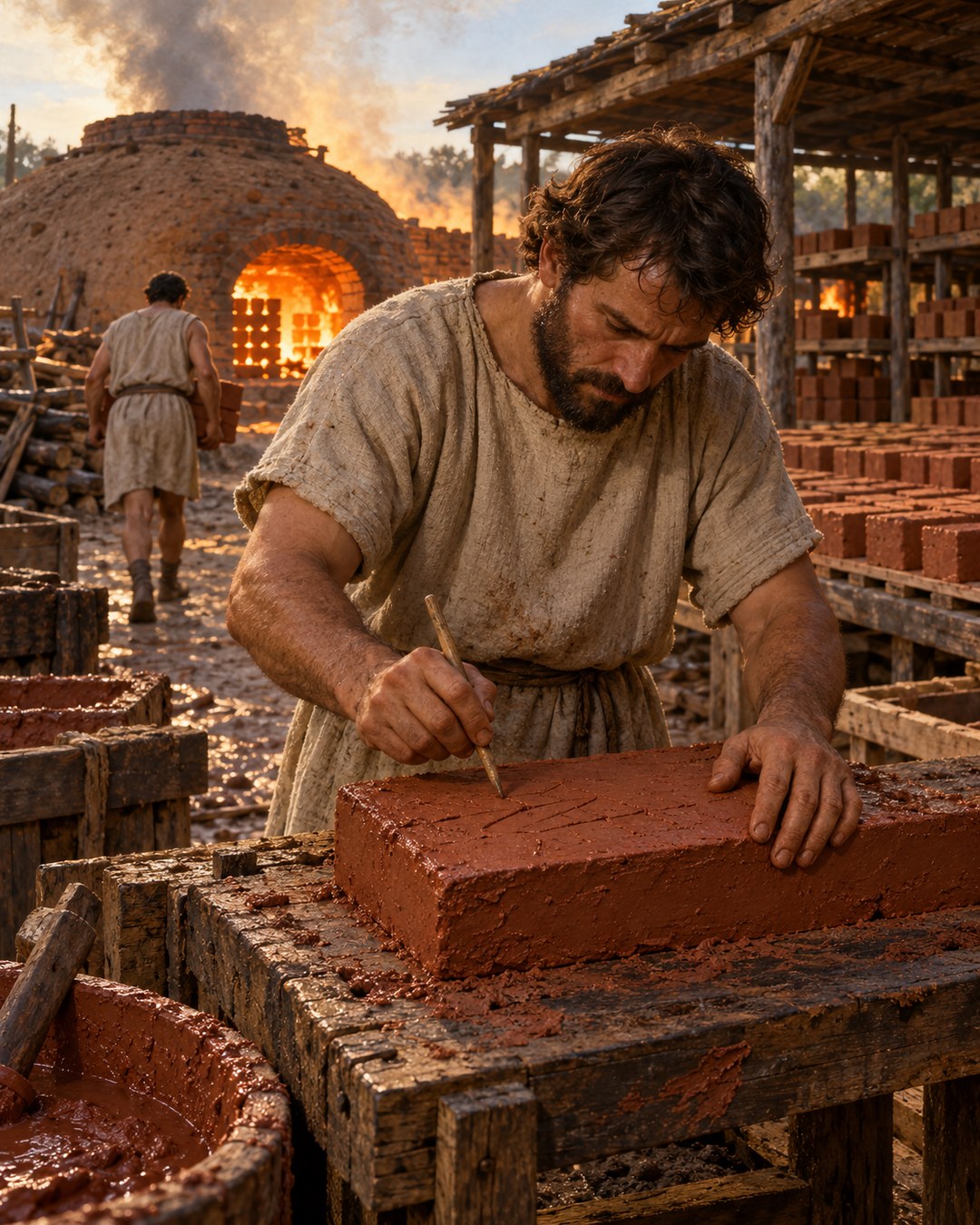
Someone scratched a complaint into a red clay brick while it was still soft. The target was a co-worker named Austalis. He had been wandering off alone every day, the writer said, and the count had reached thirteen days.
The message survived because its surface was not paper or wax. Once fired, the Lydion brick fixed the roughly cut letters into ceramic. A moment of workshop irritation entered the fabric of a Roman building material.
The London Museum reads the graffito as a rhyming couplet and sees it as evidence that brickmakers could read and write simple poetry. Its point was not literary display alone. The verse publicly recorded one worker’s repeated absence.
Soft Clay Gave the Complaint a Narrow Window
The inscription had to be made before firing. Freshly formed clay accepted the rough incisions; after the kiln hardened the brick, the same tool would no longer move through the surface in the same way.
That timing places the writer inside the production sequence. This was not a visitor adding a later note to a finished wall. Someone encountered the brick as workable material and used the interval between shaping and firing.
The choice also carried risk. A mark cut too deeply might damage the surface. A message noticed early could perhaps be smoothed away. If the brick was rejected before firing, the complaint would vanish with it. Survival depended on the object continuing through production.
The letters are described as roughly incised. Roughness suits a workshop intervention made with available time and a pointed implement rather than a formal inscription planned by a stonecutter.
Clay turned an ordinary grievance into durable evidence because the kiln did not distinguish between planned fabric and improvised words. Heat hardened both the brick and the accusation.
That process differs from the iron stylus whose own inscription carried a joke from Rome to London. The stylus was a writing instrument marked as an object; here, an unnamed worker turned building material into the writing surface.
The brick’s broad face offered more room than a small potsherd or tool handle, but its future use could hide the result. Writing on it was simultaneously conspicuous in the yard and vulnerable to burial inside a bonding course.
Thirteen Days Turned Annoyance Into a Record
The complaint is unusually specific. Austalis did not merely disappear too often. The writer counted thirteen days and said the behaviour happened every day.
A number changes a workplace accusation. It suggests observation across time rather than anger at a single absence. The count made repetition part of the charge.
The surviving Latin is compact: “Austalis dibus tredecim, vagatur sibi cotidim.” The museum translates it as “Austalis has been wandering off on his own every day for the past 13 days.” The wording names the person, duration, repeated action and solitary character of the wandering.
We do not know why Austalis left, whether the writer’s count was fair, or whether a supervisor ever saw the brick. The graffito preserves an accusation, not an adjudicated attendance sheet.
That distinction matters. The anonymous complaint gives one worker’s perspective on another. Austalis cannot answer from the surviving object. His name remains because someone else chose to attach it to a tally.
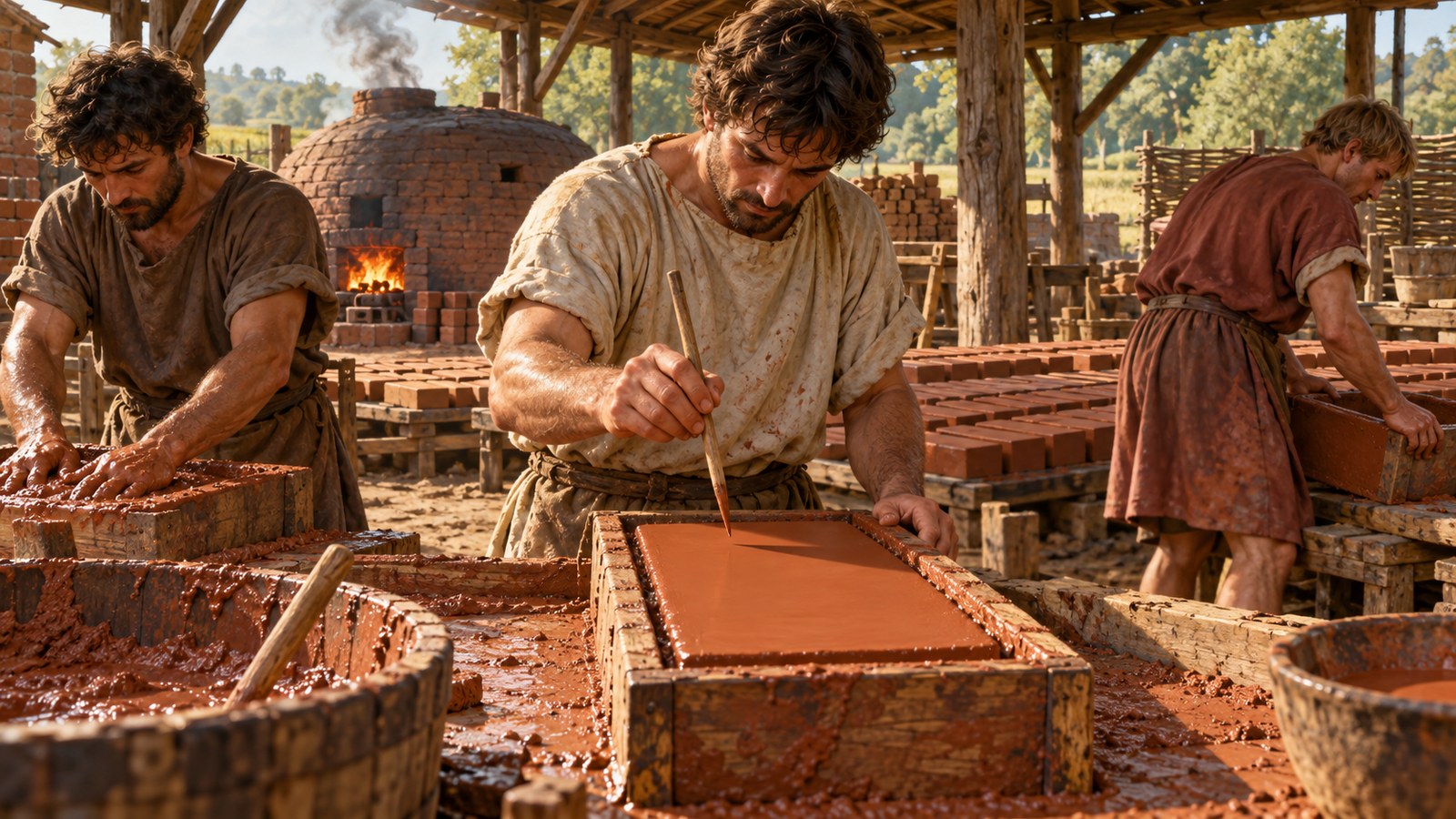
Even so, the act of counting implies that absence affected shared work. Brickmaking linked digging, tempering, moulding, drying, moving, firing and building. A worker who repeatedly left could shift effort onto others even when his exact role is unknown.
The phrase “on his own” adds a social edge. The writer did not describe an assigned group task elsewhere. Austalis’s movement appeared self-directed and outside the expected collective rhythm.
A Rhyming Couplet Made the Charge Memorable
The museum identifies the graffito as a rhyming couplet. The line pairs “tredecim” with “cotidim,” compressing the thirteen-day count and the every-day accusation into a repeated sound.
Rhyme made the complaint easier to remember and repeat. A workshop joke or taunt can travel through speech before anyone cuts it into clay. The brick may preserve language that workers had already shared aloud.
The verse does not require an elite literary setting. Simple poetry can belong to labour, teasing and discipline. Rhythm helps organize a message even when the lettering is rough.
That combination is historically valuable. The surface rejects an easy division between literate culture and manual work. At least one person close to this brick’s production could frame a grievance in written Latin and shape it into a couplet.
The museum interprets the act as whistle-blowing on a lazy co-worker. “Lazy” belongs to the accuser’s logic: wandering away for thirteen consecutive days is presented as failure to remain at work. The object does not independently prove Austalis’s motives.
Humour and discipline could operate together. A rhymed accusation invited laughter, but it also fixed a name and count where colleagues or overseers might encounter them. Wit increased the complaint’s audience.
The Brick Was Built for a Wall, Not a Notebook
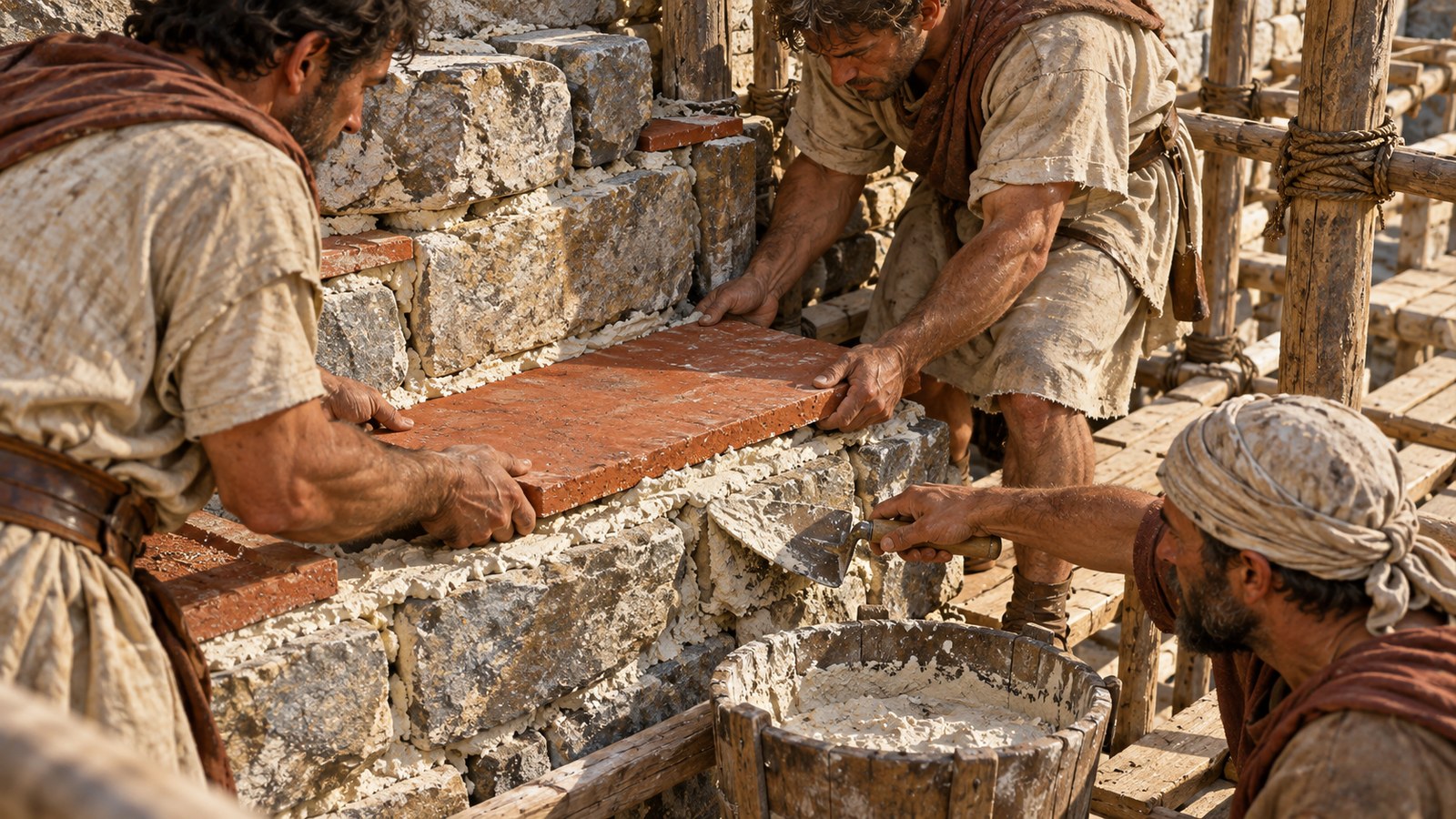
The object is a Lydion-type brick. The museum says this type measured approximately one by one and a half Roman feet and was most commonly used in bonding courses in major stone buildings.
The surviving brick measures 310 by 430 millimetres and is 46 millimetres thick. It weighs 14.244 kilograms. This was substantial building material, not a pocket-sized writing tablet.
Bonding courses helped organize masonry. A brick placed among stone could tie work together and regularize levels. Its normal value came from dimensions, flatness, strength and position in a larger structure.
The scale made the graffito physically consequential. The inscribed object had to be lifted, dried, fired and moved. If used, the complaint travelled with more than fourteen kilograms of ceramic.
Roman brick production already depended on waiting. As the rules about making bricks in spring and autumn show, clay building materials had to be managed through moisture and drying before construction. Austalis’s thirteen-day absence was counted inside a craft whose own calendar resisted haste.
We cannot safely reconstruct the brick’s final architectural position from this record alone. It may have remained visible, been hidden within masonry, or never entered a building. The message survived on the object, but its ancient audience is uncertain.
The Kiln Preserved a Voice the Payroll Lost
No employment contract for Austalis accompanies the brick. We do not know his legal status, wage, age, origin, workshop title or relationship to the writer. The object gives a name and a behavioural charge while withholding nearly everything a biography would need.
That unevenness is typical of archaeological voices. A formal monument might preserve an owner, magistrate or donor. A workshop graffito can preserve the irritation of someone who never expected a museum catalogue.
The accusation also reveals peer surveillance. Attendance was not observed only from above. Co-workers noticed who remained, who wandered, and how often the pattern repeated.
The brick therefore records more than literacy. It joins material timing, workplace rhythm, counting, humour and reputational pressure. The writer used the production process itself as a communications channel.
Firing gave that channel an afterlife no one could have planned. The complaint outlasted the day’s labour, the workshop arrangement and any response Austalis made. Thirteen days became the smallest surviving calendar of one Roman workplace dispute.
The most durable participant was neither accuser nor accused. It was the clay, caught at the precise moment when it could still receive words and was already on its way to becoming architecture.
Sources
London Museum, “Brick, Lydion brick.”