
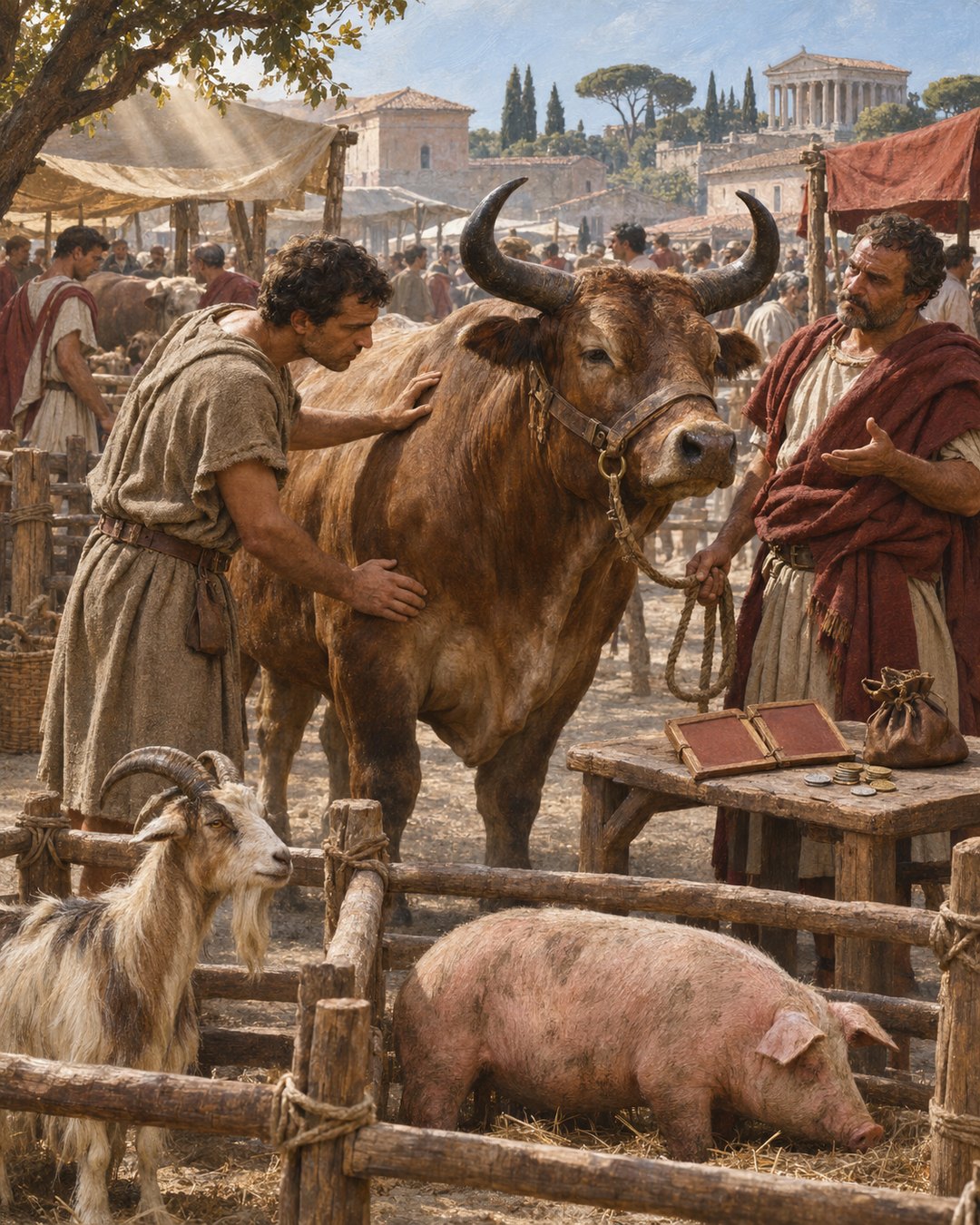
A Roman buyer could agree to a price, hand over the money and still need more before an animal was securely his. In Varro’s account of livestock management, legal precautions formed one of the basic parts of buying. He warns that neither a contract nor payment alone was sufficient in every case to transfer title.
The warning sits beside advice that looks much more physical. Buyers judged age, body shape and breeding. Experienced stockmen preferred black-horned cattle, large goats, and pigs with long bodies and short heads. They valued famous bloodlines and remembered spectacular prices. Then they asked what the seller would guarantee.
This combination shows the livestock market as more than bargaining around a pen. The animal had a body that could be inspected, a history that had to be represented, and a legal status that needed to pass correctly. A buyer purchased future work and future offspring, but he also purchased the risk that appearances or assurances might prove false.
Four Questions Stood behind the Price
Varro organizes the purchase around four concerns: age, conformation, breeding and legal precautions. Each answered a different uncertainty. Age indicated whether an animal had entered or passed its useful reproductive period. Conformation translated visible shape into an estimate of value. Breeding connected the animal to qualities a buyer could not judge from one morning’s inspection. Legal form determined whether the transaction actually transferred what the buyer thought he had acquired.
The list begins with living usefulness rather than abstract ownership. Animals at the sterile beginning or end of life could not offer the same return as mature breeding stock. The body had to be read as a timeline: what it could do now, how long it might continue, and what offspring it might produce.
Conformation supplied another kind of forecast. A buyer did not merely count legs and accept the seller’s label. He looked for traits that experienced dealers associated with strength, size or productive type. The market rewarded judgment because an error could remain on the farm for years.
The four questions also restrained one another. Excellent shape did not prove clean title. A celebrated lineage did not guarantee present health. Payment did not correct a legal defect. Varro’s scheme turns purchase into a chain in which one weak link could reduce the value of all the others.
The order also forced a buyer to keep unlike kinds of evidence separate. Teeth and bodily proportion could be inspected directly. Breeding depended on remembered origin and the seller’s account. Ownership depended on legally effective acts. A shrewd eye could assist with the first questions, but it could not silently answer the last one.
Black Horns and Short Heads Became Market Signals
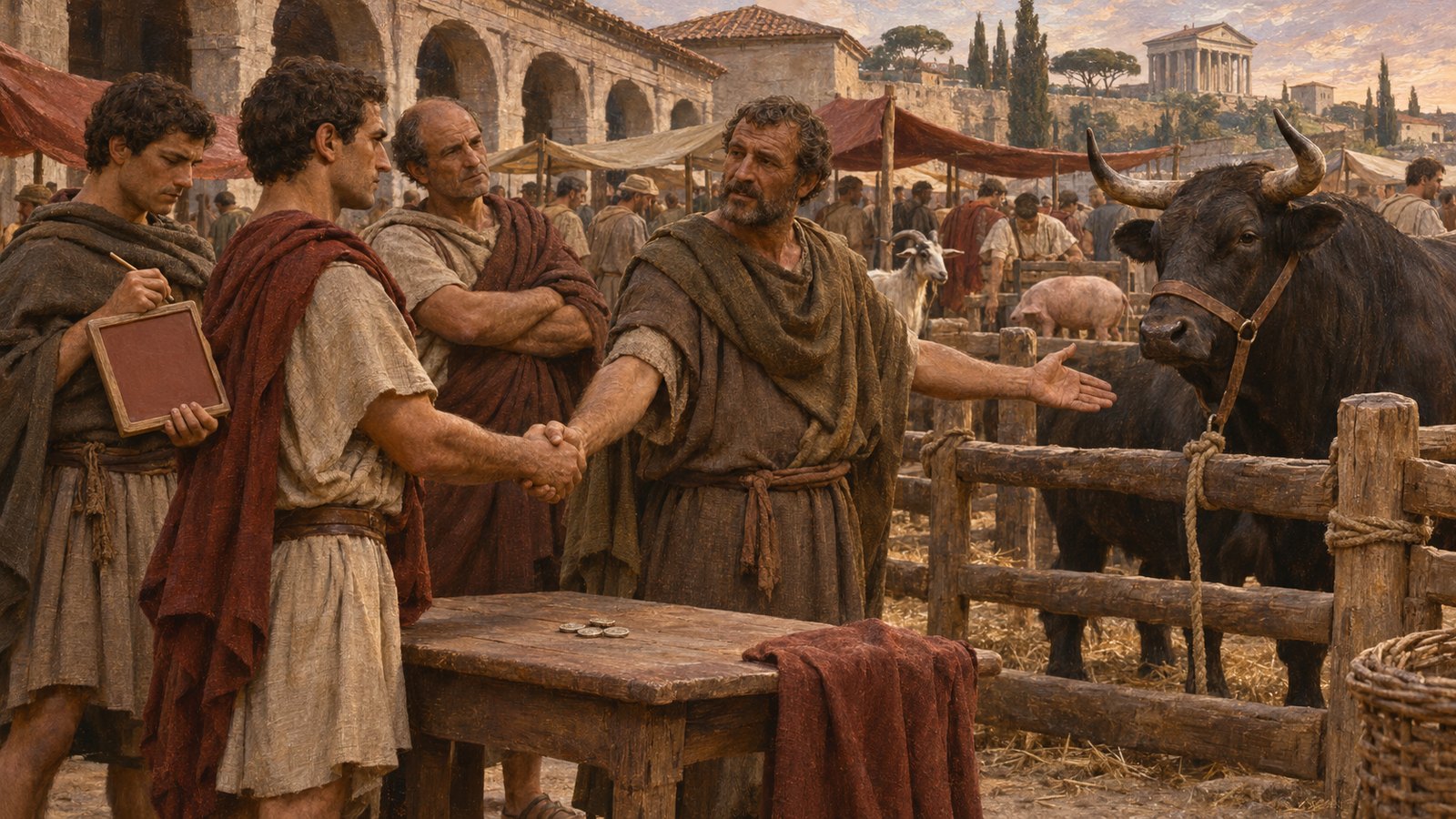
Varro’s examples are compact enough to sound like a stockman’s memory aid. Cattle with black horns were preferred to those with white horns. Large goats were chosen over small ones. Swine were valued with long bodies and short heads. The passage does not prove that every Roman market used identical standards, but it records the traits this author associated with experienced selection.
These signs made the buyer’s gaze economically active. Colour, proportion and size were not background description; they influenced price. As with the physical appraisal behind the bare-handed Roman olive harvest, knowledge was expressed through what a worker noticed and refused to damage.
Visible features were useful because the animal itself could not explain its working history. Yet appearance had limits. A handsome animal might come from poor stock. An apparently healthy goat might belong to a diseased herd. A buyer therefore moved from the surface to questions about origin and from those questions to enforceable promises.
The process was not modern veterinary certification. Varro gives no laboratory test or standardized document. He offers a layered discipline of observation, reputation and stipulation. The buyer’s protection depended on asking the correct question before the transaction hardened into a dispute.
Breeding Could Be Worth a Fortune
Varro names Arcadia in Greece and Reate in Italy as celebrated sources of asses. Reputation attached value to place and ancestry. He remembers one ass selling for sixty thousand sesterces and a four-in-hand team at Rome valued at four hundred thousand.
Those figures are not presented as everyday farm prices. Their scale makes the opposite point: exceptional breeding could push animals far beyond the value implied by feed and ordinary labour. A buyer at that level was purchasing a productive body, a pedigree and the prestige attached to both.
High prices increased the cost of uncertainty. The more a seller’s claims about breeding influenced value, the more important it became to establish what had actually been promised. A famous place name could attract buyers, but reputation alone could not answer whether this particular animal was healthy or whether the seller could pass good title.
Roman agricultural writing repeatedly connects practical objects to surprisingly large financial stakes. The pattern also appears in Cicero’s half-million-sesterce table, where material quality and social valuation magnified one piece of wood. In the livestock market, the multiplier was the animal’s expected future: work, breeding and resale.
Payment Did Not Settle Every Question of Title
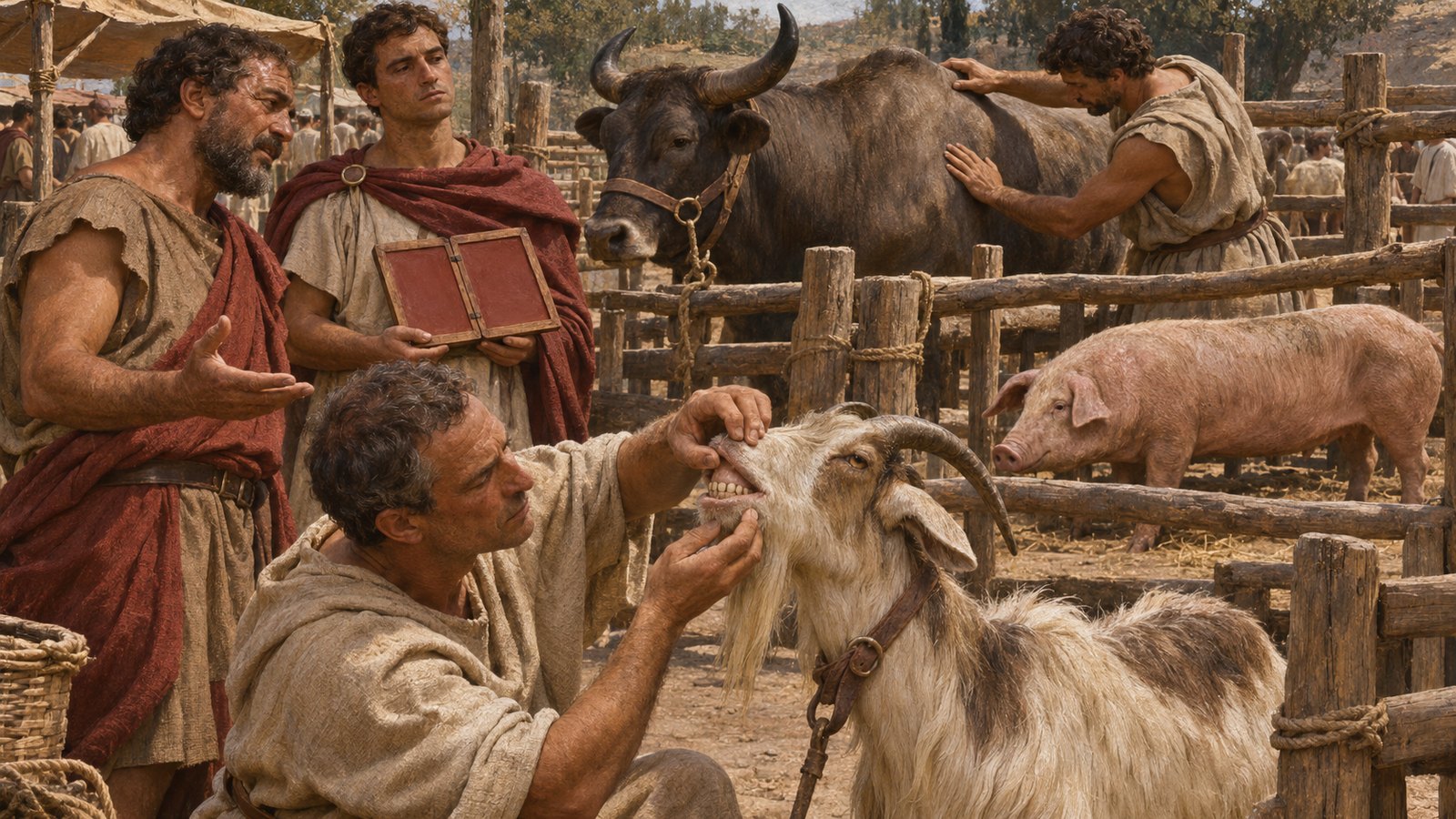
The legal warning is the article’s sharpest point. Varro says that formalities had to intervene for title to pass in some cases. A contract and even payment of the purchase money did not always complete the transfer. Money moving in one direction did not automatically make ownership move in the other.
The passage does not provide a full manual of Roman conveyancing, and it should not be stretched into one. Its importance lies in the farm manager’s need to know that a commercial act had a legal structure. Someone who treated the sale as finished at the sound of coins could discover that he had bought possession without secure title.
That risk made legal knowledge part of husbandry. The farm manager needed to understand feed and breeding, but also the transaction that brought animals onto the property. Ownership affected whether the farm could use, breed, pledge or resell the stock without challenge.
Varro’s sequence is revealing. Legal precautions do not appear in a separate philosophical discussion. They sit directly after age, conformation and breeding. Law was one more condition of a sound animal purchase, as necessary to inspect as the body and as consequential as the bloodline.
A Health Promise Defined What Could Be Disputed
Varro gives several possibilities. A seller might stipulate that the animal was healthy on the day of sale. The promise might instead reach beyond the individual and state that it came from a healthy flock or herd. In other transactions, no such stipulation was made.
Those alternatives allocated risk differently. A statement about present health focused attention on the visible animal at a particular moment. A statement about the herd reached into its environment and recent history. Silence left the buyer with fewer words to invoke if sickness emerged.
The text does not say that a promise prevented disease. It created a claim about facts. That distinction mattered because livestock could deteriorate after purchase, carry hidden problems or arrive from conditions the buyer had never seen. The stipulation marked which uncertainty the seller had agreed to bear.
Purchase was only the beginning. Varro immediately turns to feeding, breeding, rearing and maintaining health. A guarantee could not rescue bad care after the animal entered the farm. The buyer had to separate what the seller represented from what his own management later caused.
A Roman livestock sale therefore joined body, reputation, price and law. Black horns might draw the eye, Reate might support a pedigree, and coins might settle the bargain. Secure ownership and a useful remedy still depended on the words and formalities surrounding the exchange.
Sources
Varro, De Re Rustica 2.1.