
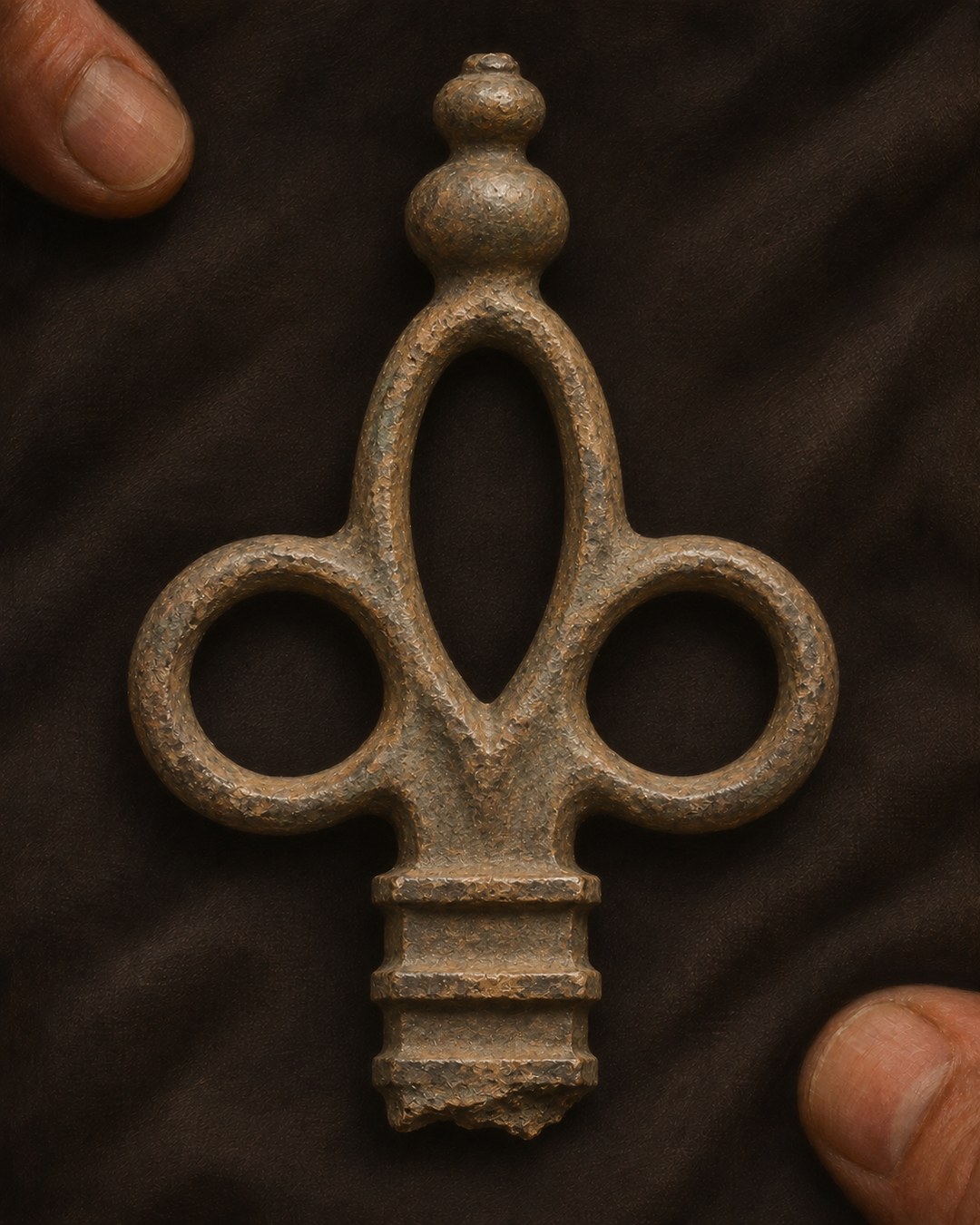
A Roman key handle survived after the parts that made it a key had disappeared. The shank and bit are missing at old breaks, leaving a 72.4-millimetre openwork handle with three expanding loops, a two-tiered knob, and a triple moulded collar. Its light grey-brown metal is catalogued cautiously as lead alloy, with a question mark. At 87.4 grams, it is substantial enough to make the lost mechanism feel present even though no tooth remains to move a lock.
The Portable Antiquities Scheme dates the object broadly to AD 43–410, while a comparison from Colchester supports a date after AD 150 for keys of this form. That narrower comparison concerns the handle type, not a known owner or door. The surviving trefoil shows how a tool for controlling access could also be made to catch the eye and fit the hand. Its decoration did not replace its function. It occupied the part a user actually held.
Three Open Loops Turned Metal into a Grip
The handle is built around a trefoil: three loops expanding outward from a common centre. The middle loop is elongated and larger than the two outer loops, which are closer to circles. One outer loop is damaged. This asymmetry in survival should not be mistaken for the maker’s original plan. The central loop’s greater height established a clear vertical axis, while the paired side loops widened the area available to the fingers.
Openwork removed metal from the interior without erasing the outline. That made the handle visually lighter than a solid slab of the same width. It also created edges and spaces a hand could engage. We cannot know the exact grip used by every ancient user, but the physical distinction between handle and missing shank is secure. This trefoil was the part designed to be seen and held; the lost lower components were the parts designed to enter the lock.
The object’s surviving width is 39.5 millimetres and its thickness is 12.3 millimetres. Those measurements keep the decoration at the scale of a tool rather than a large architectural ornament. The handle could communicate finish and status at close range. Its open loops worked within the dimensions of an implement that had to be carried to a door, chest, store, or other secured fitting.
A Two-Tiered Knob Marked the Handle’s Top
At the top of the central loop, a protruding knob rises in two globular tiers. It gives the handle a definite crown and keeps the trefoil from appearing interchangeable end for end. Below, the three loops narrow into a waist. The sequence guides the eye from rounded top, through openwork, to the denser collar that once met the shank.
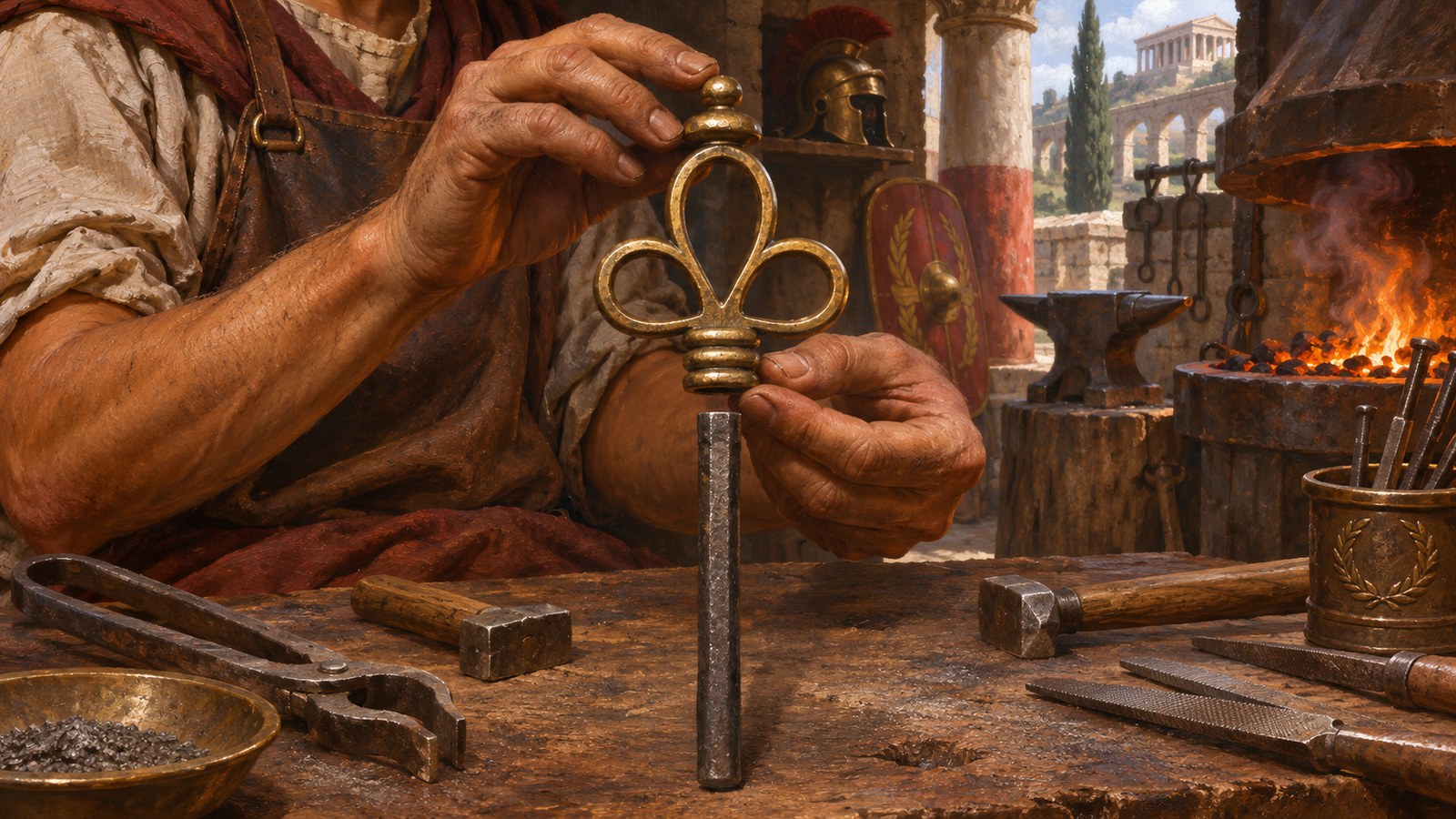
This is decoration organized around orientation. The top knob announced which end belonged in the hand; the waist compressed the form; the collar marked the transition to the working stem. Even without the missing ironwork, the surviving geometry maps the key’s direction. It points away from the hand toward the lock.
The modern scratch on the collar belongs to the object’s recent history, not its Roman use. The catalogue distinguishes it from the old breaks that removed the shank and bit. That distinction is easy to miss but essential. Damage is evidence only when its timing and relation to the object can be bounded. A fresh scratch cannot be recruited to tell an ancient story.
The Triple Collar Once Met the Missing Shank
At the base, the trefoil narrows and then expands into a triple moulded collar with a square cross-section. The collar is the surviving threshold between ornament and mechanism. Below it, the absent shank would have carried force from the user’s hand to the bit inside the lock. Because those lower parts are gone, the record cannot reconstruct the key’s tooth pattern or identify the lock it served.
The absence creates a useful limit. A handle can establish that this was locking equipment, but it cannot tell us whether the key operated a large door, a smaller box, or another secured object. The temptation to supply a grand house or treasury should be resisted. The object preserves access control in principle, not the value or location of what was protected.
A related article on a Roman ring key worn on the finger shows a very different solution to carrying and manipulating a key. The trefoil handle was not a ring and should not be treated as one. Comparing them clarifies variety: Roman locking tools could place the grip on a finger-sized loop or on an expanded openwork handle, depending on the form and intended mechanism.
Eighty-Seven Grams Survived Without a Tooth
The handle weighs 87.4 grams despite the loss of the shank and bit. Its material is recorded as cast lead alloy with uncertainty. That unusual caution should remain visible because the catalogue itself does not present the alloy identification as final. Colour alone does not settle composition, and the light grey-brown surface has also been altered by age and burial.
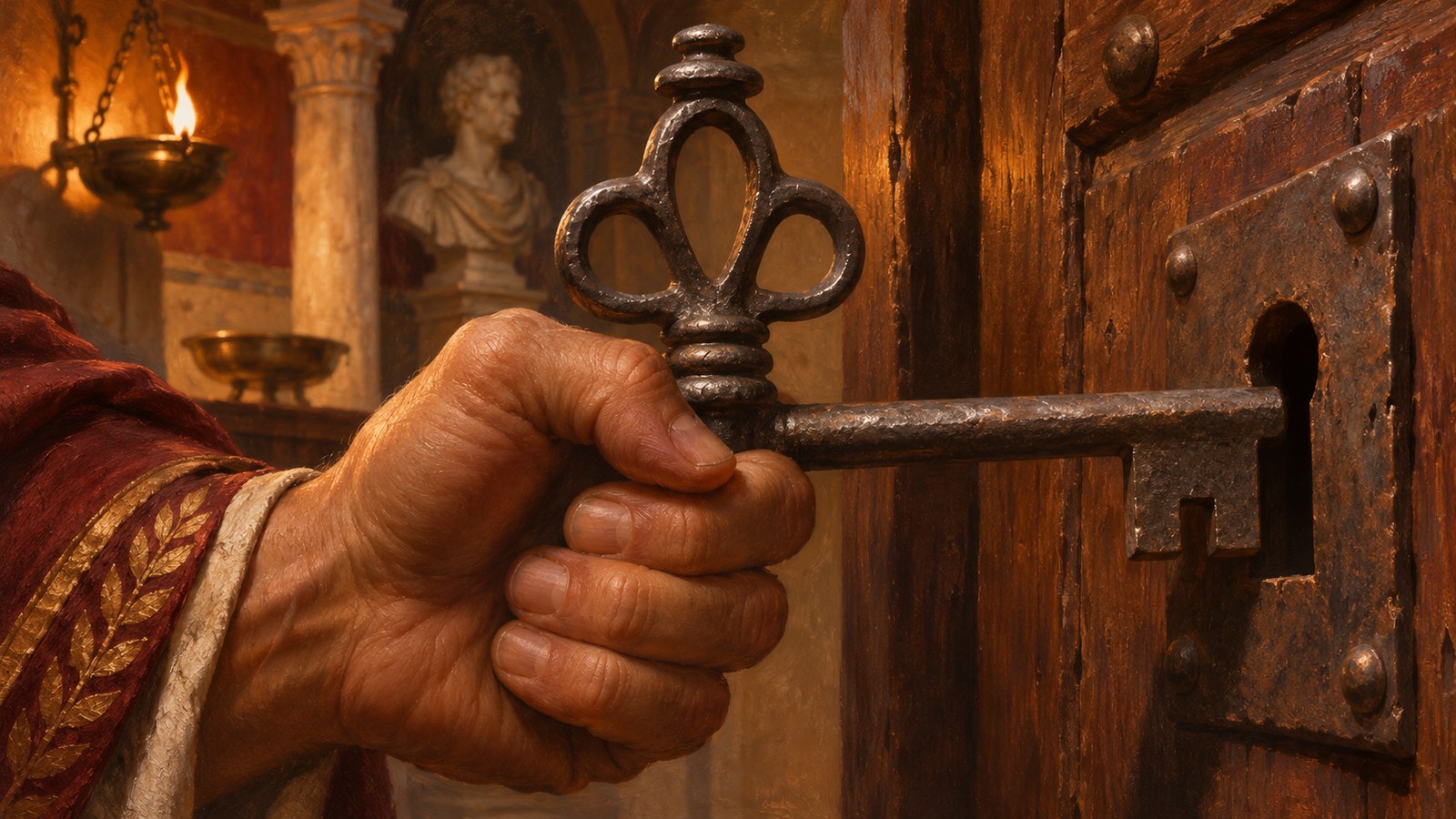
Weight changes the imagined experience of the object. This was not merely a drawn outline of a trefoil. It had mass concentrated in the loops, knob, waist, and collar. Turning the complete key would have transmitted resistance back into that grip. The decorative handle was therefore part of a small exchange of force between hand, shank, bit, and internal lock components.
The floor bolt inside another Roman locking system helps explain why a key should be studied as one element in a larger arrangement. A key did not secure anything alone. Its shape had to correspond to parts inside a lock, and the lock had to move a bolt or catch. Here, those corresponding parts are lost, so the surviving handle tells us more about touch and appearance than about the exact internal sequence.
A Colchester Parallel Places the Form after AD 150
The catalogue cites a similar handle from excavations at Colchester. Crummy’s study suggests that keys of this form date after AD 150. This is typological dating: a comparison between shared forms, not a date stamped on the object. It narrows the broad Roman range while leaving room for uncertainty about manufacture and deposition.
The value of that parallel lies in the whole arrangement, not simply the presence of three curves. The elongated central loop, two smaller side loops, top knob, narrowing waist, and moulded collar create a recognizable family. Typology becomes stronger when several connected features agree. It becomes weaker if a single decorative resemblance is isolated from construction.
No named locksmith, owner, settlement, or find circumstance survives in the Europeana record. No keyhole can be matched to the missing bit. What remains is still unusually informative: three loops made an open grip; a two-tiered knob established the top; a triple square collar marked the connection; and an old break removed the mechanism below.
The handle therefore preserves security at its most human point. The lock’s internal parts may have been hidden, but the key met its user through a carefully shaped object. After AD 150, someone could close a hand around this trefoil, feel nearly ninety grams of metal, and apply force through a shank that no longer survives. The protected room or container is gone. The designed act of gaining access remains legible.
Its survival also separates possession from access. The handle could be carried, lost, broken, or passed between people, while the corresponding lock remained fixed elsewhere. Without the bit, no modern reconstruction can restore that relationship exactly. The trefoil tells us what the authorized hand held, but not which barrier yielded when it turned.
Sources
Portable Antiquities Scheme record KENT-E2BCA1, via Europeana.