
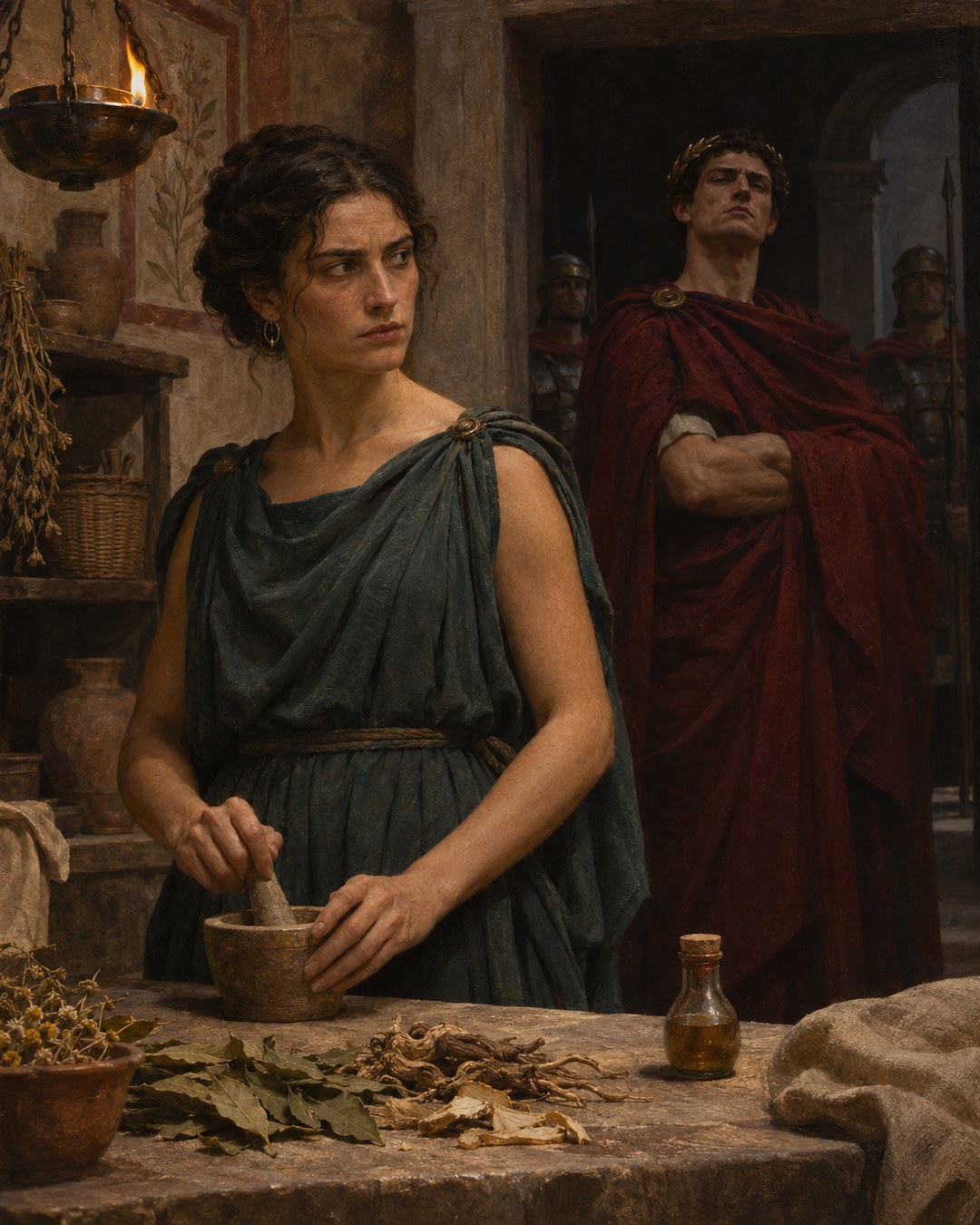
Locusta enters Roman history already condemned. Tacitus says she had recently been sentenced on a poisoning charge, yet she had not disappeared into execution or exile. Powerful people retained access to her expertise. Agrippina used it in the plot against Claudius; Nero later reached her through a praetorian officer when he wanted Britannicus dead.
That sequence is more revealing than the familiar image of a lone poisoner with a secret recipe. Locusta’s surviving story is about custody, coercion and reward. She was valuable because the court could control her, threaten her and, when her work satisfied an emperor, change her legal and material position.
The ancient accounts are hostile, dramatic and written without her voice. They cannot recover a reliable ingredient list, and they disagree over some details. Read together, however, they show why Locusta became useful to imperial power—and why a change of emperor made that usefulness fatal.
A Condemned Woman Became an Imperial Resource
Tacitus introduces Locusta during Agrippina’s move against Claudius. The empress, he says, weighed the political risks of different kinds of poison. Something rapid might expose the crime immediately; something slow might give Claudius time to recognize the plot and turn again toward his son Britannicus. In this literary reconstruction, the desired result was delayed but decisive.
Locusta supplied the expertise. Tacitus calls her an artist in the field, then immediately gives the detail that changes the scene: she had lately been sentenced for poisoning. The state had already classified her knowledge as criminal, but the palace treated the same knowledge as usable.
His phrase is sharper still. In the Loeb translation, Locusta had long been retained as part of the “stock-in-trade of absolutism.” That is Tacitus’s judgement, not an official Roman job description. It presents her less as an independent mastermind than as one element in a ruler’s available machinery.
The potion did not move directly from Locusta’s hands to Claudius’s mouth. Tacitus names the eunuch Halotus, whose normal duty included bringing and tasting dishes, as the administrator. He reports a version in which poison was placed on an exceptionally fine mushroom and later adds the intervention of the doctor Xenophon. The chain contained specialists, access and trusted proximity.
Locusta’s role was therefore narrow but essential. She allegedly prepared what others requested; people inside the household created the route to the emperor. The plot depended on a network, not simply on a mysterious woman standing outside the palace.
Custody Made Her Skill Available to Nero
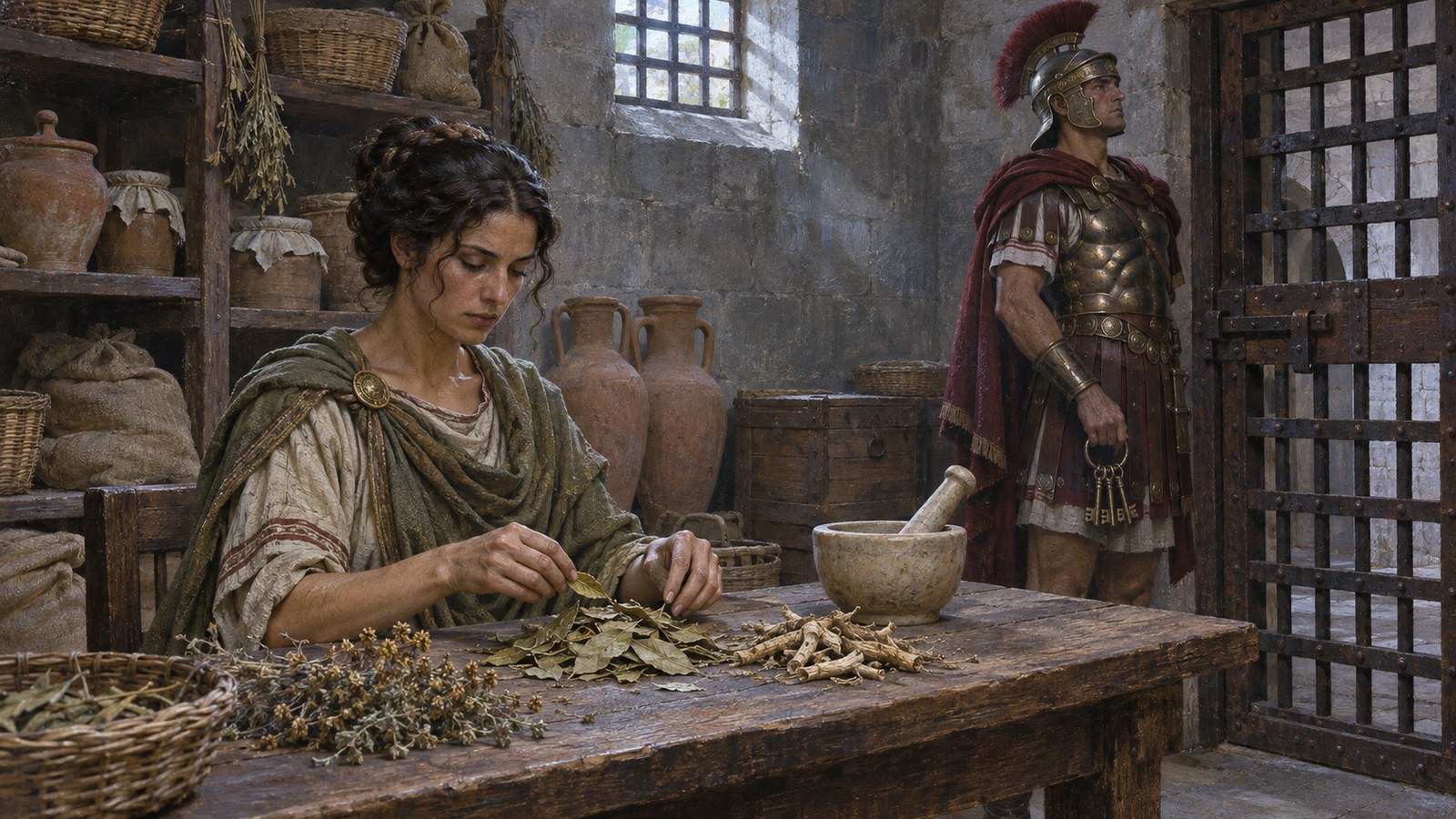
After Claudius’s death, Locusta appears again in Tacitus’s account. Nero wanted to remove Britannicus but did not dare order an open execution. His agent was Julius Pollio, a tribune of a praetorian cohort. Pollio, Tacitus says, was responsible for detaining the condemned poisoner.
That custody detail explains access. Nero did not need to search Rome for a hidden supplier. An officer already controlled the person whose expertise he wanted. The same legal vulnerability that threatened Locusta’s life made her reachable by the imperial household.
Tacitus says the first dose reached Britannicus through his tutors but did not kill him immediately. The boy’s bowels opened, and the drug passed. The historian leaves two possibilities: it lacked strength, or it had been diluted to avoid an instant result. He does not give enough evidence to choose securely between them.
What followed was coercion. Nero threatened Pollio and ordered Locusta’s execution because delay increased the risk of exposure. Tacitus then places the preparation of a faster mixture near the emperor’s bedroom, after what he calls a private test of the ingredients.
The scene makes Locusta’s position stark. Her sentence had not vanished; it could be activated when her work disappointed the ruler. Her expertise offered leverage only while the emperor wanted it. Custody, not professional independence, defined the relationship.
A Failed Dose Brought Threats, Tests and a Faster Mixture
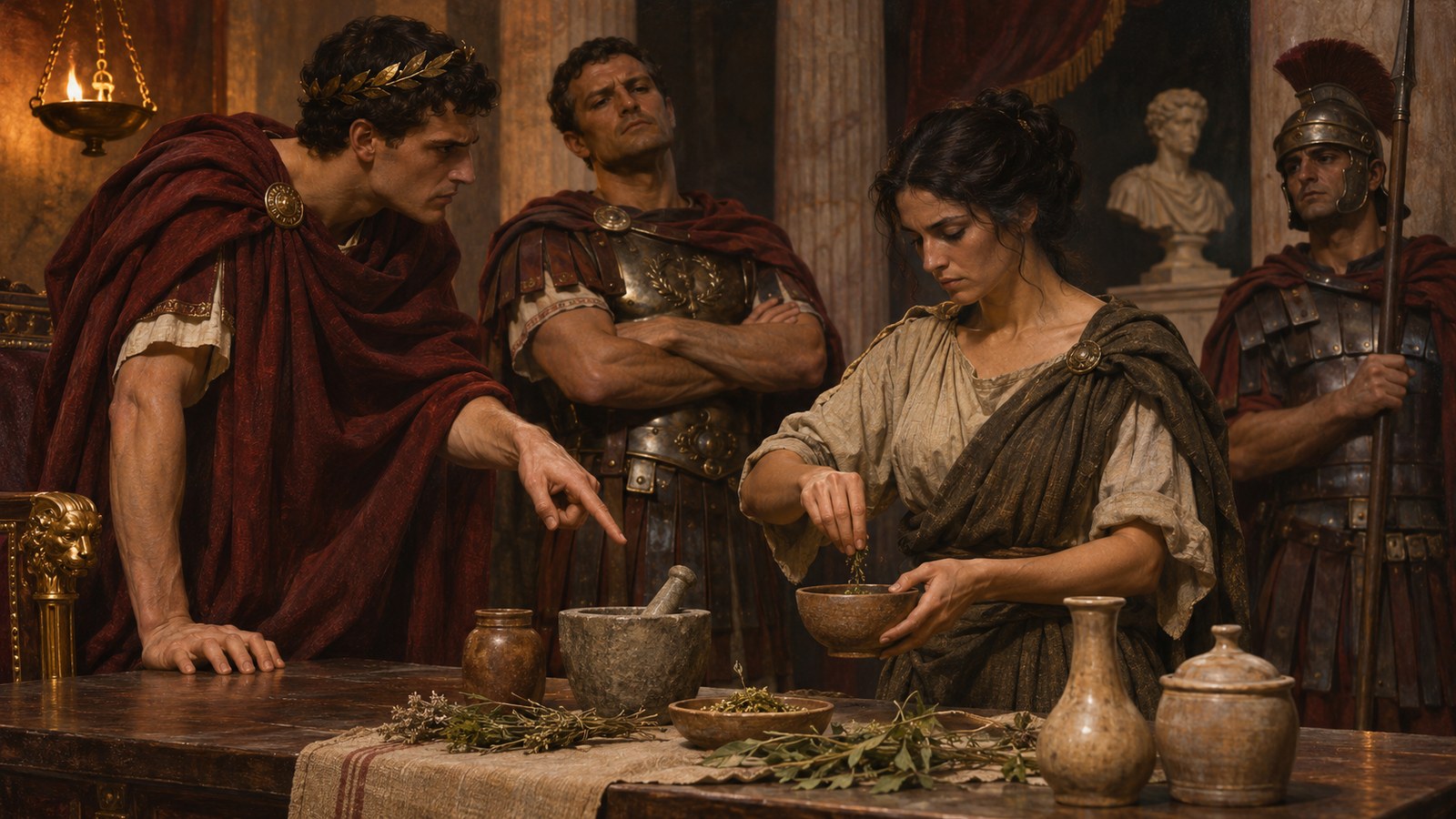
Suetonius tells the Britannicus story with different dramatic details. He calls Locusta an archpoisoner and says Nero summoned her after an initial mixture acted too slowly. In his version, Nero flogged her with his own hand and accused her of giving medicine rather than poison.
Suetonius gives Locusta a reply: she had used a smaller dose to protect Nero from the scandal of the crime. Nero dismissed the concern with a joke about the Julian law and forced her to prepare a faster potion in his room, before his eyes.
The testing scene is brutally concrete. A kid lingered for five hours. Nero ordered the mixture strengthened repeatedly, and a pig then fell dead at once. The narrative is designed to display the emperor’s impatience and direct supervision. It does not provide a recoverable recipe, and modern readers should not turn its theatrical precision into chemical certainty.
Tacitus and Suetonius agree on the larger structure: an inadequate first result, imperial anger, coercion and a faster second preparation. They differ over who received the threats, where responsibility sat and how the testing unfolded. Those differences matter because neither account is a laboratory record or Locusta’s testimony.
Both writers nonetheless place the emperor at the centre. Nero was not a passive customer deceived by a criminal outsider. In their narratives he demanded speed, controlled the circumstances and made other people bear the danger of execution.
Pardon, Estates and Pupils Changed the Meaning of Success
Suetonius says Britannicus died at the first taste of the later preparation. Nero told the dinner guests that the boy had suffered an epileptic seizure, then had him buried the next day in pouring rain. The compressed aftermath moves quickly from public collapse to an attempt at explanation and disposal.
Locusta’s outcome was entirely different. Suetonius says Nero rewarded her “eminent services” with a full pardon and large estates in the country. The condemned woman’s legal vulnerability had helped force compliance; success then allowed the emperor to remove that sentence and grant property.
He adds one more extraordinary detail: Nero sent her pupils. If taken at face value, her knowledge was not merely tolerated after the event. It was to be transmitted. The court that punished poisoning also created conditions in which the alleged specialist could teach.
This is why “court poisoner” is useful only as a modern description, not as a Roman office title. No source here gives Locusta a formal appointment, salary or bureaucratic rank. What the sources do describe is repeated imperial access, official custody, commanded work and rewards substantial enough to alter her life.
The pattern resembles other stories in which the imperial household converted private bodies and skills into instruments of rule. The same archive’s account of Agrippina carrying Germanicus’s ashes through Italy shows how a member of the same dynasty could turn a physical journey into public politics. Here, by contrast, the decisive movements happened through guarded rooms, trusted servants and a controlled prisoner.
Galba Ended the Protection That Nero Had Created
Locusta’s pardon did not guarantee safety after Nero fell. Cassius Dio, using the spelling Lucusta in the translation, places her among figures associated with the previous reign whom Galba ordered led in chains through the city and executed.
The route through Rome made the punishment public. Nero’s favour had converted a condemned specialist into a pardoned landholder with pupils; Galba’s accession converted her back into evidence of the old regime’s corruption. Her value had always depended on who controlled the palace.
That reversal also explains the limits of expertise under autocracy. Locusta could become indispensable without becoming secure. The ruler’s need created opportunity, but it also preserved the threat behind it. When the political owner of that protection disappeared, the story ended in chains.
Ancient authors had reasons to sharpen every part of this tale. Tacitus built a picture of secretive power, Suetonius arranged vivid examples of Nero’s cruelty, and Dio used public punishment to mark a new reign. None preserved Locusta’s explanation of what she did or why she did it.
Her silence should shape the conclusion. We cannot know her ingredients, private motives, birthplace or even how she understood the choices placed before her. We can see the structure around her: sentence, detention, demand, threat, reward and execution.
Nero’s court did not erase the distinction between crime and service. It moved that distinction whenever imperial convenience required. Locusta became famous not because poison operated outside Roman power, but because Roman power kept the condemned expert close enough to use.
That machinery also belongs to the wider history of Nero’s reputation. The article on why Nero became the perfect scapegoat for Rome’s Great Fire examines how hostile memory accumulated around his reign. Locusta’s story deserves the same source discipline: the literary tradition is indispensable, but its memorable scenes must be read as crafted accusations as well as evidence.
Sources
Tacitus, Annals, 12.66–67 and 13.15.
Suetonius, Life of Nero, 33.
Cassius Dio, Roman History, 63.3.4.