
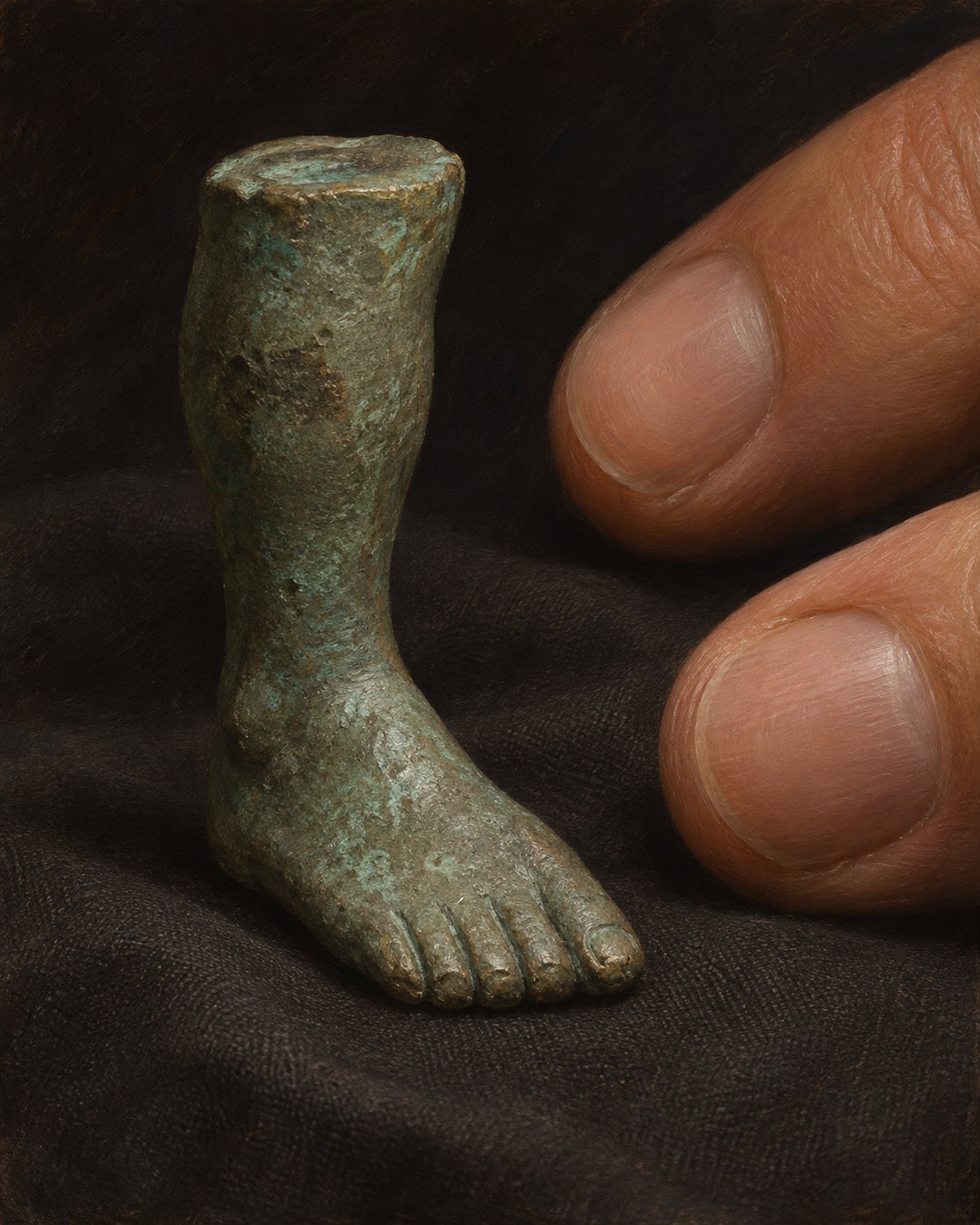
A Roman object no taller than 48 millimetres asks a remarkably large question. It is a complete copper-alloy leg and bare foot, small enough to disappear inside a closed hand. Five shallow cuts separate its toes. The calf is only 11.6 millimetres across, and the whole piece weighs 28.8 grams. Nothing in those measurements identifies its owner, a particular shrine, or even a precise moment within the Roman period. Yet the body part was made carefully enough to remain unmistakable.
The Portable Antiquities Scheme record interprets it as a votive figurine. That reading does not depend on a dramatic inscription or a named god. It begins with the object’s physical form, then tests an alternative explanation against a missing feature. Similar little legs have been called knife or razor handles, but this example has no slot for a blade. A closely comparable figurine is also understood as votive, although its foot wears a sandal. The bare foot therefore survives as more than decoration: it is the central evidence in a cautious argument about what the object did.
Five Shallow Cuts Made the Body Part Legible
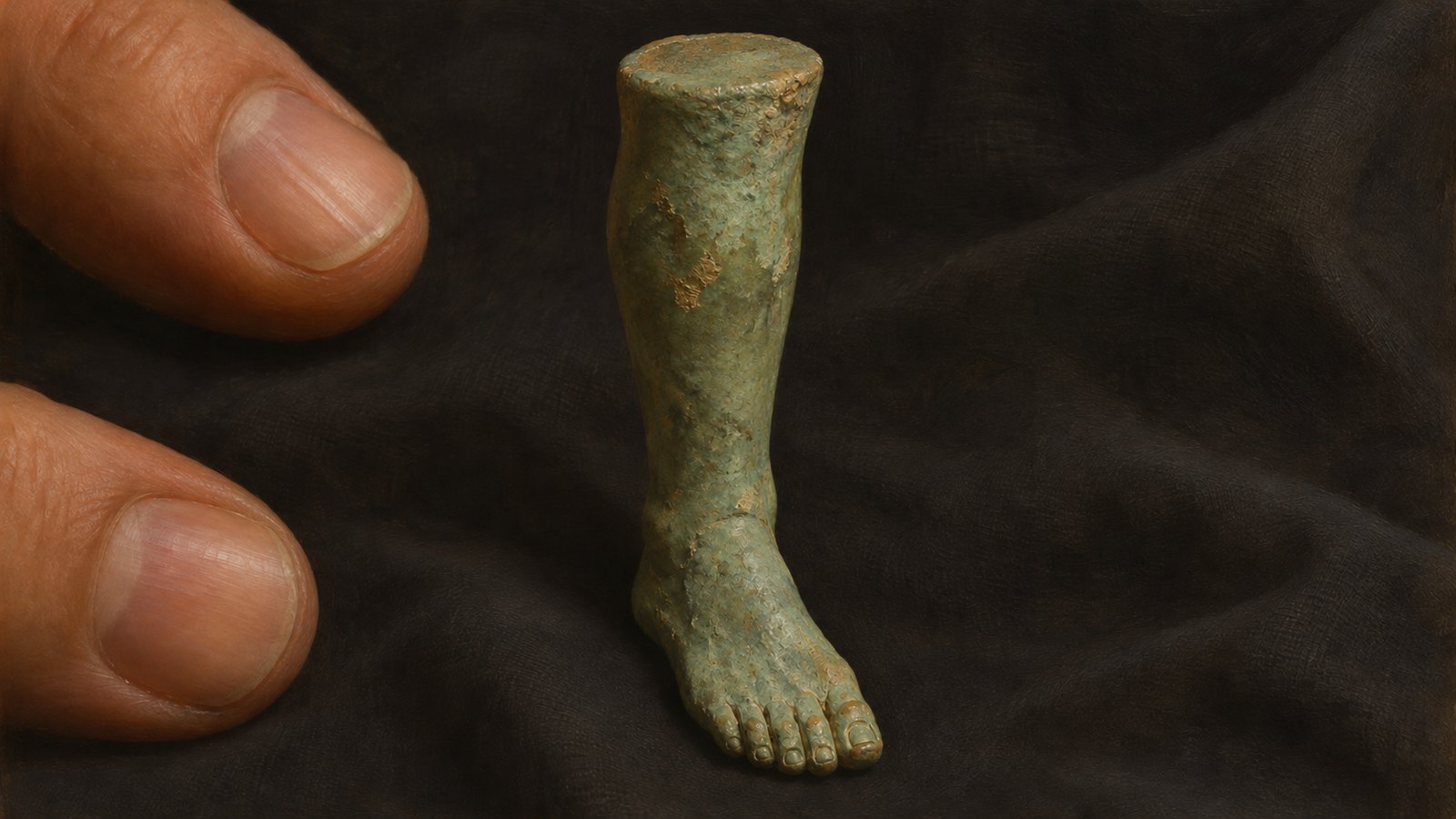
The maker did not need to reproduce an entire person. A calf, ankle, foot and five incised toes were enough. At 48 millimetres tall, the figurine compresses anatomy into a very small volume of cast copper alloy. Its foot is 22.7 millimetres long but only 8.8 millimetres wide. Those dimensions matter because they show how little material was required to make the offering readable. The object did not achieve recognition through scale. It achieved it through selection.
The toes are the decisive visual cue. Each one is denoted by a shallow incision rather than modelled as a fully separated digit. That economical treatment kept the foot clear without demanding miniature realism. The calf’s circular section and the three-dimensional construction meant the piece could be understood from more than one angle. It was not a flat emblem. It occupied space like a tiny fragment of a person.
The record describes a mid greyish-green patina and good survival. Those are present conditions, not clues to a named ancient ritual. They do, however, preserve the maker’s choices: the bare foot, the taper of the leg and the cuts across the toes. The combination lets a modern viewer recognize the represented part before knowing anything about the proposed function. In that sense the object performs its first task immediately. It says “leg” without written language.
A Missing Blade Slot Weakened the Handle Theory
Small Roman objects can invite confident labels because their shapes resemble familiar tools. Other pieces of comparable form have been described as knife or razor handles. A leg could certainly provide a convenient decorative grip. The surviving object, however, lacks the slot that a blade would require. The catalogue therefore treats the handle attribution as unlikely.
This is an important kind of archaeological reasoning because it depends on absence in a construction, not merely resemblance in an outline. A handle must connect to what it handles. Without a blade slot, the proposed mechanism is incomplete. Calling the object a handle would explain the leg-shaped exterior while leaving its practical connection unexplained. The votive interpretation asks a different question: what if the represented body part was itself the point?
A second figurine strengthens that possibility. The related object, recorded as YORYM-20DC35, is similar in form but shows a sandalled foot. The comparison does not identify a specific sanctuary or recipient god. It does make the leg shape look less like an isolated whim. Two closely comparable body-part objects, one bare and one shod, provide a firmer basis for classification than the silhouette alone.
The Offering Could Face Forward or Backward in Time
The record explains votive offerings through two possible moments: hope and thanks. Someone could dedicate an object while seeking a cure, or after believing that one had been received. The little leg fits either direction. It could turn an injured or diseased body part into a request, or it could materialize relief after recovery. The object itself does not choose between those stories.
That uncertainty changes the emotional reading. A request points toward an outcome that has not arrived. A thank-offering looks back at an outcome already experienced. Both acts make the represented limb important, but they place the worshipper on opposite sides of expectation. Since the record supplies neither an inscription nor a find context that settles the sequence, the responsible interpretation keeps both possibilities visible.
The same restraint applies to identity. No named owner survives. The figurine gives us no age, occupation, legal status or hometown. It does not tell us whether the physical problem was sudden, chronic, painful, disabling or already healed. Even the deity is unknown. The offering is specific about anatomy but silent about biography. That is precisely why the five tiny toe cuts matter so much: almost all the surviving specificity is concentrated in the represented body part.
A Bare Foot Did Not Need a Named God to Carry Meaning
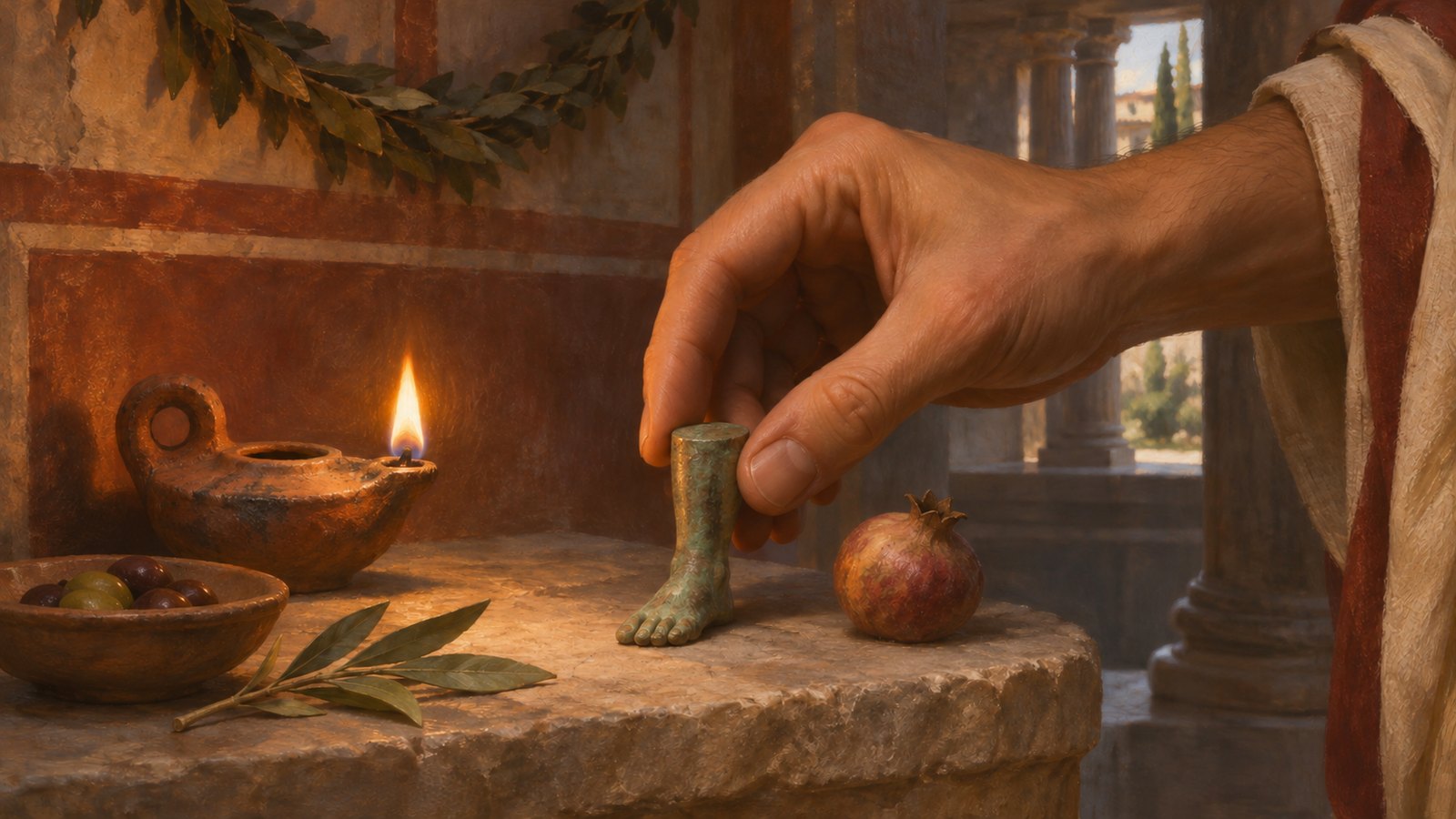
Roman religious life often worked through objects, places and repeated actions rather than through a single uniform script. A body-part offering could make an intimate concern materially present without preserving a full explanation for later readers. This figurine is especially direct. It does not show a divine figure, ritual official or mythic episode. It shows the limb involved.
That economy distinguishes it from objects whose imagery carries a more elaborate narrative. Readers interested in how small sacred places were embedded in ordinary movement can compare the crossroads shrines that marked Roman neighborhoods. Those shrines organized public space. The miniature leg instead narrows attention to one body part. Both turn an otherwise invisible relationship into something placed and seen, but their scales and audiences are very different.
The bare foot also resists easy over-interpretation. The related sandalled example shows that footwear could be represented, yet the catalogue does not say why this figurine lacks it. Bare skin may simply have made the anatomy clearest. It may have reflected the represented condition. Without further evidence, neither possibility should harden into fact. What can be said is more modest: the maker chose to expose the toes and then marked all five with incisions.
Twenty-Eight Grams Preserved a Cautious Argument
The figurine survives because several kinds of evidence reinforce one another. Its measurements establish a complete miniature rather than a life-sized fragment. Its anatomy identifies the subject. Its lack of a blade slot undermines one functional comparison. A similar sandalled piece supplies a closer parallel. The catalogue’s explanation of healing votives then gives the form a plausible ritual purpose.
None of those steps alone proves the lost event. Together they produce a bounded interpretation: a Roman copper-alloy leg, probably made as a votive offering connected with hope for a cure or thanks for one. The phrase “probably” is not a weakness. It records the distance between a surviving thing and an absent act.
That distance also links the figurine to the wider problem of Roman protection and religious duty. The Vestal Virgins made protection a concern of the Roman state; this tiny leg brings the scale down to one anonymous body. It cannot tell us whether healing came. It can show that somebody considered a leg worth translating into metal.
The final result is physically slight but conceptually exact. A calf 11.6 millimetres across rises from a foot scarcely longer than a thumbnail. Five shallow lines keep the toes visible. A green-grey surface carries the marks of age, while the complete form preserves the maker’s selection. The object does not give back the worshipper’s voice. It preserves the shape of what mattered enough to ask—or to thank.
Sources
Portable Antiquities Scheme record YORYM-346AC7, via Europeana.