
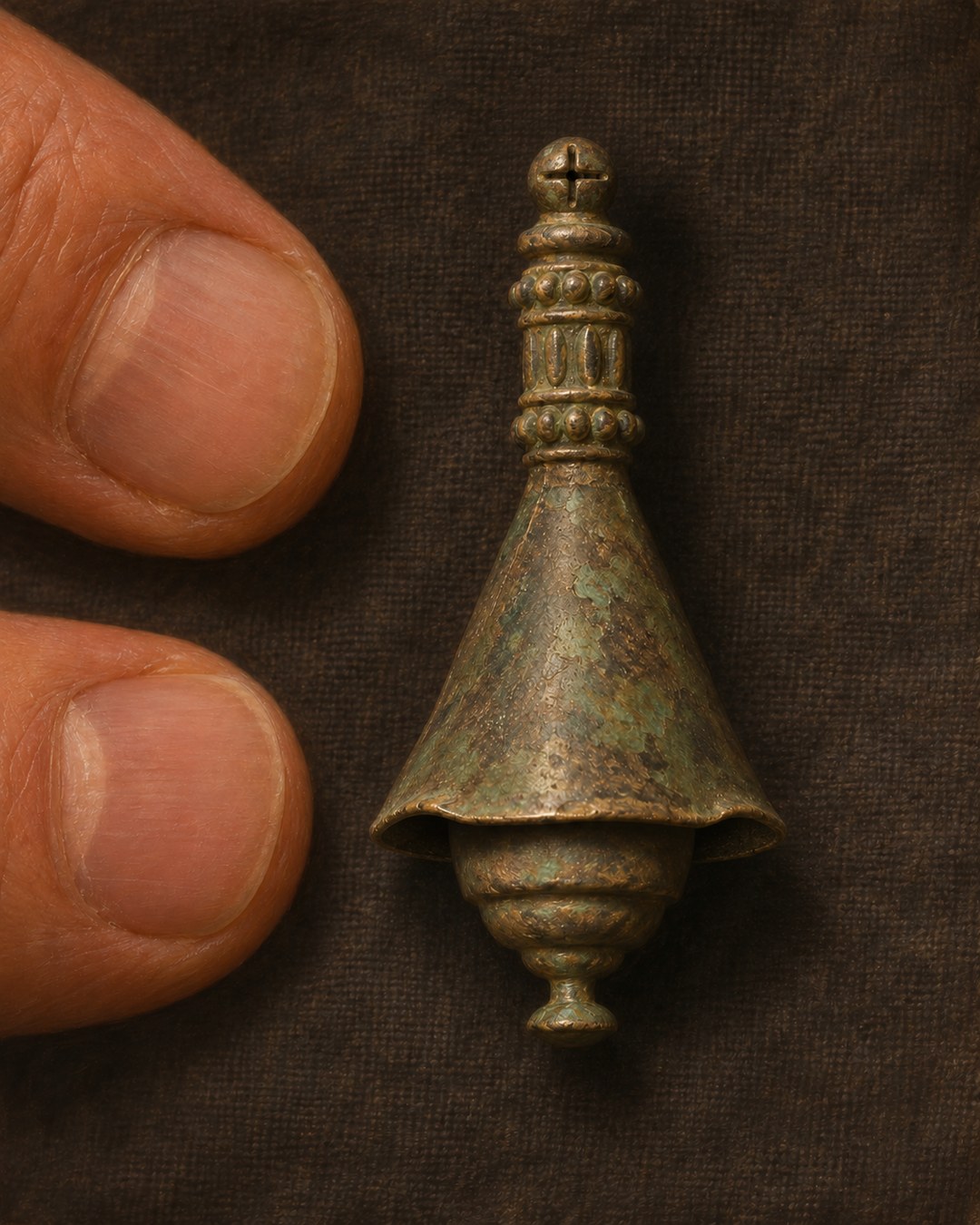
A probable Roman plumb bob only 37.65 millimetres long preserves an entire argument about vertical measurement in miniature. The copper-alloy object has a decorated shaft, a hollow conical skirt, a hemispherical knob, and a tiny mushroom-shaped projection. Piercings cross a spherical terminal in two directions. Iron staining survives where the shaft disappears into the solid body. The Portable Antiquities Scheme calls it a probable plumb bob and notes that it could have belonged to a groma, Rome’s familiar surveying instrument.
That possibility is compelling, but it remains a possibility. The record does not claim that the crossed arms, vertical pole, cords, or three sibling weights survived with this piece. It compares the object with a published example and explains how a groma worked. The correct reading therefore has two layers: the artefact’s form and dimensions are observed; its place on a surveying instrument is a reasoned identification.
Two Piercings Crossed a 5.5-Millimetre Sphere
At one end of the object, a spherical terminal roughly 5.5 millimetres in diameter is pierced vertically through one face and horizontally through two opposing faces. The openings are about 1.5 millimetres wide. Their crossing directions create the most obvious place where a cord or attachment could interact with the weight, although the surviving record does not describe an original cord.
A plumb bob needs suspension. Gravity can establish a vertical only when a weight is free to hang below a fixed point. The piercings therefore matter more than their tiny scale suggests. They connect the solid object to the absent flexible element that would have allowed it to settle. A cone sitting on a table is merely a shaped weight; a weight attached to a line becomes a measuring device.
The small terminal also establishes orientation. From it rises a vertical shaft with bead-and-reel decoration. The shaft measures about 5 millimetres across and thickens to roughly 6 millimetres below the conical skirt. The description’s “vertical” is an analytical orientation for the object. During use, the whole assembly would have hung according to gravity rather than according to a display case.
A Hollow Skirt Put Width Around the Centre
The conical skirt is hollow and approximately one millimetre thick. At its widest it reaches 19.28 millimetres, matching the object’s maximum recorded width and thickness. Two sections of the rim have been squashed. That damage reveals why the distinction between hollow and solid construction matters: a thin shell can deform in ways a massive cone cannot.
Above and below the skirt, the form narrows. The shaft thickens as it enters the upper area, while the cone contracts to 5.91 millimetres before meeting a hemispherical knob. This changing profile distributes visual and physical mass along the centreline. The object is not a plain lump of metal tied to a string. Its maker gave it a sequence of sphere, shaft, beads, skirt, narrowed cone, knob, and final projection.
The skirt’s rim damage should not be turned into a story about a particular accident. The record only states that two areas are squashed. They could have been damaged during use, deposition, recovery, or later handling. What can be said securely is that the present shape includes deformation and that the thin hollow edge made such deformation possible.
Iron Staining Marks a Hidden Junction
Around the top of the shaft, where it disappears into the solid body of the cone, the surface carries iron staining. The record does not identify a complete iron insert, and it does not explain exactly how the internal junction was assembled. The stain nevertheless marks a place where another material was present or in contact.
This is a reminder that “copper-alloy object” does not necessarily mean a component made and used in total isolation from iron. Roman tools often combined materials according to their jobs. Here, the copper-alloy exterior survives well enough to preserve decoration and dimensions, while iron is visible only indirectly through staining. The lost material can still alter how the construction is understood.
A similar division between visible fitting and hidden structure appears in Roman building equipment. The article on iron concealed inside Roman monuments examines a much larger scale. This plumb bob reverses the emphasis: its possible surveying role served construction before walls rose, while its own iron connection is now the concealed element.
The Lower Knob Ends in a Mushroom-Shaped Point
Below the cone is a hemispherical knob 11.40 millimetres in diameter and 7.5 millimetres high. At its centre stands a mushroom-shaped projection. The stalk measures 1.82 millimetres across and the head 3.09 millimetres. Those measurements are unusually exact for such a small terminal and prevent a vague reconstruction. The end was not simply “pointed.” It had a narrow stem and broader head.
For a hanging weight, symmetry around the centreline is important because uneven mass can complicate how it settles. The catalogue does not provide a balance test or prove the original centre of gravity, so we should not claim precision beyond the evidence. Yet the repeated concentric forms—shaft, cone, knob, and projection—are compatible with an object designed to hang on an axis.
The complete piece weighs 12.40 grams. That mass is modest, but the instrument did not need to crush or strike. It needed enough weight to pull a cord taut and respond consistently to gravity. Whether this exact bob served a surveyor’s groma or another suspended measuring arrangement, its proposed function depended on steadiness rather than force.
Four Cords Could Turn Gravity into a Sight Line
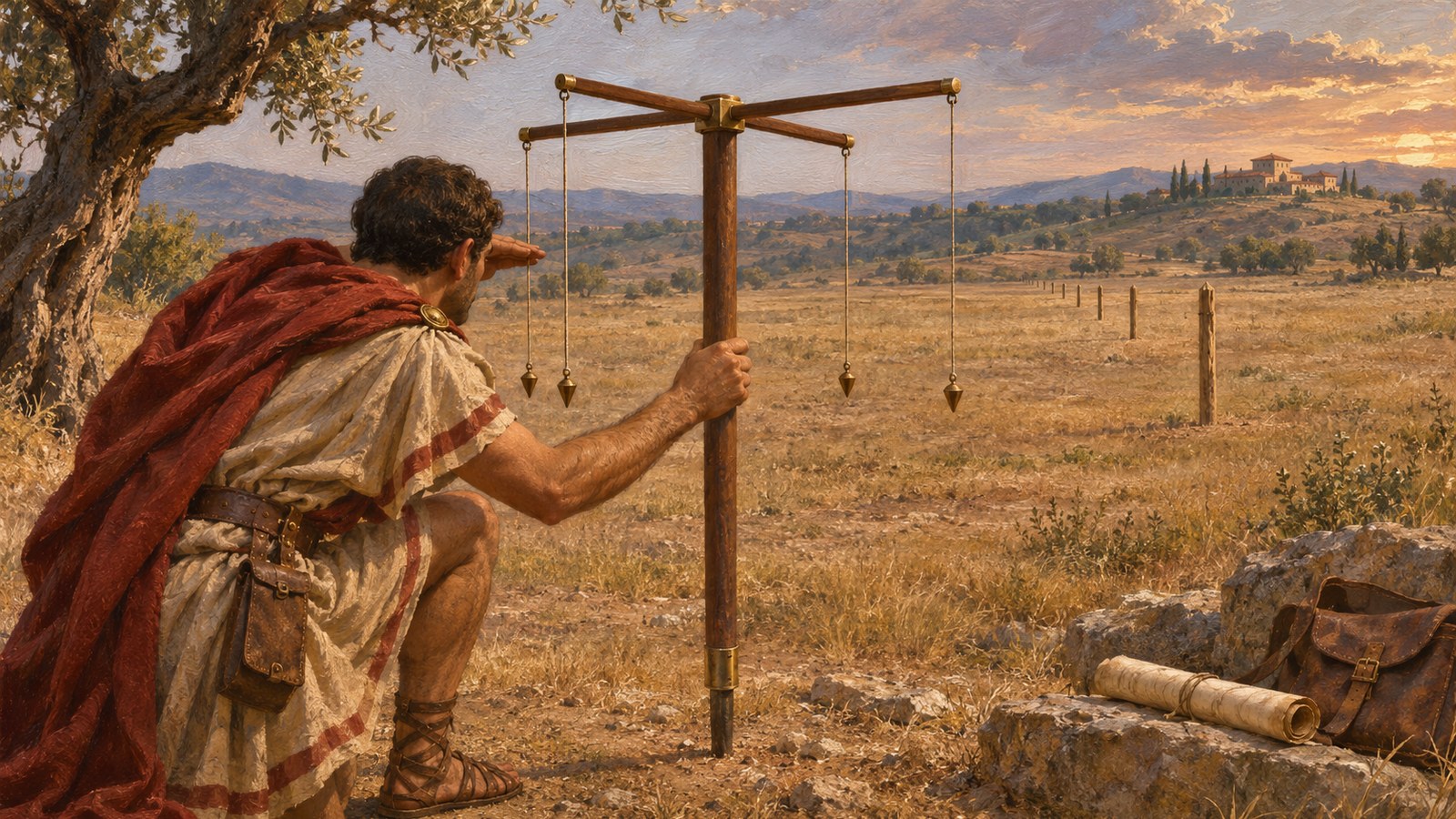
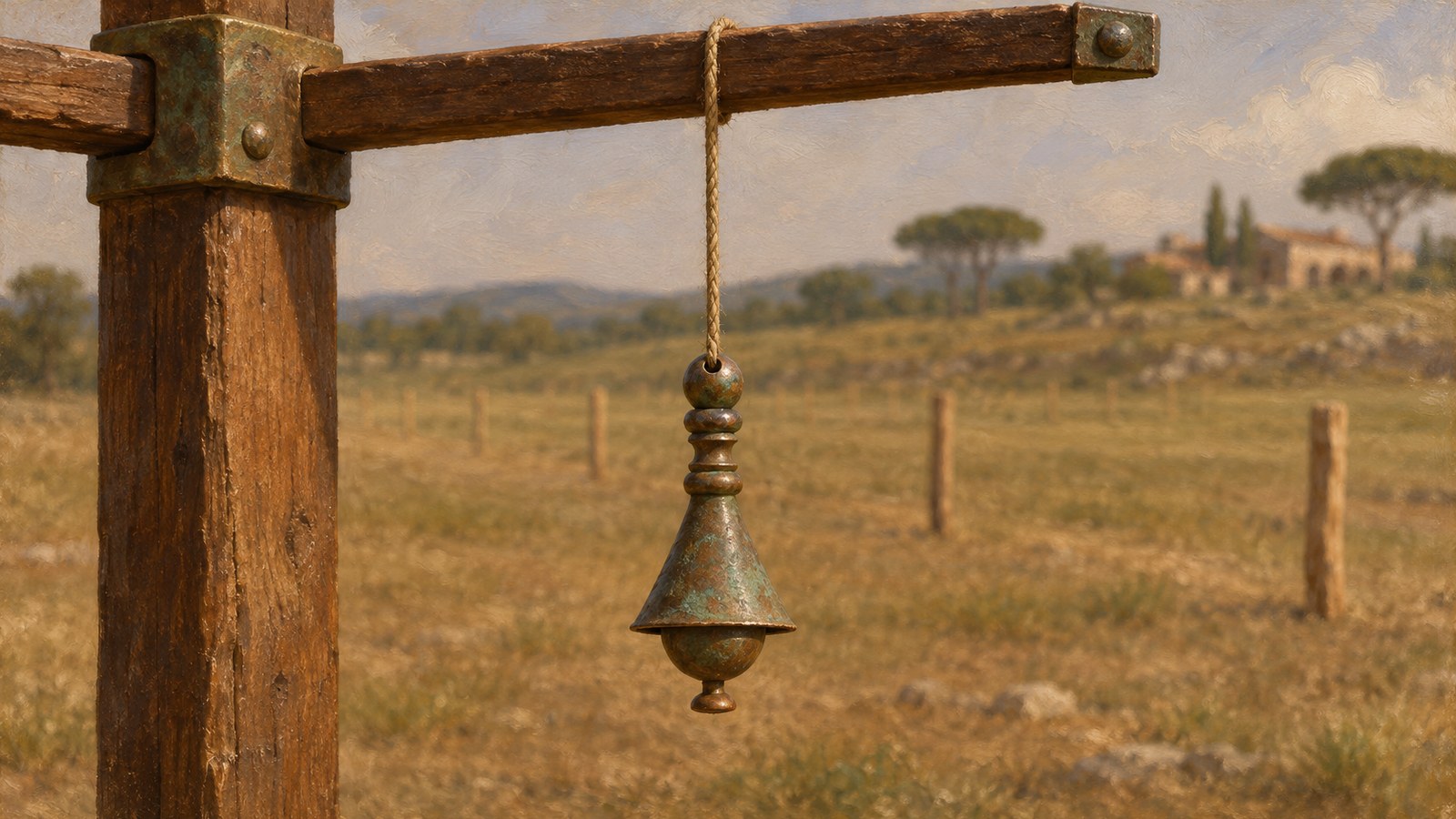
The cited comparison explains a groma as a simple instrument with crossed arms resting on a bracket attached to a vertical pole. Each of the four arms carried a cord and hanging plumb bob. When the weights hung freely, their lines helped the surveyor establish alignments and right angles. The instrument translated gravity into repeatable visual references.
This object could have been one of those four weights, but the language must stay conditional. No crossed frame was found with it in the record, and “probable plumb bob” already signals interpretive restraint. A parallel can make an identification plausible without transforming it into direct proof. The evidence is strongest where form and required mechanism meet: a compact symmetrical weight, pierced for attachment, matches the demands of suspension.
Readers can compare this process with the ways Roman surveyors made boundaries measurable. Large landscapes required instruments that reduced complicated terrain to observable references. A plumb line supplied one of the simplest references available: the direction gravity made every time.
Thirty-Seven Millimetres Could Guide a Much Larger Plan
The scale contrast gives the object its significance. At less than four centimetres long, it may have contributed to setting out roads, buildings, boundaries, or other work far larger than itself. The record does not connect it to any named project, so those are categories of surveying rather than claims about this find. Its potential reach came from the rule it embodied, not from its size.
Damage and uncertainty remain part of the picture. The skirt is squashed in two places. Iron survives as stain. The attachment cord is gone. The groma identification rests on comparison. None of that empties the object of meaning. Instead it shows how archaeological interpretation advances by matching observed construction to a mechanism while preserving the gap between “could have” and “did.”
A vertical and horizontal piercing crossed the tiny upper sphere. Bead-and-reel decoration marked the shaft. A hollow skirt widened the centre, and concentric lower forms brought the object back toward its axis. If suspended, 12.40 grams of copper alloy would have pulled downward. The probable plumb bob made gravity visible as a line—and that line could help a surveyor impose order on ground vastly larger than the tool.
Sources
Portable Antiquities Scheme record HAMP-606896, via Europeana.