
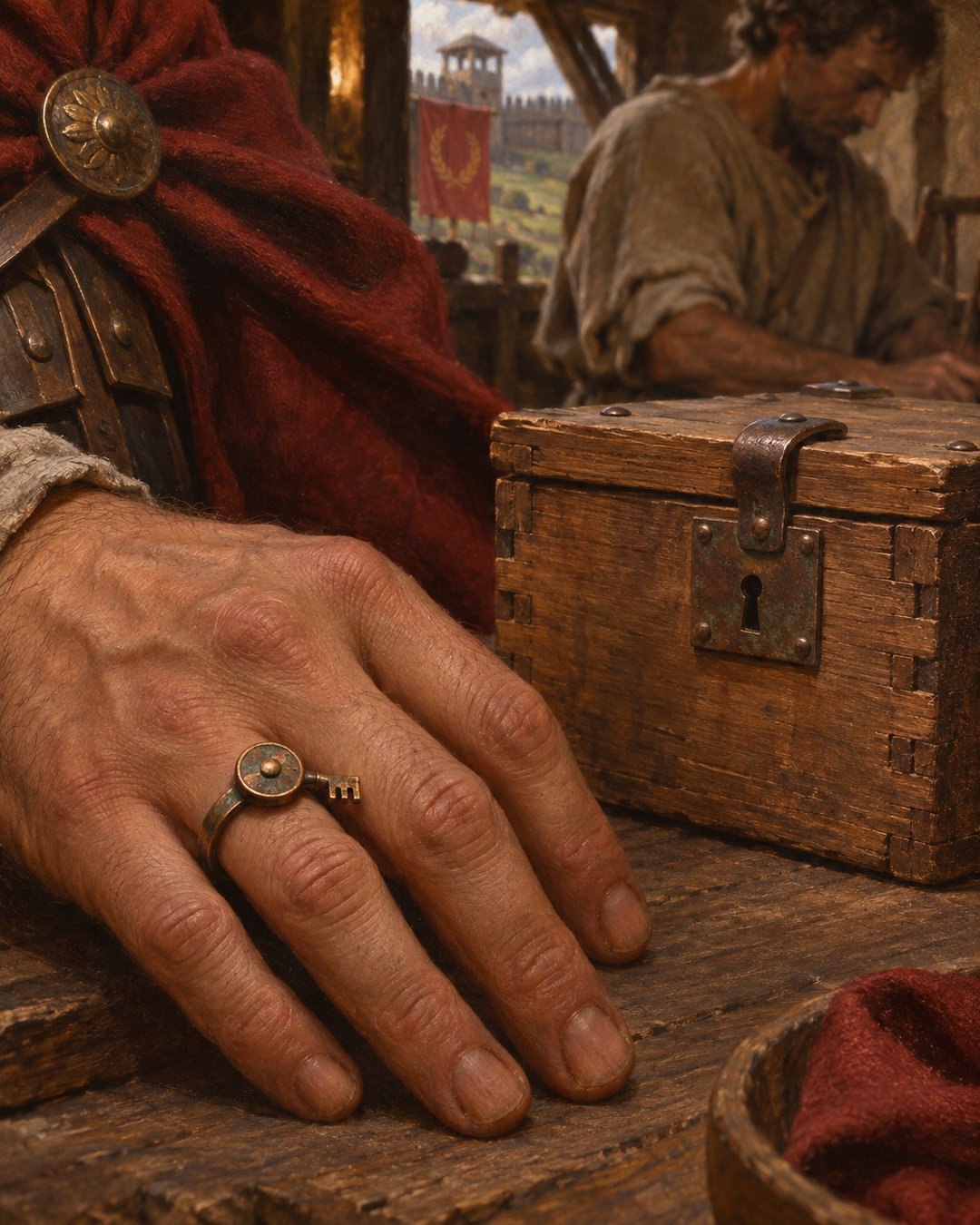
A copper-alloy key in the London Museum is only 24 millimetres long, yet it combines a lock tool with the object that carried it. Its bow forms a ring. Beyond that ring, a short cylindrical shaft bends into an S-shaped bit with four teeth.
The museum identifies it as a complete Roman lever-lock rotary ring key. It could remain on a finger rather than disappear into clothing, and the museum’s description supplies a practical reason: pockets were unknown. Carrying and opening became one design problem.
The little key does not reveal who owned it or what it secured. It does show a craftsperson compressing several requirements into one piece of metal. The ring had to fit, the shaft had to reach, the teeth had to meet a lock, and the whole object had to survive repeated turning.

The Finger Became the Key’s Carrying Place
A loose key is useful only if its owner can find it. The ring-key design made the owner’s hand part of the storage system. No separate purse, cord, or pocket was required while the key was being worn.
The London object’s ring measures 20 millimetres across overall. That dimension is not enough to identify a particular finger, and wear could vary between users. It does place the carrying loop in the scale of the hand rather than a large door fitting.
The museum calls rotary key-rings a convenient way to carry keys when pockets were unknown. Convenience here came from attachment. A small tool that might be dropped or misplaced could travel visibly with its user.
Visibility had consequences. A ring key was not merely hidden equipment. Anyone nearby could see that the wearer carried a means of opening something, although the object alone could not say whether that something was a box, cabinet, or another lockable container.
Its rectangular raised face and incised lateral moulding also made the ring more than an undecorated loop. The details gave shape to the part that touched the wearer and remained exposed when the working bit was not inside a lock.
The dimensions reveal how tightly the functions were packed. The object’s total length and height are both 24 millimetres, while the ring itself spans 20 millimetres. Most of the surviving volume therefore belongs to the grip and carrier; the lock-facing teeth occupy only a small projection beyond it.
A wearer also had to manage the bit while the ring remained on the hand. Its compactness reduced the projecting metal, but it did not erase it. The design balanced immediate availability against the inconvenience of carrying a toothed tool on a moving finger.
Roman dress did not offer the familiar modern answer of pushing every small possession into a stitched pocket. People used bags, boxes, cords, fibulae and other forms of attachment. This key solved its own carrying problem by turning the bow into wearable hardware.
Four Teeth Turned a Ring Into a Tool
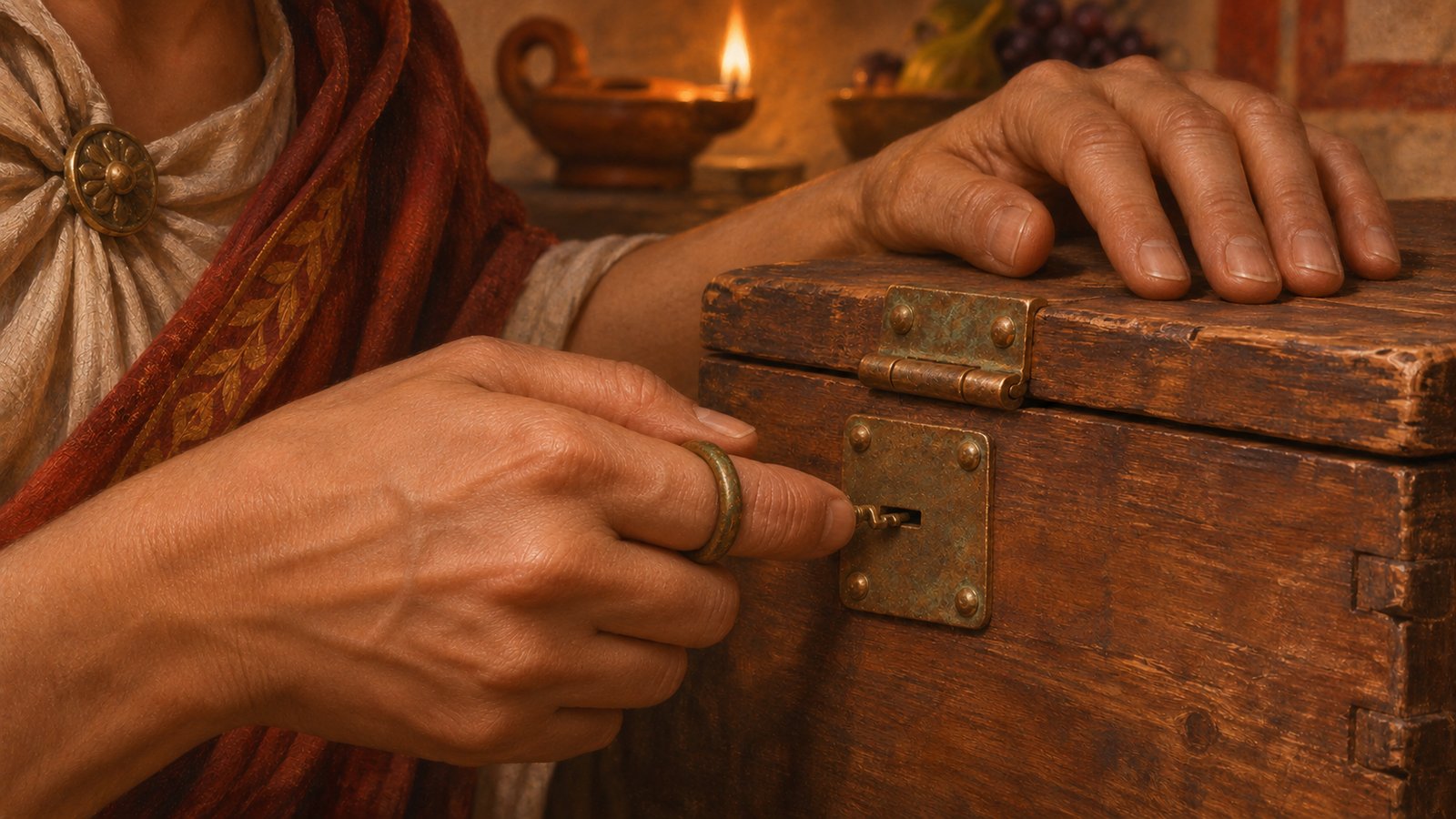
The ring did not open anything by itself. From it projected a piped cylindrical shaft ending in an S-shaped bit with four teeth. Those teeth were the key’s information-bearing edge: their arrangement had to cooperate with the lock.
The museum classifies the object as a lever-lock rotary key. In that family of mechanism, insertion and turning mattered together. The shape was not a decorative symbol of access; it was a component expected to move other components.
At only four millimetres high, the teeth demanded controlled metalwork. They had to be distinct enough to do their job without becoming so thin that ordinary handling destroyed them. The complete survival of this example lets the full sequence from finger ring to bit remain visible.
The S shape changed direction within a very short distance. That bend helped place the teeth where the lock required them while keeping the wearer’s ring and hand outside. Geometry connected a comfortable carrier to an internal mechanism the user could not see.
Turning imposed stress along the shaft. The moulded ring gave the user a surface on which to apply force, while the cylindrical section transmitted it toward the bit. If any transition failed, the elegant combination of jewellery scale and tool function would stop working.
The object’s completeness is therefore important. A detached ring might be mistaken for ornament, while a broken toothed fragment would hide its wearable end. Together, the parts explain each other. A related economy appears in two Roman folding knives whose blades hid inside their handles, although this key kept its working teeth exposed.
A Tiny Key Implied a Larger System of Controlled Access
A key is half of an arrangement. Somewhere there had to be a lock whose internal parts answered this bit. Somewhere there was also an object or space considered worth closing against immediate access.
The surviving key cannot tell us what was protected. It is safer to preserve that uncertainty than to invent a jewellery box, money chest, document case, or household door. The scale narrows possibilities but does not name the original lock.
What it does establish is repeated, selective access. A seal can expose tampering after a container is opened. A lock aims to prevent opening by someone who lacks the working key. The ring key was meant to accompany the person authorized to operate that barrier. That contrast also appears in the Roman box whose wax and cord made tampering visible: sealing and locking answered related security problems in different ways.
That relationship made custody personal. The owner could keep the opening tool on the body while moving through a house, shop, workshop, or street. Control did not depend on leaving the key beside the thing it guarded.
The key’s exposed form may also have communicated responsibility. Wearing it could show that the bearer had charge of access even when nobody watched the lock itself. That is a reasonable functional implication, not evidence for a specific Roman office or social rank.
Its copper alloy mattered to the same system. Metal could preserve the teeth and shaft through many cycles of insertion and turning. The material also allowed moulding and incised details on the ring without separating utility from finish.
Colchester Finds Put the London Key in a Broader Type
The museum does not present this ring key as an isolated curiosity. Its record says rotary key-rings are relatively common finds in Roman Britain and points to a selection of types published from Colchester.
That comparison changes the interpretation. One ingenious object could be an experiment. Repeated finds with different types indicate a recognizable solution that craftspeople made and users accepted.
“Relatively common” does not mean everyone owned one. Archaeological survival depends on material, deposition, excavation and recording. Copper alloy survives differently from leather, wood, cord, or cloth, and a museum catalogue is not a census of Roman hands.
Even so, typological variation matters. A useful design can keep the same principle while changing ring shape, shaft, bit, teeth, finish, or scale. The London key preserves one choice among a wider family rather than the only Roman answer to carrying access.
The Colchester comparison also anchors the object in Roman Britain without requiring a famous owner. Ordinary mechanisms often become historically valuable precisely because they were copied. Repetition reveals a settled practical need.
At the object level, every detail remains modest: 24 millimetres long, 24 millimetres high, a 20-millimetre ring, four teeth only four millimetres high. At the system level, those dimensions join clothing, hand movement, metalworking, locks and decisions about who could open what.
The key’s cleverness was not that it looked spectacular. It was that the owner did not need to choose between carrying the tool and using the tool. The same ring that kept it close supplied the grip that turned it.
Sources
London Museum, “Key, ring key”; Crummy, Colchester Archaeological Report 2, cited in the museum record.