
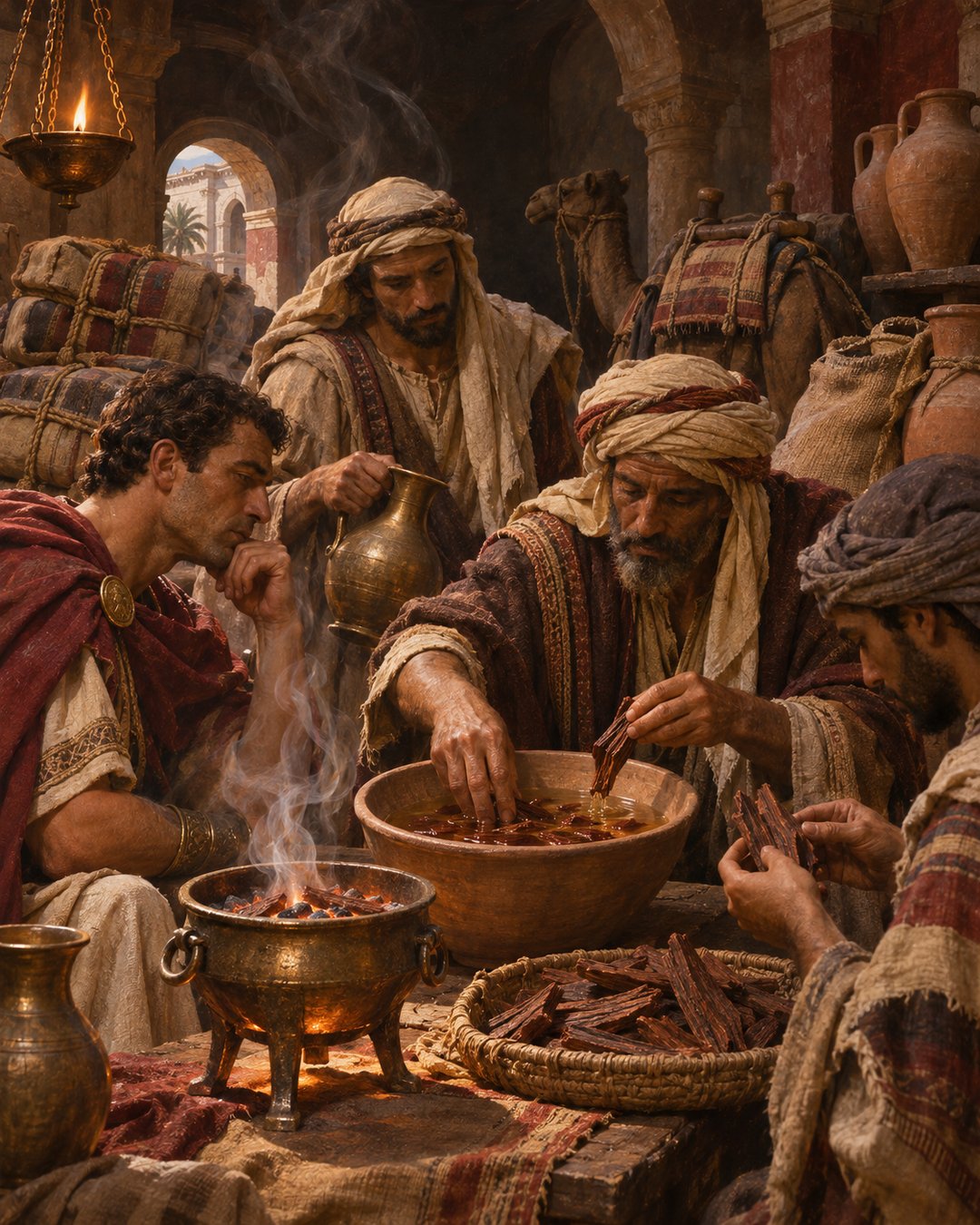
Before a piece of Carmanian wood could perfume a sickroom, it passed through several transformations. Merchants carried it west. Preparers steeped it in palm wine. Fire turned it into smoke. The room then completed the process: Pliny the Elder says the odour rose to the ceiling before descending in volumes to the floor.
The wood was called stobrum. It appears only briefly in Pliny’s long account of Arabian aromatics, but the passage connects sensory experience to a trade map. An agreeable smell that promoted sleep depended on Carmania, Arabian merchants, caravan entrepôts, palm wine, controlled burning, and an enclosed interior tall enough for smoke to travel through. Luxury was not one object. It was a chain of handling.
Palm wine prepared the wood for smoke
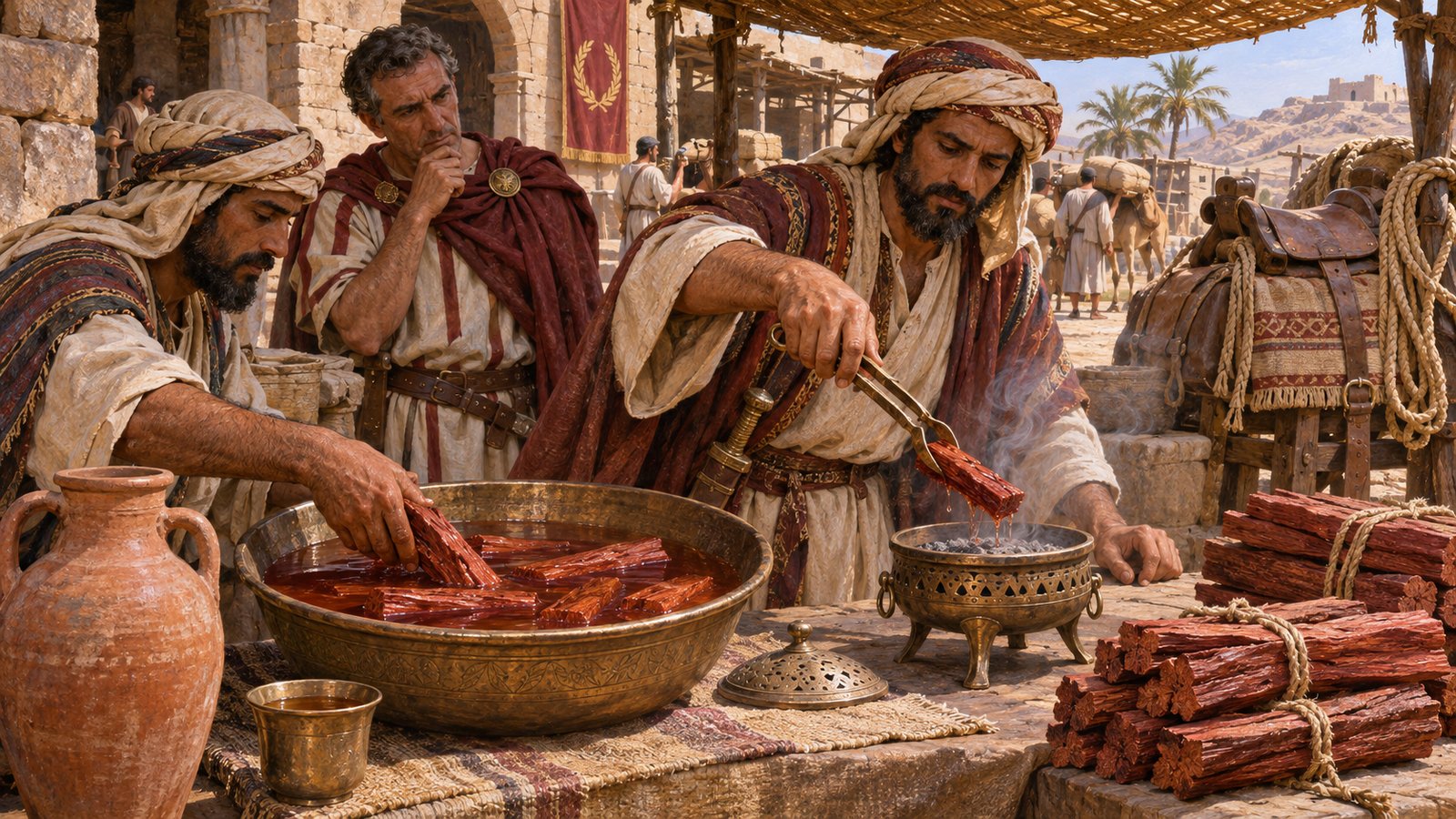
Pliny describes stobrum as the wood of a tree imported by Arabians from Carmania. They used it for fumigation, but not straight from the bundle. First it was steeped in palm wine and only then set alight. The liquid preparation distinguished the material from ordinary fuel.
Steeping would wet the surface and change how quickly a piece caught and smouldered. Pliny does not offer a chemical explanation, so it would be wrong to invent one. His sequence nevertheless makes practical sense as a controlled craft: select the aromatic wood, expose it to palm wine, and burn it in a way that produces sustained fragrant smoke rather than a quick blaze.
Palm wine also located the process culturally. The preparation used a regional drink with a traded wood, combining materials that came to hand within Arabian commerce. The treatment added labour and knowledge before the product reached its final user. A buyer needed more than stobrum; someone had to know what to do with it.
That distinction resembles other Roman-era processes in which value emerged through ordered preparation. Frankincense was cut, collected, sorted, and guarded. Pepper changed grade as fruit ripened and dried. In the article on sealed aprons in Alexandria’s frankincense workshops, security became part of processing. With stobrum, the key additional material was palm wine.
The scent travelled up before it came down
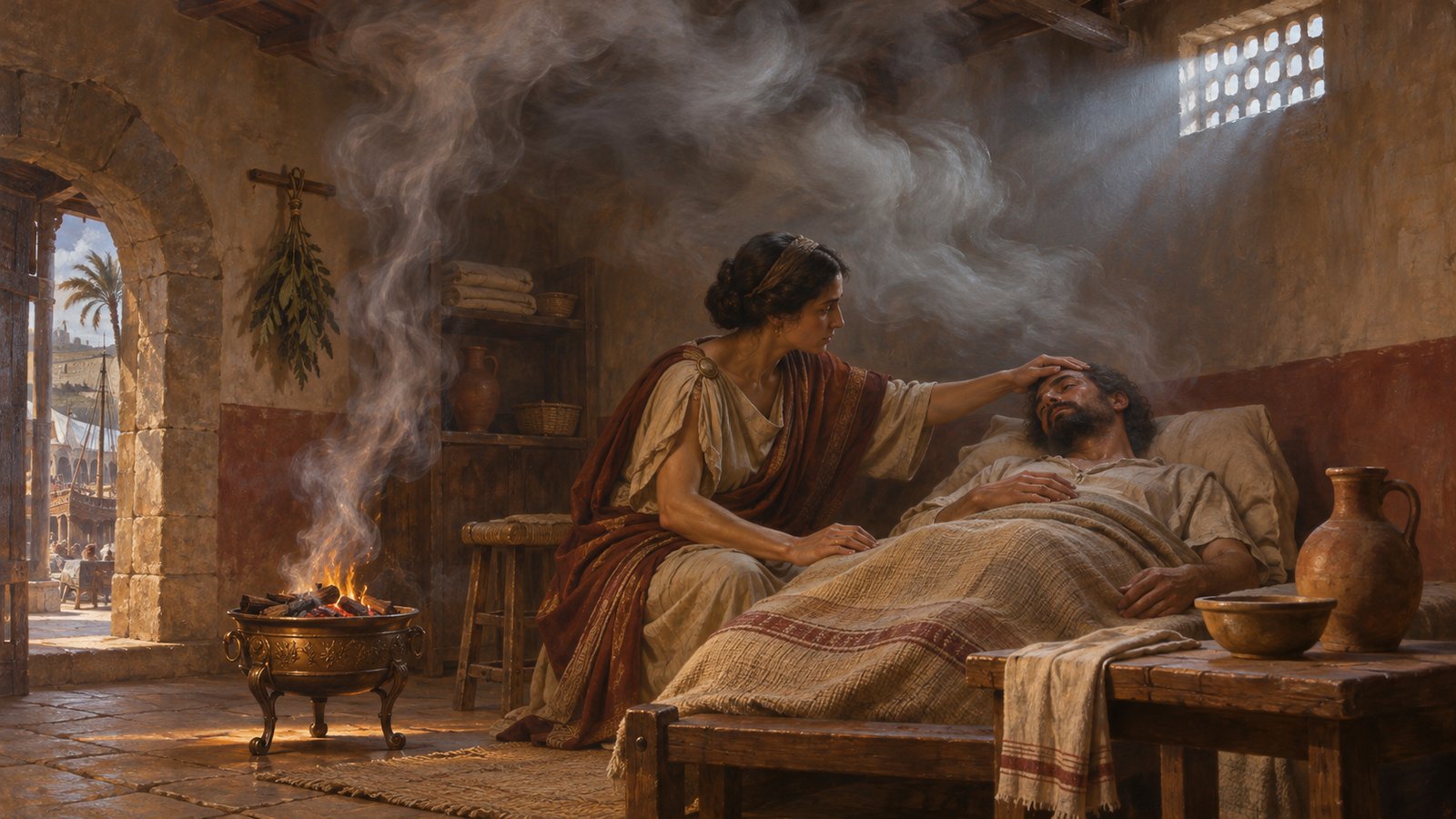
The most memorable detail is spatial. Pliny says the odour first ascended to the ceiling and then descended in volumes to the floor. The description asks us to picture a room filling gradually. Smoke left the brazier, gathered above, spread, cooled, and returned through the occupied space.
This path made architecture part of the treatment. A low outdoor fire would not create the same experience. The fumigation needed an interior whose ceiling and walls could hold the scented air long enough for it to circulate. The user did not simply lean over burning wood; the room was charged from top to bottom.
Pliny calls the smell agreeable but also notes that it could bring an oppression of the head without pain. The qualification matters. Aromatic strength was the desired property and the risk. The best evidence of potency was bodily: the head felt the room even if it did not ache.
A controlled brazier, an attendant, and some ventilation would have mattered in practice, though Pliny does not specify them. What he does specify is enough to reject a modern image of a small scented trinket. Stobrum worked volumetrically. Its smoke occupied air, and the patient occupied that air with it.
Sleep gave the perfume a medical purpose
Stobrum was used to promote sleep in people who were ill. That purpose placed the fumigation between perfume and remedy. The wood pleased the senses, altered the atmosphere, and encouraged rest. Pliny does not claim that it cured the underlying illness. Its work was to make sleep more reachable.
The distinction is important because Roman medical care included environmental management as well as drugs and surgery. Light, heat, air, bathing, food, and rest could all be adjusted around a patient. Fragrant smoke added another controllable quality to the room. The treatment changed surroundings so that the body might respond.
The head pressure Pliny mentions may also have signalled a limit. More scent was not automatically better. An attendant had to judge fuel, room size, and duration from experience. The text preserves no dosage, but it preserves a warning sensation. Craft knowledge often survives in exactly that form: stop or alter the procedure when the material announces itself too strongly.
The desired result was quieter than spectacle. No dramatic cure, rare vision, or priestly revelation followed. A sick person slept. That modest outcome helps explain why long-distance aromatics could enter domestic and medical routines rather than remain confined to public altars.
Carrhae linked the brazier to a caravan map
Pliny does not leave stobrum inside the room. He traces the commerce through Carrhae, which served as an entrepôt. From there, an older route went to Gabba, a journey of twenty days, and then onward to Palestine in Syria. Juba, one of Pliny’s named authorities, reported a later turn toward Charax and the Parthian kingdom.
An entrepôt concentrated goods without being their place of origin or final use. Bundles could be assembled, exchanged, taxed, repacked, and redirected. Stobrum’s identity as Carmanian wood survived those transfers because merchants and buyers cared about provenance. The name connected the scent in a distant room to a landscape far beyond it.
The twenty-day stage gives the trade physical weight. Pack animals needed fodder and water. Handlers needed rest and security. A bundle that looked small beside a brazier represented weeks of movement even after it reached Carrhae. Price and rarity grew from logistics as well as desire.
Roman-period trade often depended on such difficult transitions. The story of royal fishermen guiding ships through Barygaza’s tides shows local expertise carrying imported goods through dangerous water. Stobrum’s route used another form of expertise: knowledge of inland stations and political corridors.
Perfume traffic moved in both directions
The route was not a one-way line carrying eastern fragrance toward Roman consumers. Pliny says Syria sent storax back to Arabia. It was burned there to counter the weariness produced by the population’s own powerful perfumes. A region famous for aromatics imported a different aromatic to relieve saturation with familiar smells.
That reversal complicates any simple map of producer and consumer. Arabia supplied frankincense, myrrh, and other scented materials, yet Arabian users also wanted contrast. Storax answered local sensory fatigue. Trade moved differences in smell as well as scarce substances.
Pliny imagines Arabian towns and villages filled with smoke from incense and myrrh wood used even for cooking. What reached Roman altars as an exceptional fragrance could form part of an ordinary fuel environment closer to production. Stobrum occupied still another niche: imported, prepared with palm wine, and used for sleep.
One piece of wood therefore carried several geographies at once. Carmania supplied the tree. Arabian merchants managed the commodity and preparation. Carrhae and other stations organized movement. A patient’s room turned it into descending smoke. The final scent was local, but the process was continental.
The commodity’s form helped make that movement possible. Wood could be cut, bundled, loaded, and stored before its final preparation. Unlike a finished perfume, it did not have to arrive as a delicate liquid mixture. Palm wine and fire activated the experience near the point of use. Transport and preparation were separated across the route.
That separation also distributed expertise. Caravan merchants needed to preserve identity and provenance; dealers at an entrepôt needed to redirect the bundles; household or medical attendants needed to steep and burn them. No single worker controlled the whole chain. The descending smoke was the visible end of many earlier decisions that the patient could neither see nor verify.
Pliny’s short notice is therefore unusually dense. It gives a plant product, an origin, a treatment, a sensory path, a bodily effect, a medical purpose, an entrepôt, and changing routes. Stobrum is obscure today, but the operations around it make the ancient trade legible.
Sources
Pliny the Elder, Natural History 12.40.