
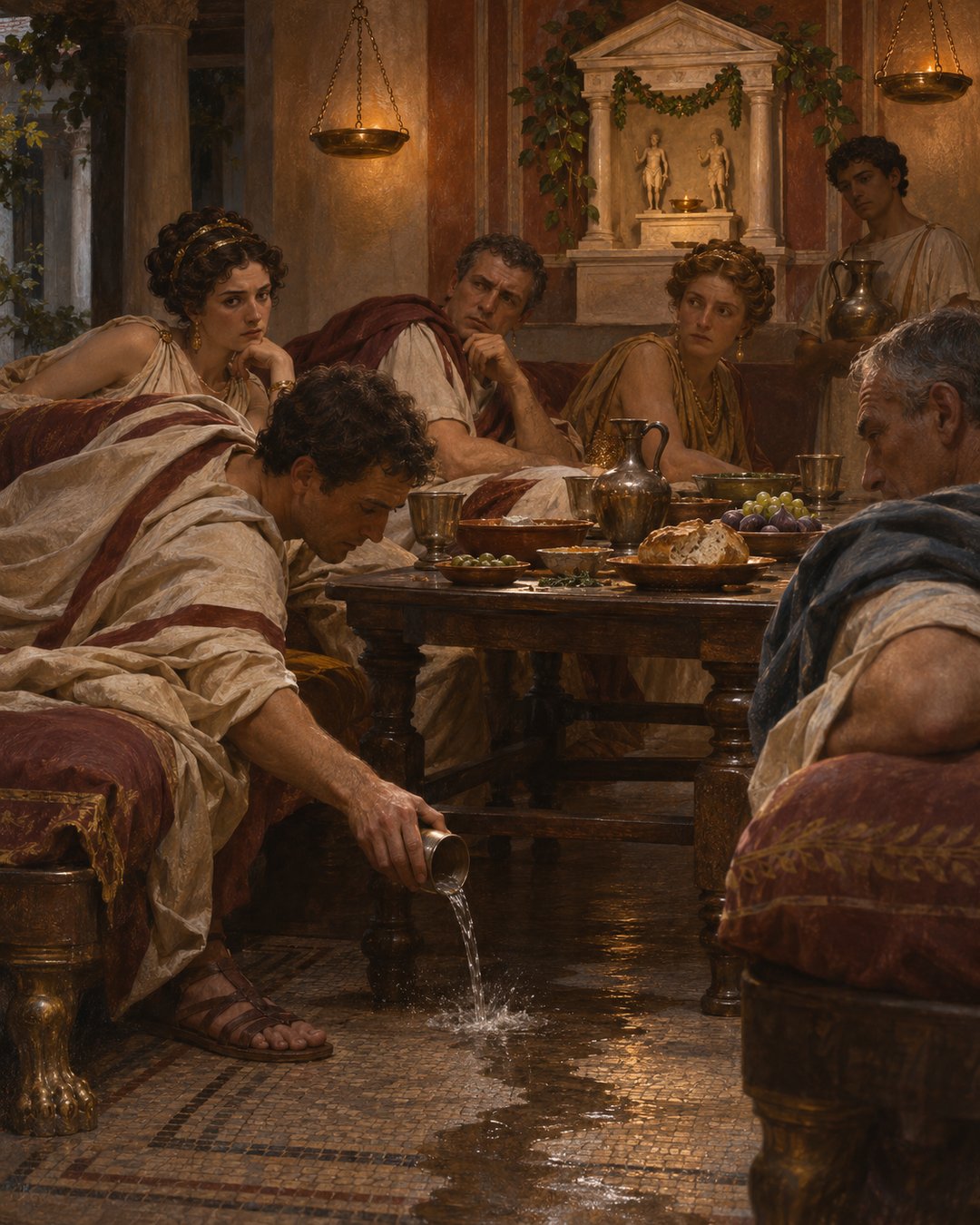
A Roman dinner did not become religious only when someone recited a prayer. In Pliny the Elder’s catalogue of everyday observances, the table was already crowded with invisible consequences. A spoken reference to a fire could make someone pour water beneath the table. A broom moving at the wrong moment could become an omen. A morsel dropped from a guest’s hand might have to return to the tabletop rather than be blown clean.
Pliny records these details while asking whether words and customary acts possess real force. His answer is not a tidy declaration of belief. Instead, he points to what people actually do. Even those who doubt charms, he suggests, arrange ordinary life as though names, gestures, timing, and accidental signs matter. Dinner becomes his strongest evidence because its rituals were repeated in houses night after night.
A spoken fire called for real water
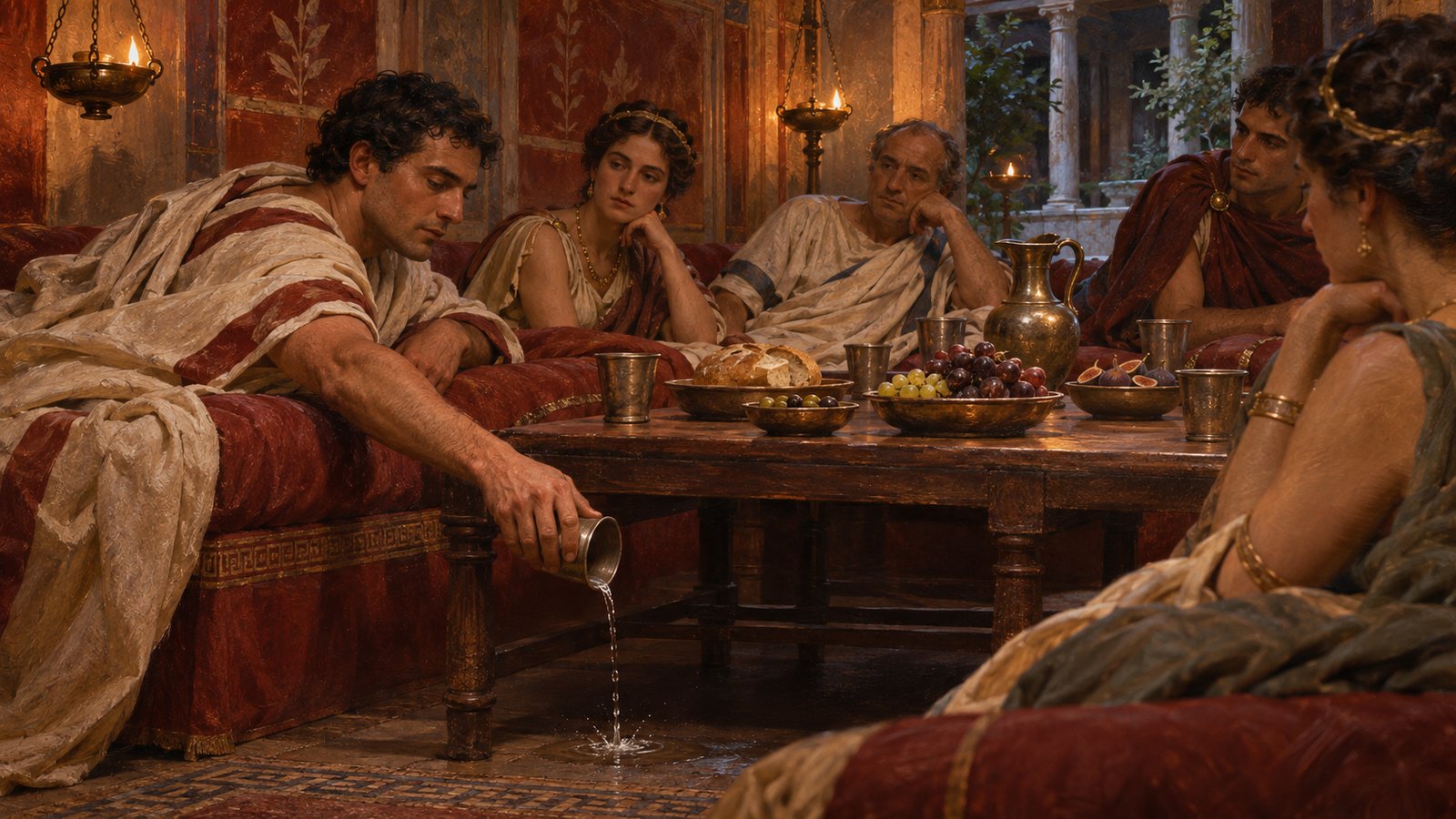
The most vivid custom begins with conversation. If diners happened to mention a fire while eating, Pliny says they averted the inauspicious omen by pouring water beneath the table. The response paired word and substance with almost theatrical economy. Fire entered the room through speech; water answered it physically, but discreetly, below the shared surface of the meal.
The act did not extinguish an actual flame. Its logic belonged to prevention and counter-sign. Mentioning disaster risked giving the subject a presence at the table, so the diners introduced its opposite. The water went under the table rather than into a cup or over the food. That placement kept the meal intact while treating the space that supported it.
Such a gesture required almost nothing: a small amount of water, a hand, and awareness of the conversation. Its simplicity helped it travel through households. No priest had to be summoned. No expensive victim was required. A diner could perform the correction before talk moved on, turning concern into action without ending the evening.
Pliny places this custom among New Year wishes, lucky names, greetings after a sneeze, and gestures of adoration. The setting changes, but the pattern remains. Words do not float free of the body. They are answered by turns, touches, claps, kisses, or poured water. Roman religious habits could live inside reflexes.
The table could not be disturbed carelessly
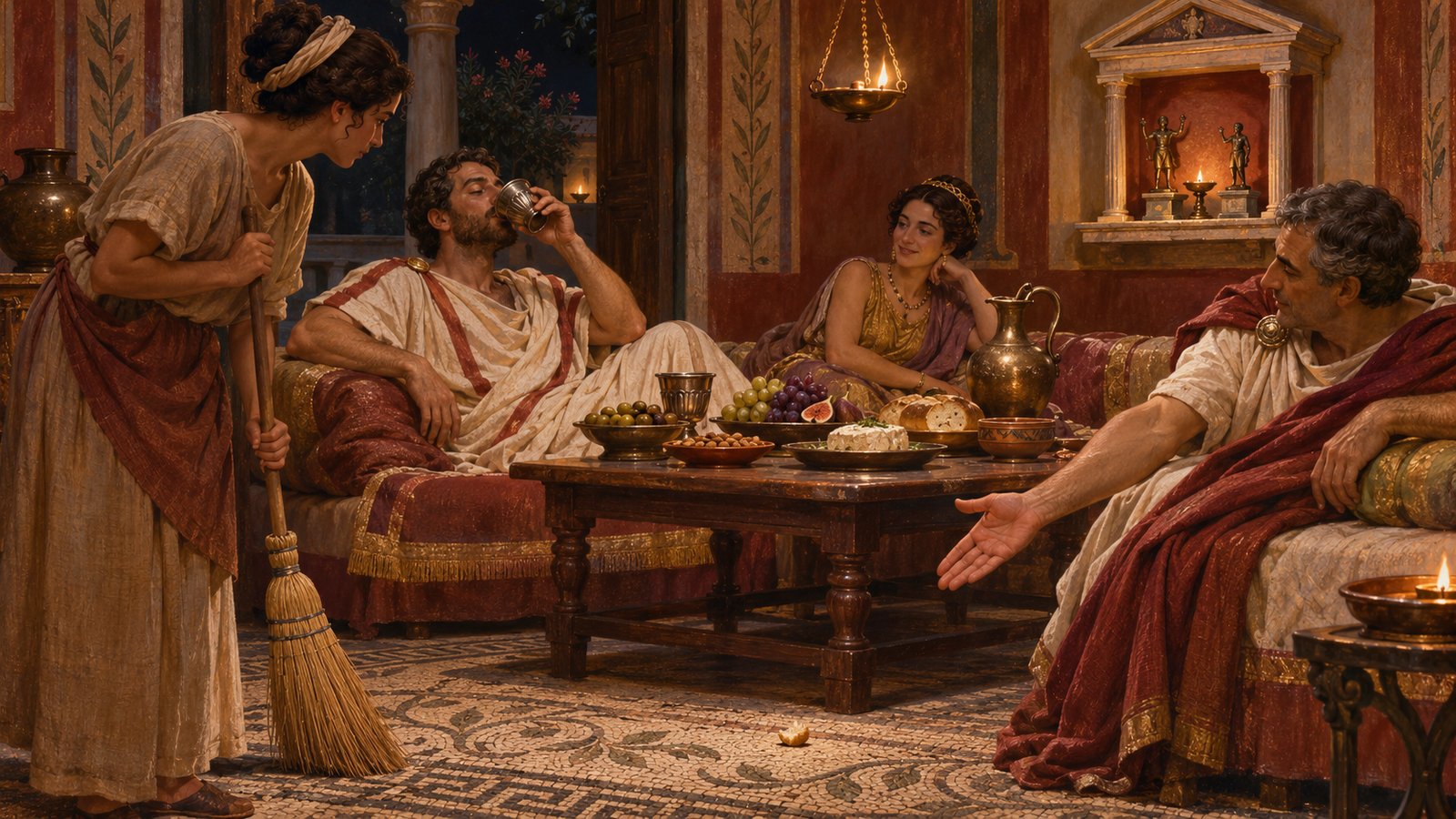
Movement around the meal carried its own risks. Sweeping the floor while someone was rising from table was considered an unfortunate presage. So was removing the table or tray while a guest was still drinking. The problem was not dirt or furniture by itself; it was an action crossing another action at the wrong time.
A household attendant therefore needed ritual timing as well as practical skill. Clearing too quickly could disrupt the social and sacred completeness of the meal. The guest had to finish. The rising diner had to complete the departure. Only then could broom, tray, and table move safely. Domestic service preserved order partly by knowing when not to act.
This concern makes sense in a dining room where rank and placement were already legible. The most important place at a Roman dinner was structured into the arrangement of couches and guests. Pliny adds another layer: time itself had positions. A servant’s efficient motion could become a bad sign if it overtook a guest’s unfinished moment.
The customs also reveal how fragile a shared meal could appear. Plates, cups, bodies, speech, and sweeping all moved in close proximity. The rules made that complexity manageable. They slowed the transition from eating to clearing and gave everyone a recognizable boundary between a meal in progress and a meal concluded.
A fallen morsel still belonged to the meal
Food that slipped from a guest’s hand did not simply become waste. Pliny says that in former times it was returned to the table. Blowing on it to clean it was forbidden. The accident had produced a sign, and ordinary hygiene could not erase that status with a puff of breath.
The rule preserved continuity. A morsel that had belonged to the meal still belonged to it after touching the floor. Replacing it acknowledged the accident without pretending it had not happened. The food did not need to be eaten again; it needed to be restored to the ritual field of the table.
Pliny says auguries could be drawn from the words or thoughts present at the moment food fell. That made context decisive. The same physical event might acquire a different meaning depending on what had just been said or considered. A dropped morsel was not a fixed code. It was an interruption that invited those present to connect accident, conversation, and expectation.
For a pontiff celebrating the feast of Dis, the fall of food was especially dreadful. The prescribed response was exact: place the morsel back on the table, then burn it in honour of the Lar. The domestic guardian received what the disrupted meal could no longer hold. Fire, dangerous when summoned casually in conversation, became controlled expiation in a formal sequence.
The gods were present without a ceremony beginning
Pliny gives his own explanation for the cluster. These usages, he says, were established by people who believed the gods were ever present in human affairs and at every hour. Divine attention was not switched on by a priest and off when sacrifice ended. It extended into a sneeze, a tingling ear, an awkward silence, and the handling of crumbs.
That continuous presence did not make every dinner solemn. The details imply habit rather than terror. A guest could talk, drink, laugh, and still know that a few actions had to be completed correctly. Religion was woven through sociability, not set against it. The household managed risk while continuing the meal.
Other Roman rules placed similar boundaries around sacred specialists. The article on why a knot could stop Jupiter’s priest shows restrictions carried through clothing, thresholds, and nights away from home. Dining customs spread a lighter but wider net. They applied not only to one priestly body but to guests, attendants, furniture, and food.
Pliny is also a critical witness. He does not ask modern readers to accept every omen. He gathers practices because their persistence demonstrates something about belief. People may deny that words possess power in theory, yet still salute a sneeze and pour water when fire is named. Behaviour can preserve convictions more stubbornly than argument.
One room held conversation, labour, and omen
The dining room in this passage is neither a temple nor a merely private refuge. It is a working household space. Guests speak and drink. Attendants wait to sweep and clear. Food falls. Water is poured. A Lar receives a burnt offering. Social, practical, and sacred actions occupy the same few metres.
That overlap is what makes the customs valuable. Grand public rituals show Rome representing itself. Table rules show people negotiating uncertainty at hand level. The materials are a cup of water, a broom, a tray, and a morsel. Their meanings depend on timing and relation.
Pliny’s Romans did not need to stop dinner and announce that religion had begun. The meal had never been outside it. A word could call up danger, a gesture could answer, and a servant’s pause could keep the evening in order.
The customs also depended on witnesses. Water beneath the table meant something because the diners had heard the dangerous word. Waiting to sweep meant something because the rising guest and the attendant shared the pause. Returning a morsel meant something because everyone had seen it fall. These were small public acts inside a private room, making the household itself responsible for remembering the proper sequence.
That shared memory explains why Pliny could cite the practices without describing a written manual for them. Repetition taught the rules. Older diners corrected younger ones; attendants learned the rhythm of clearing; hosts knew which accidents required repair. The table carried tradition through hands and timing as effectively as a formal inscription carried a decree.
Sources
Pliny the Elder, Natural History 28.5.