
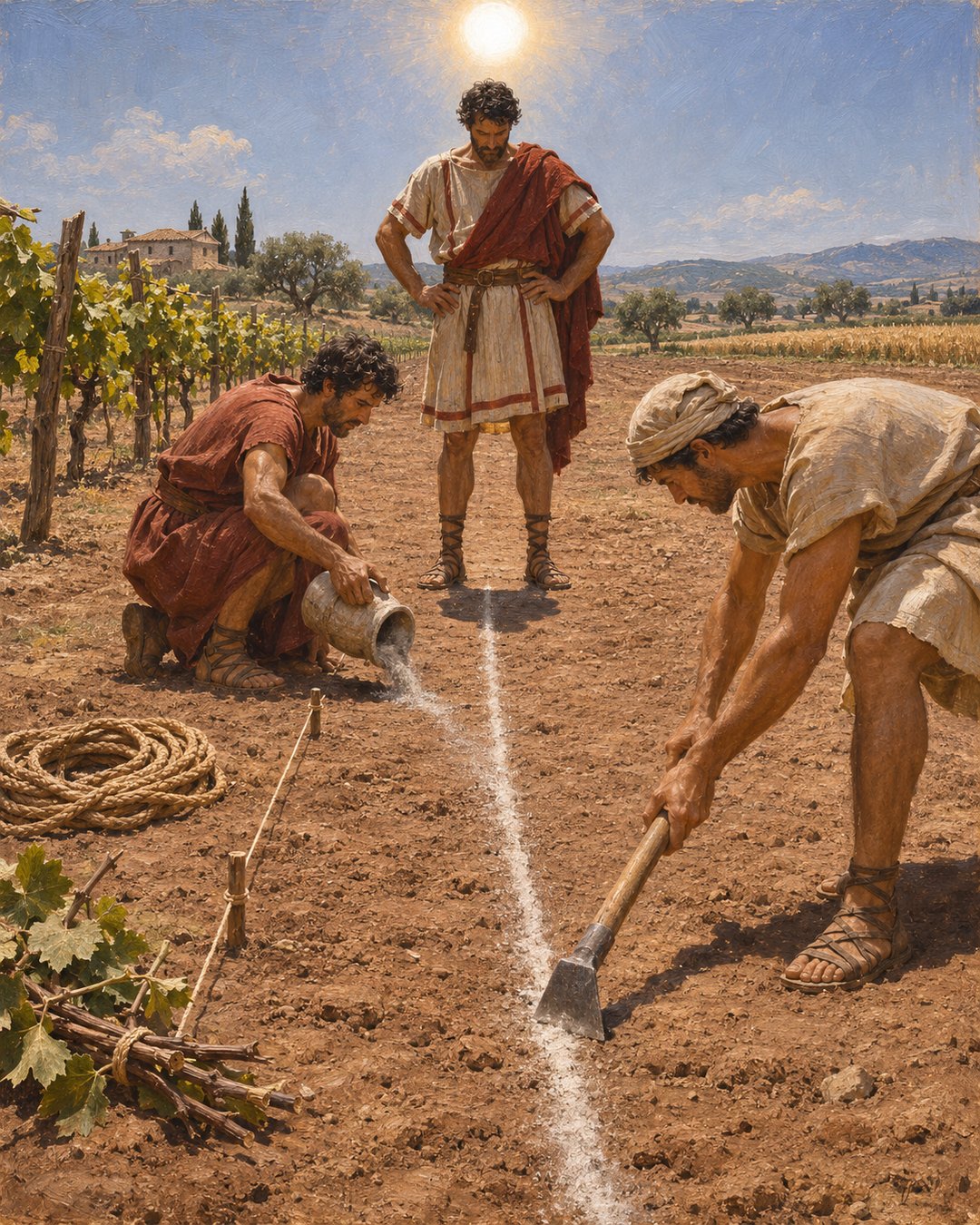
A handful of ash could disappear under one gust, yet Pliny the Elder asked a farmer to trust it with the orientation of an entire field. His method needed no engraved instrument and no permanent survey monument. It began with a person standing in sunlight at the sixth hour, waiting until the shadow in front of him became as short as it would be. A hoe, a measured line, and a small circle scratched into the ground did the rest.
This was not abstract astronomy placed decoratively inside an agricultural book. Pliny connected the resulting directions to choices that could wound or protect living plants: where a pruning cut faced, when a wind made ploughing unwise, and which aspect suited a vine or fruit tree. The procedure shows Roman technical thinking at its most portable. Knowledge moved into the field because the farmer’s own body became the first instrument.
The shortest shadow fixed the first line
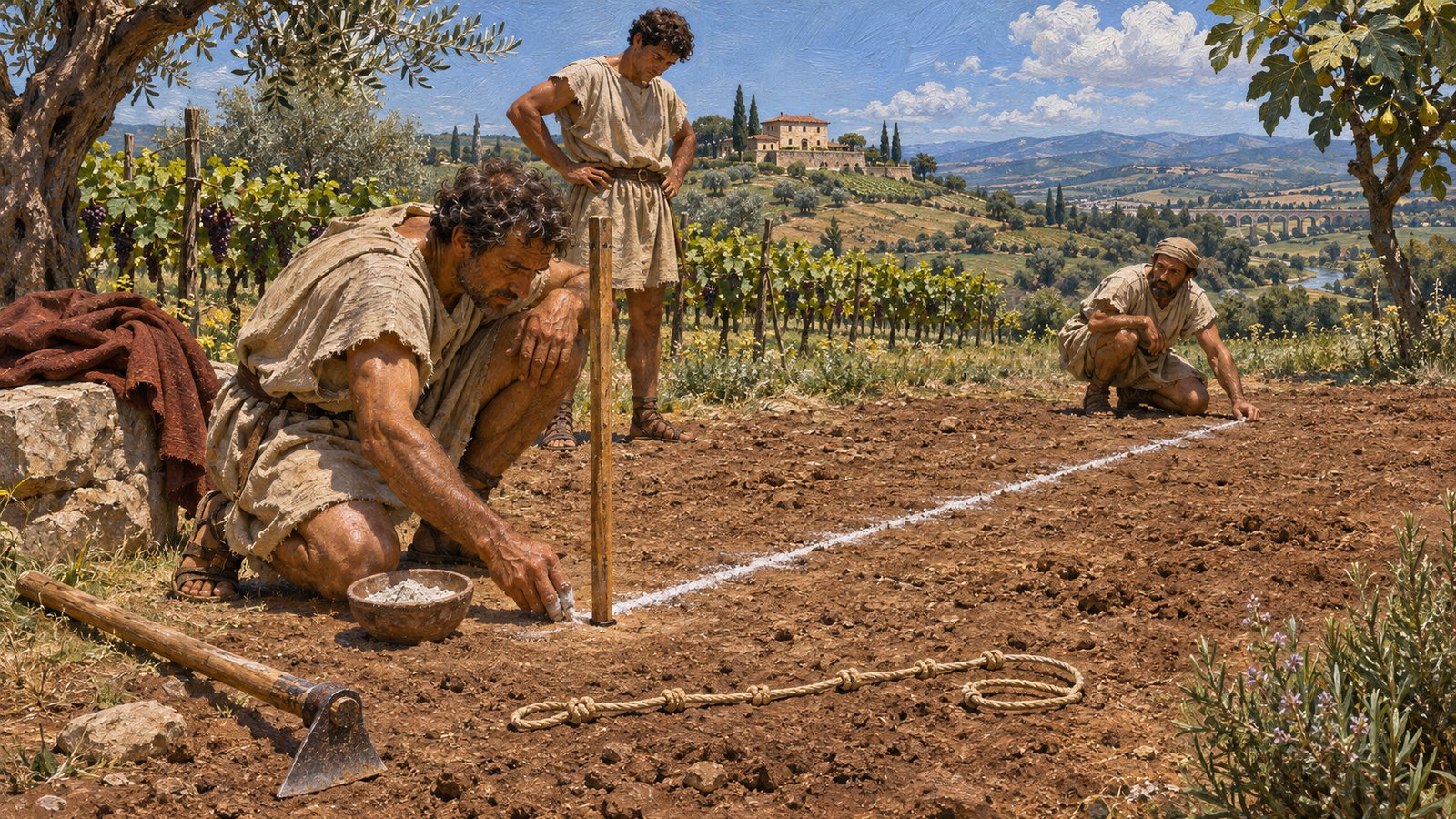
Pliny starts before the mark is made. The observer notes the quarter in which the sun rises on that particular day. At the sixth hour, he stands so that this sunrise point lies on his left. South is then in front and north behind. The line that would run through the field on that axis receives a technical name in his explanation: the cardinal line.
The instructions require movement rather than a single glance. The observer turns around to look toward the shadow that had been behind him. In the new position, sunrise lies to the right and sunset to the left. The decisive instant arrives when the shadow directly ahead is shortest. That detail matters because sunrise does not occur at the same point on the horizon every day. Pliny later warns that east must not simply be guessed from habit.
The scene is easy to reconstruct physically. A worker stands on open soil while another watches the shadow contract. At the chosen moment, the head of the shadow gives one end of an axis and the feet give the other. The body supplies a vertical reference; the sun supplies the moving light; noon supplies the repeatable moment. None of these parts works alone.
Roman farming texts often preserve this kind of tightly sequenced labour. The recently described Gallic wheeled harvester also makes sense only when the order of animal, frame, teeth, and crop is kept straight. Here the sequence is turn, wait, mark, divide, and interpret. A field direction is produced by actions, not by a label.
Ashes turned sunlight into a working diagram
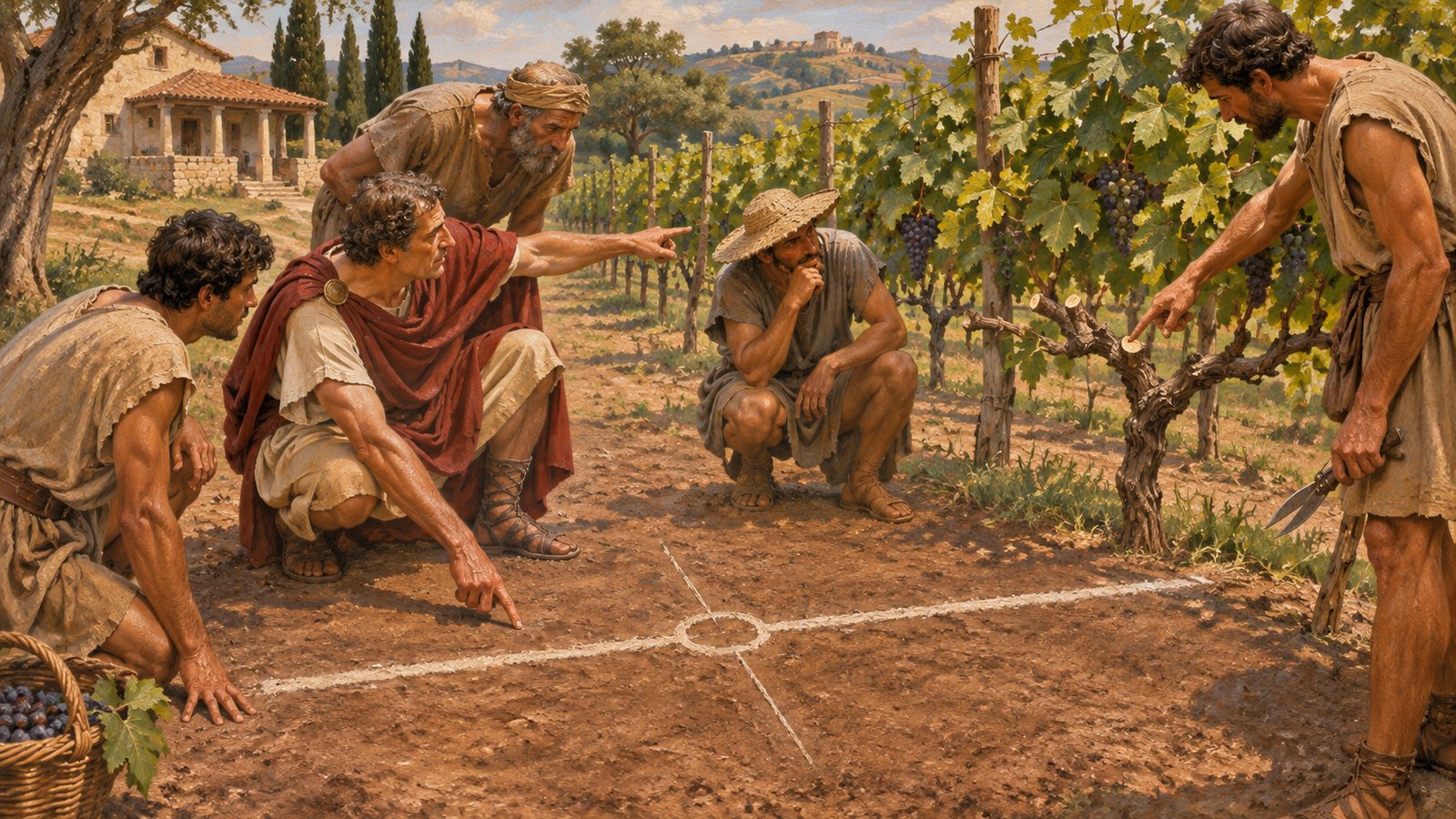
Once the shadow is in place, Pliny offers two ways to preserve it. A furrow can be traced lengthwise with a hoe. Alternatively, the worker can draw a line with ashes, about twenty feet long. At its midpoint—the tenth foot—a small circle is described. Pliny calls that circle the umbilicus, the navel.
The word is revealing. The diagram is organized around a centre that joins its parts, just as a navel marks the centre of a body. The end toward the shadow’s head indicates the point from which the north wind comes. The stretch between the central circle and the observer’s feet points toward the south wind. A temporary pale streak on brown earth has become a directional model.
Ash was well suited to this stage. It was visible, cheap, and easy to extend or correct. It could show a line without requiring a trench across cultivated ground. Yet its fragility also meant the workers had to complete the observation deliberately. Wind, a misplaced foot, or ordinary field traffic could erase the evidence. Precision did not require a precious material; it required attention while the material still carried the result.
The twenty-foot length gave room for error to become visible. A very short mark could drift noticeably if the observer misplaced its end. A longer line allowed assistants to stretch a cord, compare both sides of the central point, and carry the axis outward. Pliny does not describe every helper, but the operation belongs naturally to cooperative field work rather than solitary contemplation.
The wind entered every pruning cut
Finding north and south was only the beginning. Pliny immediately applies the directions to plants. Pruning cuts should not face the northern point. Vines and vine-supporting trees generally should not take that aspect either, though he names African, Cyrenaican, and Egyptian climates as exceptions. A rule had to be adjusted to place.
The south demanded its own caution. In Italy, Pliny describes that wind as humid or fiercely hot; in Africa, he says it brought intense heat and clear weather. Bearing branches could be trained toward it in Italy, but fresh wounds in trees and vines should not. The same point on the diagram therefore did not carry one universal meaning. It had to be read through climate, crop, and operation.
Pliny also tells farmers not to plough when the north wind blows and not to fell timber or touch the vine under the south wind. Whether every recommendation survived practical testing is less important than the structure of the advice. Direction, weather, plant tissue, and timing form one decision. The ash line did not predict everything; it organized the questions a farmer had to ask.
That sensitivity to placement appears elsewhere in Roman agricultural planning. Rooms for baths, ovens, and water storage could be separated from wine spaces because heat and moisture threatened the product, as the article on Roman wine-room planning shows. In both cases, orientation was a material safeguard, not an aesthetic afterthought.
A portable compass before the compass
Calling this method a compass would be anachronistic if it suggested a magnetized needle. Nothing in Pliny’s procedure points north automatically. The observer must know the day’s sunrise quarter, wait for the correct hour, turn his body, and interpret the shadow. It is better understood as a field algorithm: a repeatable chain that converts celestial movement into lines on the ground.
The equipment list is strikingly modest. A hoe already belonged in the field. Ash came from a hearth or fire. Measuring twenty feet required a known pace, rod, or cord, not an elaborate device. The central circle could be drawn with a stick. Technical access depended less on owning a specialist instrument than on remembering the sequence accurately.
That portability also made instruction vulnerable. Skip the turn, choose a long morning shadow, or assume that sunrise always marks the same east, and the final directions drift. Pliny’s repeated positional language guards against those mistakes. The prose acts like a supervisor: left, front, back, turn, right, left, shortest, middle. Each word keeps the body and diagram synchronized.
The method therefore belongs to craft as much as science. It is learned through performance. A novice could watch an experienced farmer establish the line, then repeat the procedure on another plot. The result was visible enough for a group to inspect. If the ash axis disagreed with an established boundary or known wind, the workers could question the setup before committing a row of vines.
A field carried a small model of the sky
At the end of the operation, the sky had not been reduced to theory. It had been brought down to the scale of feet, furrows, pruning wounds, and planting rows. The small circle at the centre held together sun, shadow, north wind, south wind, and human labour. It was temporary, but the decisions made from it could shape a field for years.
That is the real force of Pliny’s passage. Roman technical culture did not always hide inside monumental aqueducts or surveying equipment. Sometimes it appeared as a worker turning at noon and another worker sprinkling ash along a shadow. The intelligence lay in coordinating ordinary things precisely enough that they became more than ordinary.
The ash line vanished. The vines did not. Their aspect, their cuts, and the days on which they were handled carried the diagram forward after weather and feet had erased it from the soil.
Sources
Pliny the Elder, Natural History 18.76.