
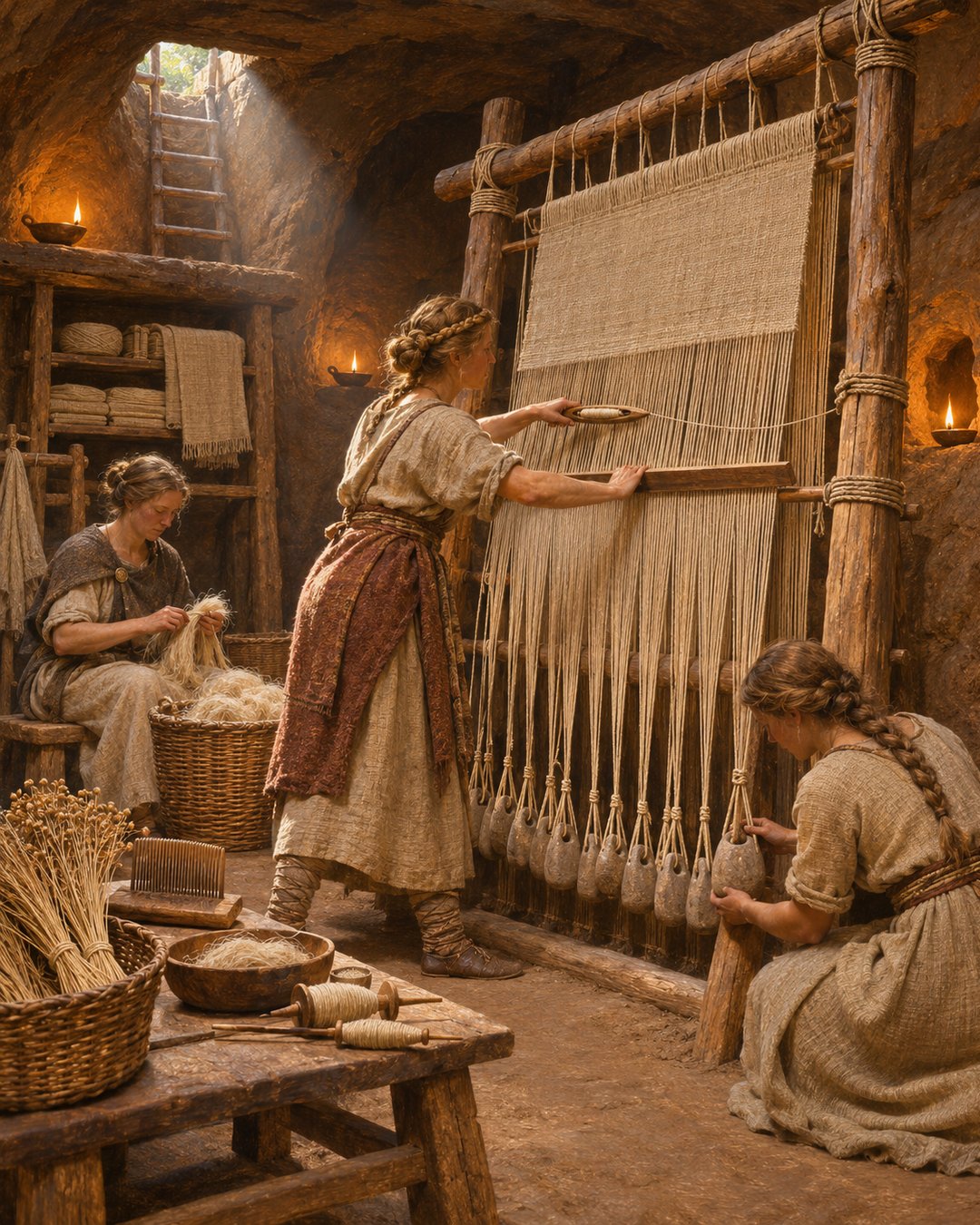
Pliny the Elder placed some of the Roman world’s linen looms where daylight barely reached: in caves deep underground.
He first assigns the practice to Germany, then says the same thing happened in the Alian territory of northern Italy, between the Po and Ticino rivers. The detail is easy to turn into picturesque mystery. Yet Pliny gives no ritual explanation and no tale of hidden guilds. He puts the caves inside a practical survey of fibres, weaving regions, finished quality and price.
The underground room mattered because linen was judged through the cloth and through the thread itself. Whiteness, fineness, substance and even the sound of a strand tested against the teeth could separate one product from another. The cave belonged to a working landscape of fields, water, looms, markets and specialized local reputations.
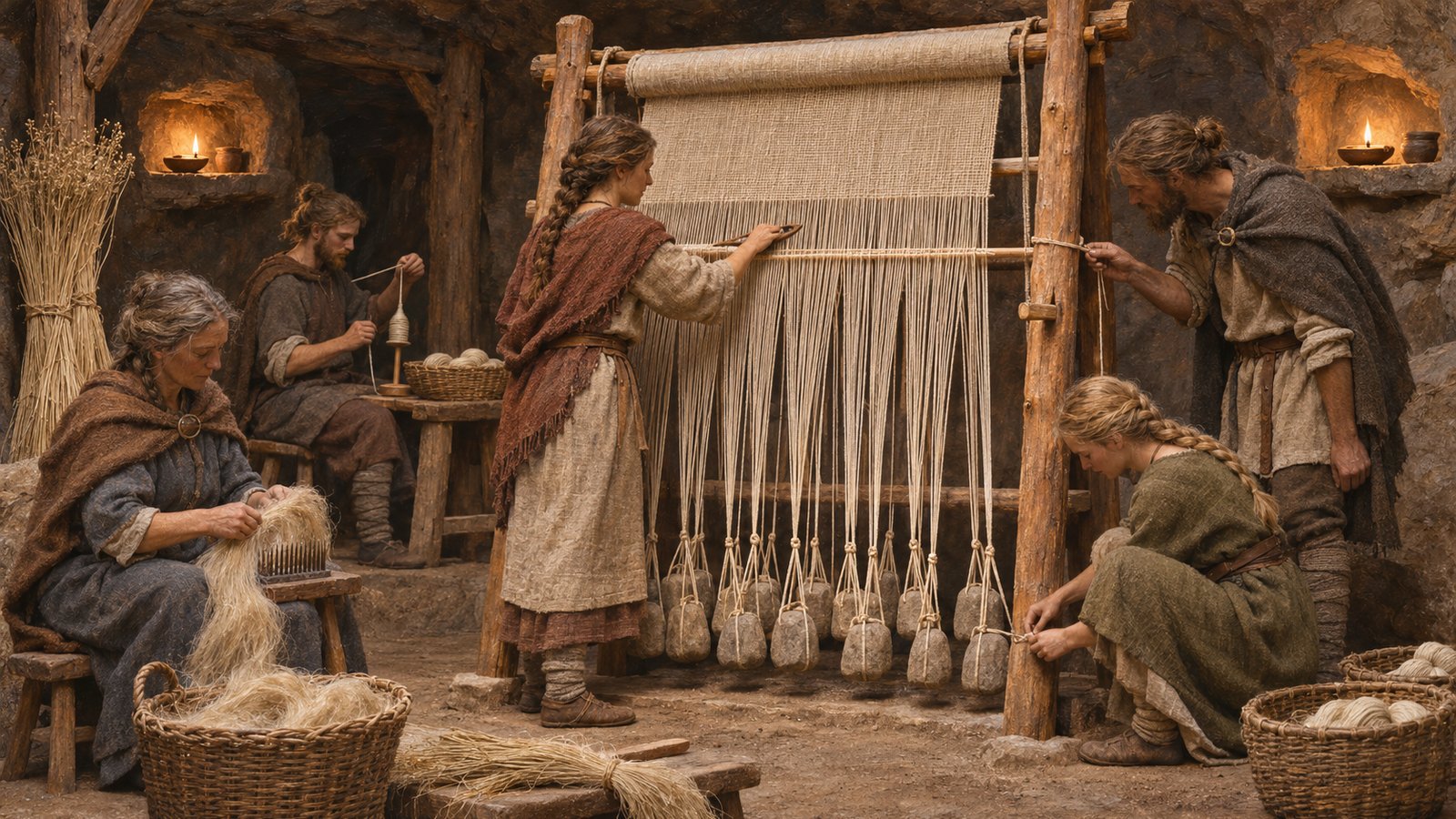
The workshop sat below a landscape of flax
Pliny begins with the crop. Flax, he says, was commonly sown in sandy soil after only one ploughing. It grew quickly, from spring sowing to summer pulling, and he believed it exhausted the ground. Before there could be an underground weaving room, there had to be a field, a harvest and a chain of preparation that turned stalks into workable fibre.
His geography then expands rapidly. Egyptian flax helped carry merchandise from Arabia and India. Several peoples of Gaul wove sailcloth. Communities beyond the Rhine had learned linen production. Spain, Campania and northern Italy supplied fibres or finished goods associated with distinct uses and qualities.
Inside that map, the caves are not isolated curiosities. They are workshops in regions already participating in production. Pliny says German linen weavers worked deep underground and immediately adds that the Alian territory used the same arrangement. The parallel matters: this was not presented as an inexplicable custom of one distant people.
The source does not tell us the cave’s temperature, humidity, lighting system, depth, ventilation or loom type. Those details cannot be supplied as fact. A responsible reconstruction can show constrained light and an earth-cut room, but it should preserve the uncertainty around why this setting was chosen.
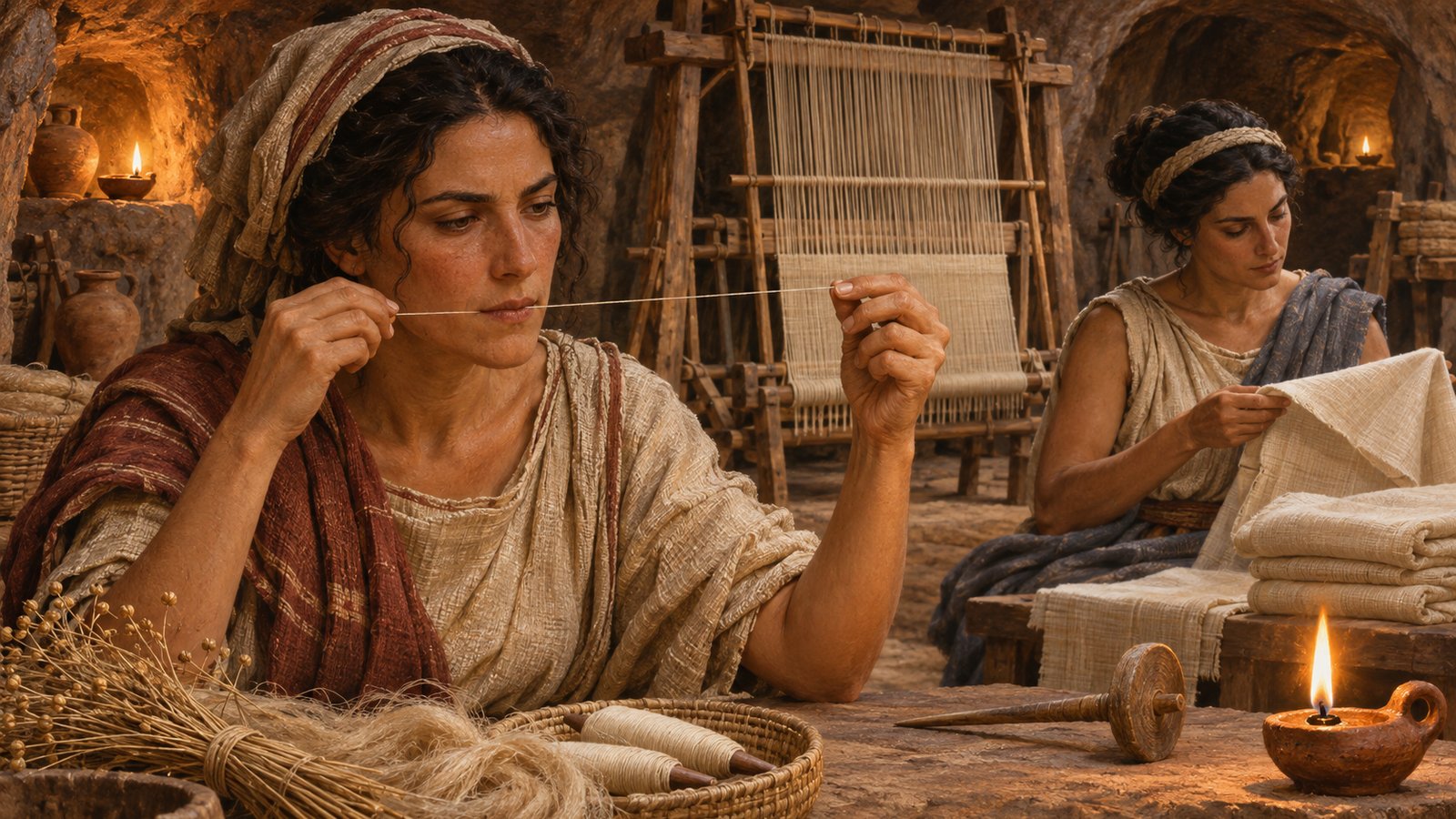
Pliny ranked cloth by feel, colour and body
The Alian territory’s linen held third place among European products in Pliny’s ranking. He places other centres above it and distinguishes their strengths. Faventian cloth was preferred for whiteness. Alian linen remained unbleached. Retovian linen combined fineness with substance and matched Faventia in whiteness.
These were not interchangeable compliments. Fineness could make a cloth delicate, but Pliny also valued “substance,” a sense that the material retained body. A downy nap pleased some buyers and displeased others. Whiteness could be prized in one market while an unbleached finish identified another origin.
The distinctions resemble the way Roman writers compared other manufactured materials. The small mechanics of spinning preserved in spindle whorls came before the finished cloth, while regional reputation formed after many repeated acts of spinning and weaving.
An underground workshop therefore produced something judged in bright public settings. Merchants and buyers did not need to see the loom room to recognize a local product. Texture, colour and finish carried the workshop’s reputation outward.
A clear twang could double the price of thread
Pliny’s most sensory test concerns thread. A particular flax thread was strong, smooth and even, almost like a spider’s web in his admiring comparison. Tested with the teeth, it gave a sharp, clear twang. He says that quality allowed it to sell for twice the price of other kinds.
The test joined several kinds of evidence in one brief action. Teeth could feel regularity and resistance. Tension could reveal whether a strand held together. Sound supplied another clue: a clean note rather than a weak or uneven response. Pliny does not explain a formal standard, so it would be wrong to imagine every merchant following an identical calibrated procedure. He does show that quality could be handled and heard.
Price translated this embodied judgment into economic consequence. A thread that looked fine but failed under tension would not support the same reputation. Smoothness without strength was insufficient. The valuable strand combined delicacy, evenness and load-bearing coherence.
That combination also links linen to the broader principle by which twisted fibres shared a load. Thread, cloth, sail and net all depended on many weak plant fibres becoming useful through preparation and alignment.
One fibre served sails, clothes and trapping nets
Pliny’s chapter moves from fine cloth to hard service. Gallic communities made sailcloth. Flax from Zoela in north-western Spain was especially useful for hunting nets. Cumaean flax in Campania served fishing, fowling and hunting, and Pliny marvels at nets that could resist boar bristles and even a knife edge.
Those uses help explain why regional distinctions mattered. A sail demanded strength across a broad woven surface. A fine garment rewarded softness and appearance. A hunting net had to hold under sudden force. The same plant entered different technical systems, and producers cultivated reputations for meeting particular demands.
Pliny also associates lustrous Spanish linen with the waters near Tarraco. He does not reduce all quality to the field. Water, processing, spinning, weaving and finishing could each affect the object that reached market. The cave workshop belongs to this extended process, not merely to the moment when threads crossed on a loom.
Women beyond the Rhine, in Pliny’s account, prized linen for beauty, while Roman and provincial economies also used it to move ships and restrain animals. The fibre joined adornment to infrastructure. That breadth made careful grading profitable.
The darkness should not become the whole story
The phrase “caves deep underground” is the irresistible detail, but it is also the point most vulnerable to invention. Pliny never says that secrecy drove weavers below. He does not claim that darkness improved colour or that a stable underground climate protected the thread. Any of those explanations would go beyond his text.
What can be said is narrower. Linen weaving occurred in underground spaces in two regions he names. Those regions sat within a wide market of differentiated goods. Cloth was judged by whiteness, fineness, substance and finish. Thread could be tested by touch, tension and sound, and exceptional quality commanded a premium.
An accurate image should therefore show work rather than fantasy: a plausible loom, prepared thread, earthen or rock-cut walls, controlled lamps and people handling fibre. It should not turn the scene into a mine, a sanctuary or a secret society. The visual hook is the location; the historical subject is skilled textile labour.
The finished linen eventually left the cave. Its origin could become invisible, but its even thread, clear twang and woven body remained. Pliny’s underground workshop is a reminder that Roman material culture often emerged from spaces far removed from the bright rooms where it was bought, worn or praised.
It also shows how a reputation could join place to performance. Buyers might know Retovium for fine but substantial cloth or Faventia for whiteness without meeting the people who spun and wove it. A doubled thread price condensed many hidden stages into one market judgment. The strand had to survive handling; the cloth had to preserve the qualities attached to its region.
The cave is therefore not an exotic footnote detached from commerce. It is one end of a route that led from sandy soil and pulled flax through preparation and weaving to sails, garments and nets. Pliny’s survey keeps moving between rooms, rivers, towns and uses because linen quality did not belong to a single moment. It was accumulated across the whole chain.
Sources
Pliny the Elder, Natural History 19.2