
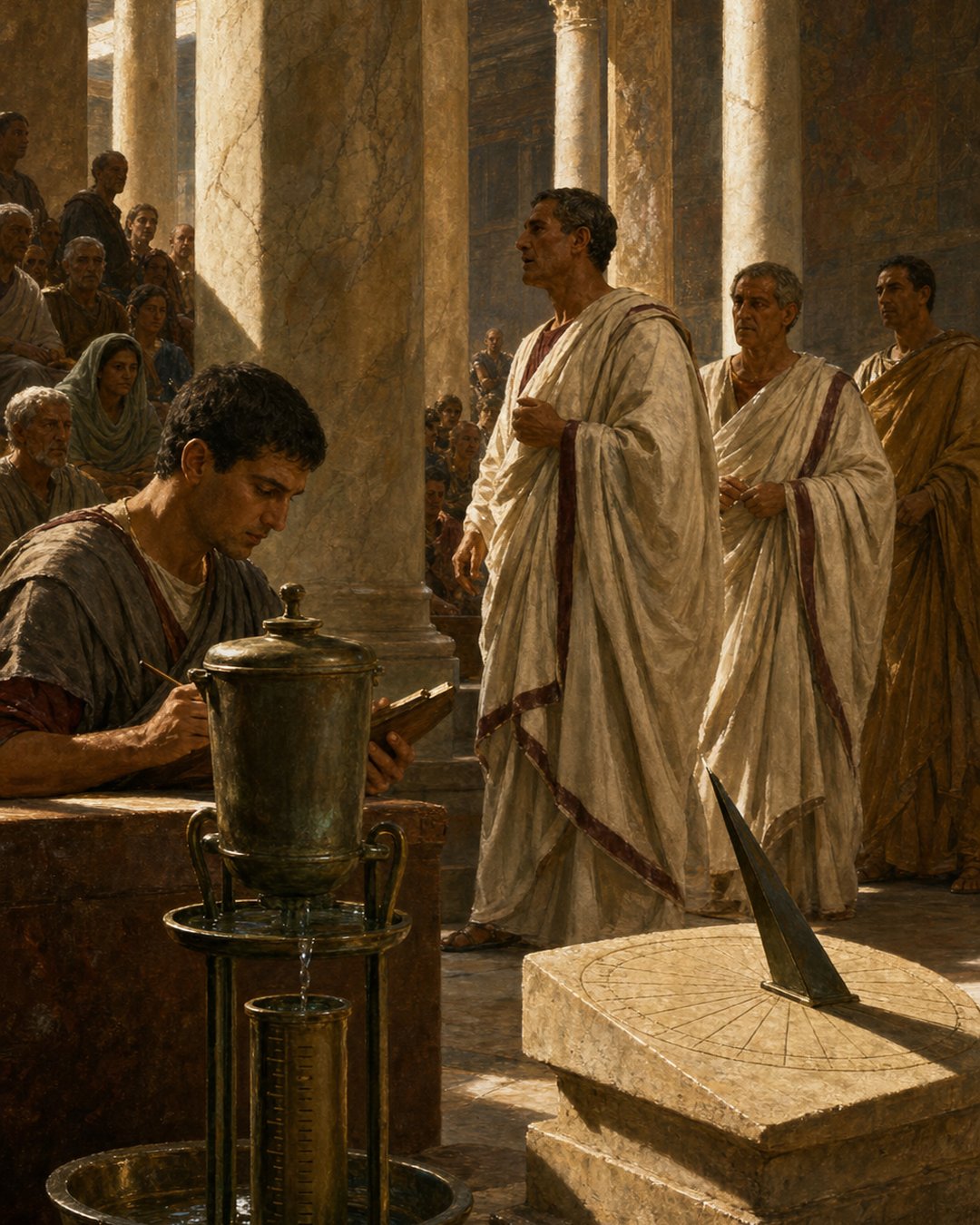
A Roman speech could run out of water. That image feels strange only because modern time is usually invisible: numbers on a screen, a clock on a wall, a vibration in a pocket. In Rome, time could be watched as water dropped, drained, and marked the limit of a voice.
Water clocks mattered because they made time public. They did not make Roman life modern, precise, or mechanical in our sense. They did something more basic and more political: they gave courts, speakers, officials, and crowds a shared object through which waiting and fairness could be measured.
Shadows were useful, but not enough
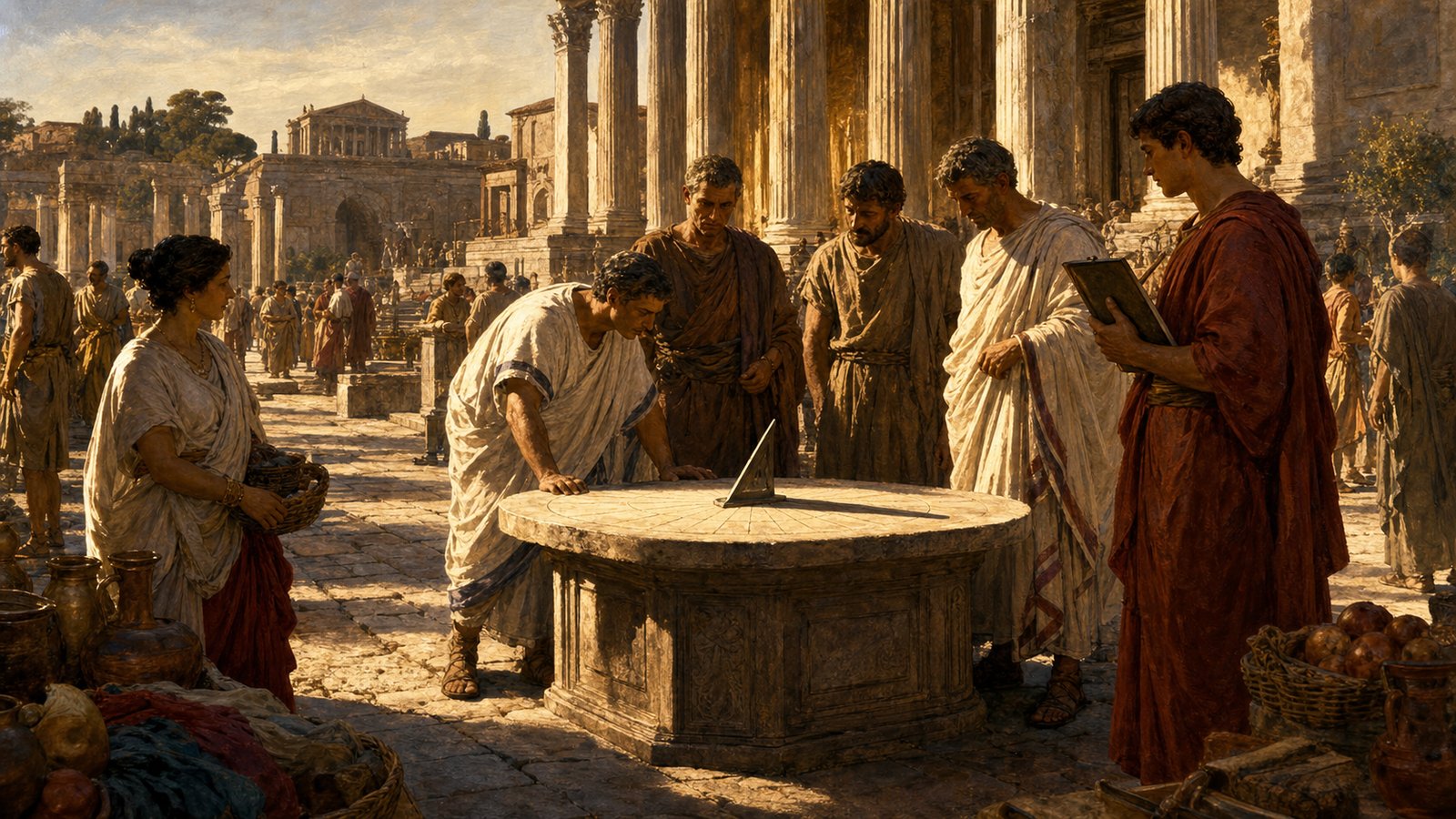
Roman timekeeping included sundials, public clocks, and seasonal hours. A shadow could organize the day in a forum or public square, but shadows depended on light, weather, placement, and season. They were powerful civic tools, yet they could not solve every problem.
A hearing inside a basilica or a controlled procedure under a roof needed another kind of measure. Water supplied it. The clepsydra made time flow in a place where the sun could not easily rule.
The clepsydra made procedure visible
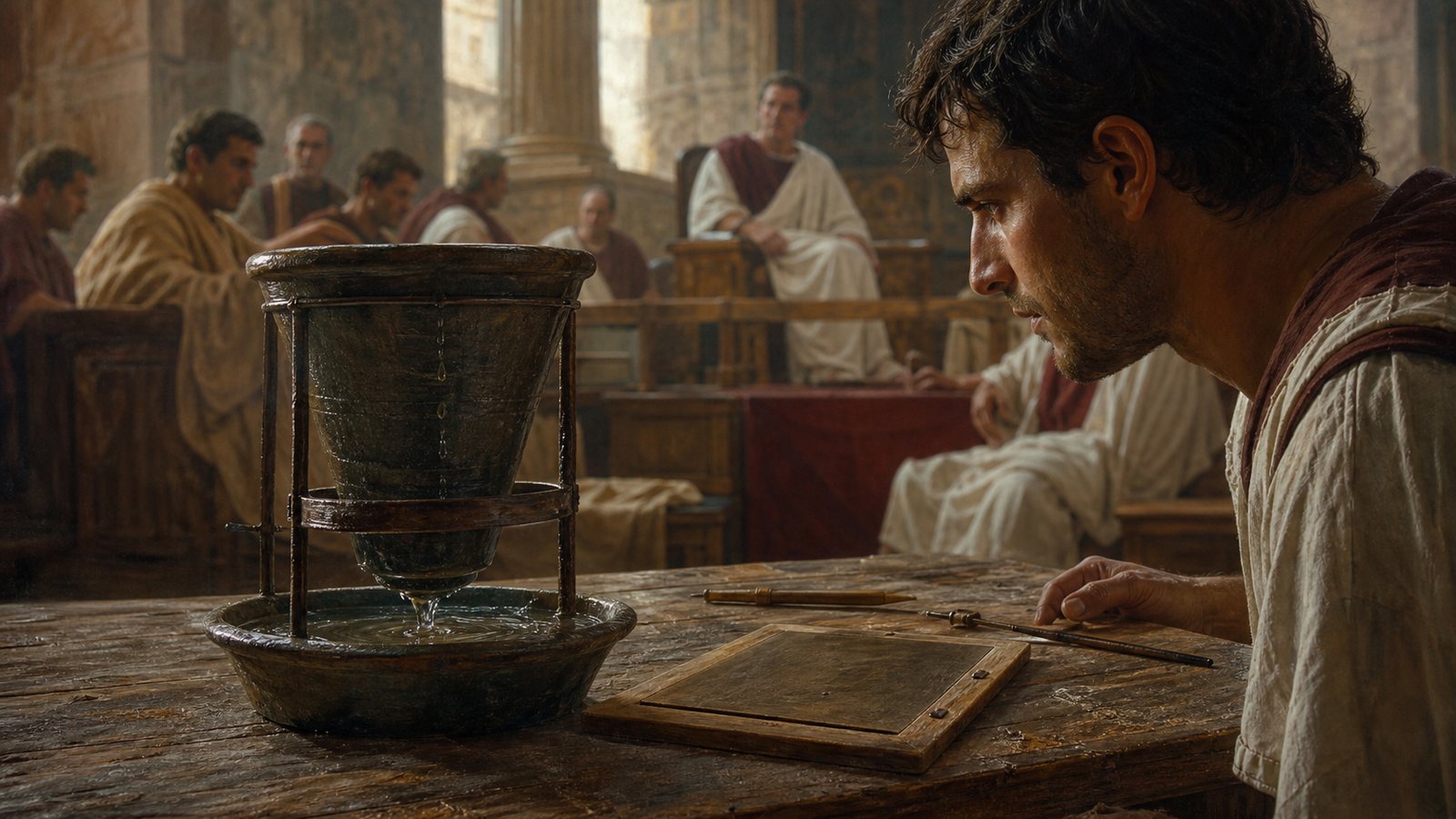
A water clock is simple in principle: water flows, and the movement marks duration. In a Roman setting, that simplicity could matter deeply. If a speaker had only so much time, the limit did not exist merely in an official’s memory. It sat on the table.
Picture a clerk watching the vessel while an advocate speaks. Wax tablets lie nearby, listeners shift in the shade, and everyone understands that the water is part of the hearing. The clock is quiet, but it has authority.
Measured time made fairness feel possible
Time limits do not guarantee justice. A clever speaker can still distort, and a powerful person can still dominate. Yet a visible measure can make procedure feel less arbitrary. It tells participants that at least one part of the contest is being counted.
That was important in a culture that loved speech. Roman public life prized oratory, but uncontrolled speech can become a form of power. A clock helped turn eloquence into a turn-taking system.
Public clocks taught a shared rhythm
The broader Roman habit of public timekeeping changed how cities felt. Clocks in civic spaces gave people common reference points for business, appointments, baths, meals, meetings, and obligations. Time became less private because the city helped announce it.
This did not mean every Roman lived by equal modern minutes. Seasonal hours stretched and shrank. But public measurement still mattered. It gave daily life a rhythm that could be discussed, expected, missed, and enforced.
Technology became part of civic trust
The water clock also shows how small technologies can carry trust. A vessel, a mark, a clerk, and a rule can make an argument seem orderly. The device does not need grandeur. Its credibility comes from being visible enough for others to accept.
That visibility is the political point. If a magistrate simply says a speaker has had enough time, suspicion can follow. If water has visibly drained, the decision feels attached to something outside the magistrate’s mood.
Time became an actor in Roman public life
Romans did not need digital precision for time to matter. They needed shared thresholds: when business began, when a turn ended, when a crowd waited too long, when an appointment was missed, when a day’s light was gone. Water clocks and sundials helped make those thresholds social.
This is why Roman water clocks made time public. They transformed passing moments into a visible civic resource. Time could sit on a table, gather witnesses, and tell even a confident speaker that procedure had a limit.
The emotional force of the device is easy to underestimate. A speaker could watch his opportunity literally diminish. An opponent could hope the water would finish. A judge or magistrate could point to an object rather than a feeling. Time became a participant in the room.
The water clock also joined physical motion to social discipline. Drops and levels are ordinary things, but under civic rules they become commands. When enough water has passed, a voice must stop. The material world lends authority to procedure.
That made timekeeping a small cousin of other Roman public technologies: roads, milestones, boundary stones, ledgers, and measures. Each turned a potentially disputed experience into something more visible, countable, and official.
There was still room for manipulation. Devices can be managed, filled, paused, or interpreted by people. But the need for a device tells us that Roman public life wanted procedure to appear accountable. The clock gave accountability a form that people could see.
Public time also shaped urban patience. Markets, baths, courts, and patronage calls all depended on expectations about when things happened. A city without shared time is a city where waiting becomes harder to explain.
The clepsydra therefore belongs in the history of power because it limited power as well as served it. It helped officials manage speech, but it also offered participants a visible standard. The same object could discipline the ambitious advocate and restrain the impatient magistrate.
That is why the image of a speech running out of water is so revealing. It shows a society that understood time as something that could be staged, watched, consumed, and argued over. Roman time was not invisible. In the right room, it had a surface, a sound, and a level falling toward silence.
The difference between public and private time also mattered. A farmer, sailor, or household could judge the day by habit, light, hunger, heat, or task. A court needed something more shareable. It needed a measure that people with opposing interests could not easily dismiss as one person’s convenience.
That shared measure changed the emotional balance of a proceeding. A long speech became not simply tiresome but measurable; a short reply became visibly constrained; a delay became something that had consumed a resource everyone could watch. The clock turned impatience into evidence.
Water also softened the abstraction of time. It made duration material without requiring literacy. Even someone who could not read a tablet could see a vessel lower, a clerk adjust attention, and the room respond to a limit. Civic order was carried by eyes as much as by documents.
This is why the humble device belongs beside more famous Roman instruments of order. The empire measured roads with milestones, land with survey lines, status with names and offices, and speech with water. Each measure made a social world easier to manage because it made a disputed thing visible.
Even imprecision did not make the practice meaningless. Roman hours varied with daylight, and devices needed human handling, but the public act of measuring still changed expectations. People could argue about fairness because a visible public standard had first taught them to expect fairness in the use of shared civic time.
Sources & Further Reading
- Smith Dictionary, Horologium
- Encyclopaedia Britannica, Clepsydra
- Smith Dictionary, Hora
- Pliny the Elder, Natural History, 7
- Cambridge Core, Roman Courts
- Smith Dictionary, Tabulae
- Martial, Epigrams
- Oxford Classical Dictionary, time-reckoning