
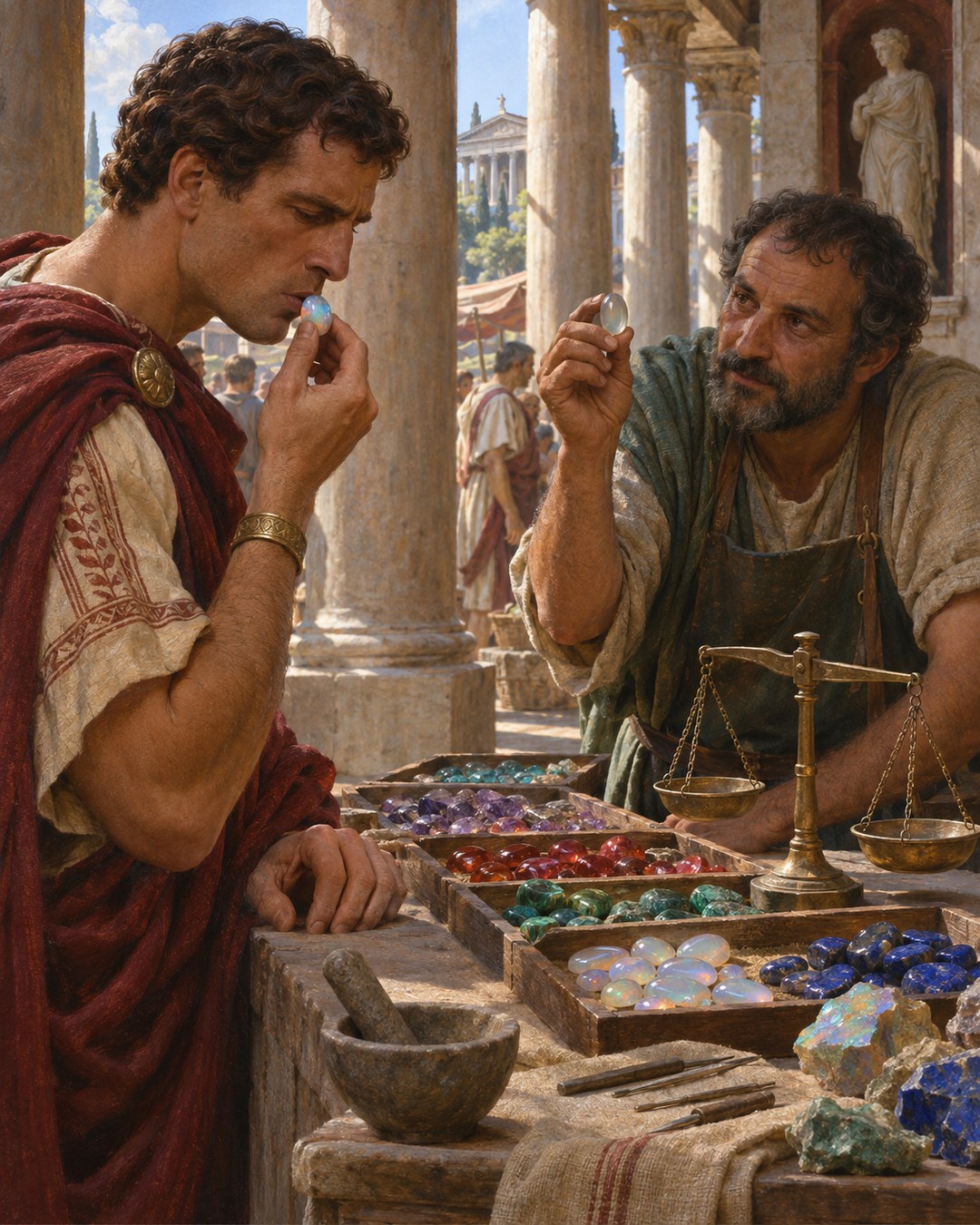
A Roman buyer suspicious of a brilliant stone did not need to begin with a jeweller’s loupe. Pliny the Elder describes a sequence of tests built around ordinary senses: look early, weigh the object, touch it to the mouth, study its interior, and inspect what a harder material did to its surface.
The coolest detail is literal. Pliny says a genuine precious stone should feel cooler to the mouth than an imitation. Glass could reproduce colour and transparency, but the comparison asked whether it also behaved like the mineral it claimed to be.
This was not a foolproof laboratory. It was a market defence assembled from light, touch, weight and controlled damage. Its logic reveals both the sophistication of Roman gem fraud and the practical knowledge buyers brought to small luxury objects.
Morning Light Came Before the Harder Tests
Pliny recommends testing transparent stones in morning light, and no later than the fourth hour if possible. The instruction made illumination part of the procedure rather than a decorative convenience. A stone examined under one light could disclose qualities that a darker room or later glare concealed.
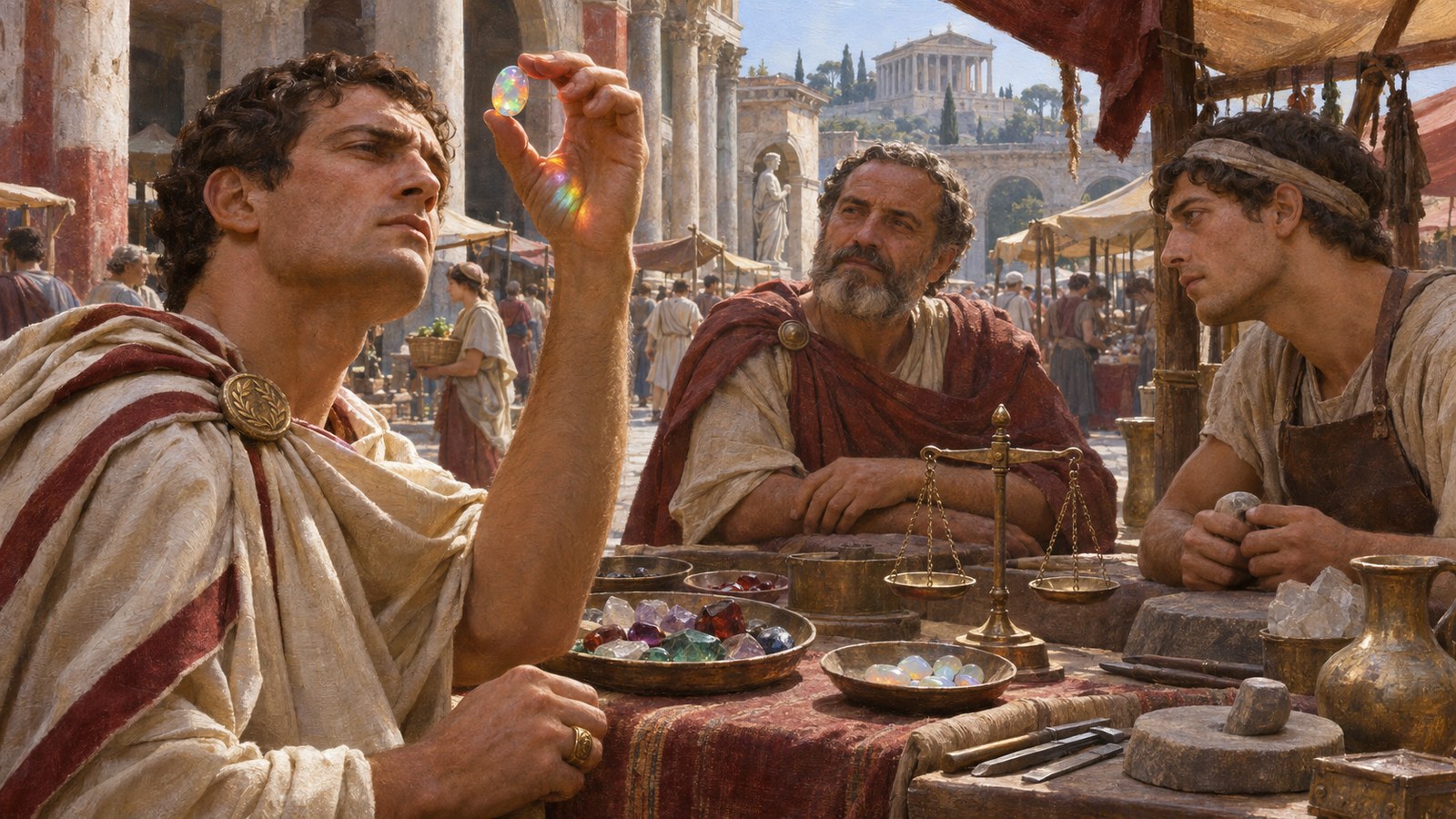
He had already applied sunlight to opals. A false opal held between finger and thumb showed one transparent colour through its body. A genuine one sent successive colours toward the fingers, now one hue and now another. The hand became both holder and projection surface.
That comparison was aimed at a specific fraud. Pliny says no stone was imitated more exactly in glass than opal. The warning matters because it prevents us from imagining ancient counterfeit luxury as crude work that only fooled the careless. The copy could be convincing enough to demand a staged test.
The procedure also separated appearance from behaviour. Colour alone was not the verdict. The examiner watched what the colour did when sun, stone and fingers occupied a particular arrangement.
Weight and Coolness Challenged the Glass Copy
After light came comparison by weight. Pliny states that the genuine stone should be heavier. A buyer therefore needed a plausible reference, whether another stone, prior handling experience or a balance. The point was not simply that heavy meant valuable; it was that materials with similar appearances did not necessarily share density.
Then came comparative coolness at the mouth. The wording implies a contrast, not an isolated sensation. A cool object by itself proved little, but the genuine and fictitious materials could be judged against one another under the same conditions.
The mouth test belongs to a wider ancient world of skilled touch. Craftspeople judged heat, texture, moisture and resistance with bodies trained by repetition. Here the buyer’s lips supplied a sensitive contact surface for a tiny polished object.
Roman craftspeople also understood that finishing altered what a surface revealed. The stages by which abrasives brought stone toward a shine appear in the Roman sequence from coarse grit to polish. A fraud test had to look beyond that persuasive finish.
Bubbles and Uneven Brilliance Betrayed the Interior
Pliny next directs attention into the body of the imitation. He lists blisters, which fit the trapped bubbles that can survive glassmaking, along with surface roughness and filaments. He also notes unequal brilliance and brightness that seems to fail before reaching the observer’s eye.
These are not interchangeable defects. A bubble is a contained pocket; a filament is a line; roughness belongs to the surface; uneven brilliance emerges as the object moves through light. The list asked the examiner to search several visual depths rather than glance once at colour.
The opal discussion offers its own defect catalogue. Pliny mentions a heliotrope-like colour, resemblance to crystal or hail, intervening salt-like grains, surface roughness and sharp points. Some features lowered quality without proving that the stone was glass. Diagnosis required distinguishing a flawed natural object from a fabricated one.
That distinction is central to the market problem. “Not ideal” and “not genuine” were different verdicts. A natural opal could have defects; a glass imitation could appear smooth and attractive. The buyer had to identify the material before negotiating beauty.
Saws, Files, and Obsidian Dust Raised the Stakes
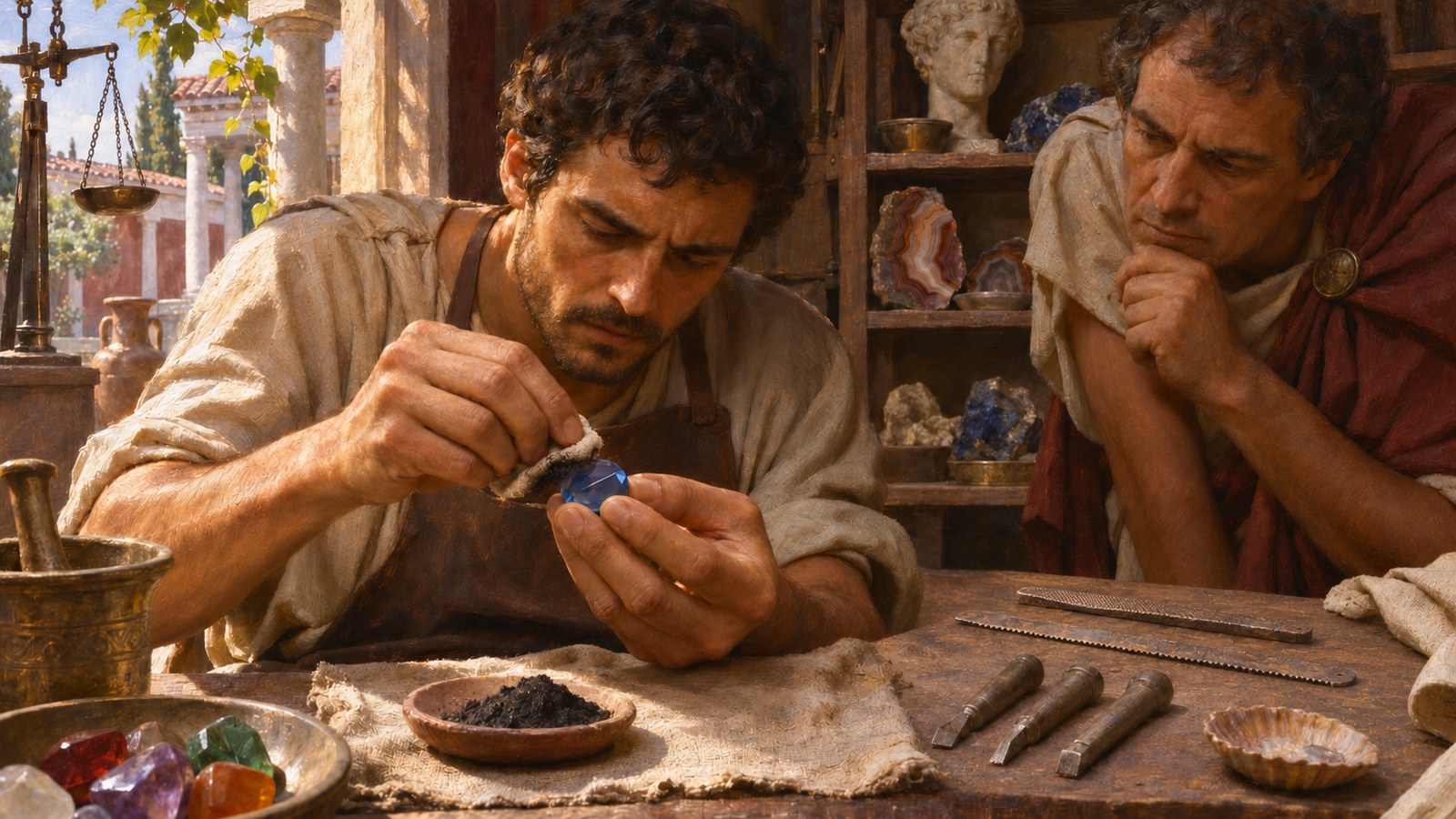
The most decisive test was also the one sellers resisted. Pliny calls striking off a fragment with an iron saw the best method, then immediately says dealers did not allow it. They likewise refused testing with a file. Certainty carried a price because the test could visibly damage the object being sold.
This conflict made non-destructive clues commercially important. A buyer might want proof, while a dealer could reasonably object that a chip or file mark reduced the value of a genuine gem. The transaction turned knowledge into a negotiation over who bore the risk of testing.
Pliny offers another abrasive comparison. Dust from obsidian would not mark a genuine stone, he says, but left a white scratch wherever it touched an artificial one. The test translated an invisible material difference into a visible line.
Ancient lapidaries already worked within hierarchies of hardness. Pliny says some stones could not be engraved with iron, while others needed a graver blunted at the edge. All precious stones, he adds, could be cut and polished with adamas, and heating the graver accelerated the work.
The same hardness that challenged an engraver could therefore support authentication. Cutting knowledge did not sit apart from market knowledge. The workshop taught which tools should bite, skid, scratch or leave a pale trace.
Opal Fraud Shows Why One Test Was Never Enough
Opal makes the full sequence easier to understand. Its appeal came from shifting colours, but shifting colour was also what glassworkers tried to mimic. Pliny’s account moves from a celebrated visual effect to the practical fear that the effect could be manufactured.
He describes the genuine stone as returning different refulgent tints in succession. The false stone, under the specified sunlight test, remained one transparent colour through its body. This was a narrow predicate: not “glass looks dull,” but “watch whether the colour changes as light reaches the fingers.”
Pliny also records where related stones were said to occur—India, Egypt, Arabia, Pontus, Galatia, Thasos and Cyprus—and how preferences could turn on sky-blue, purple, green or wine-like depth. Provenance language and colour vocabulary gave dealers many ways to tell an attractive story. Physical testing offered the buyer a counterweight to the story.
Another Lost Eagles article follows the composite look of three layers sold as a single sardonyx. The present evidence concerns a different mechanism: glass imitating a whole transparent gem. Both cases show why a convincing name was not enough.
We should not turn Pliny’s rules into modern gemology. Some classifications and claims do not map neatly onto present mineral species, and his “adamas” is not automatically every modern meaning of diamond. His text preserves Roman categories and reported practice, not a calibrated instrument manual.
Yet the sequence is coherent. Examine under controlled light. Compare weight and temperature. Look for bubbles, threads and interrupted brilliance. Escalate to scratches or cutting only when the commercial risk permits it. No single clue had to carry the whole verdict.
The mouth test is memorable because it makes luxury tangible. A gemstone could carry an exotic origin, a brilliant colour and a high price, but for one moment it rested against the buyer’s lips as a cool material problem. Roman fraud met its first resistance not in a court, but in the trained senses of the market. The smallest object could demand the most disciplined attention before money changed hands.
Sources
Pliny the Elder, Natural History, Book 37, chapters 22 and 76.