
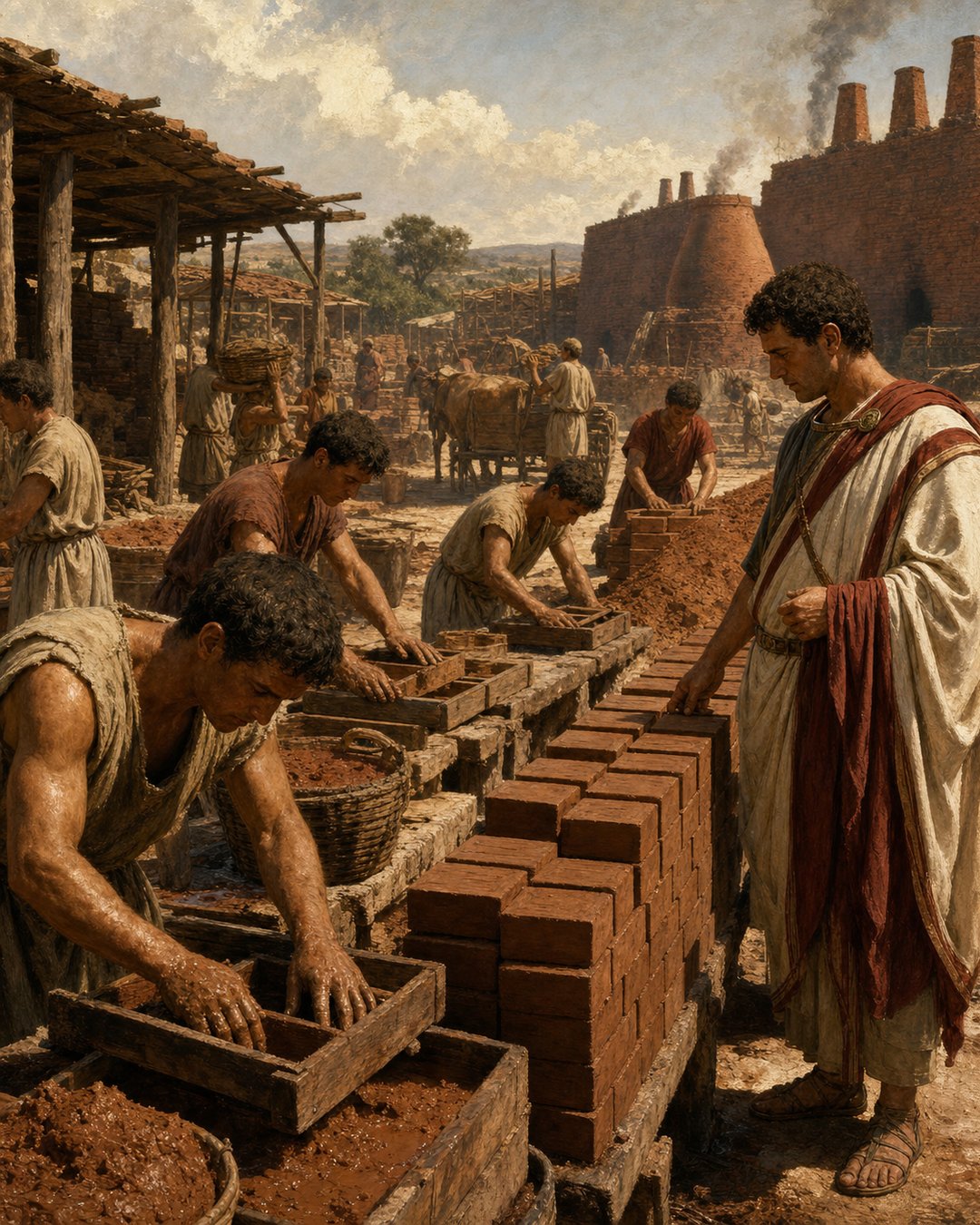
A Roman wall could speak before anyone covered it with marble. Its voice was small, rectangular, and easy to miss: a stamp pressed into wet clay before firing. To the casual eye it was only a mark on a brick. To a historian, it can be a name, a workshop, an estate, a date, and a clue to who profited from the city rising upward.
Brick stamps matter because they turn buildings into documents. They remind us that Roman architecture was not made only by emperors, architects, and monuments. It was made by clay pits, kilns, transport, landowners, contractors, enslaved and free laborers, and estates whose names entered the fabric of the city.
The mark came before the monument
A stamped brick began as wet clay, not as history. Someone pressed a die into it while it was still soft; only later did the kiln harden the surface and make the mark durable. The result was a tiny record baked into construction itself.
That sequence matters. The name was not added after glory arrived. It belonged to the production process. Long before a building received paint, stucco, or marble facing, its supply chain had already left evidence.
Brick made ownership visible
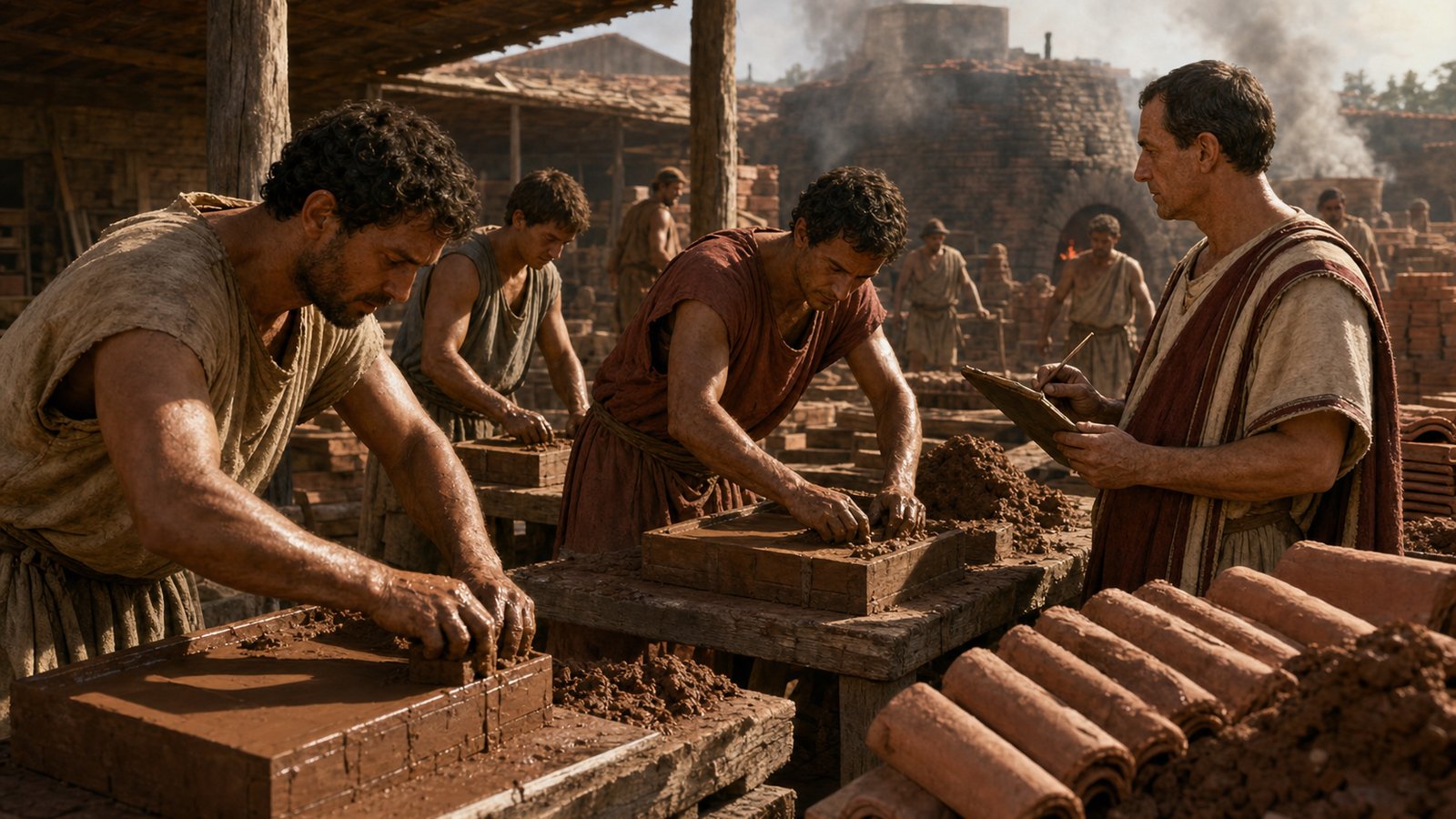
Roman brick and tile production was tied to figlinae, estates, and workshops. A stamp could advertise or identify a producer, owner, or production group. The wall therefore carried more than material strength. It carried the social world that supplied it.
Picture a kiln yard outside the dense city: clay underfoot, moulds on benches, workers stacking bricks, smoke hanging over the yard, and an overseer counting output. The mark pressed into clay connected that scene to a future wall miles away.
Imperial names entered ordinary construction
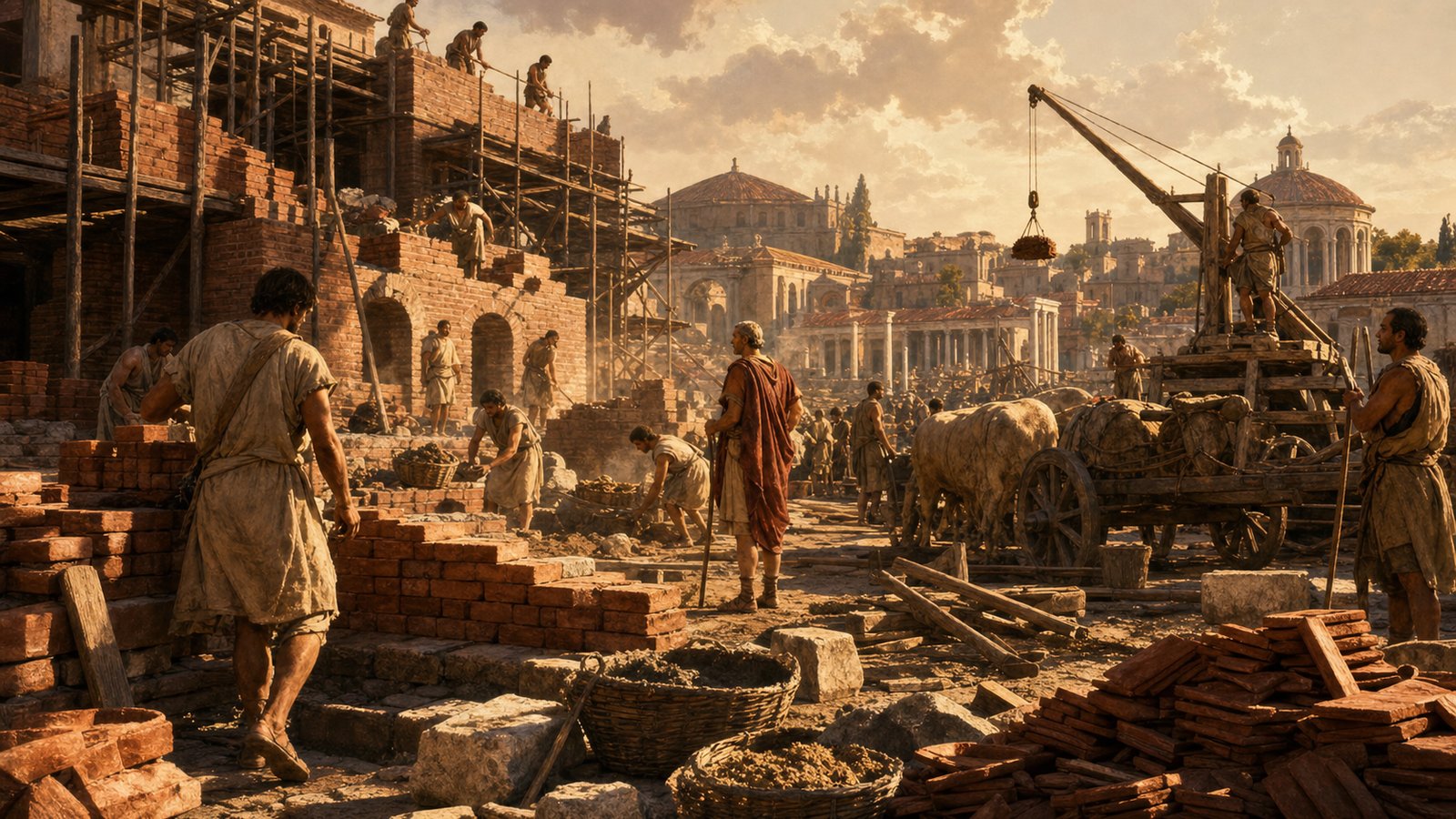
The surprising part is how public an apparently humble object could become. Imperial families and elite landholders could be connected with brick production, and buildings in Rome could preserve those links in the most practical material imaginable. Power did not always need a statue; sometimes it needed a brick stamp.
This makes stamped brick a quiet form of presence. A name could sit inside a bath, warehouse, apartment, or public building, not as a speech but as an embedded claim about supply, property, and responsibility.
Dating a wall can begin with a stamp
Because stamps changed over time, they can help date construction. Archaeologists and historians use them as evidence, not decoration. A wall becomes less mute when one brick can connect it to a workshop, official formula, or production period.
The value is concrete. A stamp may not tell the whole story, but it narrows the possibilities. It can help separate one phase of building from another and show how a city was repaired, expanded, or reorganized.
Labor was hidden in plain sight
Roman monuments often make labor disappear. Finished architecture asks the viewer to admire scale and order, not the hands that shaped clay or fed kilns. Brick stamps partly undo that erasure because they point back to production.
They do not give us every worker’s name. Most labor remains anonymous. But the stamped object at least insists that a building came from a chain of people and places, not from imperial will alone.
The city was an archive of supply
Rome’s greatness depended on ordinary materials becoming reliable at enormous scale. Bricks had to be made, dried, fired, hauled, sorted, bought, and set. A stamp compresses that whole system into a mark small enough to fit in a hand.
This is why Roman brick stamps made buildings speak. They gave walls a memory of how they were produced. Under the surface of grandeur, they preserved the business of making Rome physically possible.
The detail also changes how we imagine Roman power. A decree can order a project, but a city is built through repeated acts: clay cut from the ground, sand mixed with lime, carts creaking toward a site, workers lifting loads, and masons deciding which brick faces outward. The stamp belongs to that repeated world.
It also explains why the mark could outlive the intention behind it. The person who pressed a die into clay might have been thinking about accounts, ownership, or routine identification. Centuries later, the same mark becomes historical evidence. Bureaucratic habit becomes memory.
The humble material is the point. Marble announces itself; brick usually waits behind plaster, revetment, or later ruin. When the covering disappears, the construction fabric begins to tell a different story from the official façade.
For emperors, that mattered because building was reputation. Baths, walls, warehouses, and monuments projected order. Yet the order had to be manufactured somewhere. A brick stamp ties display to the dirtier world of production.
For elite landholders, production could be profitable and politically useful. Estates that supplied building material participated in the city’s growth. Their names did not need to be shouted from the rostra to enter public life. They entered through material dependence.
For archaeologists, a stamped brick is a disciplined kind of clue. It cannot be asked leading questions. It simply sits there with its shape, formula, clay, and context. Interpretation must build outward from that stubborn object.
The stamp also makes Roman buildings less anonymous. A wall is not merely a wall when it can be tied to a workshop or production network. It becomes a surface where ownership, labor, and chronology meet.
That is why the smallest mark can change the largest structure. A bath complex may overwhelm the eye, but a single brick can pull attention back to a human scale: a mould, a hand, a die, a kiln, a cart, a ledger.
The city therefore spoke in layers. Marble spoke of prestige. Inscriptions spoke of dedication. Brick stamps spoke of supply. To understand Rome, we need all three voices, including the one baked quietly into clay.
The pattern is useful because it ties a visible object to a much larger system. A stamp, ditch, mask, road, wall, or speech did not stand alone. It connected property, labor, authority, memory, and spectators in ways that Romans could recognize without needing a modern explanation.
The human scale is just as important as the institutional one. Someone pressed the clay, pulled the rope, lifted the mask, counted the cart, watched the gate, or listened from the crowd. Roman power often became durable through exactly those repeated gestures.
This is also why the topic should not be reduced to a charming detail. The detail matters because it opens the machinery behind the larger story. It shows how Rome converted ordinary materials and routines into public confidence.
If we follow that machinery closely, the monument becomes less distant. It is no longer only an impressive ruin or a famous custom. It becomes a working system made of hands, tools, names, fear, ambition, timing, and memory.
The best Roman evidence often works like this. It begins with something concrete enough to touch and then leads outward into institutions. The small object survives because the system needed it, and the system becomes visible because the object survives.
Sources & Further Reading
- Smith Dictionary, Later
- LacusCurtius, Roman Brick-Stamps
- World History Encyclopedia, Baths of Caracalla
- World History Encyclopedia, Roman Architecture
- Smith Dictionary, Figlinae
- Historia Augusta, Marcus Antoninus
- Metropolitan Museum of Art, Roman Architecture
- British Museum, Roman brick stamp
- Cambridge Companion to Ancient Rome
- Oxford Classical Dictionary, Roman building industry