
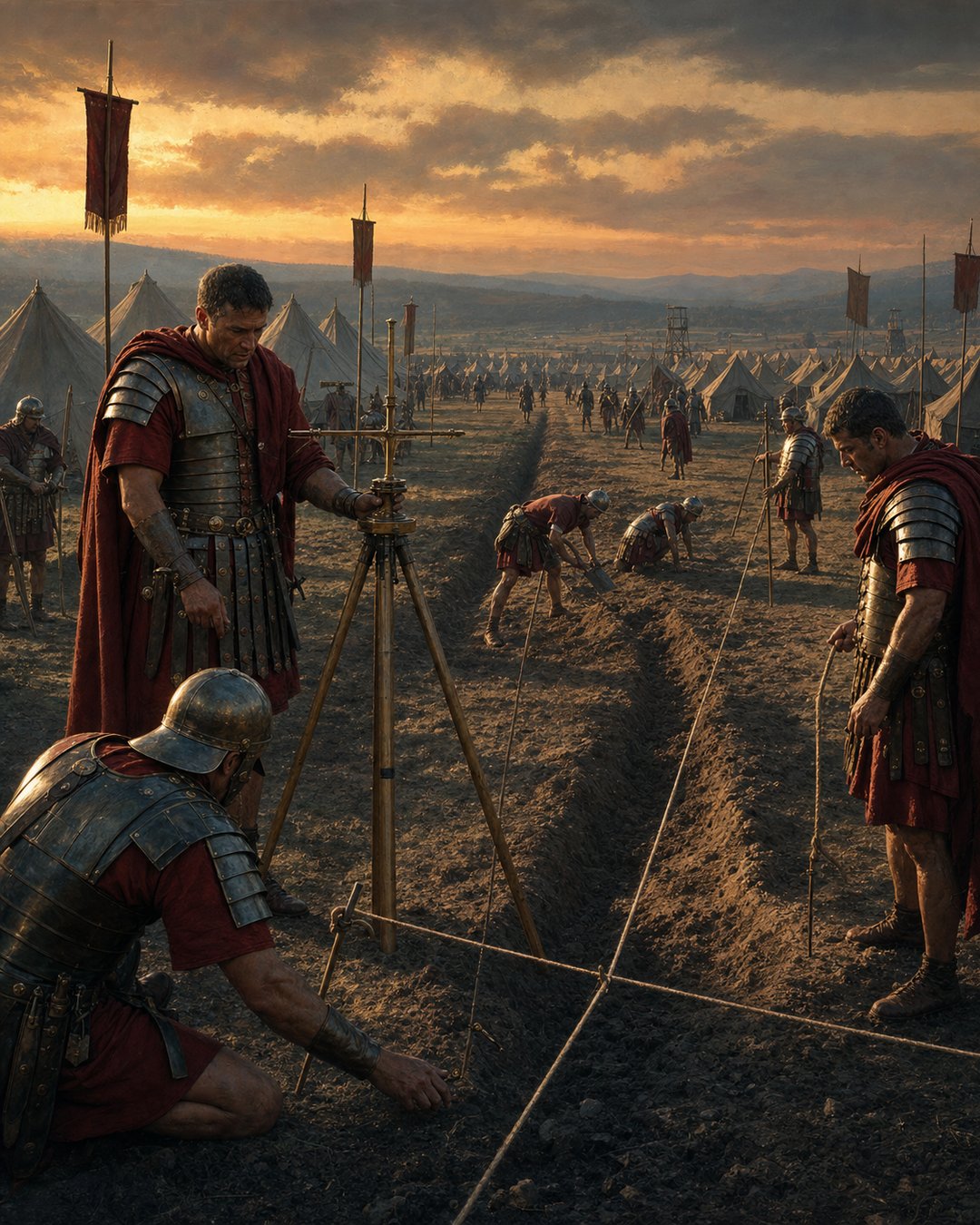
A Roman army did not simply stop when the day’s march ended. It measured a place, cut a ditch, raised a rampart, set gates, arranged tents, posted watches, and turned unfamiliar ground into something recognizable. The camp was not an afterthought. It was conquest made repeatable.
Marching camps mattered because they gave Roman movement a portable order. An army deep in enemy country still needed lanes, command points, animals, carts, standards, tools, food, and sleep. The camp turned danger into a nightly system.
Stopping was part of the march
To modern eyes a camp can look like a pause. For Roman soldiers it was work. The halt produced another task: survey, dig, carry, guard, cook, repair, report, and prepare to move again. The day was not over until order had been rebuilt.
Polybius describes the Roman camp as a planned arrangement, not a random spread of tents. That regularity allowed soldiers to know where things belonged even when the landscape changed.
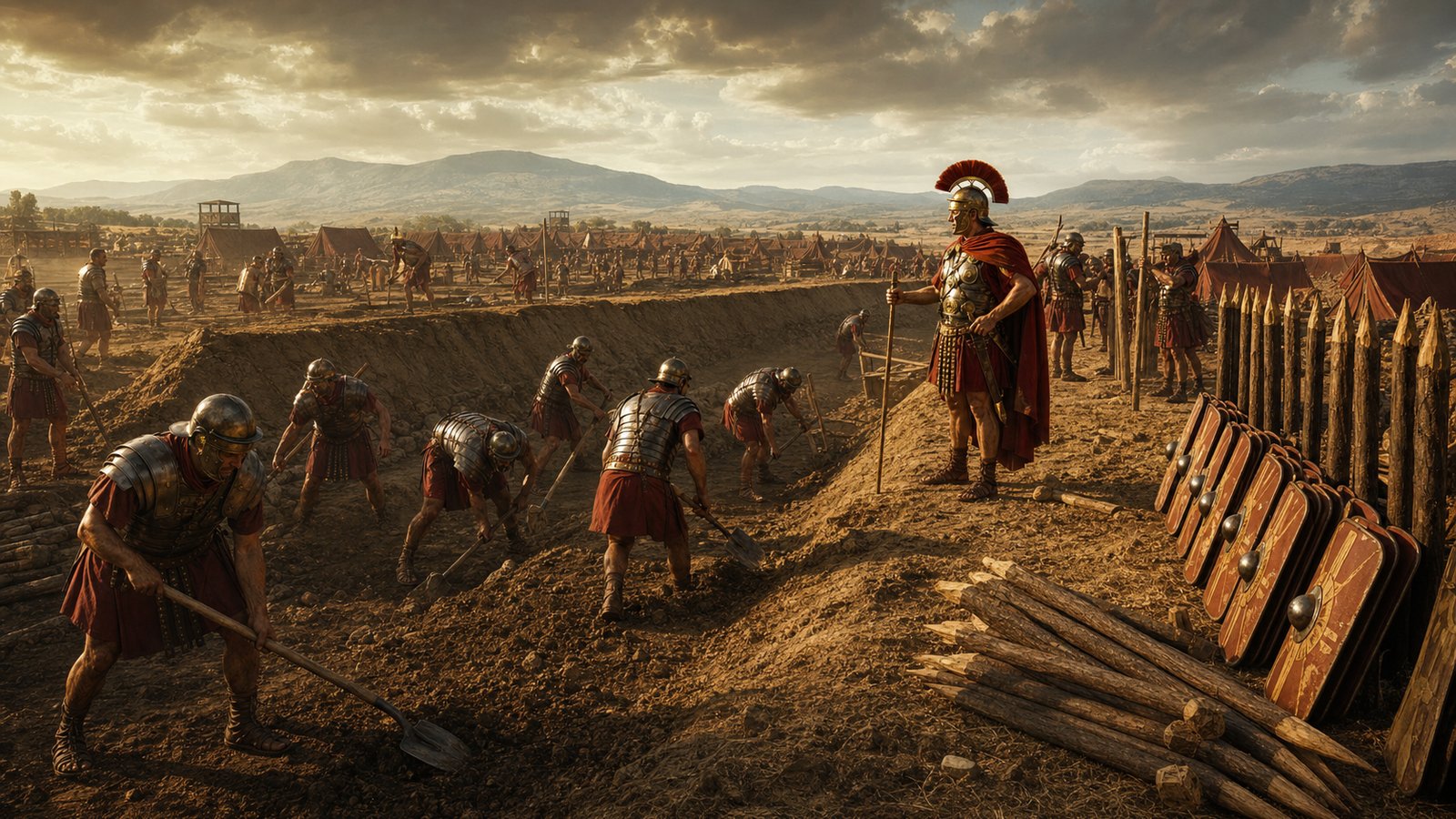
The ditch made uncertainty visible
A ditch and rampart did more than slow an enemy. They marked the line between the army’s temporary order and everything outside it. The boundary said: here begins the Roman night.
Imagine dusk on a frontier road: measuring ropes pulled straight, a groma set up, legionaries cutting earth, and timber stakes stacked beside shields. The scene is military, but it is also administrative. Space is being turned into procedure.
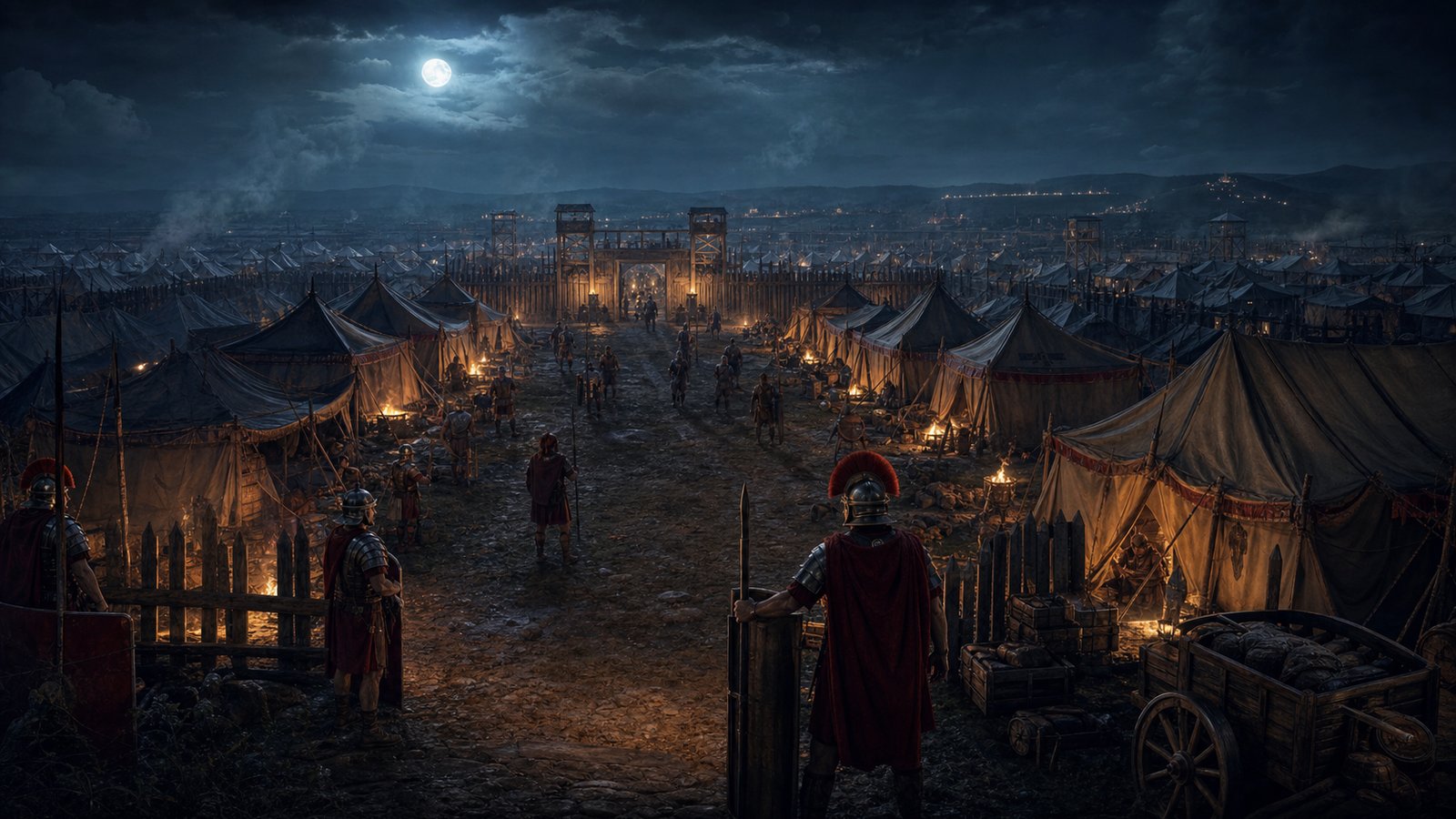
The same layout reduced panic
Repetition is a weapon. If soldiers knew where the gate, commander, standards, tents, and streets would be, confusion lost some of its power. The camp gave thousands of men a shared map before a crisis began.
That regularity mattered most under stress. A sudden alarm at night is less chaotic when watches, routes, and gathering points already exist. Discipline is easier to maintain when the ground has been organized in advance.
The camp carried Rome into hostile places
A marching camp made the army a small mobile city. It contained command, religion, punishment, stores, animals, craftsmen, cooks, guards, and routines. The army did not leave society behind; it compressed a version of Roman order into leather, timber, earth, and habit.
Josephus noticed Roman discipline because it was visible. The camp showed that Rome’s strength was not only courage in battle. It was the ability to make preparation itself into a system.
Work made sleep possible
Every Roman night in campaign required labor before rest. Men who had marched now dug. Men who would fight tomorrow now lifted stakes. The protection of the camp was not free; it was bought with tired bodies before supper and sleep.
The sensory world matters: iron biting soil, shouted measurements, carts creaking into lanes, smoke rising from fires, and sentries taking position while the last light leaves the ditch. That is the sound of military order becoming physical.
Conquest depended on repeatable habits
Rome conquered in part because it could repeat difficult things. March, measure, fortify, guard, sleep, break camp, and march again. A single victory could win a day, but repeated habits made campaigns sustainable.
This is why Roman marching camps made conquest repeatable. They turned movement into method. Wherever the army went, it tried to bring a known shape with it, and that shape made the next day possible.
The camp also disciplined command. Orders had locations. Units had places. Supplies had routes. A commander did not control thousands of men by courage alone; he controlled them by making space legible.
For enemies, that predictability could be intimidating. The army that arrived at dusk and immediately began building signaled that it expected to stay alive, move again, and impose order even on ground it had never seen before.
The camp’s temporary nature makes it more impressive, not less. A stone fortress declares permanence, but a marching camp declares the ability to create order quickly. That skill is exactly what a campaign needs.
The habit also joined engineering to psychology. A ditch can stop bodies, but a planned camp also calms the people inside it. Soldiers who know the pattern can behave as if they are not lost.
That is why camp archaeology can feel so revealing. A faint earthwork or cropmark may preserve one night of Roman procedure. The soldiers moved on, but the pattern of their discipline remained in the soil.
The camp further protected supplies, and supplies protected strategy. Grain, animals, tools, spare weapons, and documents all needed to survive the night. An army that cannot protect its carts cannot keep conquering.
Polybius’ description of order and Josephus’ admiration for discipline point to the same lesson. Roman military strength was not a single heroic mood. It was a culture of repeated preparation.
The most ordinary acts were therefore strategic: measuring, digging, posting guards, placing tents, opening gates, closing gates. They look small only if we forget that an empire is built from repeatable acts.
The marching camp was Rome’s answer to uncertainty. It could not remove bad weather, ambush, hunger, exhaustion, or fear. But it could give the army a practiced response to the moment when the road ended and the dangerous night began.
The pattern is useful because it ties a visible object to a much larger system. A stamp, ditch, mask, road, wall, or speech did not stand alone. It connected property, labor, authority, memory, and spectators in ways that Romans could recognize without needing a modern explanation.
The human scale is just as important as the institutional one. Someone pressed the clay, pulled the rope, lifted the mask, counted the cart, watched the gate, or listened from the crowd. Roman power often became durable through exactly those repeated gestures.
This is also why the topic should not be reduced to a charming detail. The detail matters because it opens the machinery behind the larger story. It shows how Rome converted ordinary materials and routines into public confidence.
If we follow that machinery closely, the monument becomes less distant. It is no longer only an impressive ruin or a famous custom. It becomes a working system made of hands, tools, names, fear, ambition, timing, and memory.
The best Roman evidence often works like this. It begins with something concrete enough to touch and then leads outward into institutions. The small object survives because the system needed it, and the system becomes visible because the object survives.
For the people inside the scene, none of this felt like future history. It felt like work, duty, display, or obligation. Only later do we see how those actions helped make Rome legible to itself and to us.
The result was never just symbolic. It shaped decisions: where materials moved, how men slept, who appeared honorable, which names remained visible, and which institutions looked competent when pressure arrived.
That practical consequence is the reason the episode deserves attention. Rome did not survive through spectacle alone, and it did not rule through paperwork alone. It fused spectacle, paperwork, labor, and habit until each reinforced the others.
Sources & Further Reading
- Polybius, Histories, Book 6
- Polybius, Histories, 6.27–42
- Josephus, The Jewish War, Book 3
- Vegetius, De Re Militari
- Smith Dictionary, Castra
- World History Encyclopedia, Roman Army
- Historic England, Roman Camps
- Britannica, Roman road system
- Smith Dictionary, Groma
- Cambridge Companion to the Roman Army