
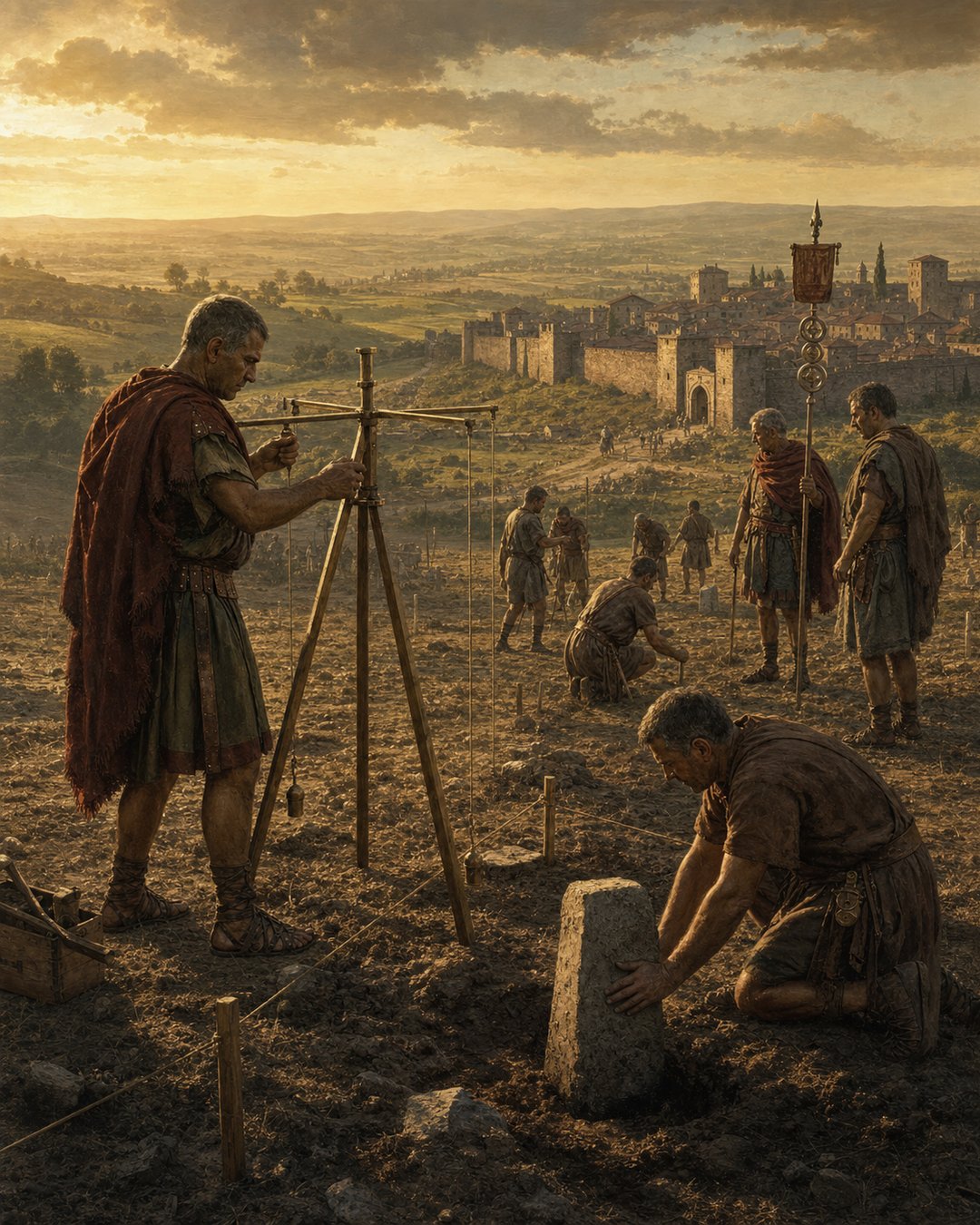
A conquest did not become permanent when the battle ended. It became harder to undo when someone measured land, drove stakes into soil, assigned plots, opened roads, and persuaded retired soldiers to build lives where an army had once passed.
Roman veteran colonies mattered because they turned military victory into civilian geography. A discharged soldier could become a farmer, neighbor, magistrate, father, creditor, witness, and reminder that Rome intended to stay.
The sword was followed by the survey line
The most important instrument after conquest was not always another weapon. It could be a measuring tool. Roman land division made power visible through straight boundaries, plots, roads, and regular civic space.
Picture a surveyor setting a groma while former soldiers wait beside packs and tools. The scene is quieter than battle, but it changes the future more slowly and stubbornly. Land is being converted into Roman order.
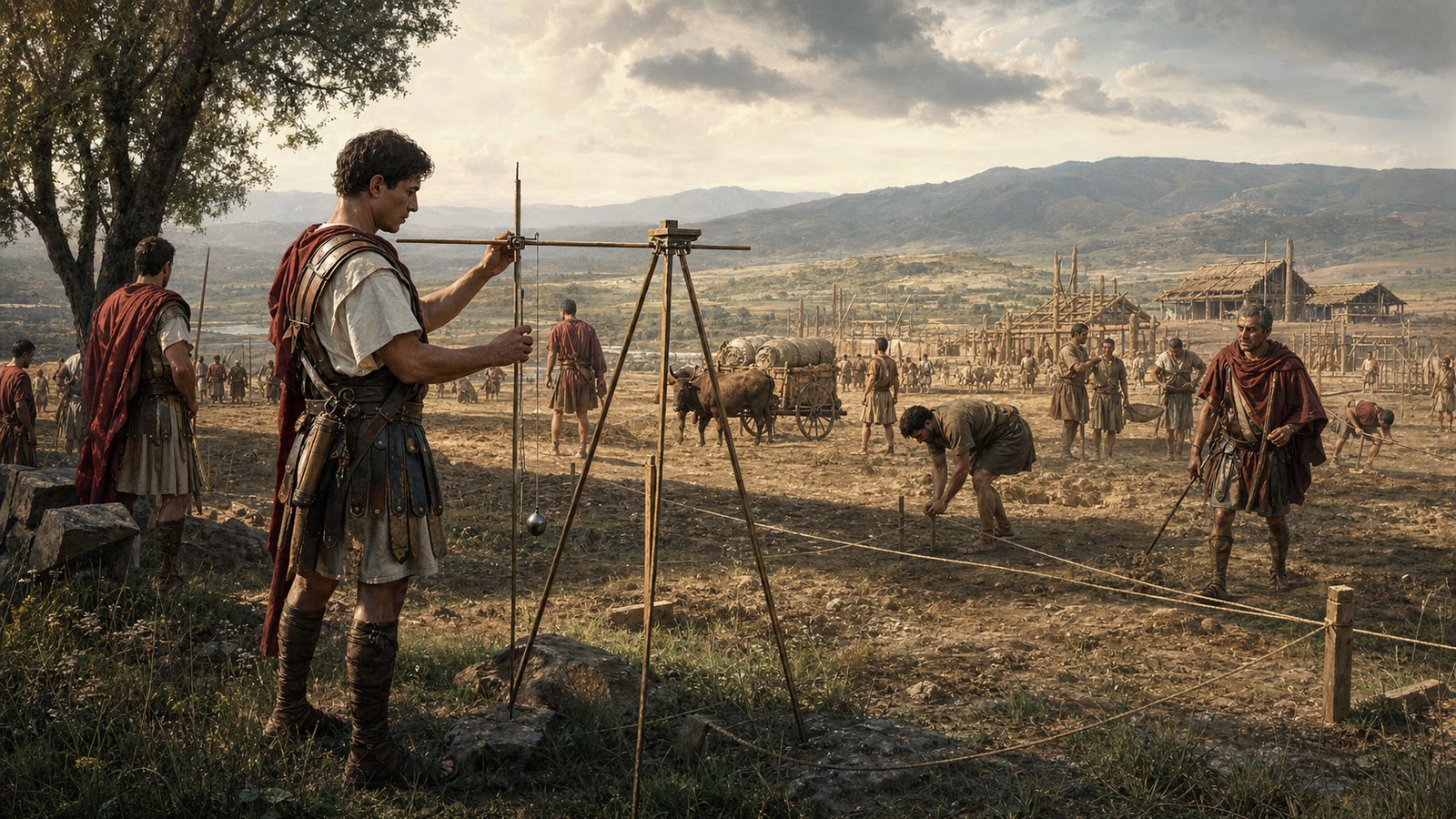
A veteran became a local fact
A veteran colony rewarded service, but it also placed trained Roman men in strategic places. The soldier who once marched under orders now held land, raised a household, and carried Roman habits into a new landscape.
That mattered because permanence depends on people. Walls can be damaged and garrisons recalled, but families, farms, markets, and property claims root conquest in daily life.
The grid taught the land a new language
Centuriation and planned streets did not merely organize fields. They taught inhabitants to move, trade, dispute, and remember through a Roman pattern. A straight road or boundary line could become a civic argument in the soil.
This kind of order was not neutral for everyone. Appian’s civil-war narratives remind us that land distribution could bring pain and dispossession. Permanence for one group might mean loss for another.
Colonies carried institutions, not only settlers
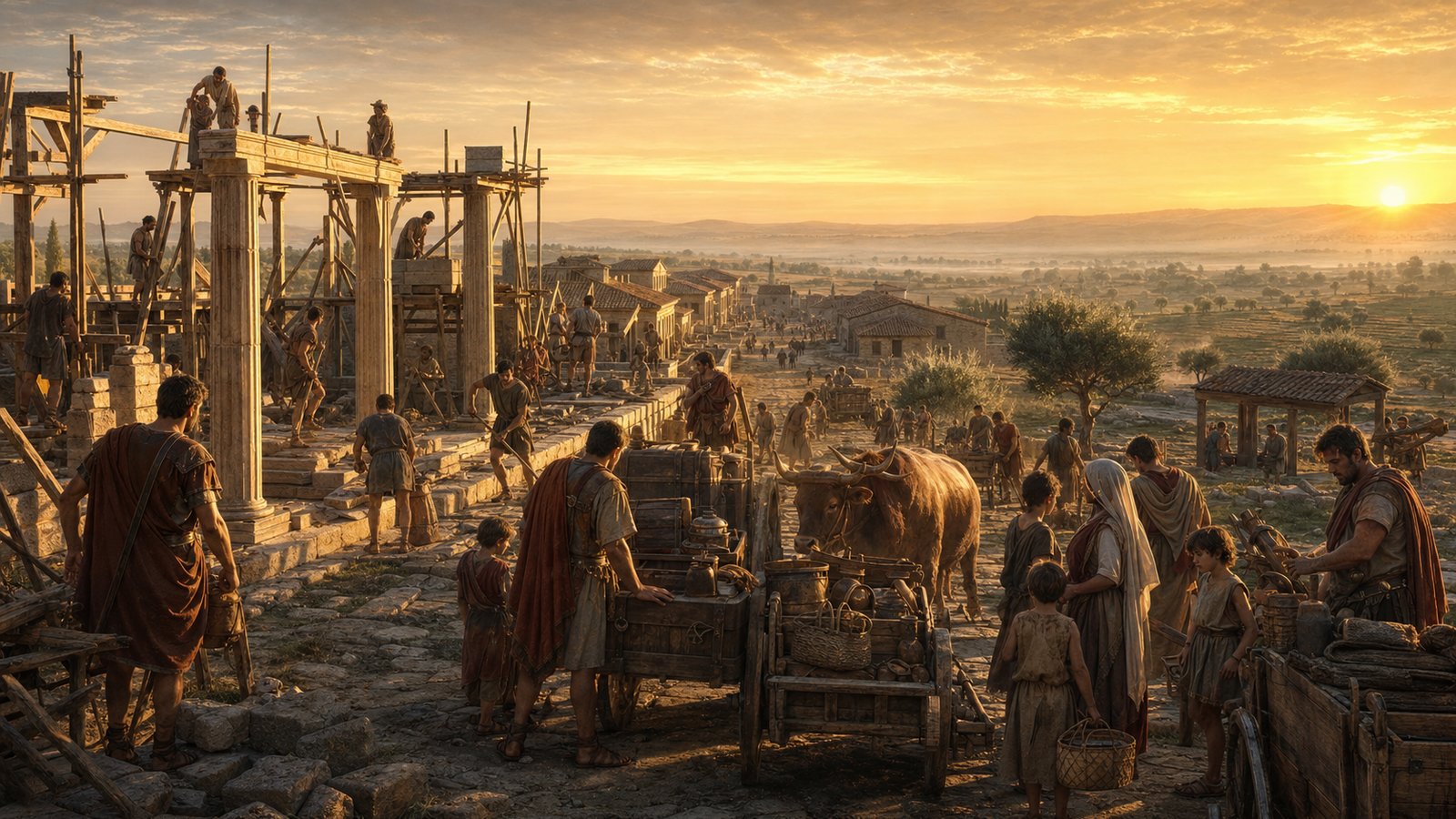
A Roman colony was not just a cluster of houses. It could carry magistracies, public space, ritual, law, and the expectation that civic life should look Roman. The settlement made empire ordinary.
The forum under construction mattered as much as the farm plot. It gave the new community a place to make decisions, display honor, and perform public life under Roman forms.
Augustus understood the political value
After civil wars, veteran settlement helped solve a dangerous problem: armed men needed rewards, and the state needed stability. Augustus could present settlement as restoration, even when the process was disruptive.
The veteran’s allotment therefore linked personal memory to political settlement. A plot of land said that service had been recognized and that a new order had authority to distribute futures.
Victory became difficult to erase
A battlefield can be forgotten. A colony keeps making claims every planting season. Roads, fields, contracts, marriages, graves, and local offices continue the work after the army has moved on.
This is why Roman veteran colonies made conquest permanent. They planted Roman power in routines that survived the noise of war. The empire did not only occupy land; it taught land to remember occupation.
The colony also changed the veteran. He was no longer only a man of the camp. He became a stakeholder in the settlement he had helped secure. His interest in Rome’s power could become as practical as his harvest, boundary, and household.
That personal interest gave empire a local defender. A veteran with land might care about roads, security, courts, and markets because those systems now protected his own future.
The transformation could be deeply unequal. Existing communities might face pressure, displacement, or new legal arrangements. Roman permanence often came with someone else’s uncertainty.
The physical signs made that uncertainty hard to ignore: straight lines across fields, measured plots, new public buildings, Latin names, and graves of settlers who expected their descendants to remain.
The colony therefore joined reward and control. It solved one Roman problem by creating a Roman presence in another place. The reward to the soldier became a message to the territory.
It also helped convert memory into landscape. Men who had fought in wars could turn their campaigns into stories told around fields, shrines, markets, and family tables.
For Rome, that was useful because loyalty becomes stronger when it is attached to property. A man defending an abstract state is one thing; a man defending his farm, road, and status is another.
The quietness of the process should not fool us. Measurement can be as consequential as violence. A plotted field can keep speaking for power long after the sword is sheathed.
The map made conquest durable because it divided the future into manageable pieces. A road here, a plot there, a boundary line beyond it: each mark encouraged people to behave as if Roman order would last.
For the veteran, the allotment could transform loyalty into self-interest. His past service was rewarded with land, but that land now depended on the stability of the system that granted it.
For local communities, the same settlement could feel like pressure. Roman order often arrived as a plan already drawn by others. The straight line might be efficient, but it could also cut through older claims and memories.
That tension made colonies politically useful and socially difficult. They promised order to Rome while forcing negotiation, resentment, cooperation, or adaptation on the ground.
The colony also made distance less abstract. Rome was no longer only a far city, a tax demand, or an army passing through. It became neighbors, fields, magistrates, markets, and visible public space.
Land measurement gave authority a special confidence. It suggested that the territory could be known, divided, assigned, taxed, defended, and inherited. The act of measuring was also an act of belief.
Even the veterans’ bodies carried memory. Their scars, accents, habits, and stories tied the settlement to campaigns elsewhere. A new colony could become a living archive of service.
The process explains how conquest outlasted commanders. A general might die or fall from favor, but the plotted fields and households he helped create could remain stubborn facts in the landscape.
Permanence, then, was not a single event. It was built through harvests, disputes, marriages, burials, repairs, and the repeated use of streets that had first been lines on a surveyor’s plan.
The point becomes clearer when the object is treated as part of a system rather than as a curiosity. It connected people, rules, space, labor, and memory in ways that shaped behavior after the first moment had passed.
That connection is the reason the evidence still matters. It lets us see Roman power at human scale, where institutions became habits and habits became expectations.
The remaining trace is small, but the implication is large: durable empire often depended on repeated acts that seemed ordinary to the people performing them.
Ancient Rome often made authority durable by making it repeatable. The same gesture, route, display, measurement, or routine could persuade people that the arrangement was normal because they encountered it again and again.
Sources & Further Reading
- Britannica, colony: Ancient Roman settlement
- Livy, History of Rome
- Smith Dictionary, Agrimensores
- Oxford Classical Dictionary, centuriation
- Cambridge Companion to the Roman Army
- Augustus, Res Gestae
- Metropolitan Museum of Art, Roman colonies and urbanism
- Appian, Civil Wars
- Britannica, Roman road system
- World History Encyclopedia, Roman Army