
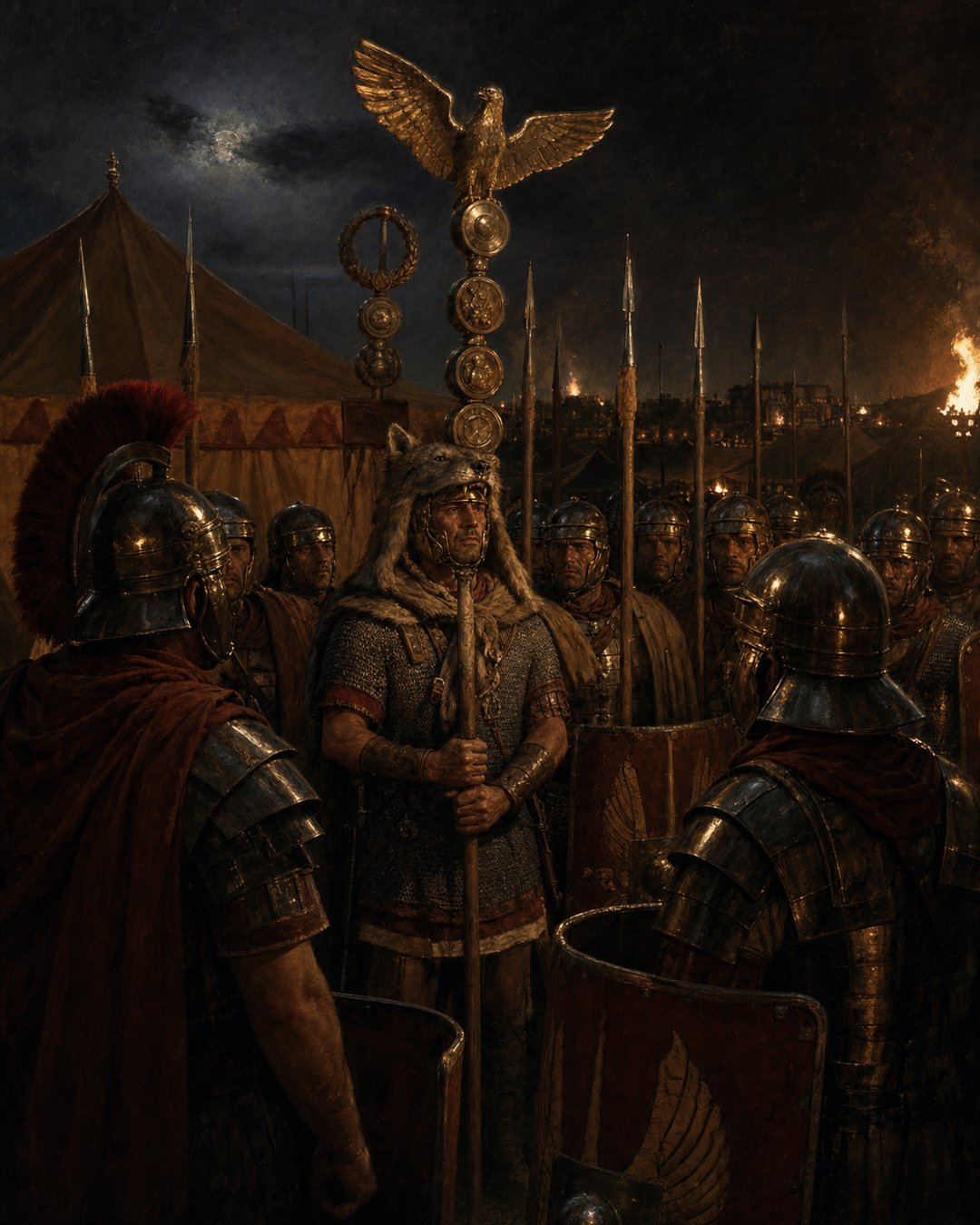
A Roman standard was not merely decoration on a pole. It stood above dust, helmets, shields, fear, and shouted orders. Men could look toward it, rally around it, swear by what it represented, and feel disgrace if it fell into enemy hands.
Standards mattered because they made the legion visible to itself. In an army of thousands, identity had to be seen, carried, guarded, and remembered. The standard turned a unit from a crowd of armed men into a body with a center.
A unit needed a visible center
Battle is confusion before it is glory. Dust rises, lines bend, voices break, and fear narrows attention. A standard gave soldiers a point higher than the press of bodies.
The practical function is easy to understand. If men can see where their signifer or eagle stands, they can orient themselves. Visibility becomes discipline.
The standard carried more than directions
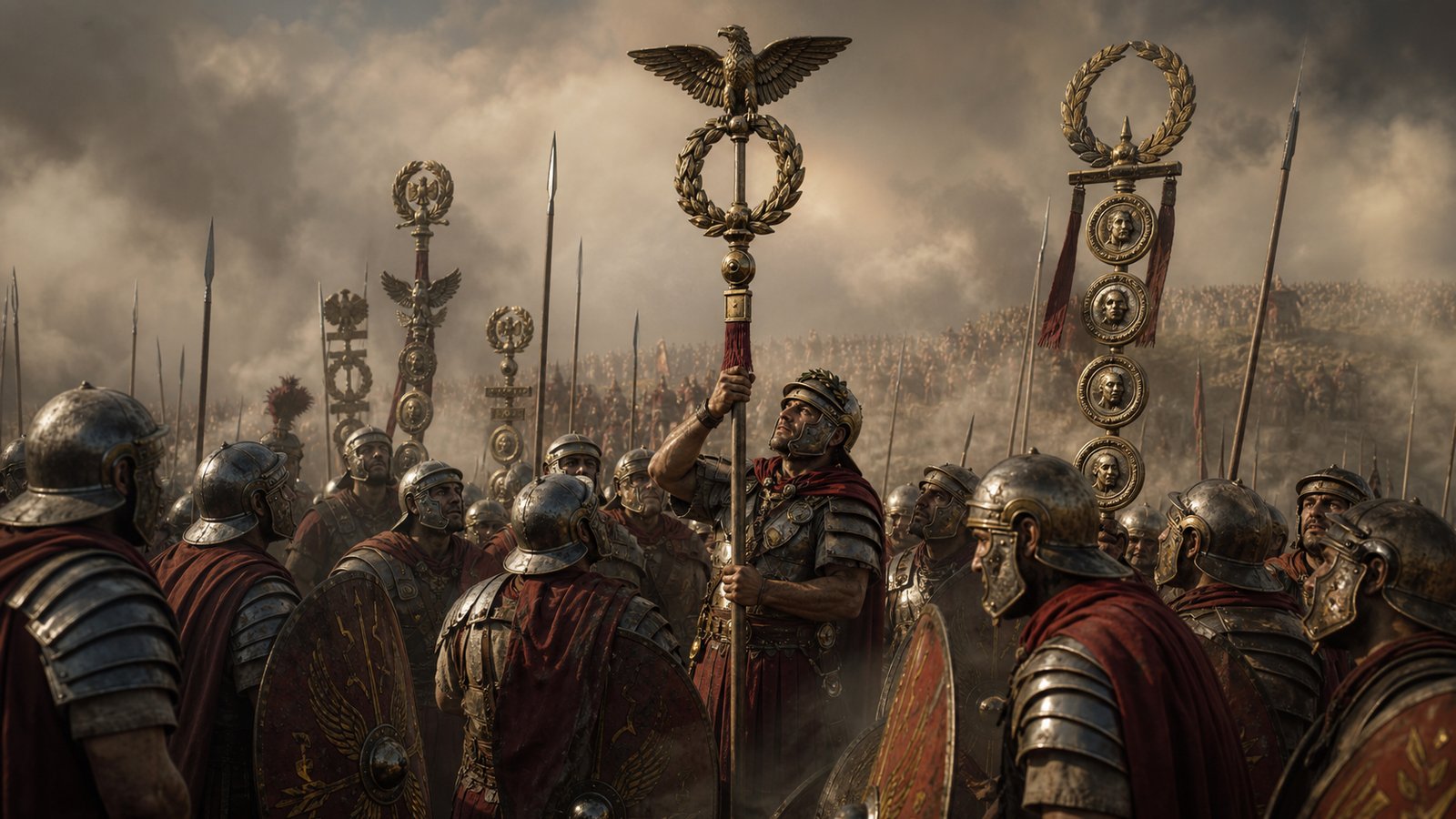
Roman military signs also carried honor. The eagle, unit standards, and related emblems were treated as more than tools. Losing them could stain memory; recovering them could be advertised as victory.
Augustus understood this when he celebrated the return of standards from Parthia. A diplomatic recovery became public proof that Roman honor had been restored. The object condensed a much larger story.
A signifer made identity portable
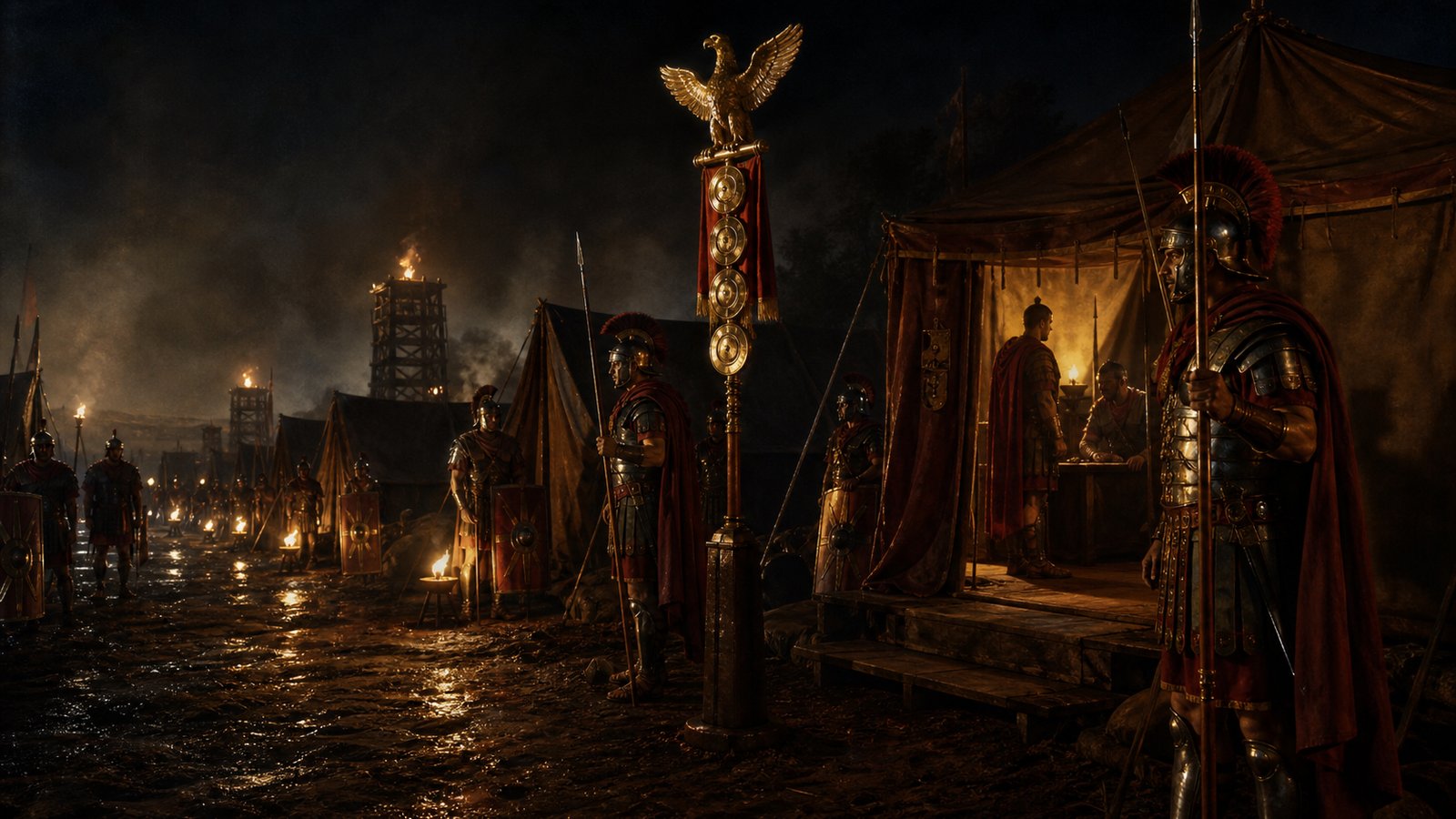
The standard-bearer’s body mattered because identity had to move. The signifer carried a visible symbol through march, camp, and battle. The unit’s center was not fixed in stone; it walked with the men.
Imagine a column forming before dawn: helmets in low light, pack animals restless, orders passing down the line, and the standard rising so every soldier knows where his group begins. The image is practical and emotional at once.
Camp gave the symbol a home
Inside camp, standards could be associated with command space, ritual, and the ordered life of the unit. The symbol that guided men on the move also helped define where authority lived when the army stopped.
That connection made the camp more than a sleeping place. It became a temporary world where signs, tents, guards, roads, and orders all reinforced belonging.
Ancient writers knew the emotional charge
Tacitus and other authors use standards as charged objects in stories of mutiny, loyalty, panic, and shame. Men respond to them because the objects concentrate discipline and memory in a visible form.
A standard is powerful precisely because it seems too small for what it carries. Metal, wood, cloth, and emblems become courage, disgrace, oath, unit pride, and imperial authority.
Visibility made loyalty harder to hide
The standard forced identity into the open. Soldiers could see whether their unit advanced, halted, rallied, or broke. The object made collective behavior visible to comrades and commanders alike.
This is why Roman standards made legions visible. They gave an army a shared point of attention, a portable memory, and a symbol that could survive in story long after the battle ended.
The standard also helped solve the problem of scale. A small group can know itself by faces. A legion needed signs. The bigger the institution, the more it needed visible symbols to remain emotionally real.
The eagle could become almost sacred without ceasing to be practical. The same object that helped men orient themselves could also hold their oath, reputation, and fear of disgrace.
The danger of losing a standard shows how deeply Romans linked symbol and reality. The material object was not the whole legion, but its capture could make defeat feel complete.
The recovery of standards worked in the opposite direction. It allowed leaders to claim that a wound to Roman honor had been repaired. A returned object could become a public story of restored confidence.
For soldiers, the standard’s visibility was immediate. It rose where they could see it, moved when they moved, and stopped where their unit gathered. It made belonging physical.
For commanders, it offered a way to read the field. Standards showed where bodies were forming, hesitating, or collapsing. A symbol could become an instrument of command.
The standard also connected camp and battle. The men who saw it beside tents at night saw it again in formation by day. Routine gave the symbol emotional depth before crisis tested it.
In that sense, Roman standards were memory machines. They carried previous marches, punishments, victories, losses, and oaths into the next moment of danger.
A legion did not become visible only to its enemies. It became visible to itself. That may be the deeper reason the object mattered so much: men fight differently when they can see what they are supposed to be.
The standard’s importance also came from repetition. Soldiers saw it on march, in camp, at ceremony, and in danger. Familiarity prepared the object to matter when fear made thinking narrow.
It gave the unit a shape that could survive movement. Men changed places, columns stretched, dust obscured faces, and orders became confused, but the raised sign could still tell soldiers where their collective center stood.
The object also made shame public. If a standard was lost, the disgrace was visible and memorable. Defeat became attached to something that could be named, recovered, displayed, or mourned.
That visibility explains why rulers used standards in propaganda. A recovered sign could say more quickly than a speech that Roman honor had returned. The object gave diplomacy a military face.
For the man carrying it, the duty was dangerous. A signifer had to remain visible when visibility itself attracted attention. The symbol’s power depended on someone accepting that risk.
In camp, the standard linked daily order to battlefield identity. It stood near routines of watch, command, sacrifice, and assembly, so loyalty was rehearsed before it was tested.
The emotional charge did not cancel the practical function. The same pole could help men align in dust and also remind them of oath, punishment, victory, and the eyes of their comrades.
This combination is what made Roman military symbols so durable. They worked because they solved real problems while also giving those problems a language of honor.
A legion needed food, roads, discipline, pay, and command. It also needed a way to see itself. The standard supplied that visibility in a form men could follow.
The point becomes clearer when the object is treated as part of a system rather than as a curiosity. It connected people, rules, space, labor, and memory in ways that shaped behavior after the first moment had passed.
That connection is the reason the evidence still matters. It lets us see Roman power at human scale, where institutions became habits and habits became expectations.
The remaining trace is small, but the implication is large: durable empire often depended on repeated acts that seemed ordinary to the people performing them.
Ancient Rome often made authority durable by making it repeatable. The same gesture, route, display, measurement, or routine could persuade people that the arrangement was normal because they encountered it again and again.
Sources & Further Reading
- Smith Dictionary, Signa Militaria
- Cassius Dio, Roman History
- Polybius, Histories, Book 6
- World History Encyclopedia, Roman Standard
- Smith Dictionary, Signifer
- Tacitus, Annals
- Cambridge Companion to the Roman Army
- Vegetius, De Re Militari
- Augustus, Res Gestae
- Metropolitan Museum of Art, Roman Art