
Roman authority often had to travel farther than a voice could carry. Orders, accounts, receipts, private letters, and official instructions needed to move through hands, roads, rooms, and delays without losing their force.
A seal mattered because it made a document a guarded object. Wax, cord, tablet, and mark told the receiver that someone had sent this deliberately, and that the message had a history before it arrived.
A document was also a thing
It is easy to imagine writing as pure words, but Roman documents were physical objects. Wooden tablets could be folded, tied, carried, stored, opened, and shown. Their authority depended partly on how they survived handling.
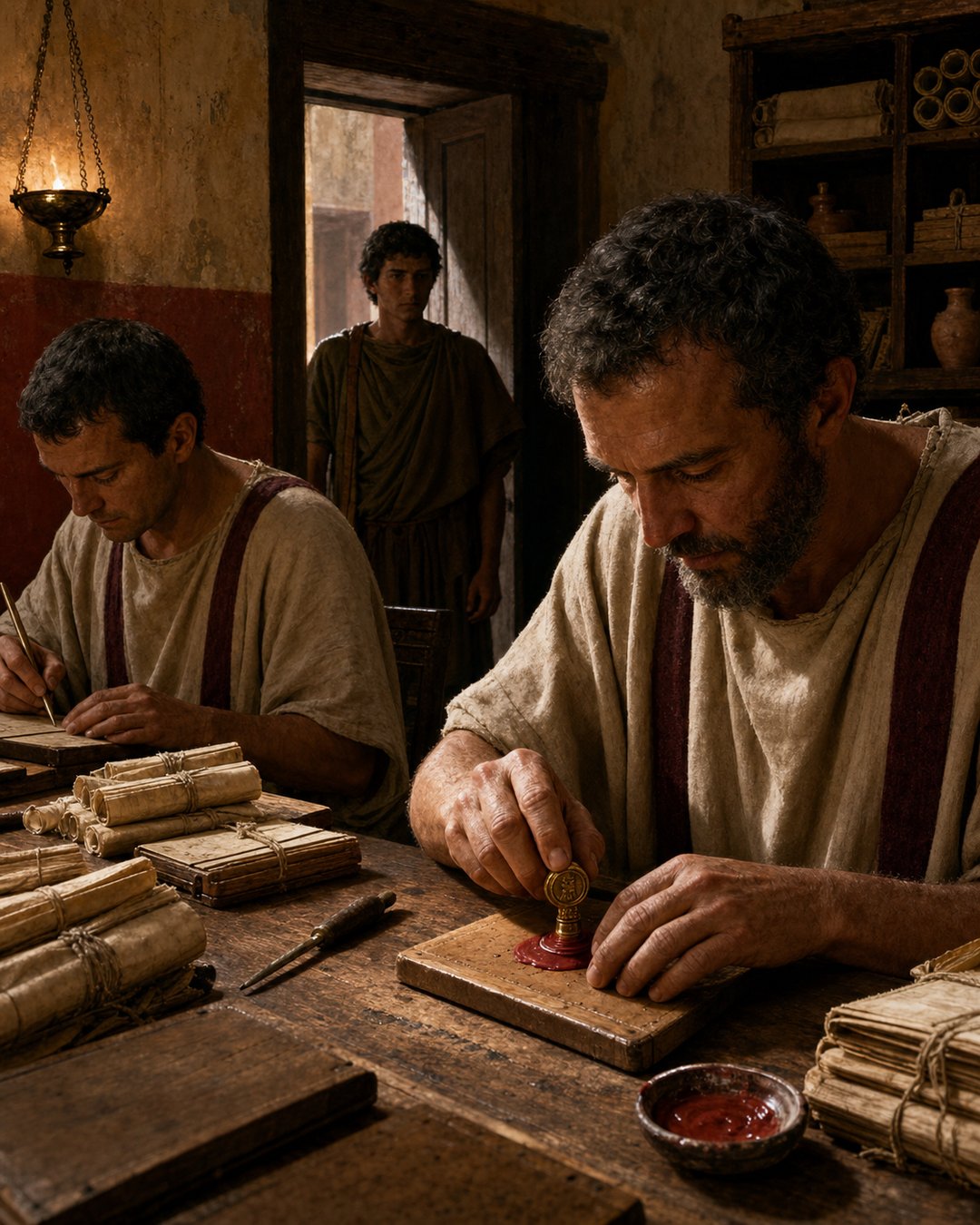
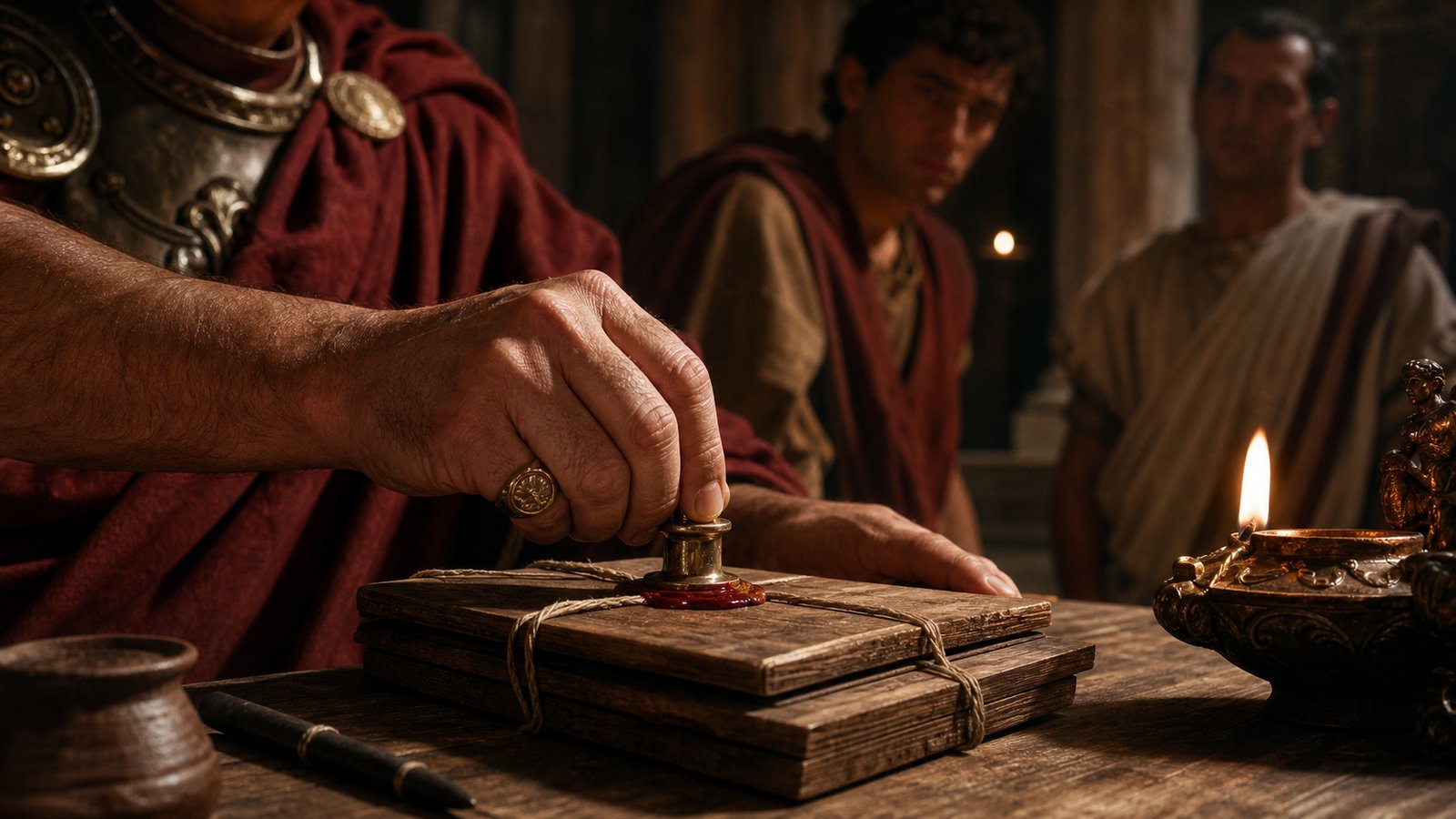
Picture a scribe pressing a ring into warm wax while a courier waits near the doorway. The mark is small, but the gesture changes the tablet. It is no longer only writing; it is a packet with custody.
The seal managed absence
A commander, patron, magistrate, or business partner could not always be present. The sealed document helped solve that problem by carrying a recognizable sign from one place to another.
The mark did not remove the need for trust. It organized trust. Receiver, messenger, and sender all understood that the state of the seal mattered before the words inside were even read.

Vindolanda shows writing in motion
The Vindolanda tablets are powerful because they show written communication as part of practical frontier life. Invitations, reports, lists, and instructions moved through a community that needed writing to keep relationships and administration connected.
Those tablets remind us that Rome’s written world was not limited to grand inscriptions. It also lived in portable messages, ordinary materials, and hands that carried information between people.
Small objects could carry large systems
Tesserae, tablets, and seals show how Roman order could depend on small portable things. A token, tally, or marked document could prove access, identity, agreement, or permission in a way that speech alone could not.
This is the hidden scale of administration. Empire needed roads and armies, but it also needed objects that could be checked on a desk. A seal gave authority a surface.
A broken seal told its own story
The physical condition of a document mattered. A disturbed cord or damaged wax could warn the receiver that the packet’s journey had gone wrong. In that sense, the outside of the message spoke before the inside did.
The sensory details are humble: wax softening under pressure, cord pulled tight, stylus scratches on tablets, lamp soot above a desk, and a messenger shifting weight while the mark cools.
Authority became portable
Roman power did not travel only through soldiers. It moved through written instructions, accounts, permits, lists, and reminders that could cross distance with a messenger. The seal helped those objects arrive as more than loose words.
This is why Roman seals made documents travel with authority. They turned absence into a manageable condition, giving a distant person or office a small physical presence in another room.
The seal also slowed the reader down. Before the message was opened, someone had to notice the mark, the cord, and the condition of the packet. That pause created a ritual of recognition.
Ritual mattered because administration depends on habits. If people repeatedly treated sealed documents as serious, then the mark acquired practical power through use.
The system could still be abused. A seal could be forged, stolen, broken, or ignored. But the possibility of abuse proves the value of the object, because people do not counterfeit what no one respects.
A sealed tablet also protected hierarchy. Not everyone had the same right to open, read, or answer a message. The outside of the document helped define who belonged in the chain of trust.
At the same time, the object made power vulnerable. Once authority traveled in a tablet, it depended on messengers, weather, roads, storage, and human honesty. Rome had to trust small links to hold large distances together.
That vulnerability is what makes the seal interesting. It was both a symbol and a practical device, both a mark of status and a tool against uncertainty.
The Roman habit of recording, marking, and carrying information helped make rule repeatable. Orders could be sent, accounts compared, promises remembered, and disputes anchored to objects.
A ring pressed into wax therefore deserves attention. It is a tiny scene, but it shows authority becoming portable, checkable, and resistant to disappearance.
The pattern also mattered because it was repeatable. Romans learned authority through repeated encounters with objects and places that seemed ordinary: a counter, a seal, a road, a monument, a mark, a queue, or a familiar route through the city.
That repetition gave small details political weight. A single scene might look trivial, but the habit formed around it could teach people where to gather, whom to trust, what to remember, and how to recognize power when it appeared.
For this reason the evidence should not be reduced to decoration. Material details changed behavior. They shaped how people moved, spoke, waited, watched, and judged one another in daily life.
The human scale is essential. Rome was not experienced only through emperors, armies, and laws. It was also felt through surfaces, doorways, hands, lamps, dust, food, wax, stone, and the sound of other people nearby.
When those details are put back into the story, the larger system becomes easier to understand. Roman power lasted partly because it found ways to become useful, visible, memorable, and difficult to ignore in ordinary settings.
The surviving evidence is fragmentary, but the fragments point toward a world where public life was built from repeated practical encounters. What looks small in isolation could become large because it happened every day.
That daily quality is the key. A city does not become Roman only by decree. It becomes Roman when people keep meeting Roman forms in the places where they eat, work, travel, mourn, write, bargain, and remember.
Attention to these forms also protects the story from becoming too abstract. The empire was made of institutions, but institutions had to touch bodies and routines before they could feel real.
In that sense, the object or place at the center of this article is a clue. It shows where official systems and private lives met, and where Rome turned an idea into a visible habit.
The lesson is not that every Roman saw the system clearly. Most people probably noticed immediate needs first: a drink, a document, a road, a family duty, a message, a promise, or a name on stone.
Yet those immediate needs gave the system its strength. Power became durable when people used its forms for their own practical reasons, not only when officials demanded obedience.
That is the quieter story behind the grander one. Rome endured through places and objects that made authority feel normal because they kept appearing at the moments when people needed something done.
The result was a civilization whose public systems could be encountered in miniature. A person did not have to understand the whole empire to learn how one of its small mechanisms worked.
Sources & Further Reading
- Smith Dictionary, Tabulae
- Smith Dictionary, Tessera
- Vindolanda Tablets Online
- World History Encyclopedia, Roman Daily Life
- World History Encyclopedia, Roman Roads
- Metropolitan Museum of Art, Roman Art