
Why Roman Baths Were Quietly Political
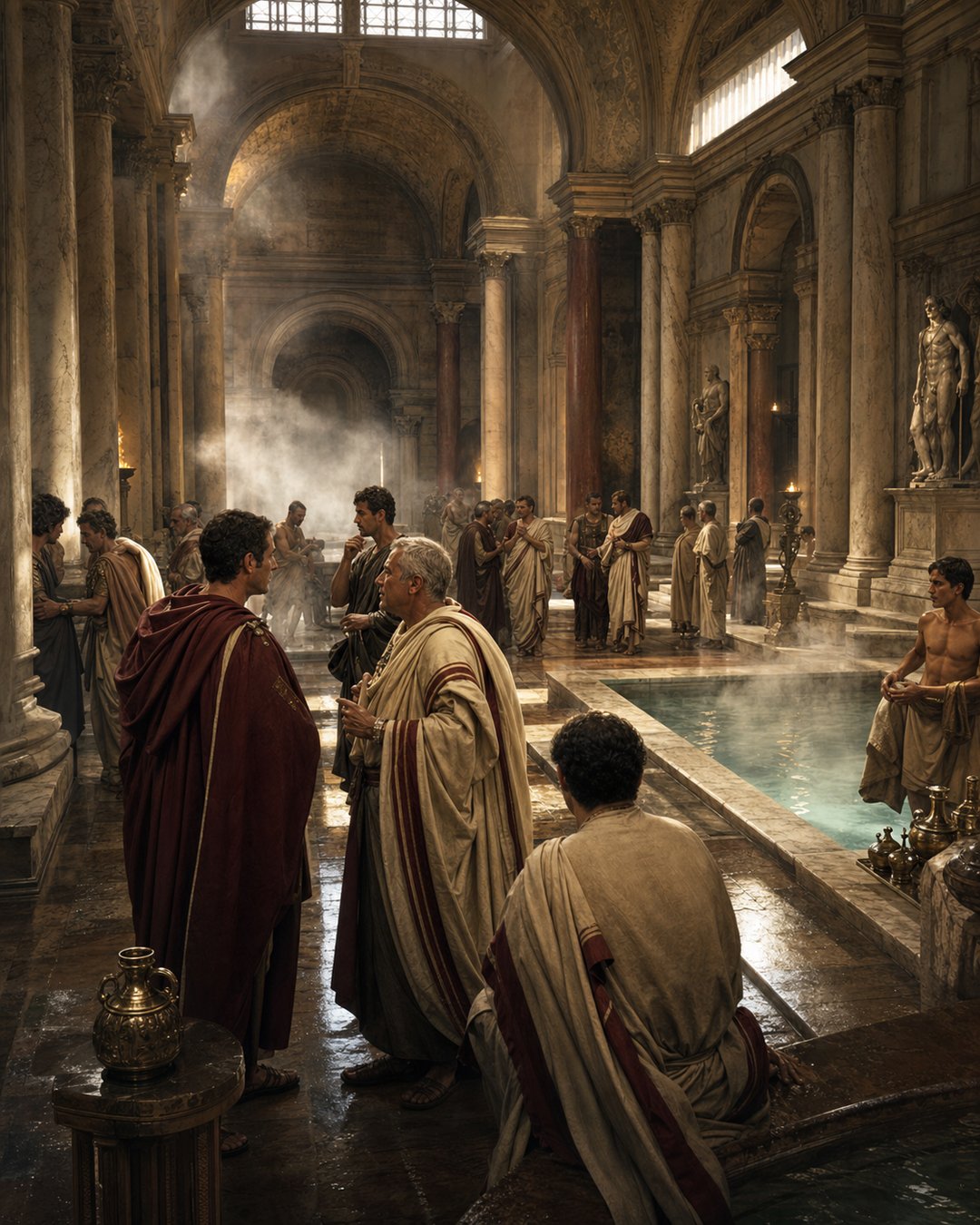
A Roman bathhouse looks, at first, like the easiest building in the ancient city to understand. People came in dusty, scraped, perfumed with oil or smoke, and left cleaner than they arrived. Steam blurred the lamps. Sandals slapped stone floors. Bronze vessels, strigils, towels, tunics, and gossip moved from hand to hand.
But the bath was never only a place to wash. It was a public machine for gathering bodies, status, favors, rumors, and gratitude under one roof. In a city where politics often happened through presence as much as speeches, a warm room could do political work.
Vitruvius cared about the machinery, not just the marble
Vitruvius, writing about architecture, treats baths as practical civic systems. In On Architecture 5.10, he discusses the placement of warm baths, light, heat, and room arrangement. That matters because a bath complex was not a decorative luxury dropped into a city. It needed furnaces, water, raised floors, service corridors, bronze fittings, storage, attendants, and constant fuel.
Those hidden systems shaped the social experience. The bather in the tepidarium felt comfort; the worker near the furnace felt heat as labor. The elite patron saw a building that could make his generosity visible every day. The ordinary visitor felt a political promise in the most physical way possible: warmth on skin, water on stone, time away from the street.
The apodyterium was a map of rank
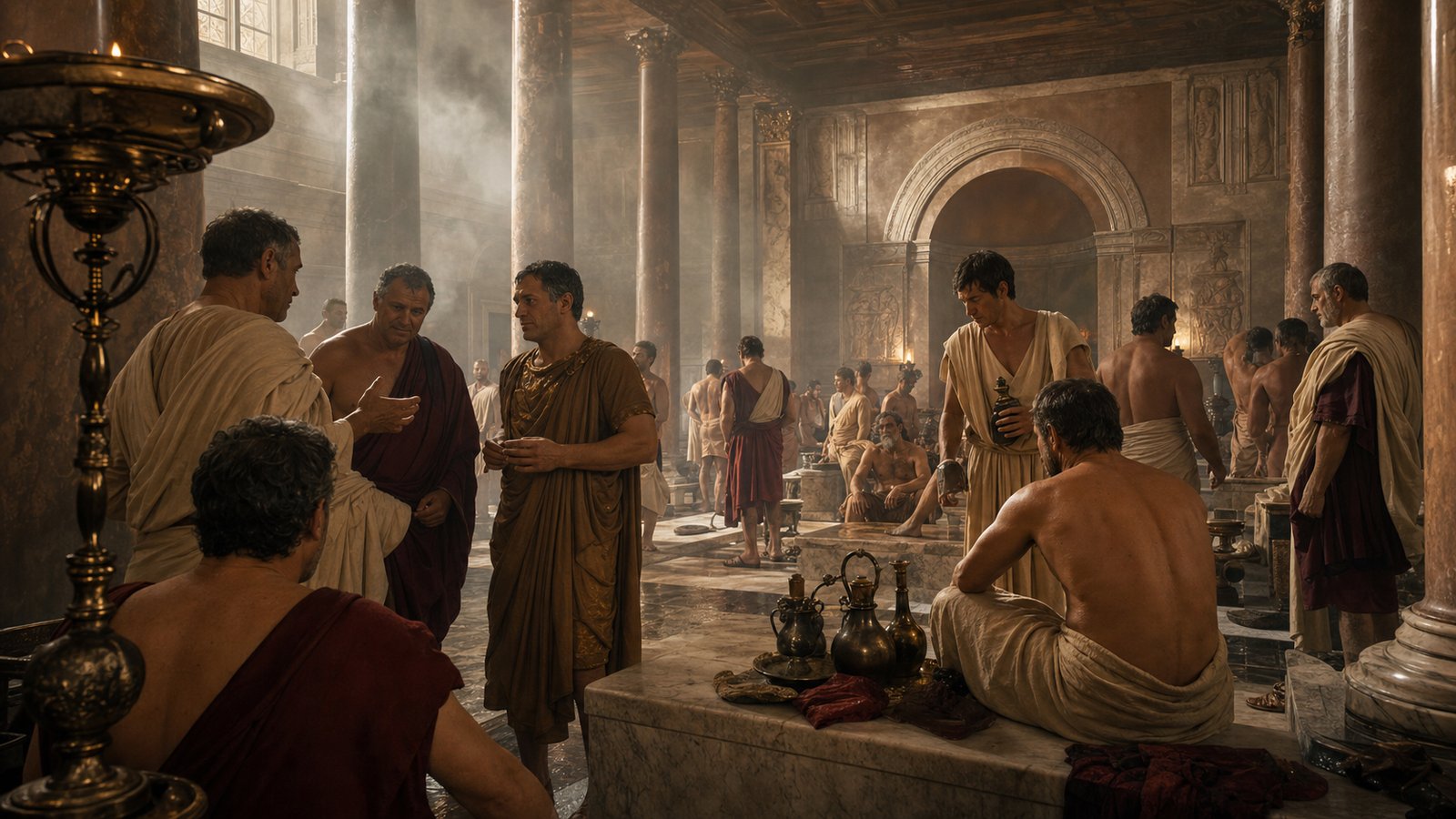
The changing room was not neutral. A senator’s garment, a freedman’s careful politeness, a client’s greeting, a merchant’s news, and an attendant’s quick hands all belonged to the same scene. Roman status did not disappear because everyone sweated. It became more visible because people met without the formal architecture of court or assembly.
That is why the bath could be useful to power. A man could be seen. A request could be floated. A rumor could be tested before it reached the forum. Friendship, dependence, insult, and ambition could all pass through a room that modern eyes might mistake for leisure.
Public generosity had a temperature
Baths were also benefactions. A wealthy local, a magistrate, or an emperor could pay for construction, repair, free access, or improved facilities. The gift was not abstract. It entered the calendar of ordinary people. Every return visit reminded bathers that civic comfort had a name attached to it.
That made bathing an unusually intimate form of propaganda. A triumph was spectacular but rare. A speech might be forgotten by dinner. A bath could fold gratitude into habit. The citizen did not have to love the benefactor in theory. He only had to step into the heat and remember who made the room possible.
The furnace was part of the politics
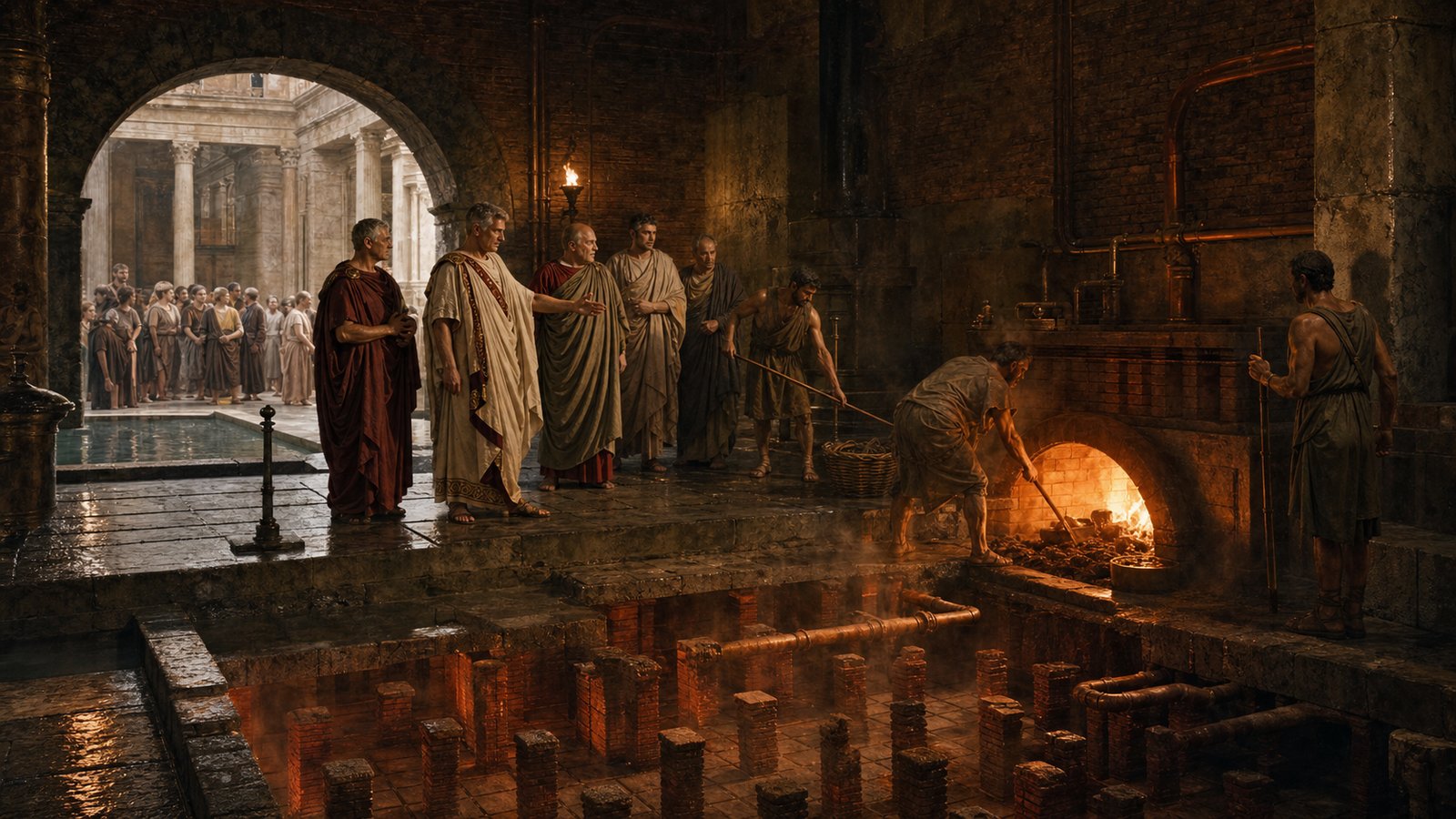
The hypocaust is easy to romanticize because it feels ingenious. Raised floors, hollow spaces, and hot air made comfort portable. Yet the same system also exposed the hierarchy behind comfort. Someone cut fuel. Someone fed the fire. Someone cleaned the soot. Someone hauled water and managed the spaces that allowed others to appear refined.
Roman public life often worked this way. Grandeur depended on labor kept just out of sight. The bath did not hide that completely. It placed ease and exertion close enough that the social order could be felt in the building itself.
Gossip moved faster in steam
A bath gathered people who did not always share a dinner table. That made it a rumor engine. A tax demand, a governor’s disgrace, an emperor’s illness, a marriage alliance, a lawsuit, a shortage, or a joke could travel through conversation before it became public knowledge.
This was not formal politics, but Rome did not run only on formal politics. Reputation was a civic currency. The bathhouse helped mint it, stain it, and pass it along.
Why the bath matters
The political point is not that every bather was plotting. It is sharper than that. Roman power survived by entering ordinary routines. Roads carried armies, aqueducts carried water, games carried spectacle, and baths carried status through comfort. A warm room could teach a city who gave, who waited, who served, who belonged, and who had enough leisure to be seen.
The bathhouse was not a break from Roman politics. It was one of the places where politics took off its toga, kept its rank, and kept talking.
The bath turned private bodies into public evidence
Roman bathing also blurred a boundary that modern people often keep firm: the line between private care and public life. Oil, scraping, sweat, hair, smell, scars, jewelry, servants, and clothing all entered the same social theatre. A man’s body could advertise discipline, age, wealth, illness, military service, or leisure. Even silence could say something.
That is why the building mattered to ambition. A client did not need a formal appointment to be noticed. A young man could learn who greeted whom, who waited, who was ignored, and who had enough influence to move easily through the room. The bath made hierarchy visible without posting a law on the wall.
Imperial comfort was still control
The greatest baths later built by emperors made this logic enormous, but the principle was already local. Give the city water, heat, exercise, shade, marble, and routine, and the giver becomes part of ordinary time. The gift says: power is not only command; power is the ability to make daily life feel arranged.
That is the quiet politics. No herald needed to announce it every hour. The furnace, the pool, and the crowd did the announcing. They taught people that public life could be experienced as comfort supplied from above.
What the steam concealed
The most important political work of the bath may have been that it felt apolitical. No one had to call a meeting for the room to matter. Men arrived for health, warmth, cleanliness, exercise, and company; they left with news, obligations, impressions, and sometimes a sharper sense of where they stood. That is how soft power often works. It does not always announce itself as command.
The bathhouse therefore belongs beside the road, the aqueduct, and the amphitheater in the Roman vocabulary of rule. It made the city feel serviced. It turned resources into gratitude and gratitude into reputation. Under the lamps and steam, Rome taught people that public generosity could be touched, heard, smelled, and remembered.
The detail changes the whole room
The useful habit is to stay with the concrete detail long enough for it to change the story. A furnace, a boundary trench, a thrown crust of bread, or a neglected bundle of petitions is not decoration. It is evidence of how Roman power entered daily life. The grand interpretation only works when it is tied to objects, places, bodies, and named ancient witnesses.
That is also why the simpler version is not enough. Rome did not survive as a set of slogans. It survived in practices that people repeated, feared, resented, enjoyed, and remembered. Follow those practices closely, and the familiar story becomes less flat, more human, and more dangerous.
That method also guards against the easy myth. Instead of saying that Rome was simply brutal, brilliant, decadent, or modern, it asks where the claim can be seen. Who is standing in the scene? What number, room, route, office, ritual, or ancient sentence anchors the argument? Once those anchors are visible, the article is no longer a recycled Roman mood. It becomes a specific case study in how a particular Roman system worked.
Sources & Further Reading
- Vitruvius, On Architecture, 5.10
- Fikret Yegül, Bathing in the Roman World
- World History Encyclopedia, Roman Baths