
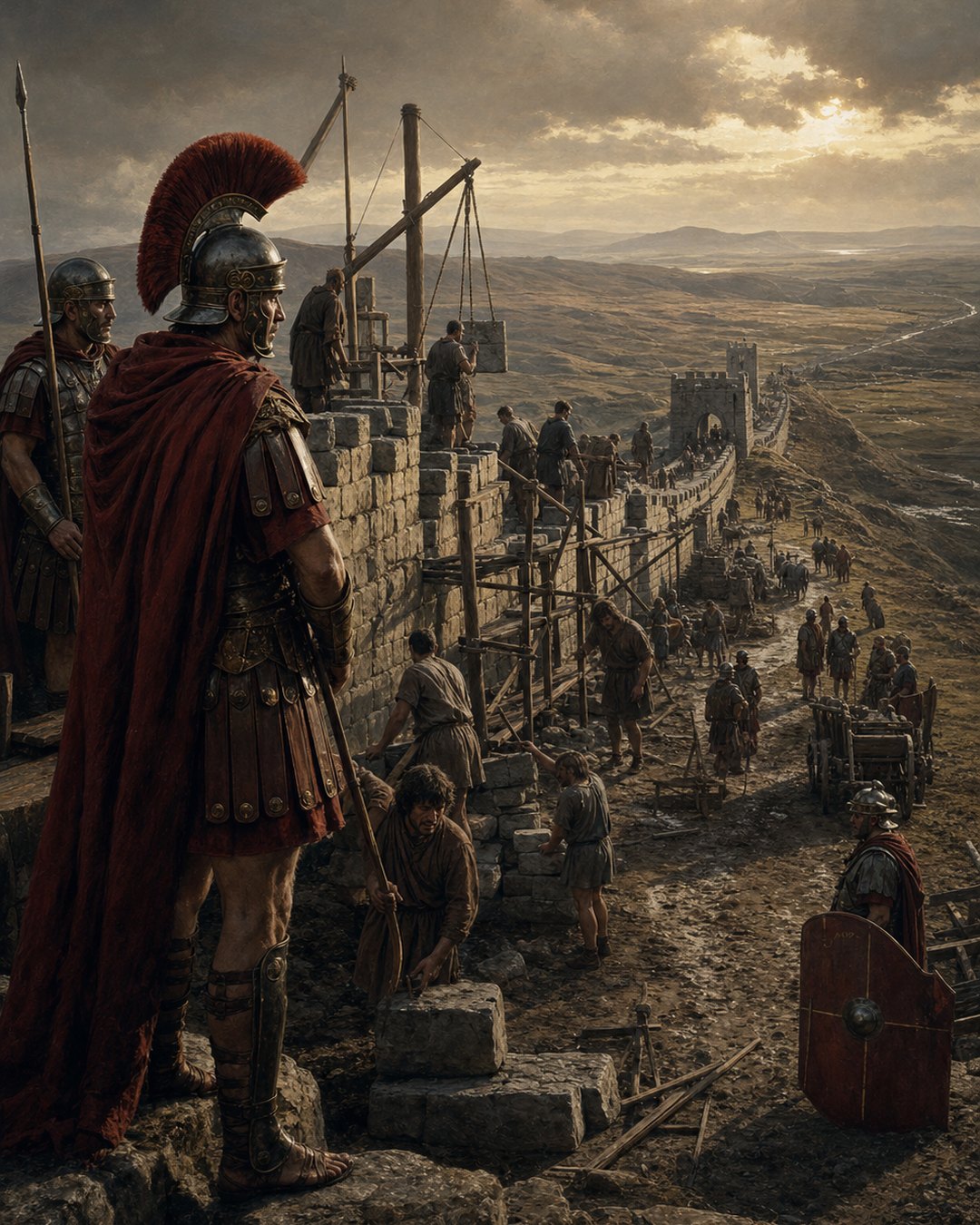
Hadrian’s Wall is easy to picture as a stone line across northern Britain. That picture is not wrong, but it is too still. The wall mattered because it turned a frontier into a routine: inspections, passes, taxes, patrols, letters, quarrels, repairs, and the daily work of deciding who could cross Rome’s edge and under what terms.
The emperor Hadrian visited Britain in AD 122, and the building programme traditionally attached to that visit became one of Rome’s most visible frontier experiments. It was not simply a panic barrier against people beyond the province. It was a staffed system: roughly 73 modern miles from the Tyne to the Solway, with forts, milecastles, turrets, roads, ditches, gates, and soldiers placed where movement could be seen and managed.
A frontier became an address
Before the wall, northern Britain already had Roman roads, forts, supply lines, and military habits. What changed under Hadrian was the effort to make a boundary legible on the ground. A traveler did not just meet “Rome” somewhere in the mist. He met a gate, a post, a clerk, a patrol, and a commander whose authority was backed by the larger province behind him.
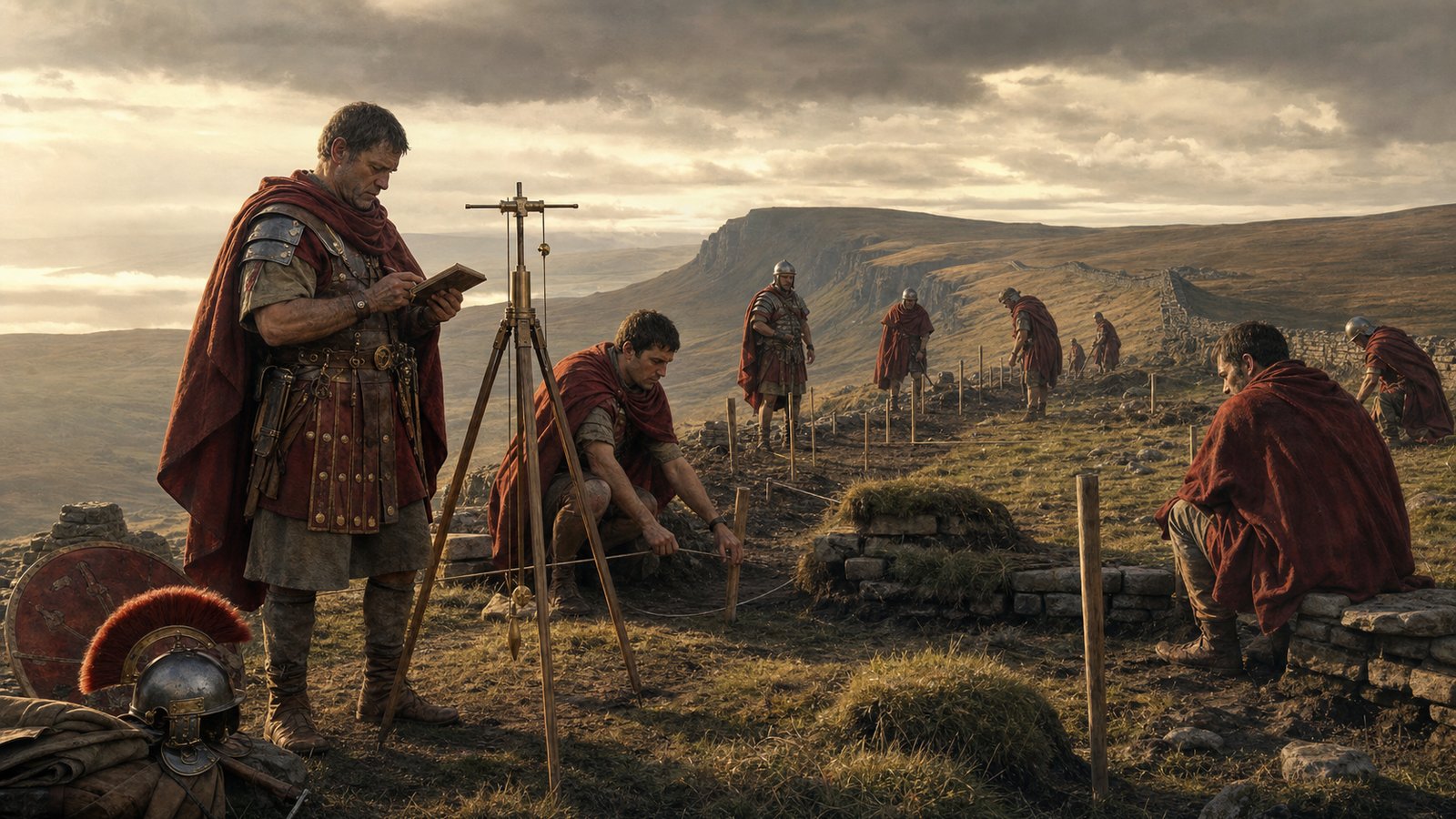
That is why the wall’s physical details matter. A continuous curtain line was only one part of the machine. Milecastles and turrets broke distance into supervised intervals. Larger forts such as Housesteads, Chesters, and Vindolanda anchored garrisons and paperwork. The vallum earthwork south of the wall added another controlled zone behind it. The result was not a single stone sentence. It was a grammar of movement.
The wall watched movement more than it stopped it
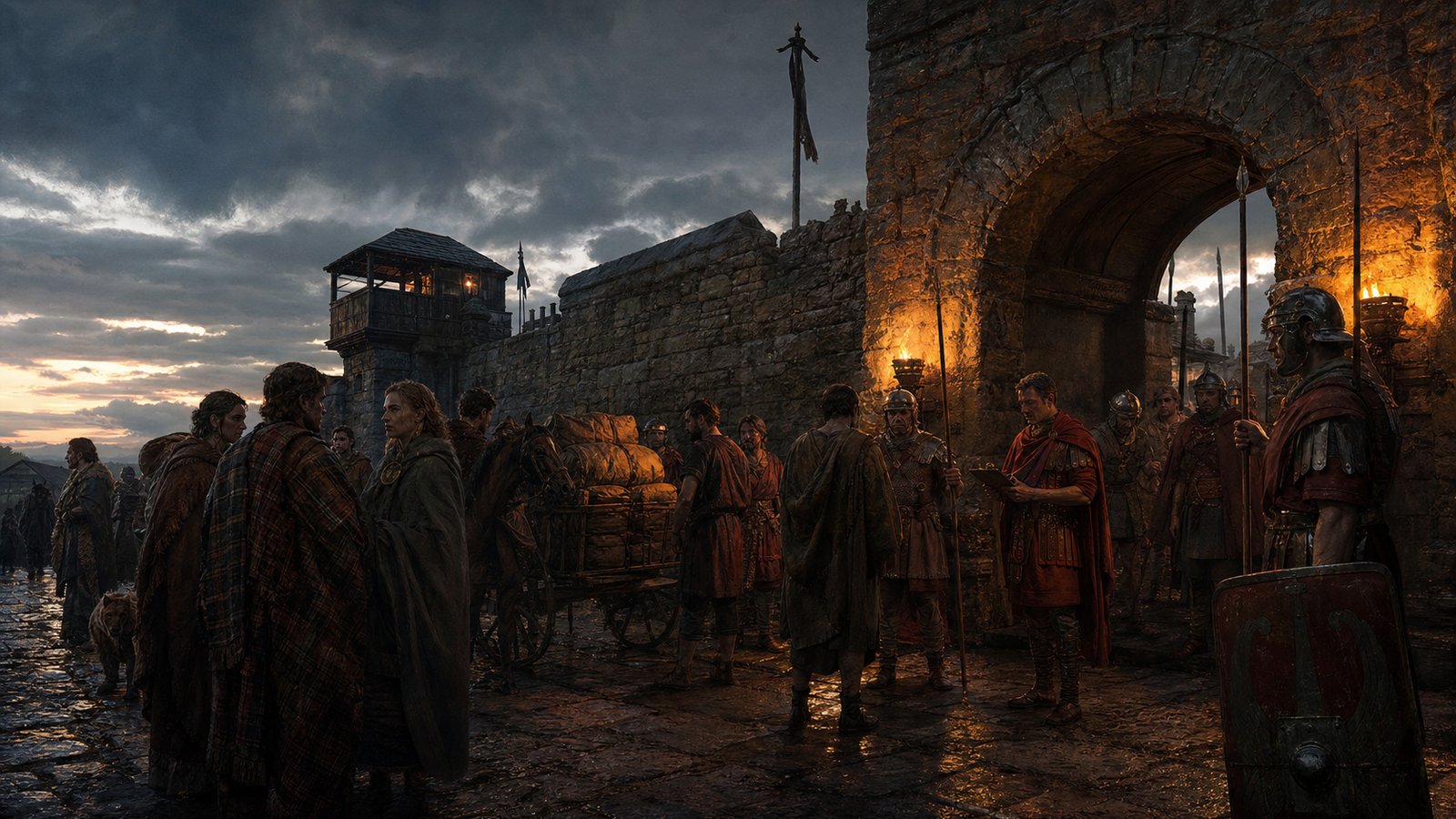
A modern border wall is often imagined as a device that says no. Hadrian’s Wall was closer to a device that asked who, why, and with whose permission. Gates through the line allowed crossings. Forts needed food, fuel, animals, wages, repairs, and information. Local communities did not vanish because a Roman emperor ordered stonework. They met soldiers, supplied them, argued with them, traded with them, and sometimes suffered under them.
The frontier therefore made Rome visible in small negotiations. A merchant with pack animals, a farmer bringing goods, a messenger, a recruit, or a local leader all encountered a system that could record, delay, tax, or redirect them. That kind of power is less dramatic than a battle scene, but it lasts longer. It turns geography into administration.
Hadrian was drawing limits, not only lines
Hadrian’s reign is often remembered for consolidation after the enormous expansion of Trajan. Ancient literary tradition presents him as an emperor who inspected armies and provinces closely, and the frontier works fit that temperament. The wall announced that Rome could still build at imperial scale, but it also admitted something important: endless forward motion was not the only way to rule.
The message was double. To provincials inside the line, it said Roman order had a northern edge guarded by paid men and permanent works. To groups beyond it, it said contact with Rome would happen through selected points. To soldiers stationed there, it said their service was not a temporary expedition but a way of life on a cold, regulated border.
The soldiers lived inside the policy
The wall was built and maintained by people, not by an abstract empire. Legionaries, auxiliary troops, engineers, quarrymen, clerks, and commanders made the frontier real day after day. The Vindolanda tablets, written on thin wooden leaves from a fort just south of the wall, preserve the texture that monuments usually hide: invitations, supply requests, military reports, complaints, names, and ordinary social ties.
That evidence matters because it pulls the wall out of postcard history. Behind the stone were boots in mud, spare cloaks, beer, writing tablets, birthday invitations, and commanders trying to keep units supplied. A frontier is not only a place where armies face enemies. It is a place where bureaucracy develops muscles.
The paperwork made the stones matter
The most revealing frontier evidence is not a heroic inscription. It is the small handwriting from Vindolanda. The tablets show officers and households asking for supplies, reporting men present or absent, arranging visits, and keeping social obligations alive in a garrison landscape. A birthday invitation from Claudia Severa to Sulpicia Lepidina is famous because it feels startlingly human, but its importance is larger than charm. It proves that the military zone was also a domestic and administrative world.
Those written scraps help explain why the wall should not be reduced to masonry. A gate without records is only an opening. A patrol without orders is only men walking in weather. Rome’s frontier worked when soldiers, clerks, commanders, suppliers, and local contacts repeatedly turned imperial decisions into routine acts. The emperor could order a boundary, but the boundary survived through lists, messages, repairs, and habits.
Control also created dependence
The wall did not isolate Roman Britain from the lands beyond it. It created a relationship in which contact became more official and more uneven. Forts needed grain, animals, leather, metalwork, timber, and labour. Civilians near the line could profit from the military market while also being watched by it. Communities north of the frontier could not ignore the gates, because the gates were where access to Roman goods and Roman trouble became concentrated.
That dependence cut both ways. Soldiers stationed along the wall depended on supply chains stretching south through the province and ultimately into the imperial treasury. If pay, food, or orders failed, the impressive stone line did not feed itself. This is the quiet weakness inside many Roman achievements: the monument looked permanent, but its power had to be renewed every week by transport, discipline, and money.
The monument outlived the strategy
Rome did not treat Hadrian’s Wall as the final answer forever. Antoninus Pius later pushed the frontier north to the Antonine Wall in Scotland, and Roman control in Britain shifted repeatedly. Yet Hadrian’s Wall endured because it occupied a useful line, and because the empire kept returning to the practical logic of controlled movement. Even when policy changed, the landscape remembered the older investment.
This is one reason the wall still misleads visitors in a productive way. Its surviving stones make it look like the main fact. The deeper fact is the system that once made the stones meaningful: patrol routes, signal points, customs-like control, military pay, civilian demand, and a chain of command stretching far beyond Britain.
Its real force was administrative imagination
Hadrian’s Wall was not “just a wall” because Roman power was rarely just one thing. The same structure could be military, fiscal, symbolic, and logistical at once. It reassured some people, warned others, organized soldiers, shaped commerce, and gave the emperor’s idea of order a hard edge in the landscape.
The famous line across Britain therefore tells us less about Roman fear than about Roman method. When Rome could not or would not simply absorb everything beyond a frontier, it tried to turn the frontier into a managed habit. Stone helped. So did gates. So did letters, rosters, wages, towers, roads, and men cold enough to remember that empire was made from maintenance as much as conquest.
Sources & Further Reading
- English Heritage, “History of Hadrian’s Wall”
- Encyclopaedia Britannica, “Hadrian’s Wall”
- World History Encyclopedia, “Hadrian’s Wall”
- Vindolanda Tablets Online
- Historia Augusta, Hadrian, 11
- Cassius Dio, Roman History, 69