
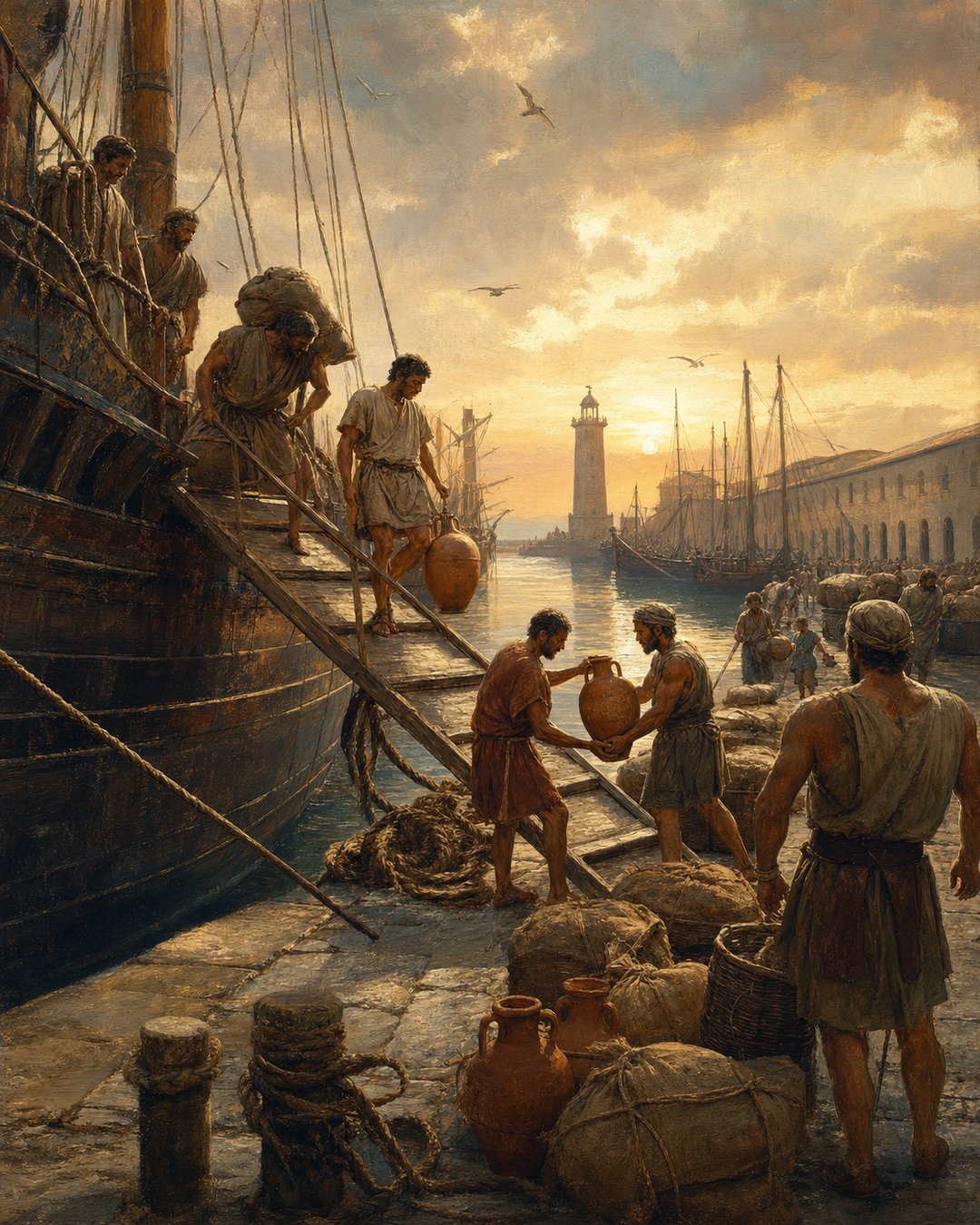
Empire can sound abstract until it reaches a dock. At Ostia, distance became visible as ships, ropes, sacks, amphorae, warehouses, ledgers, and laborers moving goods toward Rome.
Ostia’s harbor made empire feel reachable because it turned faraway provinces into practical arrivals. The system was not only conquest or map color. It was cargo handled at the mouth of the Tiber.
The harbor made distance physical
Ostia stood where river and sea met, a place where goods could move from maritime routes toward the capital. That geography made Rome’s dependence on distant places visible every day.
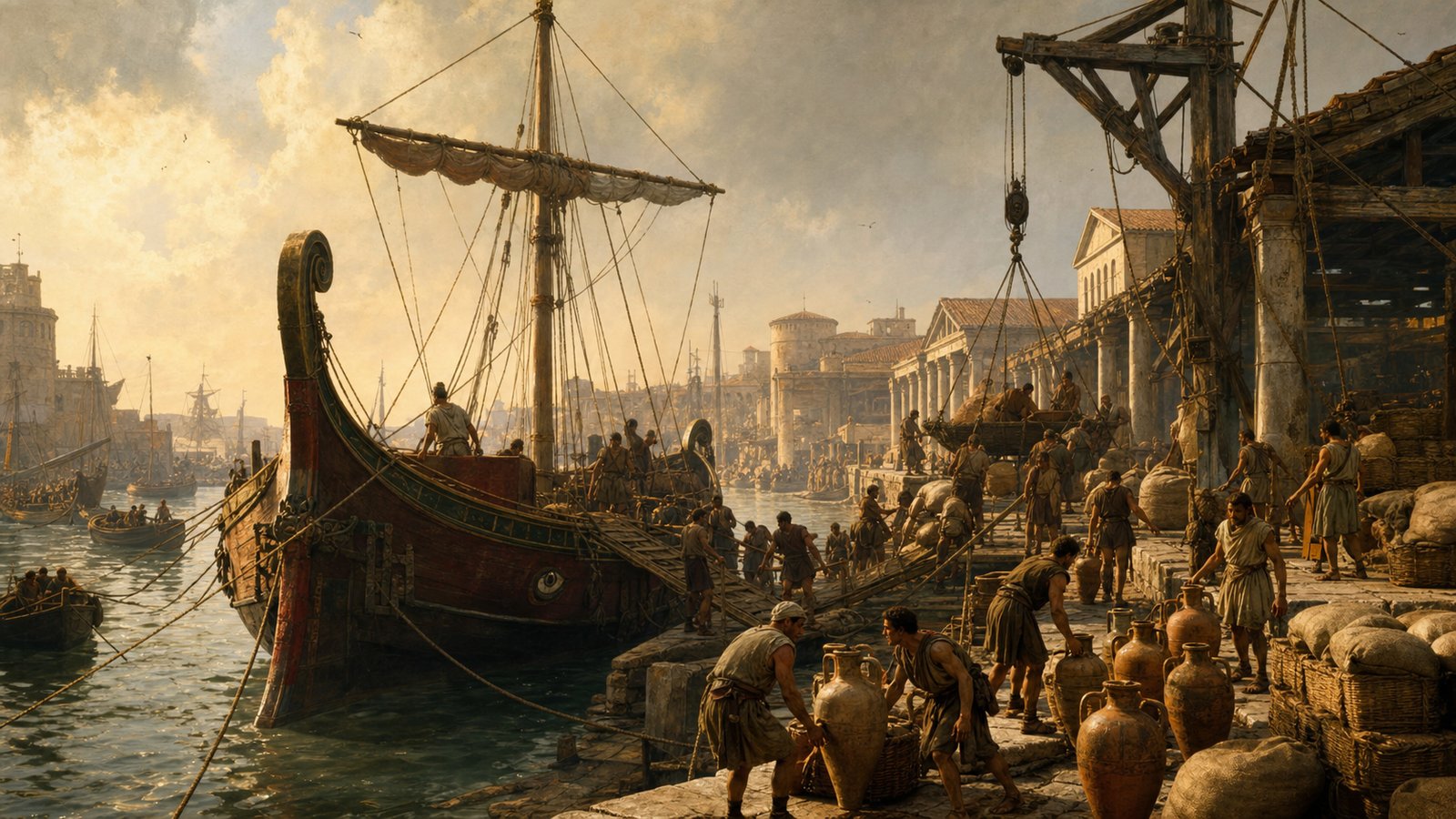
Picture dawn at the waterfront: sailors shouting, ropes tightening, a gangplank creaking, amphorae passing from hand to hand, and warehouses waiting beyond the dock. The empire has become a queue of objects.
Grain turned logistics into politics
Food supply was never just a household matter in Rome. Grain, transport, storage, and distribution were political because urban stability depended on the regular arrival of things no city could produce alone.
That makes the harbor more than scenery. A delayed ship or empty warehouse could become public anxiety. The annona made the movement of food a concern for rulers as well as merchants.
Amphorae made trade countable
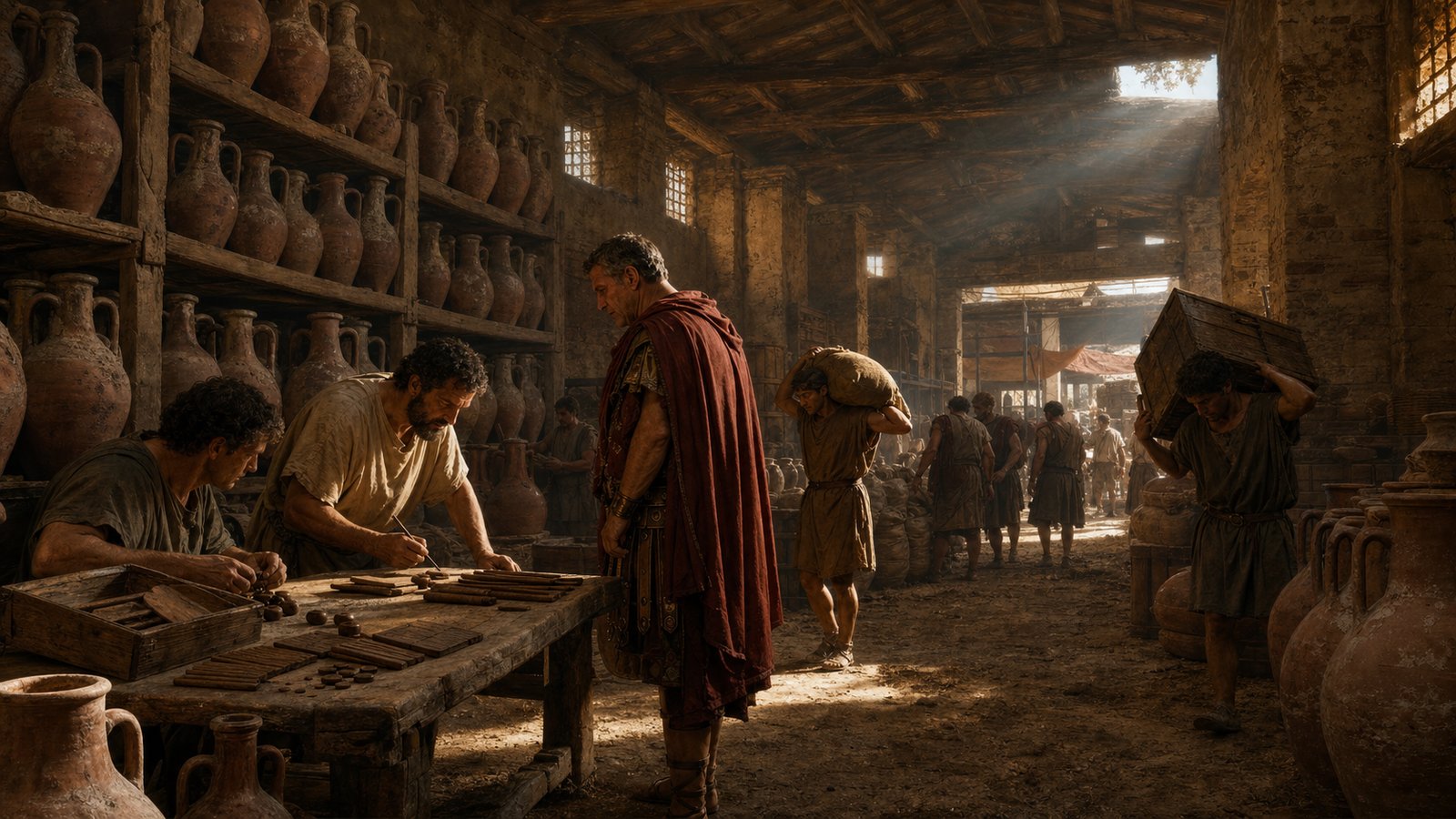
Amphorae helped turn liquids and preserved goods into transportable units. Oil, wine, fish sauce, and other commodities could be loaded, stacked, broken, replaced, counted, and recognized.
The container mattered because empire needed routine. A port does not only receive wealth; it breaks distance into manageable shapes that workers can lift and officials can record.
Warehouses held the future in reserve
Horrea gave the harbor memory. Goods did not simply arrive and vanish. They could be stored, guarded, inspected, released, and connected to later need.
That reserve changed the meaning of time. Rome did not live only from the ship that came today. It depended on systems that could hold today’s arrival against tomorrow’s hunger.
Ostia connected many kinds of labor
A harbor gathered people whose names rarely dominate imperial history: sailors, dock workers, merchants, clerks, guards, warehouse managers, animal drivers, boatmen, and officials. Their coordination made distant rule practical.
The sensory world was crowded: salt air, grain dust, creaking hulls, wet rope, oil jars, shouting, account tablets, and carts waiting for the road or river.
Empire became believable through routine
Grand power survives only if it can be repeated. Ostia made repetition visible: ship, unload, count, store, move, sell, distribute, record, and prepare for the next arrival.
This is why Ostia’s harbor made empire feel reachable. It transformed the distant world into daily procedures that Rome could see, fear, and depend on.
The harbor also exposed vulnerability. A storm, piracy, administrative failure, bad harvest, or bottleneck could turn a distant problem into Roman pressure. Reachability worked both ways.
That vulnerability helps explain why logistics mattered so much. The capital’s confidence depended on the impression that the sea could be made regular, even when nature and politics refused to be fully controlled.
Ostia’s built environment made that confidence easier to imagine. Docks, warehouses, streets, baths, apartments, and commercial spaces showed a community organized around movement and storage.
The place also compressed the empire socially. Goods from different regions could share a warehouse; people from different backgrounds could share a dockside routine; Roman demand could pull many journeys into one urban system.
For the consumer in Rome, much of that labor disappeared. Bread, oil, wine, and preserved foods arrived as if the system were natural. Ostia reveals how unnatural that ease really was.
Every amphora carried a chain of work behind it: production, container, transport, sale, loading, sailing, unloading, storage, and final movement. The harbor was where that chain became visible.
This is why a port can teach political history. It shows what rule required after the battle and after the treaty: reliable movement, records, labor, trust, and space to hold goods until people needed them.
The port also made provincial production imaginable to people who never saw the provinces. A jar on a dock or a sack in a warehouse stood in for fields, presses, workshops, and voyages beyond the horizon.
That translation was political. When Rome expected food and goods to arrive, distant communities became part of the capital’s routine, and failures elsewhere could become pressure in the city.
A harbor is therefore a place where geography becomes administration. Sea routes, river movement, storage rooms, accounts, guards, and labor schedules all had to cooperate before distance felt useful.
Ostia’s value lay in this conversion. It did not erase danger, but it gave Rome a visible system for turning uncertain arrivals into something that could be managed.
The work also depended on trust among strangers. Sailors, merchants, clerks, dockers, warehouse staff, and officials had to accept measurements, containers, records, and promises made by people they might never see again.
That trust was reinforced by repetition. The more often cargo passed through the same kinds of checks and spaces, the more the empire could seem like a working habit rather than a miracle.
When Romans imagined abundance, they were also imagining infrastructure: ships that survived the crossing, warehouses with capacity, officials with records, and laborers strong enough to move the goods.
The harbor made that infrastructure public. Anyone who saw the waterfront could understand that Rome’s appetite rested on arrivals, not merely on imperial pride.
The work was also seasonal and uncertain. Winds, storms, silting, river conditions, and political disruption all threatened the neat routine implied by a full warehouse.
That uncertainty made successful arrival emotionally powerful. A ship entering port was not only commerce; it was reassurance that the system still worked for another day.
Ostia therefore helped convert anxiety into evidence. Full storerooms, stacked amphorae, and busy crews told the city that distance had been crossed and organized.
The same evidence could sharpen fear when it failed. Empty space in a warehouse or delay at the dock made the empire feel far away again, no matter how large it looked on maps.
Harbors also created knowledge. Clerks, merchants, and workers learned which regions supplied what, which routes were reliable, which captains could be trusted, and which cargoes made people nervous.
That knowledge moved through taverns, offices, markets, and households. A port was not only a machine for goods; it was a machine for information about the wider Roman world.
For the capital, this mattered because dependence had to feel normal. Rome needed people to believe that distant harvests, jars, ships, and warehouses would keep aligning often enough to sustain urban life.
The waterfront made that belief testable. Each unloading gang, stored sack, sealed account, and cart moving inland gave Rome another small proof that faraway resources could be made present, counted, stored, and trusted before the next ship appeared in the harbor mouth at dawn, watched by dockside laborers.
Rome’s greatness was not only marble and memory. It was also a waterfront where distant harvests and cargoes became something a city could eat, count, store, and argue about.
Sources & Further Reading
- World History Encyclopedia, Ostia
- World History Encyclopedia, Roman Food
- Smith Dictionary, Horreum
- World History Encyclopedia, Roman Daily Life
- Smith Dictionary, Annona