
Why Romans Told Foundation Myths They Knew Were Dangerous
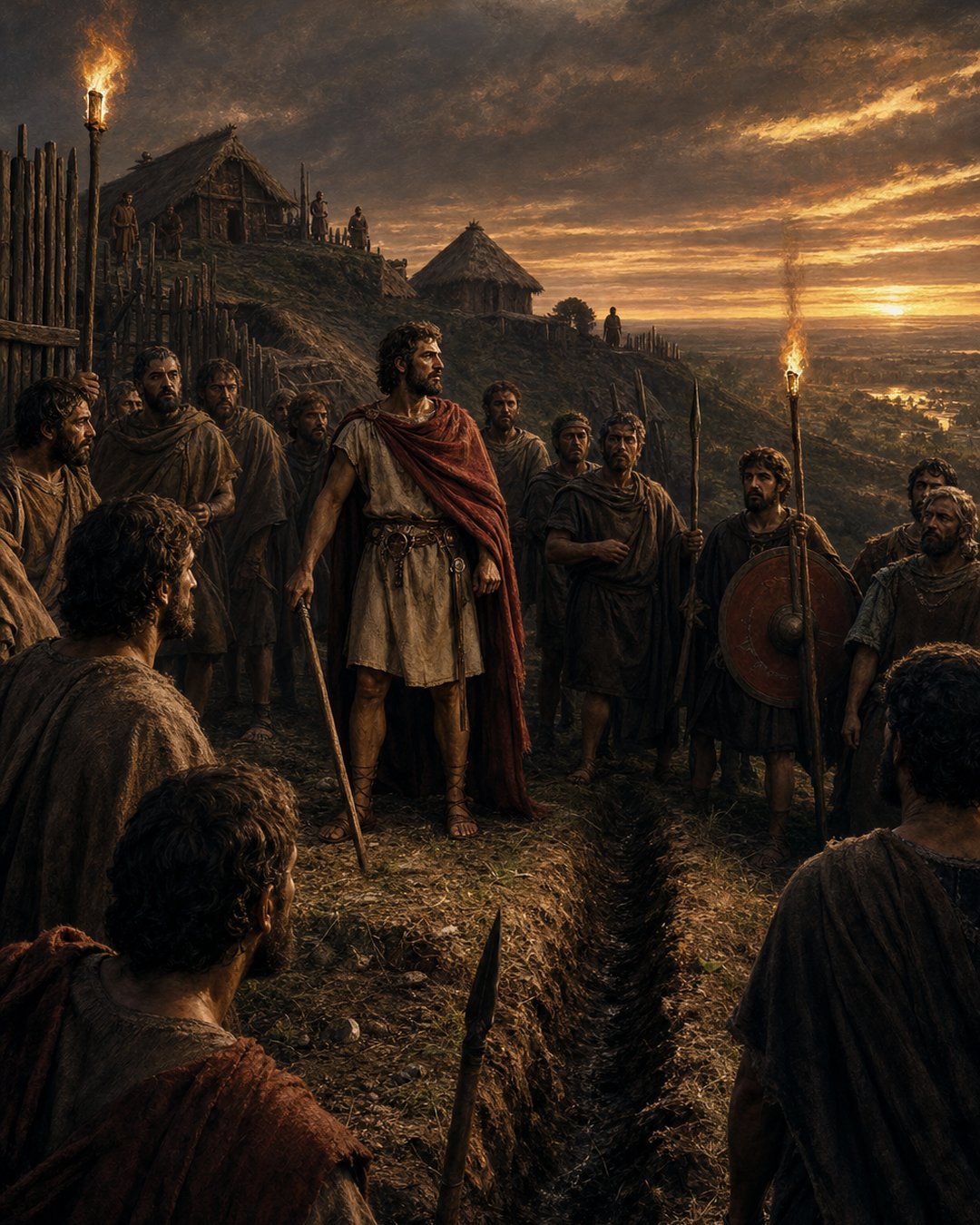
Rome did not give itself a harmless origin story. It chose, repeated, and argued over a myth full of exposed infants, animal rescue, rival hills, sacred signs, a boundary line, and a brother’s death. That is not a soft beginning. It is a warning label attached to a city.
Livy knew the earliest material was difficult. At the start of his history, he allows that the oldest traditions are more poetic than secure. Yet he still tells them because Rome needed those stories. A city does not keep a dangerous myth by accident.
The wolf is famous, but the boundary is the wound
The rescued twins are the image everyone remembers. Livy 1.4 gives the abandoned children, the she-wolf tradition, and the improbable survival that turns weakness into destiny. But the story becomes politically dangerous later, when Romulus and Remus disagree over where and how the city should begin.
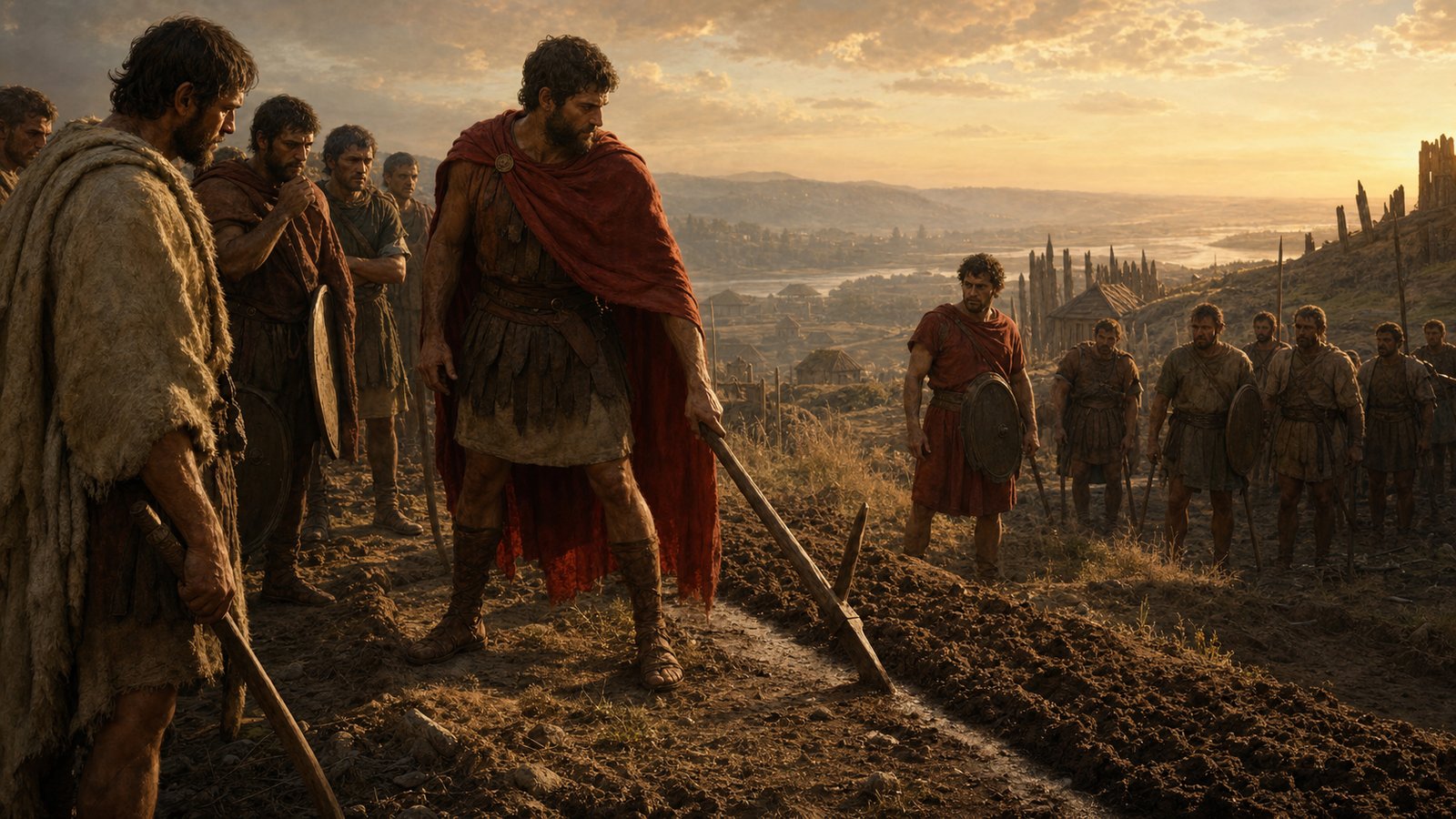
Livy 1.6–1.7 connects the dispute to augury, place, and command. The Palatine and Aventine matter because Rome’s origin is not just about bloodline. It is about who has the right to read signs, claim ground, and make others obey a line in the earth.
Augury made politics look older than politics
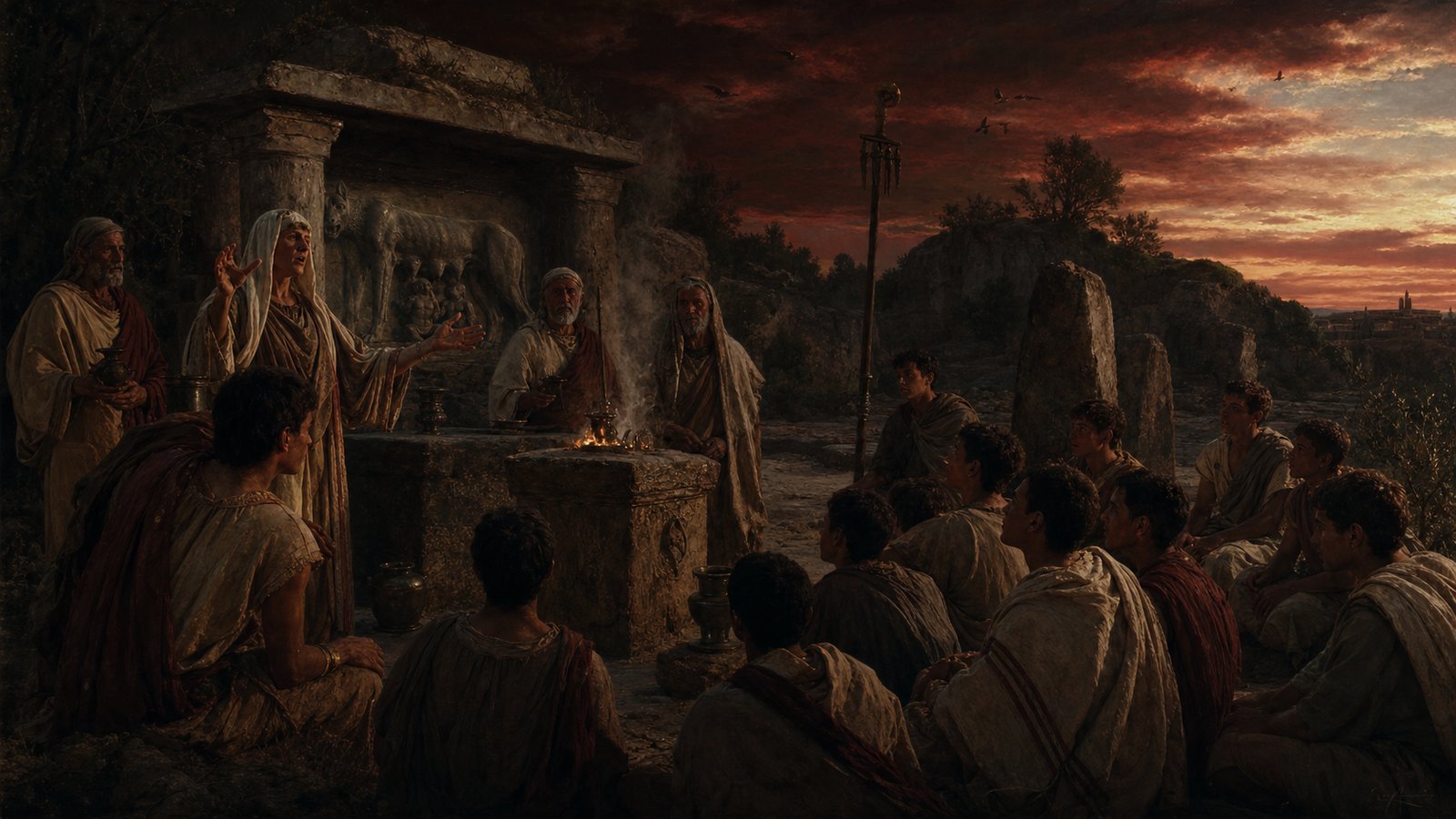
By placing birds and omens at the beginning, the myth gave authority a sacred vocabulary. The brothers do not merely vote. They watch the sky. They compete over signs. The future city is presented as something the gods might be asked to validate before men enforce it.
That does not make the story gentle. It makes it more severe. If a boundary is sacred, crossing it is not just trespass. If rule is sanctioned by signs, losing the contest is not just disappointment. The myth lets Romans imagine power as both human decision and cosmic pressure.
Remus made the story impossible to relax inside
The death of Remus is the part that keeps the foundation from becoming a nursery tale. Plutarch, in the Life of Romulus, preserves variant details about the quarrel and the killing, which shows that ancient readers were not dealing with a single tidy version. They inherited a problem.
Why would Rome keep telling a story in which brotherhood fails at the city wall? Because the discomfort served a purpose. It suggested that order had a cost, that boundaries required enforcement, and that the city’s greatness could not be separated from violence done near its birth.
The myth taught Romans how to argue about themselves
A clean origin closes questions. Rome’s origin opened them. Was Romulus a founder, a criminal, a necessary man, or all three? Was Remus a victim of tyranny or a violator of sacred order? Did Rome begin in justice, ambition, divine favor, or controlled brutality?
Those questions were useful because Roman history kept returning to them. Civil conflict, dictatorship, emergency command, sacred law, and the language of necessity all found an ancestor in the foundation myth. The story made later political violence feel both shocking and familiar.
Danger made the story durable
Romans did not need their foundation to be morally tidy. They needed it to be strong enough to carry contradiction. The twins were royal and abandoned. The wolf was savage and nurturing. The city was blessed and stained. The wall protected the future and killed a brother.
That density is why the myth lasted. It could flatter Rome as chosen, warn Rome as violent, and explain Rome as a place where boundaries mattered more than innocence.
Why Rome kept returning to the beginning
Every political community tells stories about why it deserves to exist. Rome’s story was unusually honest in one respect: it did not pretend that founding a city was painless. It put the line in the soil and forced listeners to ask what kind of act made a people.
The result is not a simple celebration. It is a Roman habit of memory. The city began by turning danger into identity, and then spent centuries doing the same thing again.
A dangerous myth made later obedience easier to imagine
The foundation story also gave Romans a language for obedience that was older than any living magistrate. If the first city boundary had to be defended with deadly seriousness, then later boundaries—legal, sacred, military, and social—could be described as more than convenience. They were part of what made Rome Rome.
This did not mean Romans agreed about the story. The survival of variants is important. Livy and Plutarch both show a tradition that could be retold with different emphases. That flexibility kept the myth alive. A rigid story breaks when readers doubt it. A troubling story adapts because every generation can find its own danger inside it.
The origin was a mirror, not a lesson card
Rome’s foundation myth did not offer one neat moral. It held up a mirror. For a conqueror, Romulus could look like necessary severity. For a critic of power, Remus could look like the first casualty of Roman ambition. For a priest, the auspices mattered. For a jurist, the boundary mattered. For a family, the brother’s blood mattered.
That is why the myth was useful long after anyone could verify the events. It gave Romans a shared story that was strong enough to fight over. In that sense, the danger was not a flaw in the myth. It was the engine that kept it politically alive.
Why the story refused to become harmless
The foundation myth stayed powerful because it never let Rome become innocent. A harmless tale would have been easier to praise but less useful in crisis. This one could explain why command hurt, why law needed force, why sacred signs could be disputed, and why a city might remember violence as both shame and necessity.
That ambiguity is very Roman. The past was not merely a museum of examples. It was a storehouse of arguments. Romulus and Remus gave later Romans a way to argue about ambition, sacrifice, kinship, and the terrible seriousness of drawing a line and calling it a city.
The detail changes the whole room
The useful habit is to stay with the concrete detail long enough for it to change the story. A furnace, a boundary trench, a thrown crust of bread, or a neglected bundle of petitions is not decoration. It is evidence of how Roman power entered daily life. The grand interpretation only works when it is tied to objects, places, bodies, and named ancient witnesses.
That is also why the simpler version is not enough. Rome did not survive as a set of slogans. It survived in practices that people repeated, feared, resented, enjoyed, and remembered. Follow those practices closely, and the familiar story becomes less flat, more human, and more dangerous.
That method also guards against the easy myth. Instead of saying that Rome was simply brutal, brilliant, decadent, or modern, it asks where the claim can be seen. Who is standing in the scene? What number, room, route, office, ritual, or ancient sentence anchors the argument? Once those anchors are visible, the article is no longer a recycled Roman mood. It becomes a specific case study in how a particular Roman system worked.
Sources & Further Reading
- Livy, History of Rome, 1.4–1.7
- Plutarch, Life of Romulus, 9–11
- Encyclopaedia Britannica, Romulus and Remus