
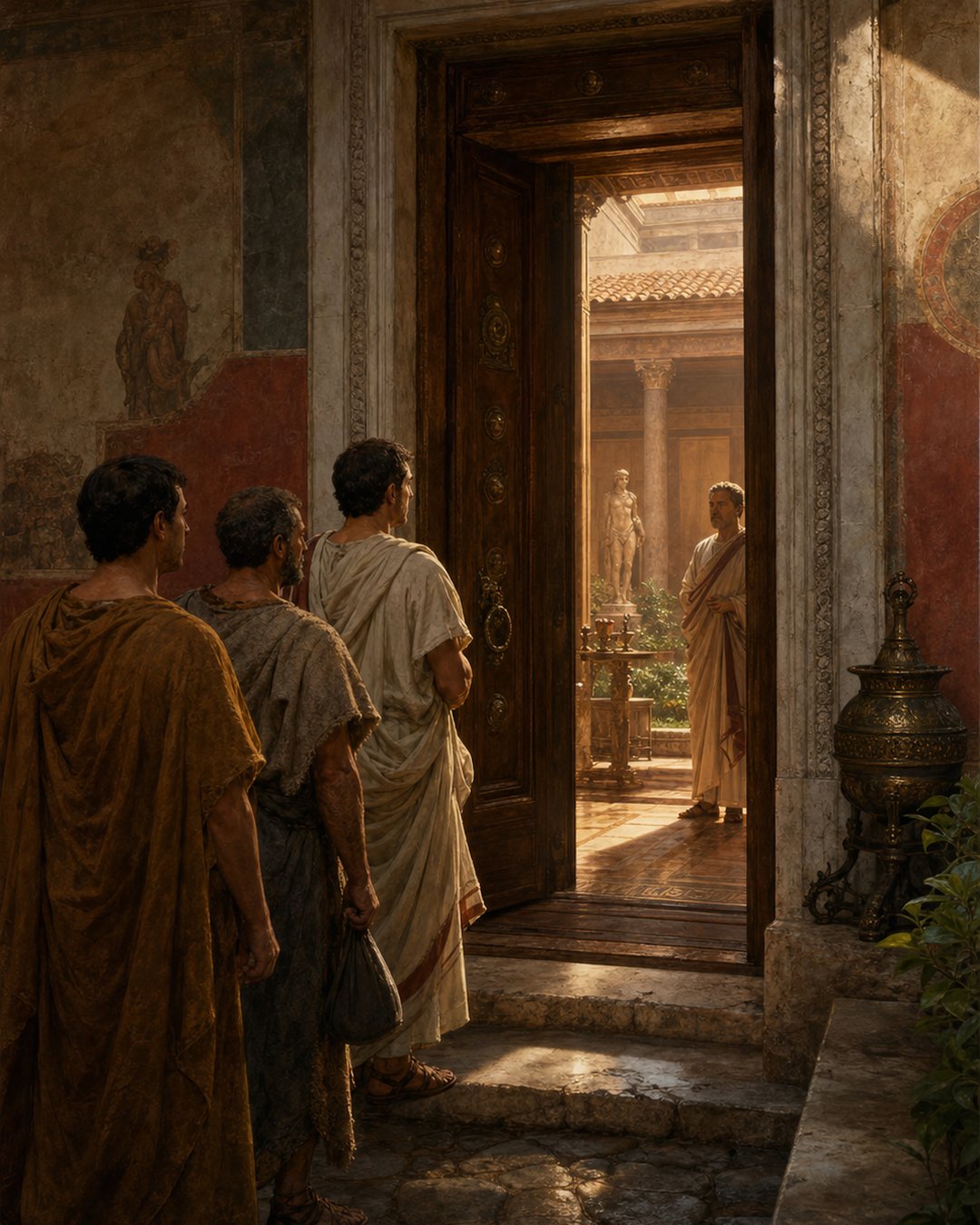
The Roman house did not begin at the comfortable center of family life. For a visitor, it began at the threshold, where the street met the door and the door decided what sort of person one was allowed to become inside.
Roman doorways made status begin before the atrium because the approach to a domus was already a social test. Waiting, entering, glimpsing, greeting, and being delayed all turned architecture into hierarchy.
The door was a social instrument
The janua was a physical door, but a Roman entrance did more than open and close. It sorted movement. It could admit a client, hold a stranger outside, frame a patron’s dignity, and let the street see just enough to understand that a household mattered.
This is why a doorway deserves attention. It is the smallest piece of architecture that can still create rank. One person passes through; another waits; a third is not recognized at all.
The atrium made privacy selectively public
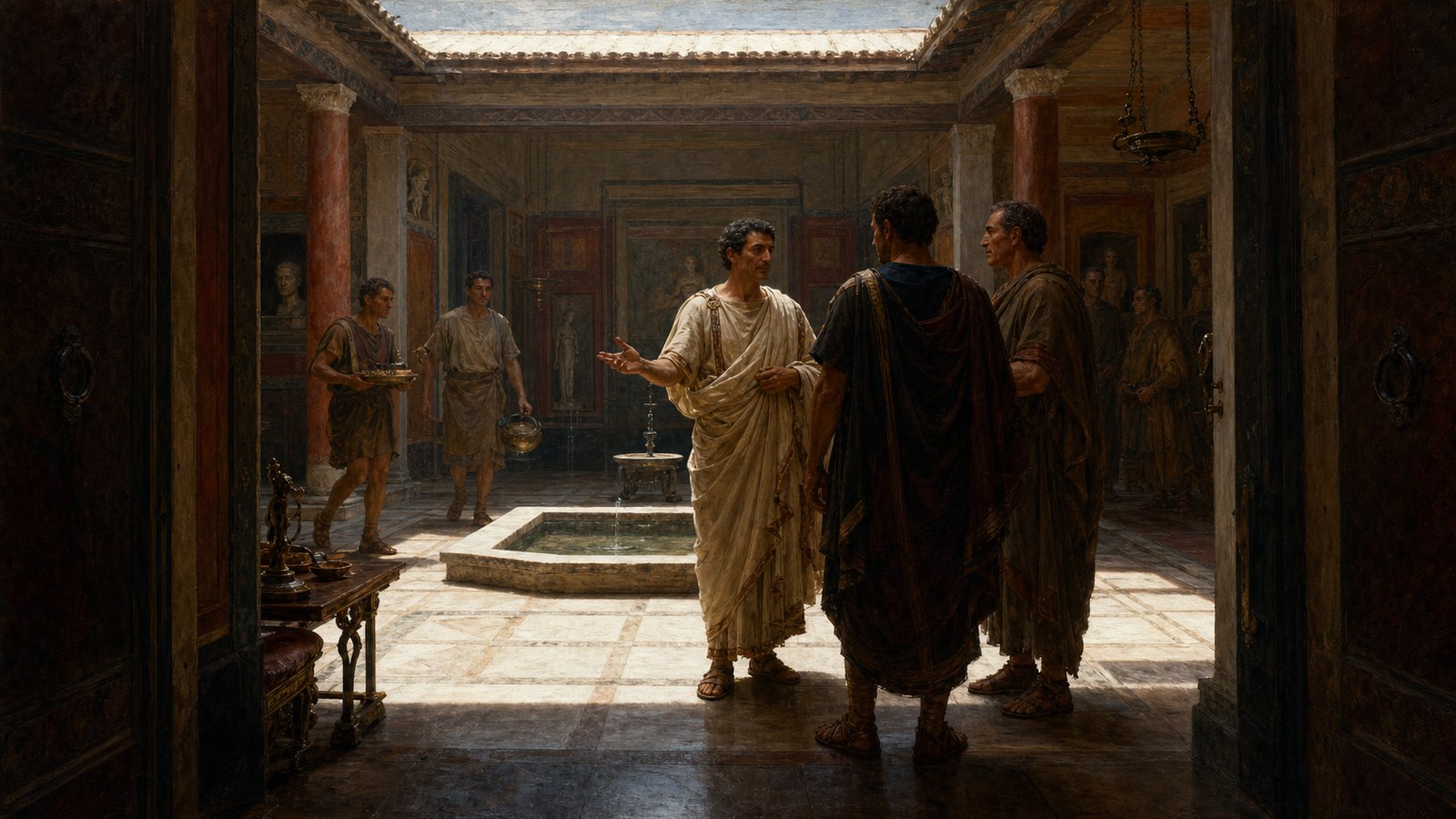
The atrium was central to the Roman house and often lit from above. It was interior space, but not simply private space. Visitors could be received there, family memory could be displayed there, and the household’s arrangement became visible in a controlled way.
A visitor did not need to tour the bedrooms to learn something about the family. The approach, the opening, the light, the reception area, and the movement of servants were enough to make a first claim.
Clients turned morning into a performance
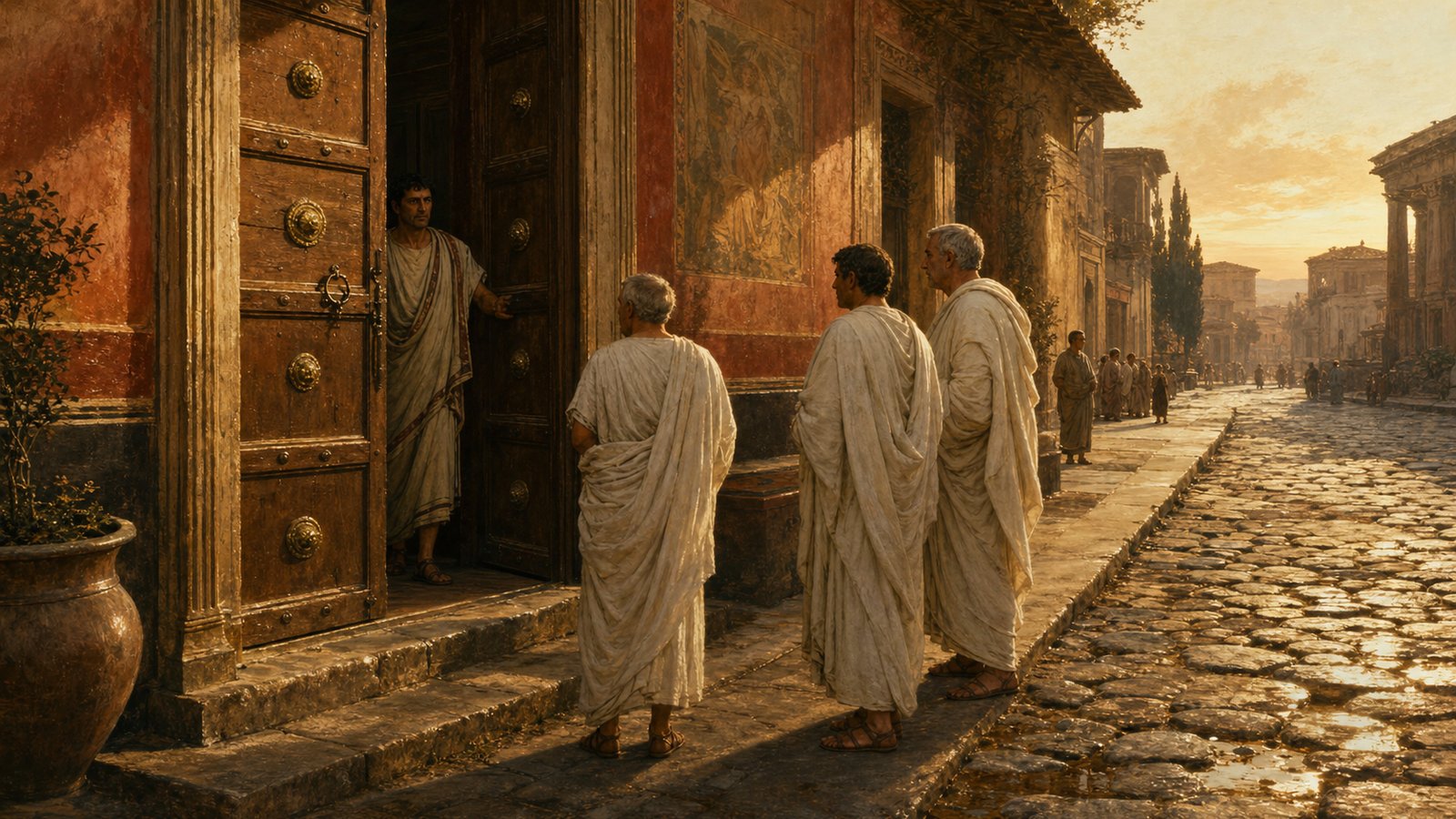
The Roman client was not merely a friend dropping by. Patronage structured obligations, favors, dependence, and public recognition. A patron’s doorway could gather people whose presence confirmed the patron’s reach.
Imagine the morning mini-scene: sandals on stone, robes gathered against the chill, voices low outside a heavy wooden door, a servant deciding whose name matters first. The house has not yet spoken, but the order of entry has.
Household religion deepened the message
The lararium reminds us that the Roman house also held ritual meaning. Domestic cult did not sit outside social identity; it helped make a family legible to itself and to those admitted near its inner world.
A doorway therefore guarded more than furniture. It guarded ancestry, ritual, reputation, and the carefully staged distance between street life and household authority.
Architecture made rank feel natural
The cleverness of the system was that status could look like simple movement. Someone waited because waiting seemed normal. Someone entered because the door opened. Someone glimpsed the atrium and understood the family’s position before anyone explained it.
Doorways made Roman status durable because they made hierarchy practical. Rank did not need to be shouted when architecture could make people line up, pause, cross, and lower their voices.
The public life of Rome was not confined to the Senate, the Forum, or the army. It also lived at the front of a house, where the first few steps could teach a visitor how power wanted to be approached.
The threshold also made time visible. A powerful household could spend other people’s mornings before any formal favor was granted. Waiting was not empty; it demonstrated that a client recognized where help, recommendation, and protection might come from.
The doorway’s power came from being ordinary. Nobody had to announce that rank was being rehearsed. The shape of the house, the servant at the entrance, and the order of movement did the work quietly enough to feel like custom.
A domus could therefore be both home and stage. Its rooms protected family life, but its front sequence exposed enough of that family to make visitors aware of ancestry, wealth, discipline, and access. The atrium was not a neutral hall; it was a managed first impression.
The lararium adds another layer because domestic religion joined household status to ritual continuity. The family did not merely own rooms. It inhabited a world of ancestors, gods, obligations, and daily rites that could be hinted at by what visitors were allowed to see.
For clients, the front of the house taught dependence with architecture rather than speeches. A man could know his place by where he stood, how long he waited, and whether he was called through the door or left watching the threshold from the street.
This made status durable because it repeated every morning. One grand ceremony might impress people once. A doorway that sorted bodies day after day made social order feel practical, familiar, and difficult to escape.
The social intelligence of the doorway was that it joined space to time. The person waiting outside was not simply outside; he was spending his morning in a visible admission of another man’s importance. The person brought in quickly could carry that small privilege back into the street as evidence of closeness.
A door also created a controlled glimpse. The atrium could be partly seen, but not fully possessed by the viewer. Light from the compluvium, the movement of household slaves, the line toward the tablinum, and the presence of ritual or memory made the house legible without making it open.
That halfway visibility suited Roman hierarchy. Power often works best when people can see enough to desire access but not enough to forget who controls it. The threshold did exactly that. It allowed the patron to turn hospitality into a measured gift.
The client’s experience was therefore physical. He stood on stone, shifted his weight, listened for names, watched the door, and measured his own standing by the progress of others. Social order was not only believed; it was felt in knees, feet, and morning cold.
Nor was the patron untouched by the performance. A doorway full of waiting clients advertised usefulness. It told neighbors that this was a house worth approaching, a family whose influence could gather bodies before breakfast, and a patron whose favor had practical value.
The domus front also blurred public and private in a distinctively Roman way. The street did not end cleanly at the door, and the household did not begin as pure retreat. Between them lay a managed zone where reputation, access, ritual, and dependence could all be staged.
That is the point hidden in the architecture. Before a visitor reached the atrium, the house had already asked and answered the important questions: Who may wait? Who may enter? Who must be announced? Who is visible enough to matter?
Even when no formal rule was spoken, the answers accumulated. A repeated morning queue could teach a neighborhood which household mattered, which dependents were useful, and which men had to seek favor rather than command it. The doorway made hierarchy durable by making it ordinary, bodily, and visible at the edge of the street.
For the visitor, that edge was never neutral. Crossing it meant accepting the house’s terms: its order of greeting, its pace, its servants, its religious signs, and its carefully rationed view of the atrium. Status began there because access itself was the first favor in public life daily.
Sources & Further Reading
- Smith Dictionary, Domus
- Smith Dictionary, Atrium
- Smith Dictionary, Janua
- Smith Dictionary, Lararium
- Smith Dictionary, Cliens
- Smith Dictionary, Patronus