
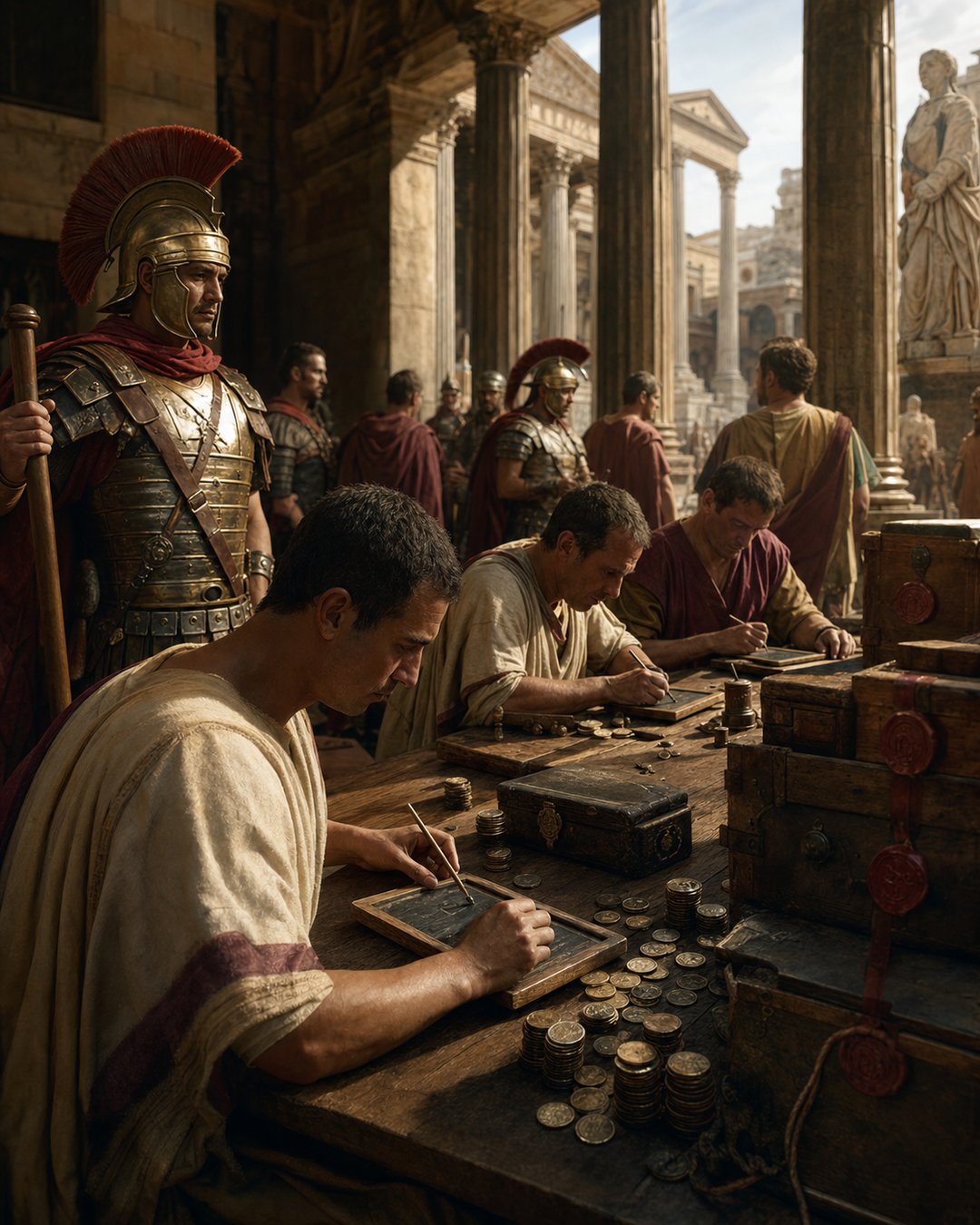
Roman war looks loud from a distance: standards, dust, shouted orders, triumphal memory. Up close, it also required a quieter world of taxes, tablets, coins, clerks, and public storage.
Treasury ledgers made war countable because military power had to pass through administration before it became legend. Rome needed men, but it also needed sums: what was owed, what was paid, what was raised, and what could be repeated.
The aerarium gave power a place
The aerarium, the public treasury, was traditionally associated with the Temple of Saturn. That location matters because money was not imagined as a vague state mood. It was stored, guarded, recorded, and connected to Rome’s civic memory.
A treasury made public power physical. Coins, documents, seals, and officials could gather in one administrative story: the republic or empire could act because resources had been made available and legible.
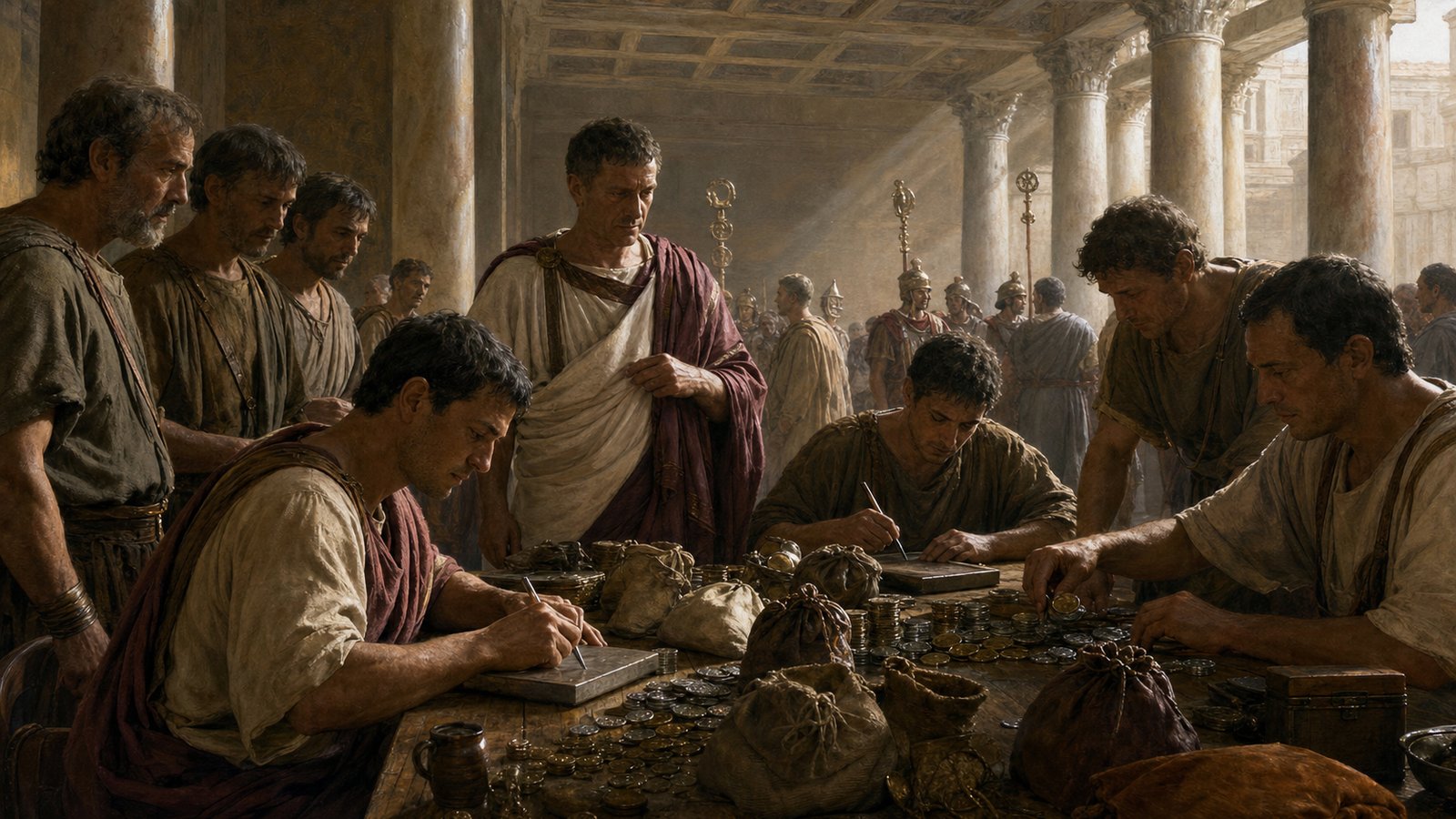
Tributum tied civilians to campaigns
Tributum was a contribution or tax. The word pulls war away from the battlefield and back into the city. Before soldiers marched, someone had to decide what could be demanded and how that demand would be turned into usable support.
This is the uncomfortable bridge. A campaign that later became a story of courage may have begun as pressure on households, communities, and accounts. War was political because it had to be financed before it could be celebrated.
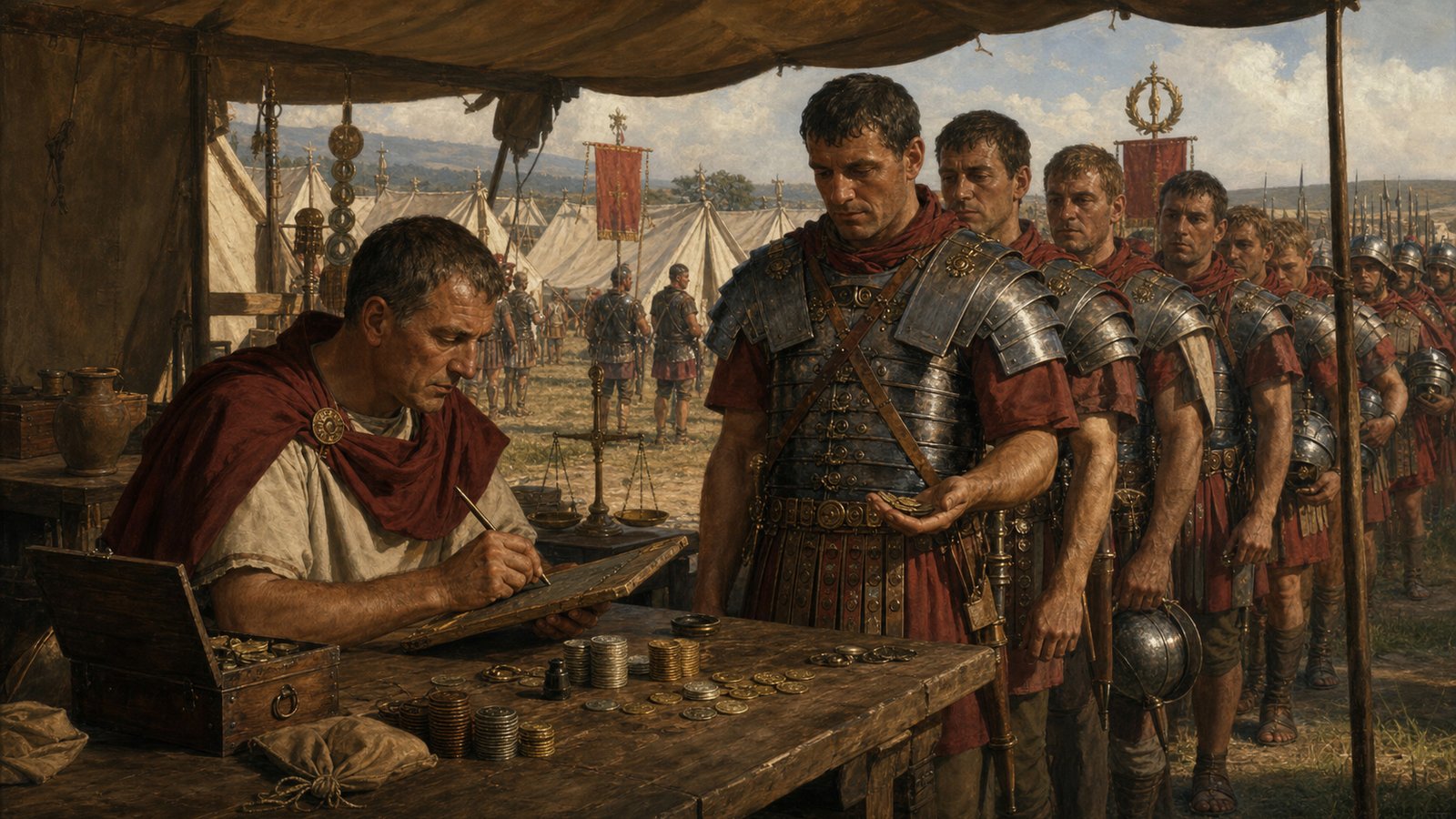
Stipendium made service measurable
Stipendium could mean military pay or a term of service. Both meanings are revealing. A soldier’s duty became a matter of time and compensation, not only loyalty or personal bravery.
Picture a pay scene without romance: a queue, a clerk, a wax tablet, a chest, a man checking what he is owed. The legion’s discipline depended partly on the fact that service could be entered into records.
Public buildings gave administration witnesses
Basilicas and the Forum placed business, law, and civic movement in visible settings. Administration did not happen only in hidden rooms. It belonged to a public architecture where witnesses, officials, and petitioners moved through the same spaces.
That visibility did not make finance pure. It made finance Roman. The state’s claims became procedures, and procedures created opportunities for memory, dispute, delay, and enforcement.
Ledgers made glory repeatable
Rome’s genius was not simply that it fought. Many peoples fought. Rome turned fighting into routines that could be counted: taxation, pay, service, storage, records, and official spaces where obligations could be recognized.
The ledger changed war by making it repeatable. A single victory could become a tradition only if men, money, and authority could be assembled again and again without pretending that courage alone paid the bill.
The bronze chest and the wax tablet are less spectacular than the eagle standard, but they belong to the same machine. Rome’s armies moved because someone could translate public ambition into numbers, and numbers into obligations that real people had to meet.
This administrative view does not make Roman warfare less violent. It makes the violence more comprehensible. An army that could be paid, supplied, counted, and recalled had a different relationship to the state than a temporary band gathered only by emergency enthusiasm.
The numbers also created a memory of obligation. A soldier could be owed pay. A taxpayer could resent contribution. An official could be blamed for failure. The ledger did not erase politics; it gave politics a sharper surface on which to argue.
Because the aerarium belonged to public memory, finance could become moral language. A depleted treasury was not merely an accounting inconvenience. It could suggest failed discipline, dangerous ambition, or a war whose glory had outrun its means.
Tributum and stipendium show the two ends of the same chain. One side asked civilians for resources; the other side turned military service into a compensated, measured obligation. Between them stood the Roman habit of making power pass through records.
That habit helped Rome scale conflict. A city could not keep expanding by courage alone. It needed ways to convert farms, allies, taxes, coin, service, and command into an army that could appear where political ambition sent it.
So the ledger deserves a place beside the standard. The standard gave soldiers a visible focus of honor, but the account made service administratively real. Without the count, glory risked becoming a story the state could not afford to repeat.
A financial view also changes the way we imagine discipline. Punishment and training mattered, but pay and expectation mattered too. A soldier who understood his stipendium stood inside a system of obligation that joined his body to the state’s promises.
Taxes carried the same double edge. They made war possible, but they also made war present at home. A levy of money could bring distant strategy into a household’s accounting, turning the frontier into a problem felt far from the marching column.
The basilica and forum gave these pressures a public texture. Clerks, witnesses, petitioners, officials, and soldiers could all move through places where money and authority were handled as civic business. Administration had a stage as surely as triumph did.
This does not mean Rome was a tidy bureaucracy by modern standards. Records could fail, officials could abuse office, and commanders could stretch resources violently. The important point is that Roman power repeatedly tried to make obligation legible enough to mobilize again.
The ledger also limited fantasy. A commander might promise honor, but the state still had to find coin, collect contribution, record service, and keep enough confidence for the next demand. War was never only a story told afterward; it was a set of entries made beforehand.
Seen this way, the quiet accountant belongs in the history of Roman arms. He did not win the battle, but he helped make the battle administratively possible. Every counted coin and marked tablet made the army less like a sudden crowd and more like an institution.
That is why the treasury deserves attention beside the camp. Rome’s strength lay not only in men who could march, but in a civic machine that could ask, count, store, pay, and ask again. The ledger made war countable, and countability made repeated war possible.
There was also a psychological consequence. When service and contribution were counted, people could imagine the state as something that remembered. It remembered who had paid, who had served, who was owed, and who had failed to meet a demand. That memory could be resented, but it also made obedience more concrete.
The point is not that ledgers were gentler than swords. They could be another instrument of pressure. Yet they reveal the hidden labor behind every Roman campaign: translating danger into requests, requests into payments, payments into service, and service into a force that commanders could use.
A battle might be decided in an afternoon, but the ability to field the army came from older routines. Coin had to be gathered, obligations had to be written, and soldiers had to believe that the system would recognize their time. Rome’s military confidence rested on that administrative patience.
Sources & Further Reading
- Smith Dictionary, Aerarium
- Smith Dictionary, Tributum
- Smith Dictionary, Stipendium
- Smith Dictionary, Forum
- Smith Dictionary, Basilica