
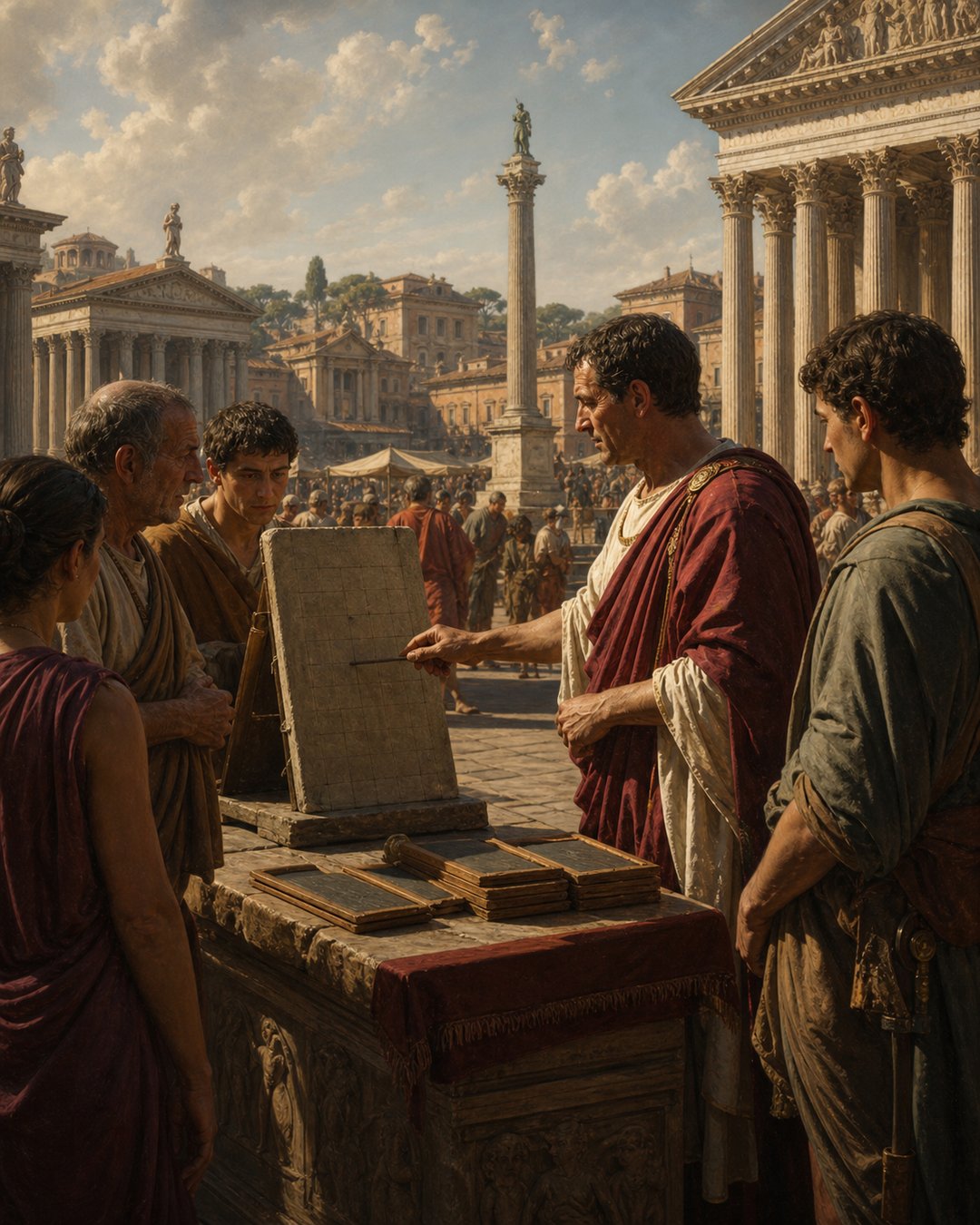
Time feels private until someone tells you when a court can sit, when a market will gather, and which day is fit for public business. Rome understood that power could live in the calendar as surely as in a command.
Roman calendars made time a public authority because dates were not merely counted. They were displayed, classified, remembered, and used to organize movement through the city.
The fasti made days consultable
The fasti were calendars or public lists that made days legible. That sounds administrative, but it is also political. A day that can be consulted is a day that has been placed under shared rules.
A citizen did not simply wake into undifferentiated time. The day carried a label, a permission, a prohibition, or a memory. The calendar turned the sky’s passage into a civic surface.
Market days gave time a crowd
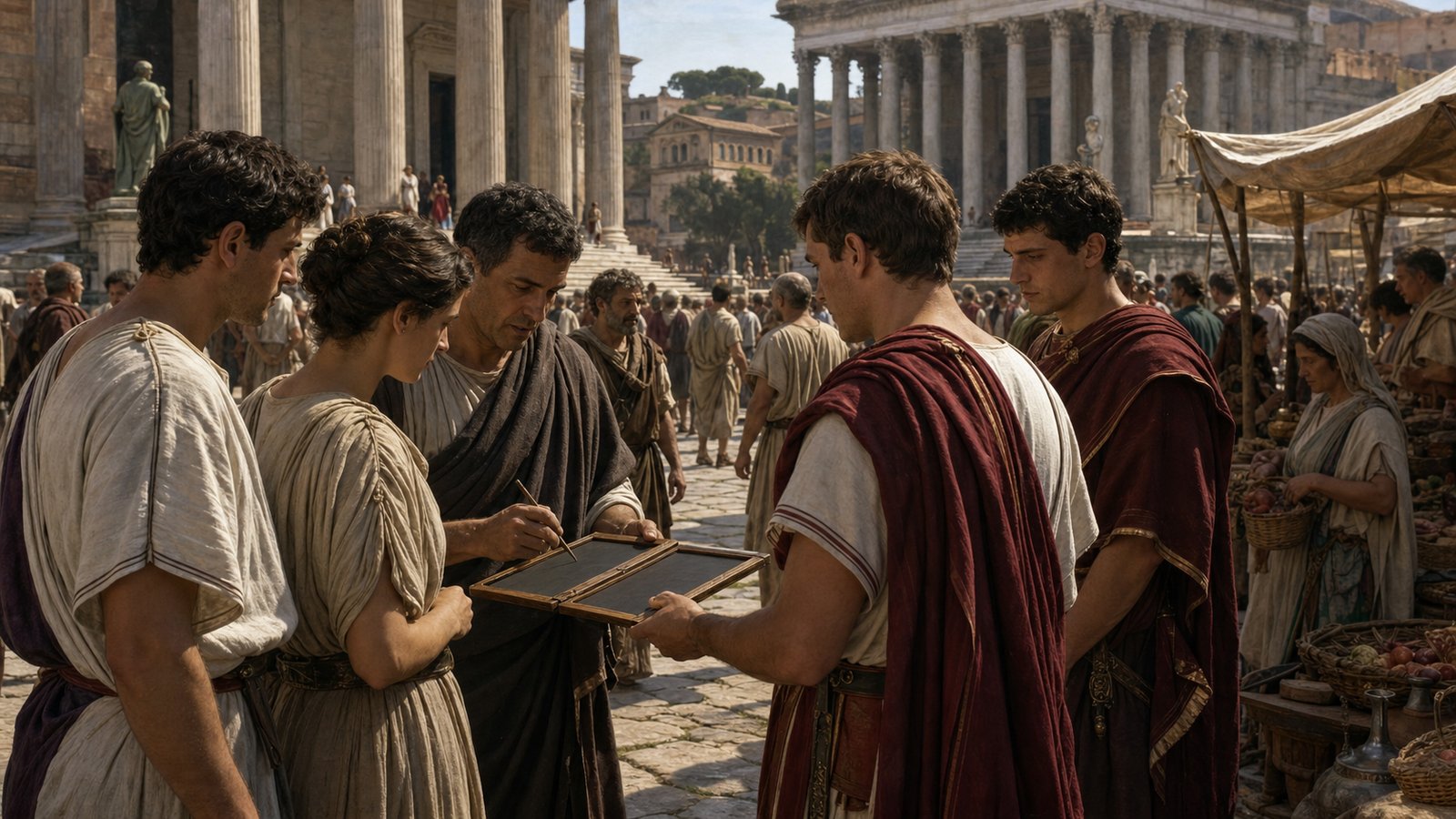
The nundinae, the recurring market days, show public time in motion. Farmers, traders, buyers, officials, and petitioners could converge because a rhythm had been established and remembered.
Picture the mini-scene: baskets arriving at the edge of the forum, tablets on a table, a magistrate’s attendants watching traffic swell, rural accents mixing with city noise. The date has become a crowd.
Classified days controlled action
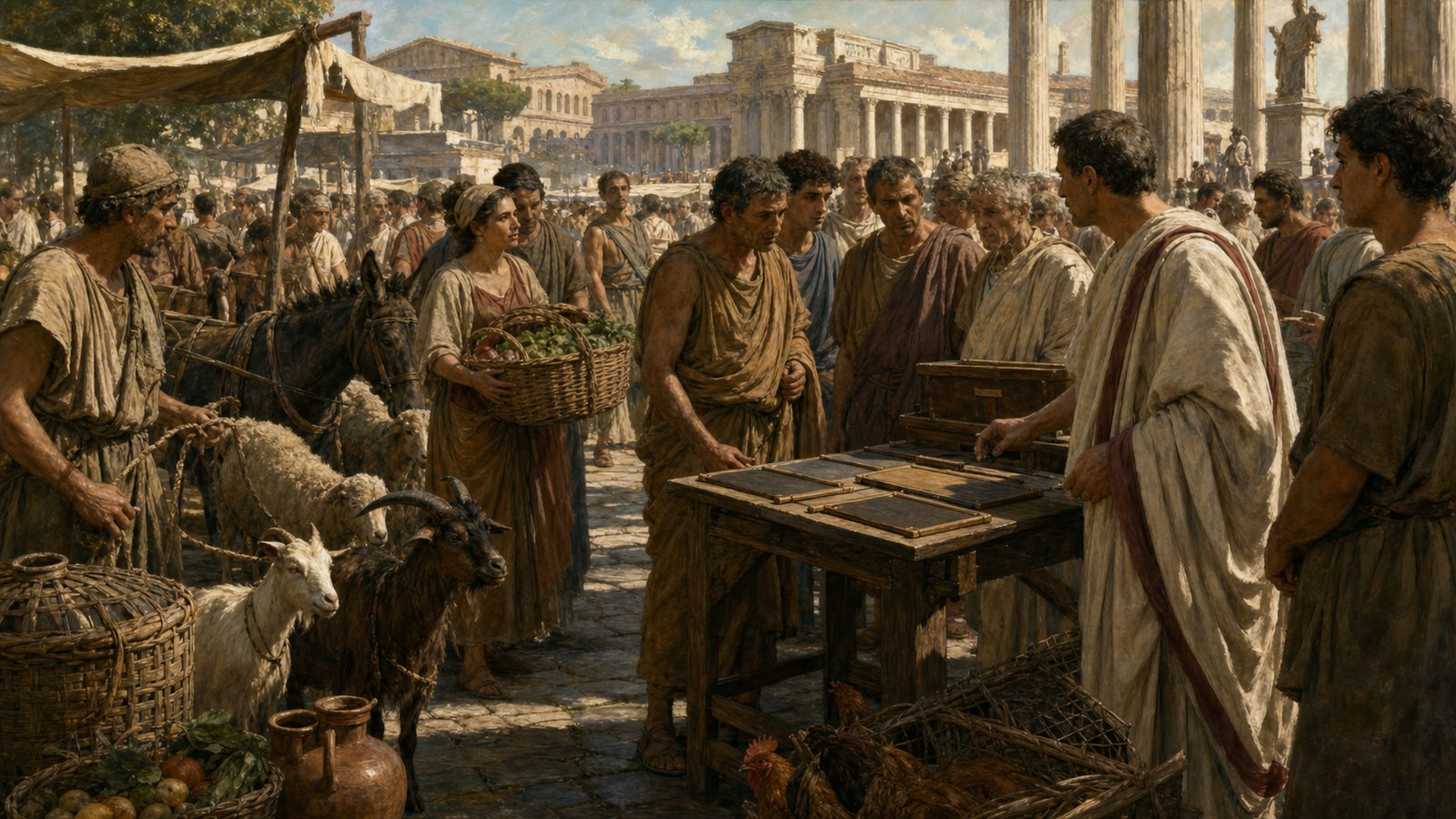
The Roman vocabulary of dies reminds us that not every day did the same civic work. Classifying time shaped what could be done, delayed, announced, or avoided. Time itself became a gatekeeper.
This is a quiet form of authority. Instead of ordering every citizen one by one, a calendar orders possibilities. It tells people when action is proper and when waiting is required.
Tablets made time portable
Tabulae, writing tablets, gave dates and records a material form. A calendar carved, copied, or written could travel through hands and memory. It could be checked, cited, and disputed.
The physical record mattered. Once time had marks, a person could point to them. A date became less like rumor and more like public evidence.
Public time made rule feel natural
A calendar’s deepest power is that it becomes ordinary. People organize around it without feeling ordered each moment. The market appears, the court waits, the festival returns, and civic life feels as if it has a rhythm of its own.
That rhythm was not neutral. It taught Romans that authority could govern by arranging time in advance. The person who controls the calendar does not merely count days; he shapes what citizens think a day is for.
This is why calendars belong in political history. A law may command loudly, but a calendar commands by repetition. It tells the city what kind of day has arrived before anyone begins arguing about the details.
The calendarium also links time to record keeping. Dates become accounts, debts, obligations, reminders, and sequences. Public authority does not only announce events; it remembers them in order. That ordered memory lets institutions outlast the people currently speaking.
The nundinae show how powerful a repeated interval can be. An eight-day rhythm could organize expectation across distance. People did not need constant messages if the rhythm itself told them when to move toward the market.
That movement made time visible in bodies. A market day was not an abstraction on a tablet. It was dust on roads, baskets in hands, animals near stalls, and a crowd that proved the calendar had reached people beyond the official who knew how to read it.
The classification of days could also create frustration. A person who wants action may discover that the day is wrong for it. Waiting becomes part of citizenship, and the calendar turns delay into a public fact rather than a private inconvenience.
This is a subtle discipline. A city that accepts shared days has accepted that time can be arranged by something larger than individual desire. The day has a civic identity before any one person uses it.
Roman public time therefore joined religion, law, trade, memory, and administration. A festival, a market, a court day, and a recorded obligation may look like separate matters, but all depend on the same deeper habit: making time legible in common.
The most revealing part is that people could point to the day. They could consult a list, remember a cycle, or challenge whether the timing was right. Authority had entered the calendar, but it had also made itself visible enough to be argued with.
This visibility did not make the system democratic in a modern sense. Priests, magistrates, and elites could possess knowledge and control that ordinary people did not. Still, public time had to be communicated, and communication created shared expectations.
A Roman calendar thus worked like civic architecture in miniature. It organized where people went, when they waited, when they traded, and how they remembered the public year. Instead of stone columns, it used named days and repeated intervals.
The day became a place in time. Citizens could gather in it, be blocked by it, use it, resent it, or rely on it. That transformation is easy to miss because calendars now look passive. In Rome, the calendar helped tell public life when to breathe.
Once time had been made public, power could operate before anyone arrived. A magistrate did not need to summon every trader individually if the market rhythm already pulled them in. A legal system did not need to explain delay from scratch if days already carried civic meanings.
The calendar therefore made authority anticipatory. It reached ahead of the present and arranged behavior before the moment arrived. That is a remarkable political act: to govern not only what people do, but when action becomes imaginable.
In that sense, Roman calendars were not background tools. They were one of the city’s quiet engines of order. They converted the year into permissions, delays, gatherings, memories, and habits that citizens could see, consult, and obey almost without noticing.
They also made authority easier to share across distance. A villager coming in for a market day did not need to know every decision in Rome; he needed to know the cycle that made arrival sensible. The calendar simplified public coordination without making it apolitical.
Because the system was visible, it could shape emotion as well as action. A festival day might carry relief, a court day anxiety, a market day urgency, and a forbidden day frustration. Public time organized feeling before it organized paperwork.
The calendar therefore gave Rome a way to make absence present. A magistrate was not standing beside every person who waited, traded, or postponed business, yet the named day could still guide conduct. Authority lived in the classification long after the official voice had faded.
This is the quiet drama of Roman time. The city did not merely count sunrise after sunrise. It made each day answerable to memory, ritual, trade, and law, then asked citizens to arrange themselves inside that public order.
Once that habit existed, even ordinary errands carried civic timing. Buying, pleading, worshipping, paying, waiting, and remembering all moved through a calendar that made public authority feel like the structure of the week itself.
Sources & Further Reading
- Smith Dictionary, Fasti
- Smith Dictionary, Calendarium
- Smith Dictionary, Nundinae
- Smith Dictionary, Dies
- Smith Dictionary, Tabulae