
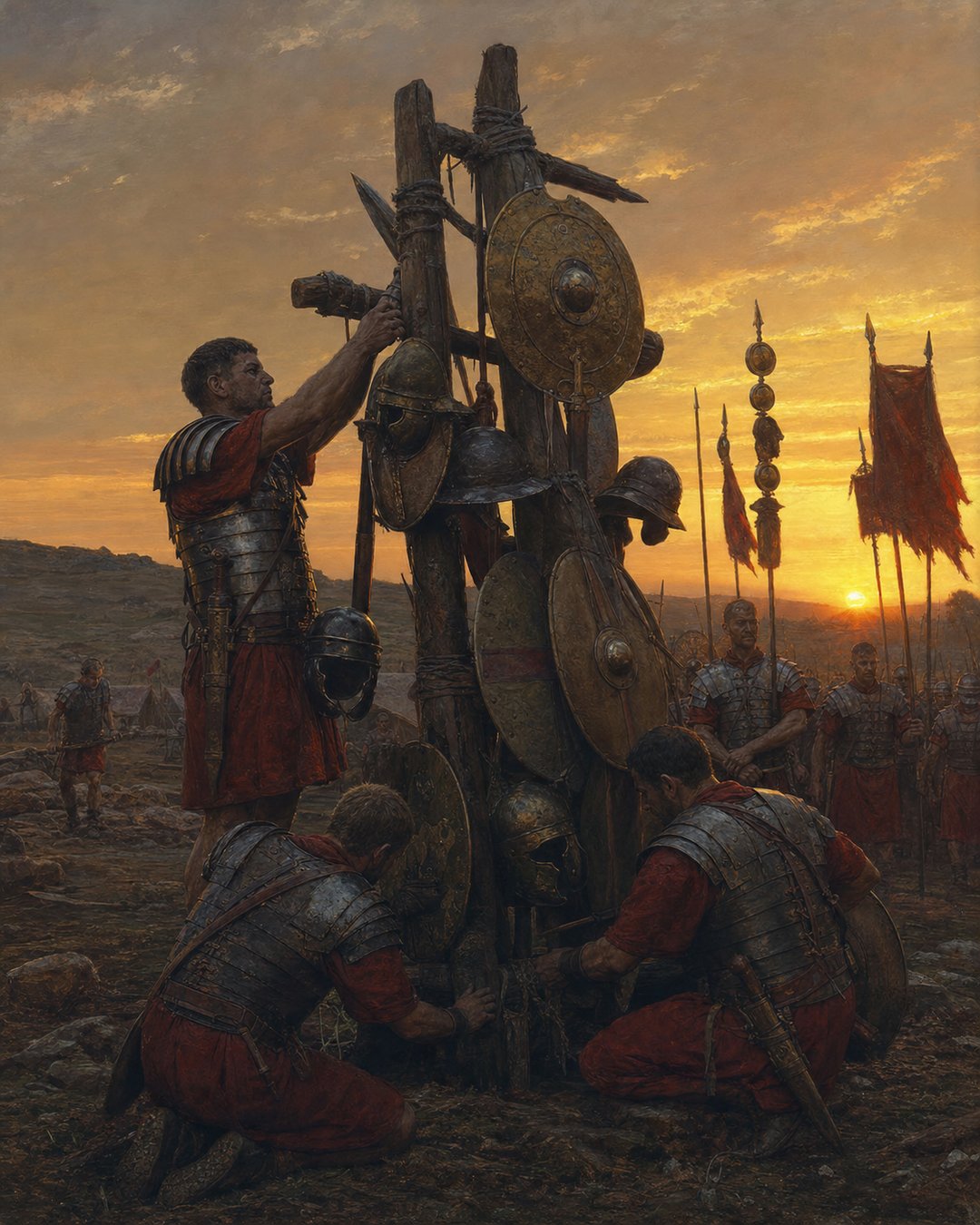
A defeated shield is just an object until someone decides where to put it. Rome was very good at deciding where objects should stand, who should see them, and what story they should be forced to tell.
Roman trophies made defeat speak in public because captured arms could be rearranged into evidence. A helmet, a spear, or a shield no longer belonged only to the battlefield. It became a witness to Roman victory.
The tropaeum began where an enemy turned
The tropaeum was linked to the place where an enemy turned in flight. That origin matters because the trophy did not merely celebrate success afterward. It marked a moment of reversal and fixed it in visible form.
A battlefield is chaotic. A trophy simplifies the chaos into a claim: here the enemy broke, here Roman force prevailed, here the story should be remembered.
Spoils changed meaning in Roman hands
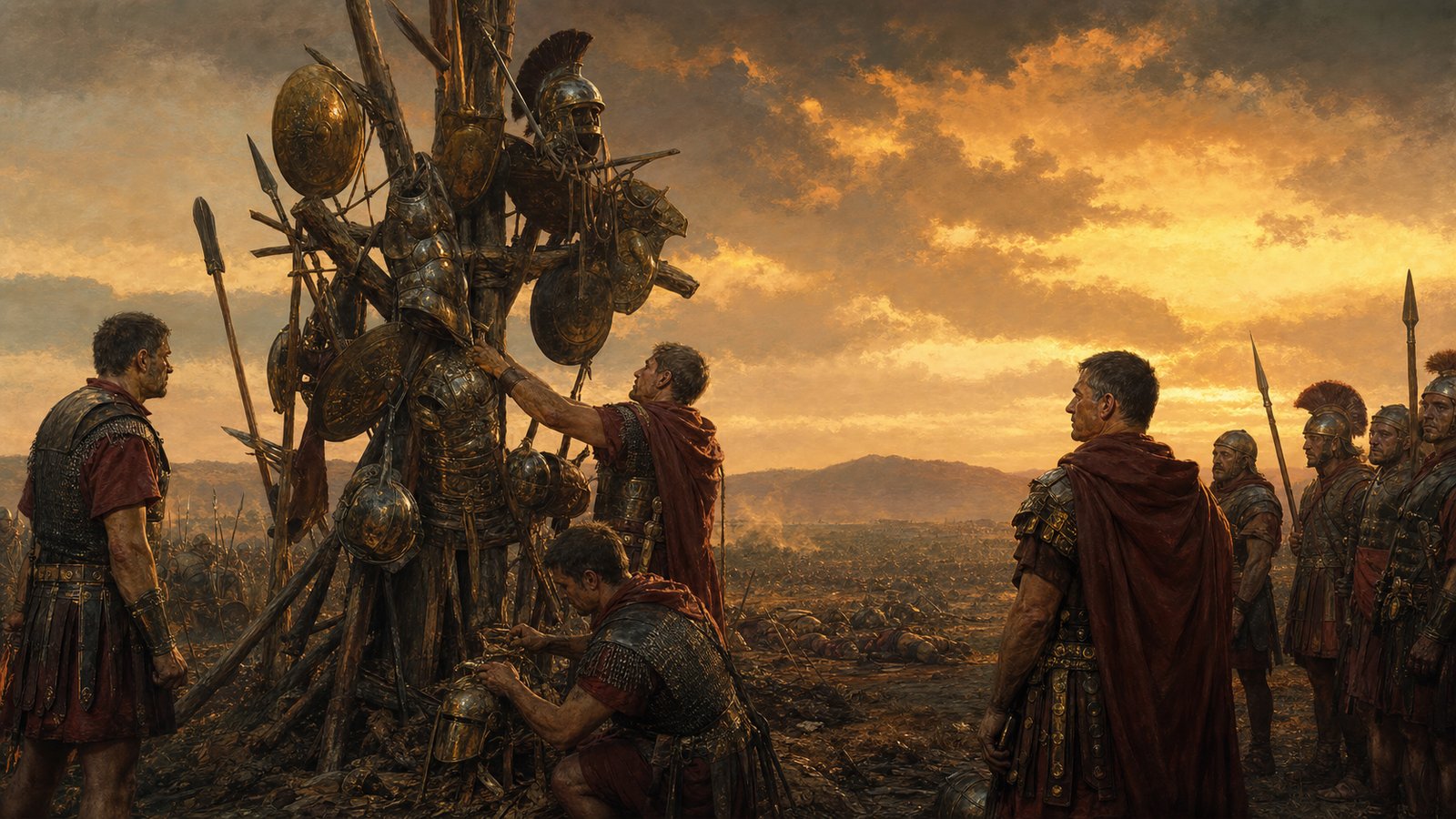
Spolia were spoils taken from an enemy, especially arms or equipment. Once removed from their owners, these objects could be made to serve a new master. A shield that had defended one body now advertised another power.
The transformation was physical and symbolic. Weapons were lifted, arranged, displayed, and stripped of their original purpose. They no longer protected; they testified.
Victory needed more than a report
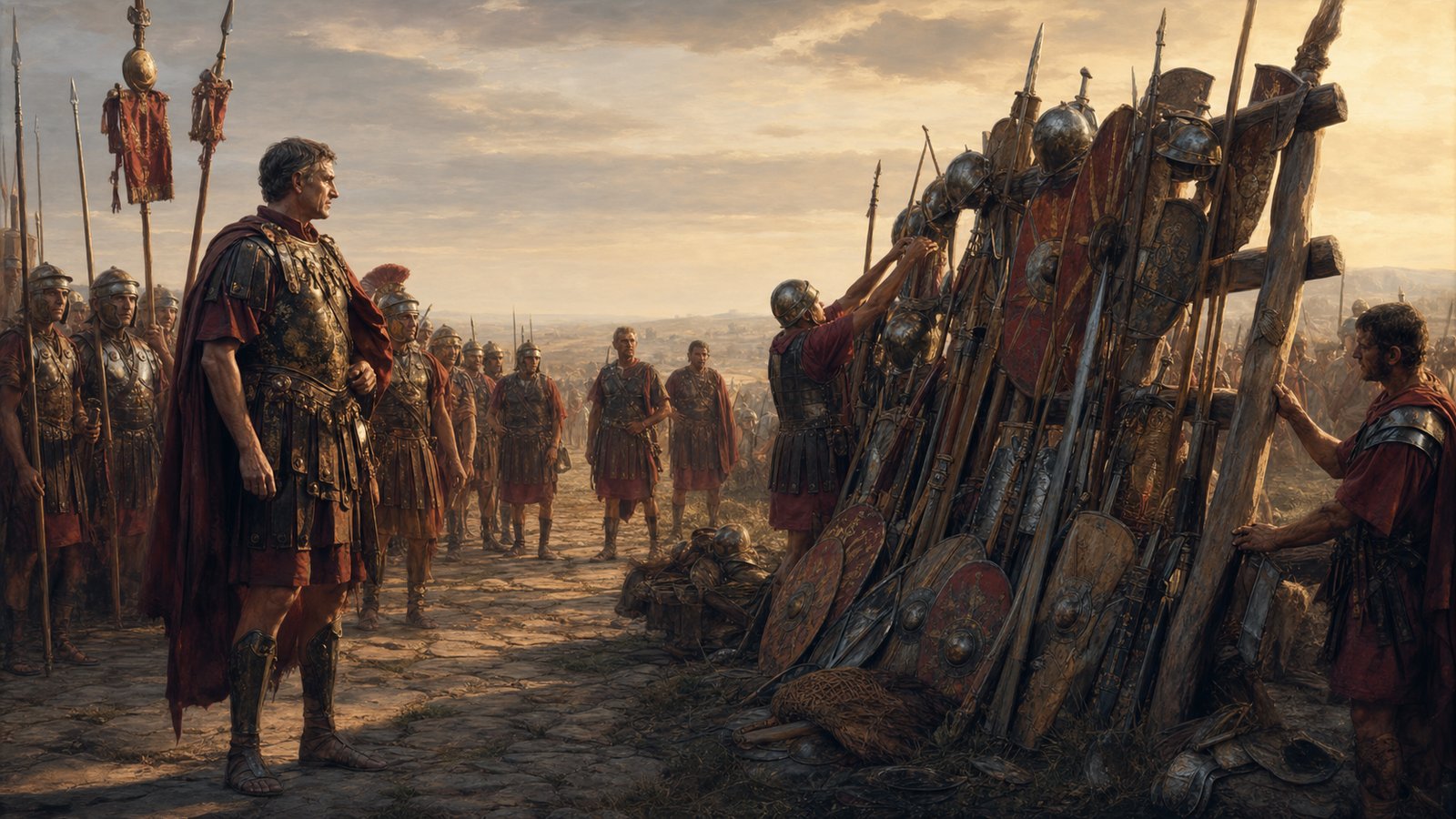
A commander could announce victory, but objects made the announcement harder to ignore. Captured arms gave the claim a surface, weight, and shape. People could look at defeat rather than only hear about it.
Imagine soldiers at sunset setting helmets and shields onto a wooden frame while dust hangs near the road. The violence has passed, but the message is just being built.
Triumph carried objects into the city
The triumph turned victory into urban spectacle. Spoils, captives, soldiers, spectators, and ritual movement brought distant violence into Rome’s public memory. The trophy belonged to the same instinct: make victory visible to people who were not there.
This is one reason Roman victory culture was so durable. It translated absence into sight. A crowd could encounter the materials of a campaign without having marched, fought, or feared on that field.
Defeat became a public language
A trophy worked because objects can speak quickly. A spear hung upside down, a shield removed from its owner, a helmet lifted where a body once stood: these are arguments before they are decorations.
Roman trophies made defeat useful after battle. They warned enemies, reassured citizens, honored soldiers, and gave commanders a visual grammar for saying that violence had produced order.
The signa of a Roman unit and the captured arms of an enemy were not the same thing, but they shared a dependence on visibility. Military power needed objects people could recognize at a distance and remember afterward.
A trophy could therefore stand between the army and the public. To soldiers, it marked achievement and survival. To citizens, it converted rumors of war into something visible. To enemies, it suggested that their own equipment could be made to serve Roman memory.
There is a harsh intelligence in that transformation. Rome did not have to invent new symbols from nothing. It could take the enemy’s own material culture and turn it against them, making defeated armor participate in the story of Roman strength.
The public display also cleaned up the narrative. Battle includes fear, confusion, mud, wounds, mistakes, and exhaustion. A trophy does not show all of that. It selects a conclusion and gives it form.
That selectiveness is part of its power. People remember through shapes. A pile of captured arms can make a campaign seem decisive even when the reality was slower, messier, or more expensive than the display admits.
The trophy also linked place to memory. Where the enemy turned, where the arms were set, where the crowd later saw the spoils: each location helped victory travel. Public memory needed anchors, and captured objects provided them.
When brought into Rome’s ceremonial world, spoils could enter a different scale of meaning. They no longer spoke only to the soldiers who took them. They spoke to families, rivals, voters, patrons, clients, and anyone else who watched the city absorb victory.
The defeated were absent, but their things were present. That is the unsettling brilliance of the trophy. It gave the enemy a role in Roman speech even when the enemy had no voice in the matter.
A shield could not correct the story. A helmet could not describe panic, courage, or grief. Once displayed, it carried the meaning assigned to it by the victors. Public objects can be eloquent because they cannot answer back.
This helps explain why Roman war memory so often favored display. A triumphal procession, a trophy, a monument, or a standard all compressed complicated action into signs that crowds could read quickly. The city did not need every detail; it needed a usable memory.
Usable memory was politically valuable. A commander’s reputation, an army’s honor, and the public’s confidence could all be strengthened by making victory tangible. The trophy did not simply celebrate the past; it prepared people to believe in future force.
None of this means the display was false in a simple way. Captured arms were real. The battlefield had happened. The enemy had been overcome. But the trophy arranged reality into a message, and arrangement is never innocent.
A Roman trophy therefore deserves to be read as a piece of public speech. It used wood, metal, leather, dust, and captured equipment instead of sentences. It told viewers where courage had supposedly stood, where the enemy had supposedly failed, and what Rome wanted the moment to mean.
The strongest trophies kept speaking after the soldiers moved on. Rain might darken the wood, metal might dull, and witnesses might change, but the object continued to state the same public fact: defeat had been captured and placed where Roman eyes could find it.
The trophy also made the enemy strangely intimate. Citizens who never saw the battle could still study the curve of a foreign shield or the damage on a helmet and imagine an army far beyond the city. Display pulled distant war into local sight.
For soldiers, that public sight mattered because it protected memory from dissolving into private recollection. A man who had marched, feared, and survived could see the captured arms raised where others could witness the cost. The trophy gave his experience an object the crowd could share.
For commanders, it was even more useful. A report can be doubted, shortened, or forgotten; an arranged display keeps repeating the claim. By turning spoils into visible proof, Roman leaders made victory harder to separate from their own public reputation.
The defeated objects therefore did double work. They remembered a battle and advertised the people who claimed to have won it. Rome made defeat speak, but it also made defeat point back toward Roman command, Roman courage, and Roman entitlement to be seen as victorious.
Sources & Further Reading
- Smith Dictionary, Tropaeum
- Smith Dictionary, Spolia
- Smith Dictionary, Triumphus
- Smith Dictionary, Signa Militaria
- Smith Dictionary, Forum