
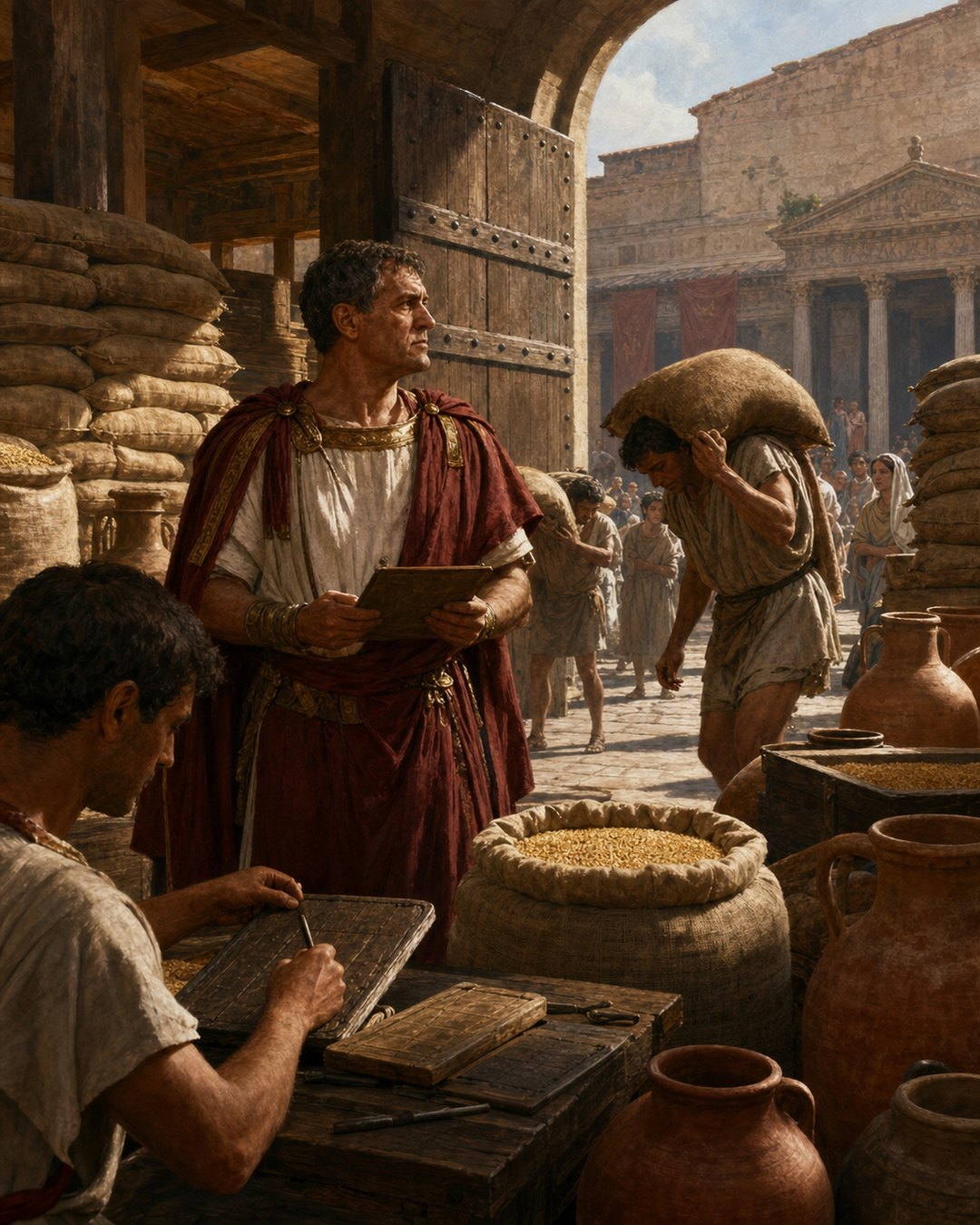
A granary is easy to mistake for a background building. It waits, it stores, it seems less dramatic than a battle, a speech, or a riot. Rome knew better.
Roman granaries made surplus visible because stored grain was not only food kept for later. It was evidence that the city could survive tomorrow’s hunger, if the chain of storage, record, and distribution held.
The horreum made reserve physical
The horreum was a storehouse, often associated with grain and goods. Its importance begins with that plain fact: surplus had a place. It was not only promised; it was contained behind doors people could identify.
A sack inside a warehouse is less exciting than a ship arriving in harbor, but it may be more reassuring. Arrival is a moment. Storage is continuity. The granary says that food has not merely come; it has been kept.
Records turned sacks into accountability
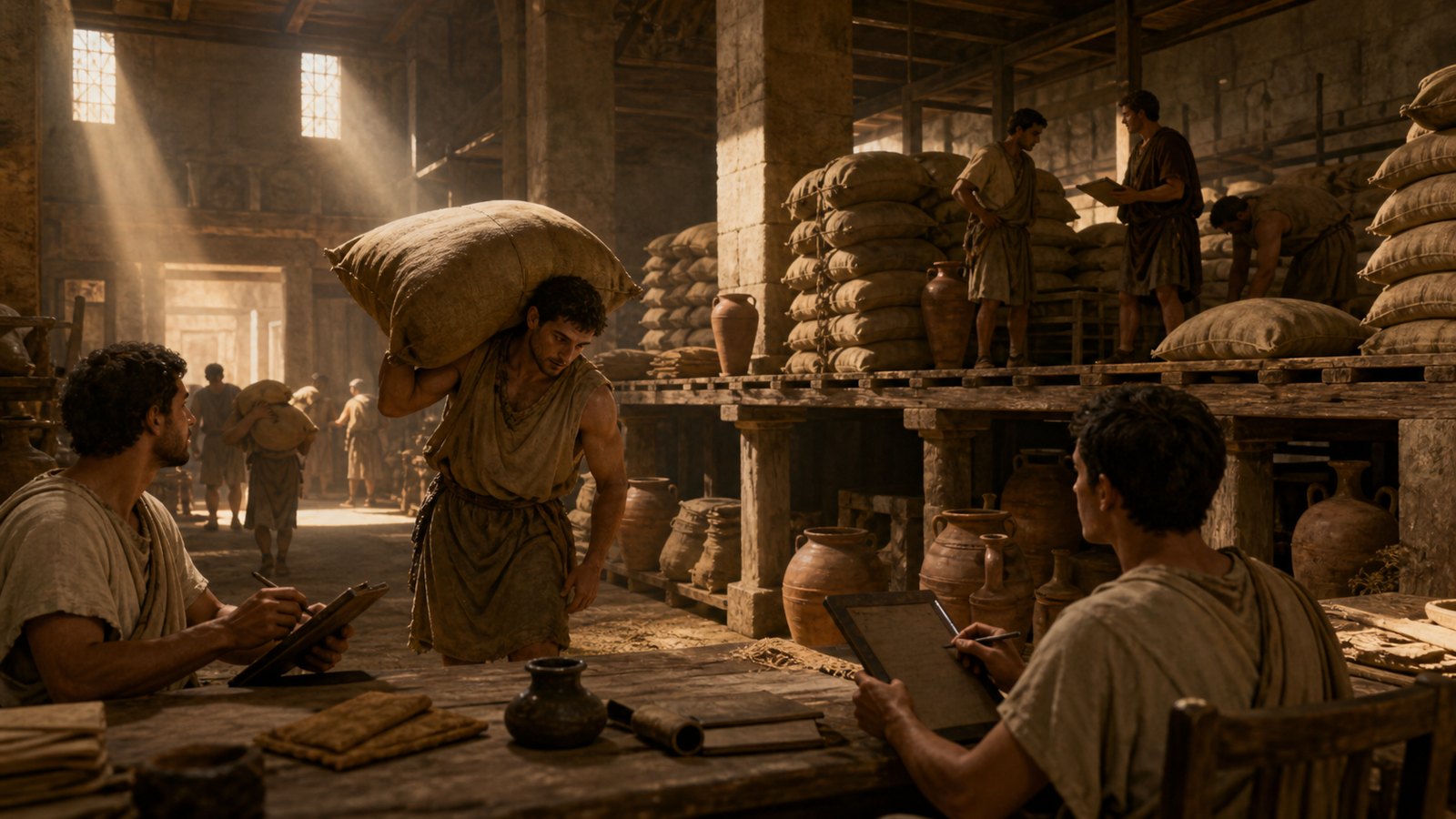
Tabulae, writing tablets, helped make supply inspectable. A pile of grain is useful, but a recorded pile of grain can be counted, compared, moved, and blamed when it disappears.
Picture the mini-scene: a porter bending under a sack, an official holding a tablet near the doorway, dust from grain catching the light, another man waiting for the count to be confirmed. The warehouse has become an argument about trust.
Vessels and sacks made surplus countable
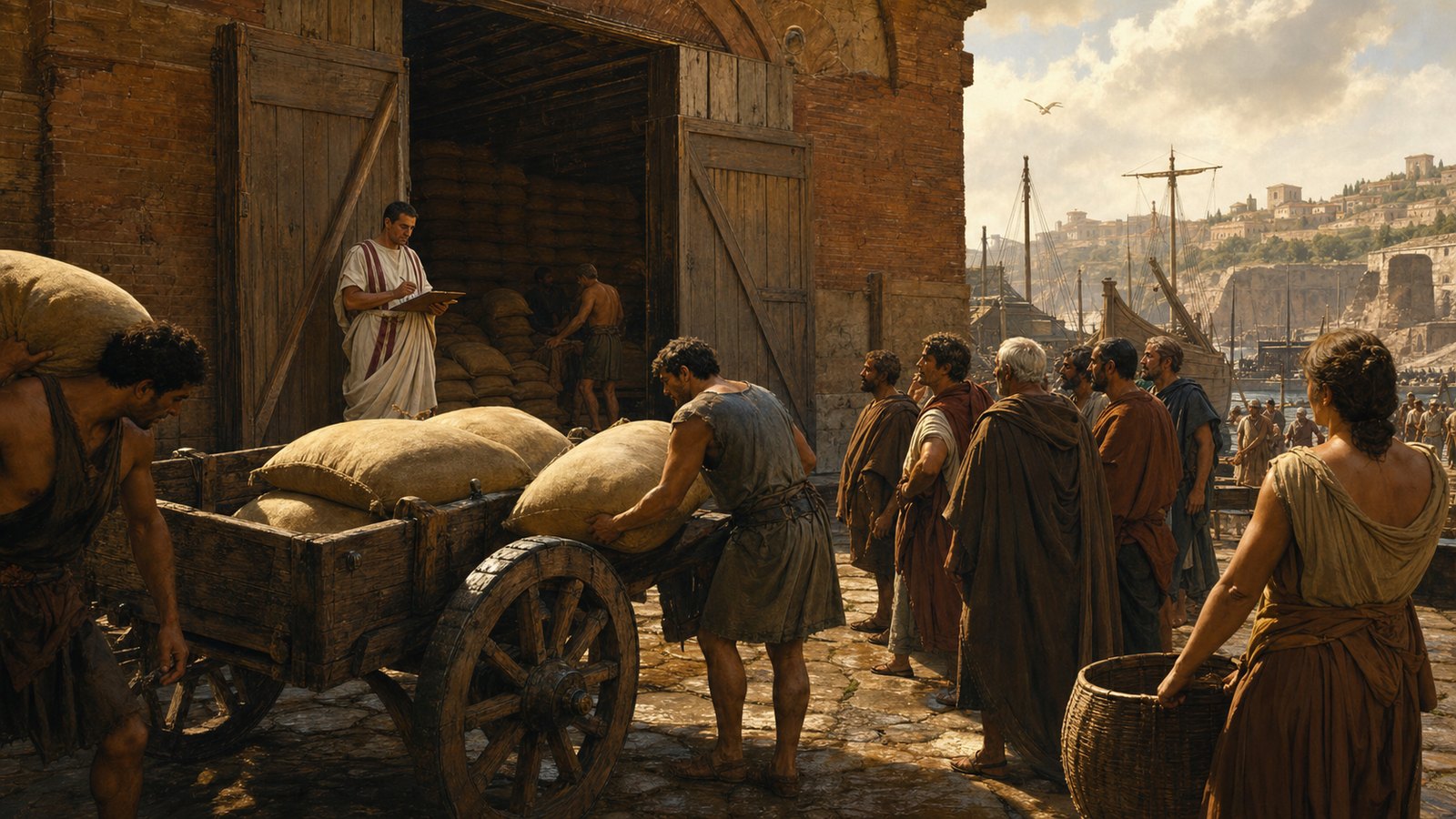
Amphorae and other containers turned goods into units that could be stored and transported. Roman supply depended on the practical art of making abundance measurable.
This is where politics enters the storeroom. A city cannot calm anxiety with vague plenty. It needs quantities, doors, guards, lists, and routines that suggest someone knows how much exists and where it is.
The annona made storage public
The annona reminds us that grain supply was a public concern. Hunger could turn from household fear into urban pressure very quickly, especially in a city that depended on long chains of movement.
Granaries did not solve every danger. Spoilage, theft, delay, bad harvests, war, corruption, and bad accounting could all break confidence. But the visible storehouse gave officials and citizens a shared object around which confidence or anger could form.
Surplus had to be seen to be believed
The granary’s power lay in making a future promise present. People could not eat tomorrow’s bread today, but they could know that grain had been stored somewhere under watch.
That visibility mattered because confidence is fragile. A city lives partly by believing that supply will repeat itself. The horreum made repetition plausible by giving surplus a door, a floor, a smell, a guard, and a record.
Rome’s grain story is often told through crisis, and crisis deserves attention. Yet the ordinary warehouse may tell us more about how confidence was maintained before crisis became visible. It was the architecture of not-yet-hunger.
A granary also changed the meaning of distance. Grain grown far away became part of the city only when it could be received, stored, and remembered in the city’s systems. The horreum made distant fields feel administratively present.
That presence was sensory. Stored grain has weight, smell, dust, pests, and risk. It requires lifting, guarding, ventilation, checking, and repair. Surplus is never passive; it must be worked on to remain surplus.
The official with a tablet therefore matters as much as the porter with a sack. One handles the physical load; the other handles public memory. Together they make the same claim: this quantity exists, and someone is responsible for it.
Responsibility could become uncomfortable. A warehouse gives citizens a place to aim suspicion. If bread is short while stores are rumored to exist, the building that once reassured can become an accusation.
That double meaning made granaries politically sensitive. They could calm fear by showing that Rome had reserves, but they could also sharpen fear by suggesting that reserves were mismanaged, hidden, or insufficient.
The annona was therefore not just a supply mechanism. It was a relationship between stomachs, officials, merchants, ships, carts, doors, measures, and records. The granary made that relationship visible at a crucial point in the chain.
A storehouse teaches a blunt lesson about empire. Power is not only the ability to conquer land; it is the ability to keep what arrives from rotting, vanishing, or failing to reach the people who expect it.
The horreum made that ability inspectable. It stood as a claim that grain had been transformed from movement into reserve. The carts could leave, the ships could unload elsewhere, but the stored sacks remained as proof that supply had paused safely.
For ordinary Romans, this may have mattered more than grand ideology. Public confidence often begins in practical visibility: doors still guarded, sacks still present, tablets still updated, porters still moving.
A granary was not a feast. It was the possibility of future bread arranged in a form the city could recognize. That quiet possibility gave the building its importance.
Rome did not need every citizen to understand every maritime route or provincial harvest. It needed enough people to believe that the chain had a solid link near them. The granary was that link made of wood, brick, grain, record, and routine.
Even the doorway mattered. A closed storehouse door could suggest protection, but an opened one could display competence: sacks moved, counted, and stacked by people who seemed to know the rhythm of supply. The building made invisible management briefly visible.
The system also required trust between unequal groups. Porters carried weight; clerks carried numbers; officials carried responsibility; hungry citizens carried expectations. The granary was the place where those roles met in a way the public could recognize.
Because grain could spoil or vanish, storage was never a simple pause. It demanded watchfulness. Moisture, pests, theft, fire, and bad records could turn abundance into failure. A working horreum was therefore a daily defense against the decay of confidence.
That defense gave the building moral force. A city that claims to rule must show that it can keep essential things available. Granaries helped Rome make that claim through repetitive work rather than grand speeches.
The stored sack was a humble object, but multiplied across a warehouse it became political evidence. It told the city that yesterday’s arrival had been preserved for tomorrow’s need, and that the future had at least been given a room.
The tablet beside the sack made the promise sharper. Counting could not remove every danger, but it gave people a way to ask what had been received, what had been moved, and what had been lost. Numbers turned suspicion into questions that officials could not ignore forever.
The granary also separated immediate appetite from managed supply. Bread might be bought in the street, but the confidence behind that bread rested partly on darker rooms where grain waited in bulk. Public eating depended on hidden work made visible at the warehouse threshold.
In that sense the horreum was both practical and symbolic. It kept grain, but it also kept a form of civic patience: the belief that stored abundance could bridge the uncertain space between today’s arrival and tomorrow’s hunger.
Sources & Further Reading
- Smith Dictionary, Horreum
- Smith Dictionary, Amphora
- Smith Dictionary, Tabulae
- Smith Dictionary, Annona