
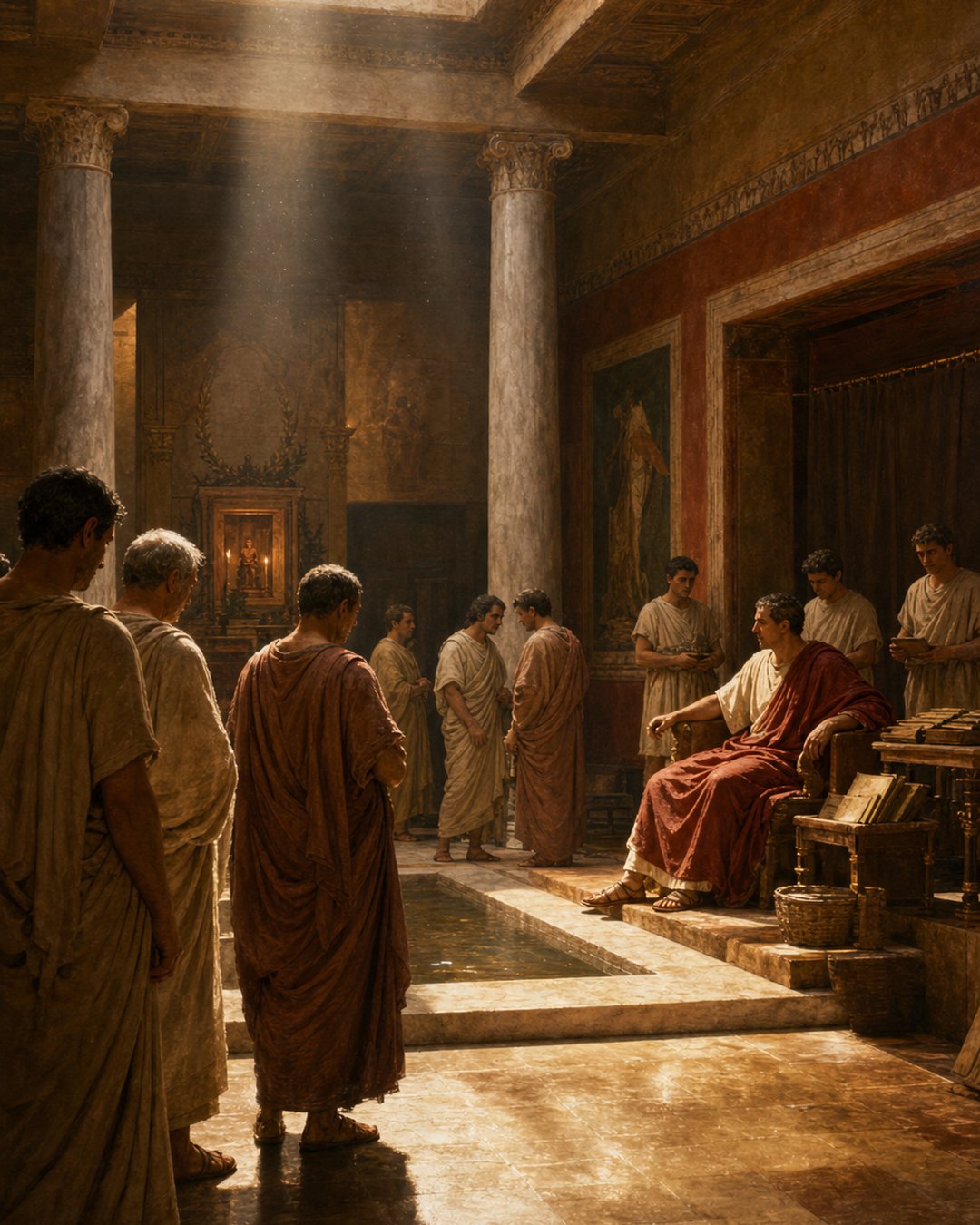
Roman influence did not always announce itself with a decree. Sometimes it appeared as people waiting in a house before the day’s business had fully begun.
Roman patronage made influence a morning ritual because obligation became visible through attendance. A patron’s importance could be measured, at least in part, by who came, who waited, and who followed.
The patron was a protector with an audience
Patronus means more than a friendly acquaintance. A patron carried protection, support, memory, and expectation. His influence depended on relationships that had to be maintained, not simply claimed.
Those relationships needed moments when they could be seen. The morning visit gave dependence a shape: bodies in a room, greetings exchanged, favors remembered, requests prepared, and hierarchy quietly rehearsed.
The client made obligation visible
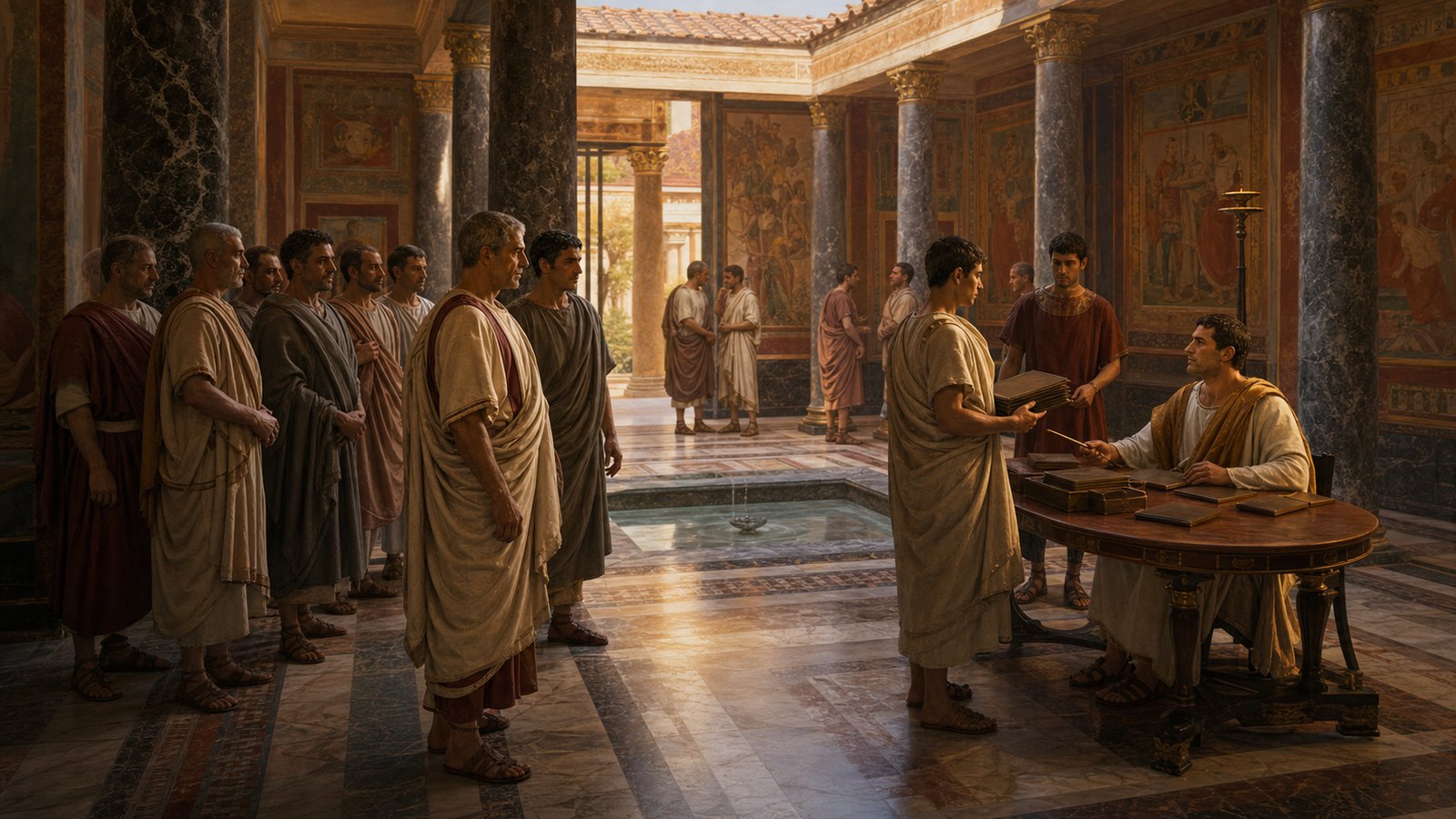
Cliens names the dependent side of the relationship. A client was not invisible social background. By appearing at the patron’s house, he turned obligation into a public-adjacent fact before any speech in the forum began.
Imagine the mini-scene: sandals on a polished floor, a steward watching the line, a patron seated near household tablets, one client rehearsing a request while another waits to be noticed. Influence has acquired a timetable.
The house opened toward the city
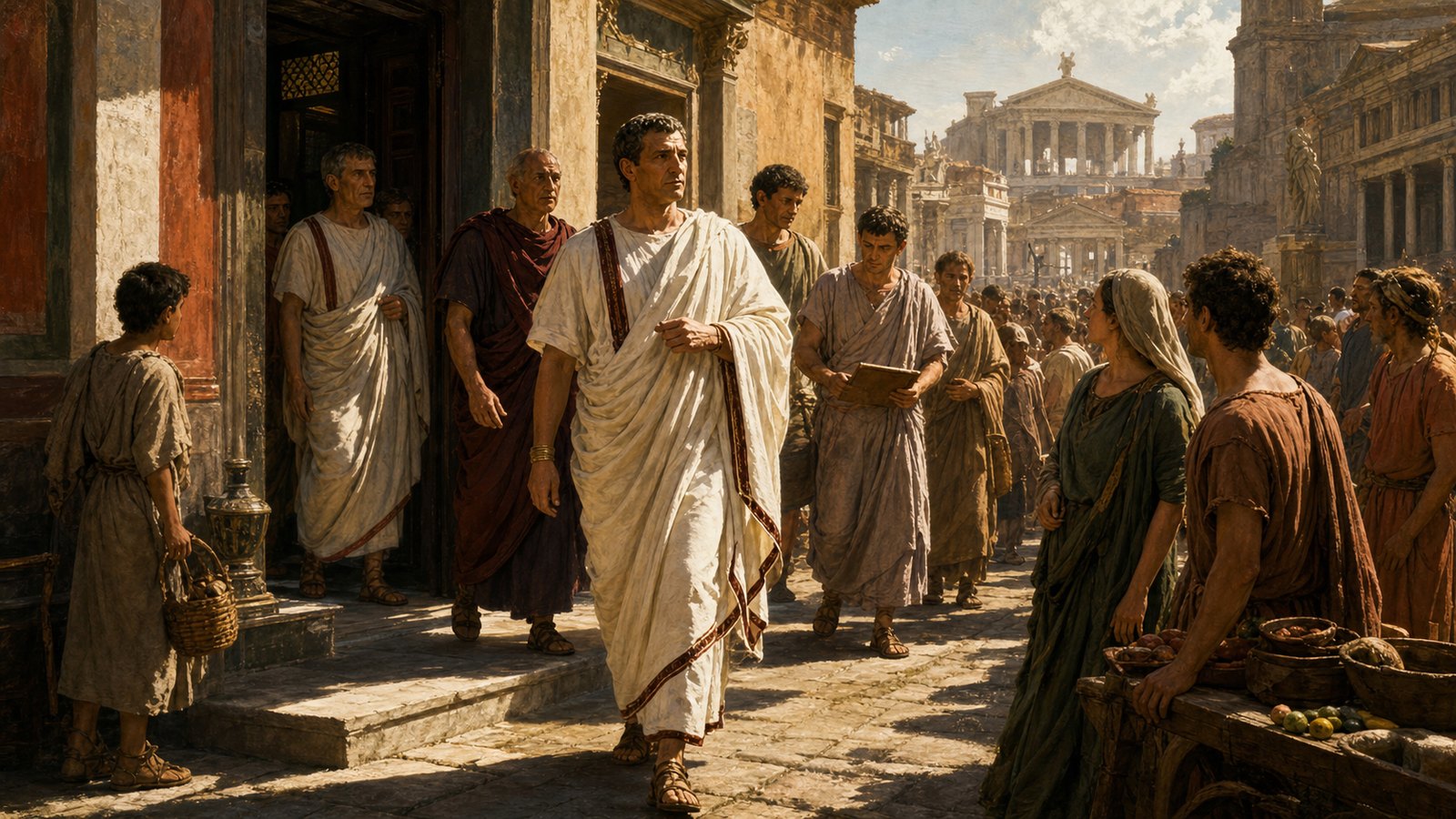
Patronage began in private space, but it did not stay there. A patron who left with clients around him carried the household’s social weight into the street and toward the forum.
That movement mattered. Public reputation in Rome depended on being seen with others, and being accompanied could make private relationships look like civic strength. The street became a measuring device.
Records helped memory survive the greeting
Tabulae remind us that Roman obligation could be written, remembered, and consulted. Not every favor lived only in spoken gratitude. Notes, accounts, names, and promises could give morning ritual a longer life.
The greeting was therefore not empty theater. It connected present bodies to older help and future expectation. A person came because something had happened, something was owed, or something might be needed.
Ritual made inequality orderly
Patronage did not remove inequality. It gave inequality a routine form. Waiting, greeting, escorting, requesting, and remembering all turned dependence into something socially legible.
This is why the ritual was powerful. It did not need to explain hierarchy every morning. It made people enact it, and repeated enactment made influence appear stable, familiar, and almost natural.
The forum matters here because it was not only a place of public business. It was also a theater of reputation. A patron arriving with visible support did not have to state his connections; the crowd could see them.
For clients, the ritual was not merely humiliation. It could offer access, protection, recommendation, a small gift, a hearing, or the chance to be remembered by someone with more reach. Dependence could be burdensome and useful at the same time.
That ambiguity made patronage durable. It was not simply domination from above or friendship from below. It was a system in which need, pride, memory, and advantage were braided together through repeated acts.
Morning was especially useful because it placed obligation at the beginning of the day. Before business unfolded, relationships were renewed. The greeting made the social map visible before the civic map became crowded.
A doorway could therefore become a political instrument. Who was admitted quickly, who waited, who was ignored, who walked out near the patron, and who had to leave alone all carried meaning.
The ritual also taught people how to read influence. A great man without visitors looked diminished. A man accompanied by many clients seemed to possess reach beyond his own body. Numbers became a kind of social argument.
There was danger in that visibility. Public dependence can embarrass both sides. The client exposes need; the patron exposes obligation to maintain generosity, attention, or protection. A thin line in the atrium could say more than a boast.
Patronage therefore made private weakness and public strength meet in the same ritual. The client needed help; the patron needed recognition. Each completed the other’s performance.
This helps explain why Roman political life cannot be reduced to formal offices. Offices mattered immensely, but the morning line shows another layer of power: personal networks made visible before official action began.
Influence was not floating in the air. It had feet, names, waiting times, doorways, tablets, and routes through the city. It could be counted imperfectly by looking at who stood near whom.
A Roman patron did not own every person who greeted him, but he could convert attendance into reputation. The ritual made support look embodied, and embodied support could matter in a culture where public standing shaped opportunity.
The morning greeting was thus a quiet machine of visibility. It transformed remembered favors into present bodies, present bodies into public reputation, and public reputation into the possibility of future influence.
The ritual also protected the patron from becoming merely private. If his dependents remained unseen, his influence could shrink into rumor. When they appeared at the door and moved with him, obligation acquired witnesses.
The client gained something from visibility too. Being seen near a powerful house could signal access, even if that access was limited or humiliating. A poor man waiting in an atrium might be exposing weakness, but he was also placing that weakness before someone expected to answer it.
This is why the morning line should not be dismissed as empty ceremony. Ceremonies matter when they decide who is remembered, who is introduced, who is accompanied, and who can plausibly ask again tomorrow.
The physical setting sharpened the message. The atrium belonged to the household, yet it functioned as a threshold to the city. People entered a private space in order to prepare for public action, and the movement from room to street carried the relationship outward.
Patronage therefore made influence temporal as well as social. It happened at an hour, in a place, before a route, among witnesses. Rome’s personal networks were not invisible webs; they had morning habits, waiting bodies, and public footprints.
The routine also made absence meaningful. A man expected in the atrium who failed to appear could send a message without speaking, just as a patron who kept someone waiting too long could show the limits of favor. Ritual created a language of presence and delay.
Because the relationship involved protection, the morning scene carried practical stakes. A client might need a recommendation, legal support, food, money, or simply the chance to remain attached to a stronger name. The line was social theater, but the needs inside it were real.
For the patron, those needs could be converted into public loyalty. The more people who relied on him, the more his household looked like a center of gravity. A private atrium became a visible reservoir of future support.
For the client, the same arrangement could feel both useful and narrowing. Help arrived through hierarchy, and hierarchy had to be performed. The morning ritual made that bargain visible in a way no formal office title could fully capture.
Sources & Further Reading
- Smith Dictionary, Patronus
- Smith Dictionary, Cliens
- Smith Dictionary, Tabulae
- Smith Dictionary, Forum