
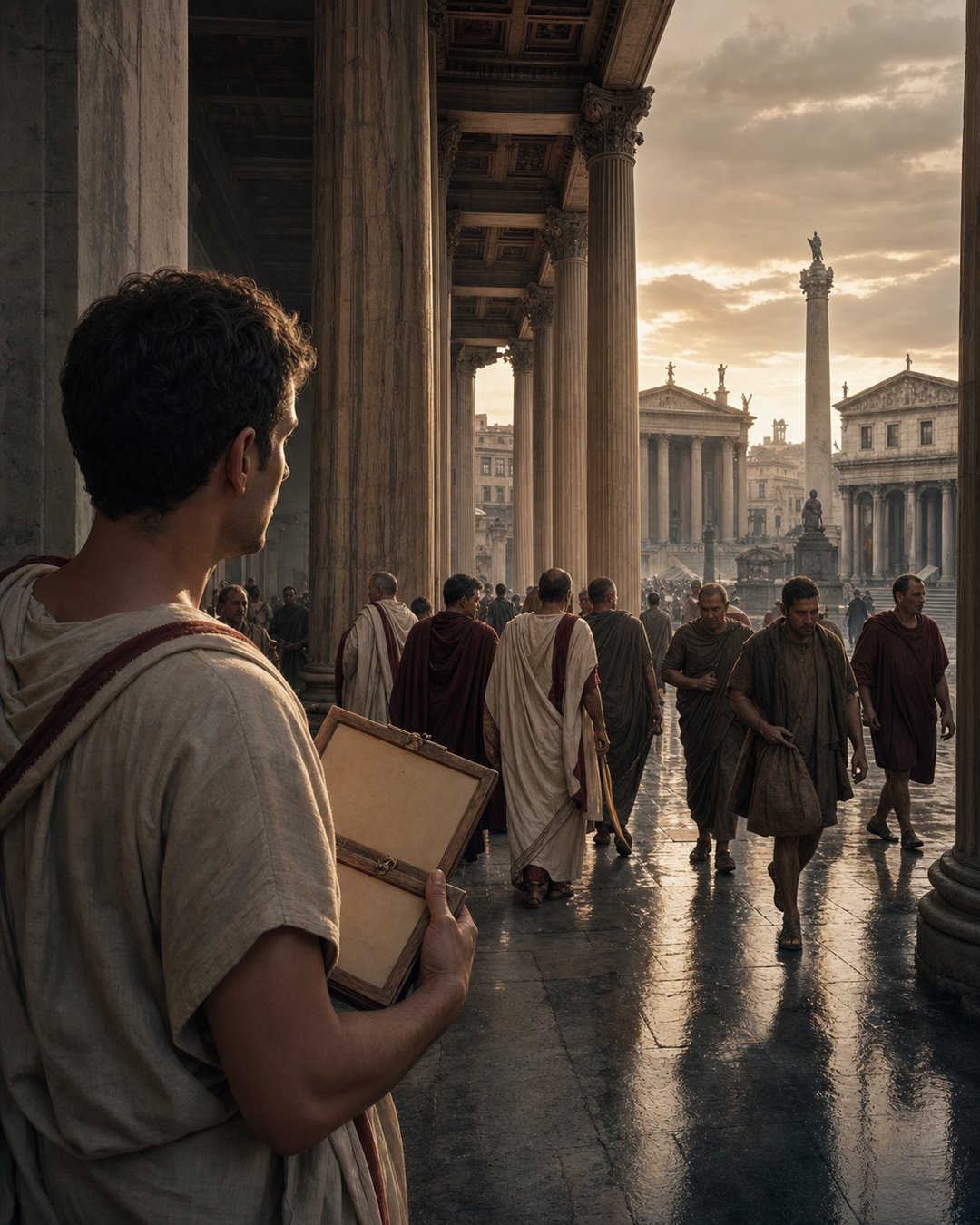
A Roman portico looks quiet beside a triumph, an aqueduct, or a battlefield. It is only a line of columns and a roof. Yet that modest architecture solved one of the city’s hardest problems: how to keep public life moving when weather, crowds, status, and business all pressed into the same streets.
Roman porticoes made public life walkable because they turned movement into a durable civic routine. Under a porticus, people could wait, bargain, watch, escort, avoid rain, seek shade, and be seen without leaving the public world.
A covered walk made the city usable
The Smith Dictionary describes the porticus as a colonnade or covered walk, and that plain definition is the key. A covered walk is not a decoration when the city depends on people appearing in public. It is infrastructure for presence.
Rome’s forum culture needed bodies: clients, patrons, traders, witnesses, clerks, messengers, and men hoping to be noticed. A portico gave those bodies a place to remain active when sun or rain would otherwise scatter them.
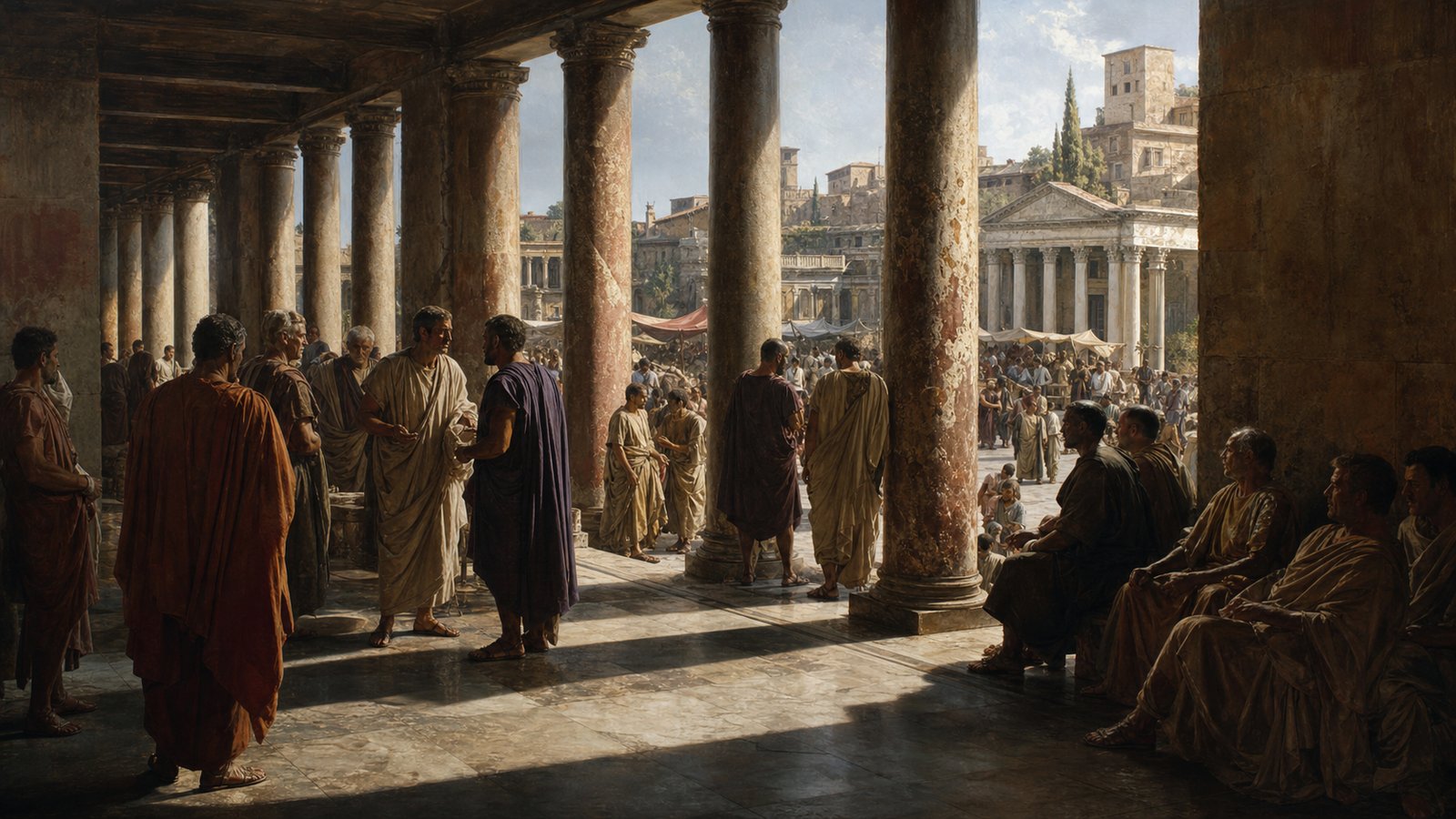
Waiting became a public act
Waiting in Rome was rarely empty. A client waiting near a patron, a buyer waiting near a stall, or a messenger waiting with tablets was already part of a social display. The portico made that waiting visible and bearable.
Picture a damp morning scene: sandals scraping on wet stone, cloaks pulled close, a clerk holding blank wax tablets, voices lowering as a better-dressed man passes through the columns. Nothing dramatic happens, yet everyone understands that the space is sorting attention.
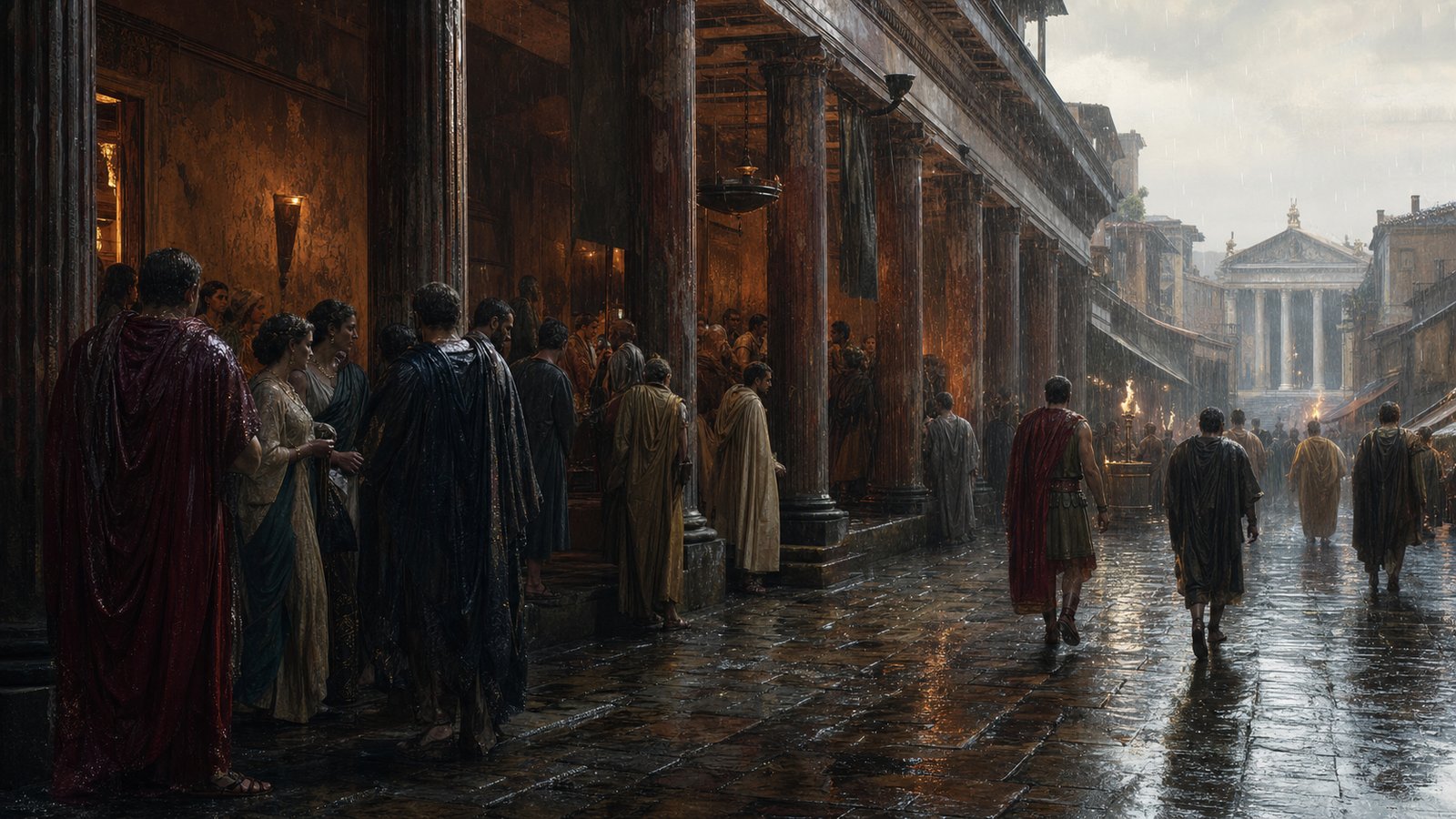
Shade gave conversation a route
A forum was not only a square; it was a system of movement. People crossed it, skirted it, paused at its edges, and used nearby buildings to turn chance encounters into business. The portico created a middle condition between open street and closed room.
That middle condition mattered. A person under a porticus was not hidden, but he was not exposed in the same way as someone standing in the open. Shade gave conversations time. Columns gave the eye a rhythm. The roof made lingering respectable.
Tablets turned talk into memory
Tabulae remind us that Roman public places were full of things that preserved obligation. A conversation under a portico could become a note, a memorandum, an account, or a promise carried away on wax.
The covered walk therefore connected gesture to record. It allowed people to meet in public while giving clerks, agents, and dependents enough stillness to turn spoken business into something that could be remembered.
Architecture made visibility repeatable
The power of the portico was repetition. A spectacular building could impress once; a covered walk could shape hundreds of ordinary movements every day. It made public life less dependent on perfect weather or ceremonial occasion.
That is why the porticus belongs in the history of Roman order. It did not simply beautify the city. It made the city’s everyday negotiations easier to perform, easier to witness, and harder to separate from status.
A person moving through the portico also learned the social geography of the city. He could see who walked alone, who was followed, who was approached, who was avoided, and who had enough confidence to slow down in a crowded public place.
The columns made this visibility orderly. They framed movement in segments, turning a noisy crowd into a sequence of encounters. Someone waiting at one bay could watch another conversation form two columns away without needing to enter it.
This mattered for patrons and clients because influence was often measured by attendance. A follower in the open forum could be lost in the crowd; a follower waiting under the same portico could become part of a visible cluster around a more important man.
Merchants and agents benefited too. Business needed contact, but contact needed time. A roof and shade made it easier to prolong a negotiation, compare offers, call a witness, or send a servant across the forum without ending the exchange.
The portico also softened the boundary between leisure and work. A man could walk as if simply passing time while still collecting news, testing alliances, listening for opportunities, and letting others see that he belonged near the center of things.
Rain reveals the value of the structure most clearly. When water drove people from the open paving, the covered walk preserved the social machine. Public life did not have to pause; it compressed under architecture and became more legible.
Nor was the portico neutral. The same shelter that protected the poor protected the powerful in more advantageous ways. Better clothing, attendants, escorts, and confident movement all read differently when many people were forced into the same visible corridor.
The space also gave memory a setting. A promise made under a certain line of columns, near a certain entrance, before a certain witness could be retold with enough detail to feel anchored. Roman public memory loved places that made stories easy to locate.
A basilica might receive formal business, but the approach to it mattered as well. The portico could prepare the encounter before it became official, letting people gather information and rehearse positions before entering a more structured setting.
In that sense, the portico was a civic hinge. It connected street to forum, sun to shade, conversation to record, and movement to waiting. It helped Rome turn urban density into usable social order.
The architecture’s modesty is exactly what makes it revealing. Rome did not need every instrument of order to look like command. Sometimes a roof on columns was enough to make people gather, pause, measure one another, and continue.
Public life became walkable because the city gave walking a script. Move under the columns, stop where others can see you, wait without disappearing, speak without leaving the crowd, and carry the result away on a tablet or in memory.
The portico made that script durable. It kept producing scenes of contact long after the builders were gone: a client scanning faces, a merchant checking a promise, a senator choosing how slowly to pass, a servant holding a message close to his chest.
The result was not equality but continuity. The covered walk helped Romans remain public through weather, crowding, and uncertainty. In a city where being seen mattered, the portico made visibility practical enough to become ordinary.
The practical value is clearest when the portico is treated as a time-making device. It gave people enough sheltered minutes to wait for a patron, finish a bargain, compare rumors, or decide whether a conversation should move into a basilica, a shop, or a private house.
Those minutes accumulated into political habit. A city where people can linger in public produces more chances for recognition, obligation, overheard news, and social pressure. The porticus did not command anyone to participate, but it made participation physically easier.
It also let the city absorb uncertainty. If an appointment was late, rain began, a crowd thickened, or a message needed revision, the covered walk provided a place where delay did not look like disappearance. Waiting could remain public instead of becoming absence.
So the portico’s importance was not only architectural beauty. It was a machine for continuity: keeping bodies available, conversations recoverable, and reputations visible long enough for Roman public life to keep moving through ordinary friction.
Sources & Further Reading
- Smith Dictionary, Porticus
- Smith Dictionary, Forum
- Smith Dictionary, Tabulae
- Smith Dictionary, Basilica