
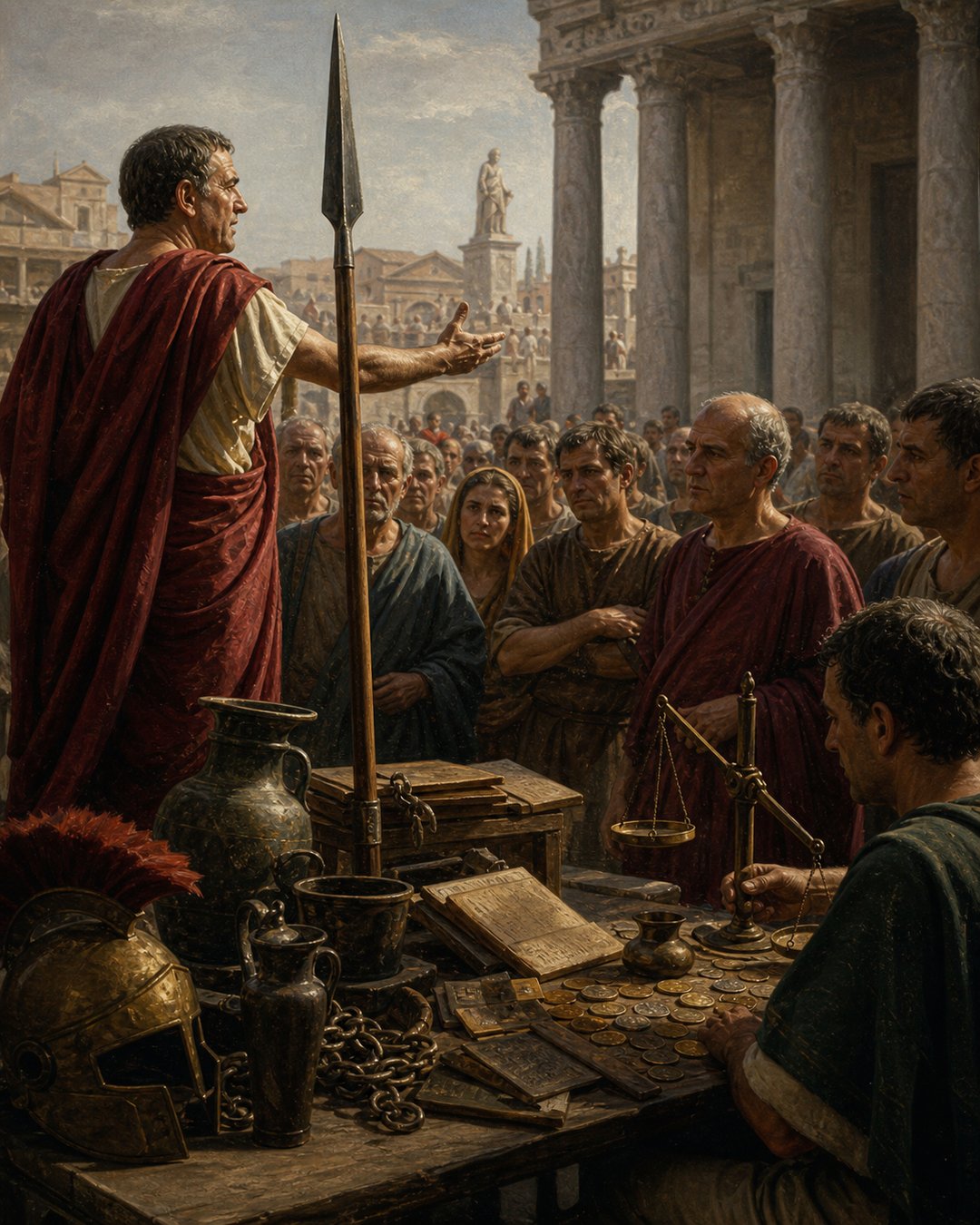
A Roman auction was not only a way to sell something. It was a way to make value happen in public, under eyes that could remember the object, the bidders, the price, and the authority of the procedure.
The detail that makes the scene strange to modern eyes is the spear. The hasta could stand beside an auction as a marker, turning a sale into something more formal than haggling across a private table.
The auction turned need into a public event
Auctio names a sale by auction, but the word matters because the procedure changed the social meaning of selling. A thing was not simply passed from one hand to another. It was offered, watched, bid on, counted, and remembered.
That publicness could suit many pressures: estate business, debt, confiscated goods, state sale, or ordinary transfer. Whatever the cause, the result was similar. A private need acquired a public audience.
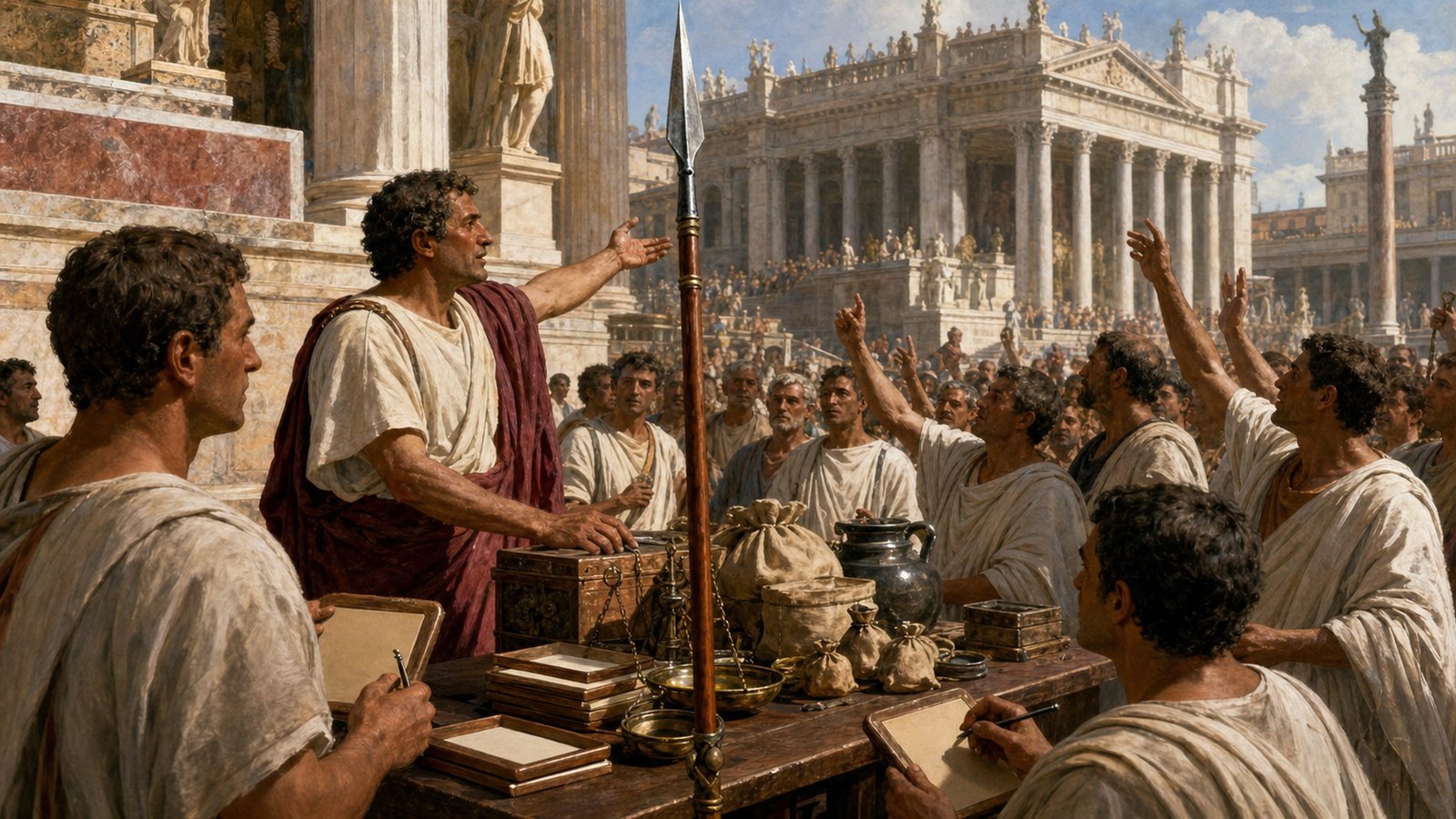
The spear made the sale look official
The hasta gave the auction a visual center. It was a simple object, but a spear planted near the sale made the scene feel anchored in authority rather than only appetite. People could see where the sale was happening and what kind of act it claimed to be.
Imagine the mini-scene: a spear upright in dusty light, a table of goods beside it, wax tablets waiting for names and numbers, a man raising his hand while others watch his courage or desperation. Price is being made in front of witnesses.
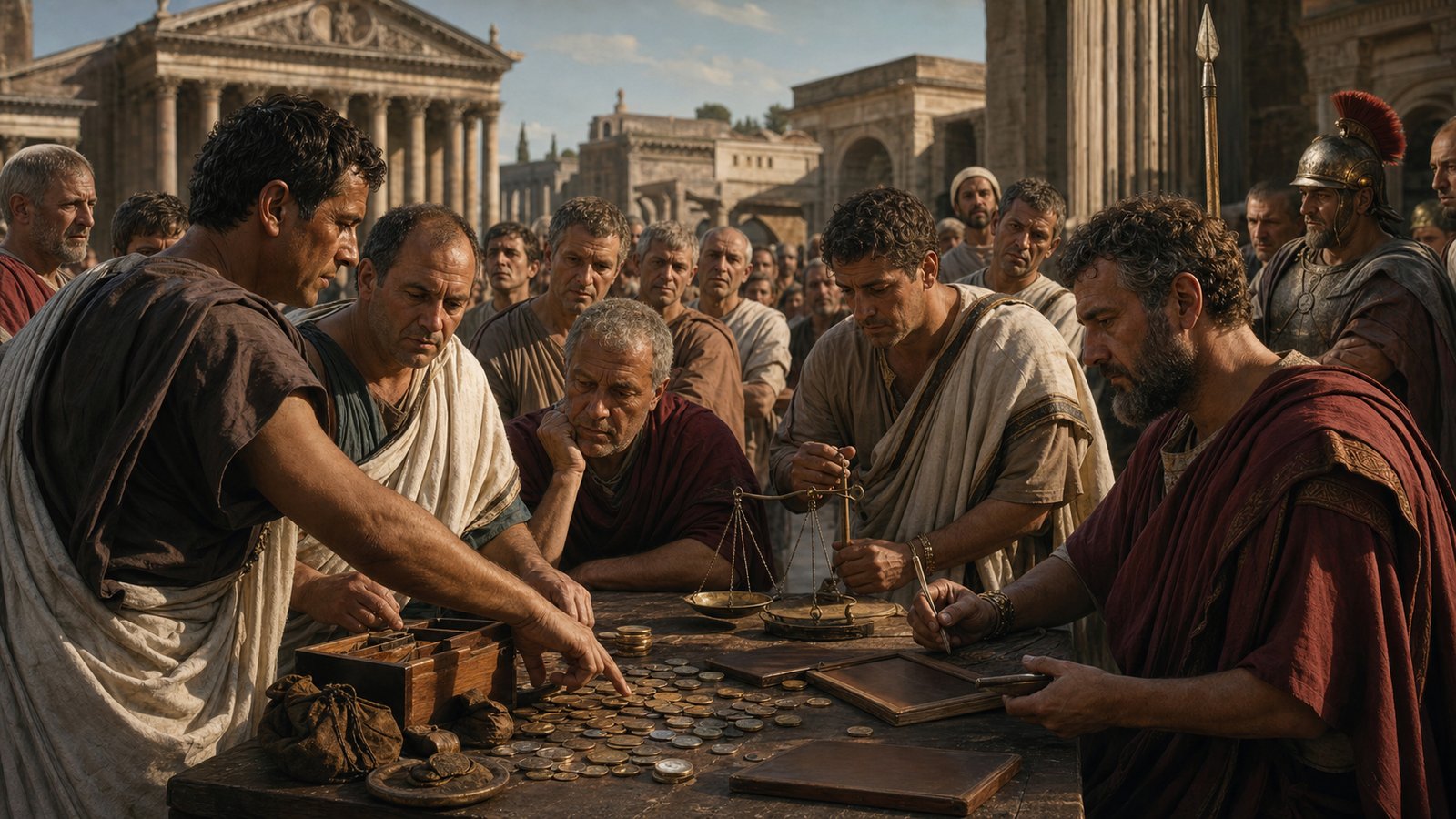
Money tables made trust physical
Mensa and the argentarii bring the money side of the scene into view. Coins, scales, accounts, and bankers meant that bidding did not float as sound alone. It had to meet objects that could be weighed, counted, checked, and recorded.
That physical accounting mattered. A high bid without credible payment was only noise. The table turned promise into something closer to proof, and the banker or money-changer helped make the sale legible to others.
The forum gave the transaction memory
The forum was the right kind of place for such pressure because it already joined legal, civic, and commercial life. A sale there did not vanish into privacy. It entered a landscape where business could be talked about later.
Public memory was useful even when it was uncomfortable. A bidder could gain a bargain, display wealth, expose need, or inherit suspicion. The same crowd that made the sale trustworthy could also make it impossible to forget.
Price became a public fact
The auction’s deeper work was to turn value into an event. Instead of saying privately that a thing was worth a certain amount, the seller let competitive voices and visible procedure produce a number before witnesses.
That number did not have to be fair in any modern sense. It only had to be publicly made. In Rome, that was powerful. A price created beside a spear, a table, and a crowd could look less like personal whim and more like civic fact.
The spear also reminds us that Roman commerce often borrowed the language of power. The market did not sit outside authority. It touched officials, records, debt, military symbolism, and public reputation.
This does not mean every auction was grand or dramatic. Many were probably ordinary, noisy, and practical. But ordinary procedures are exactly where a society shows what it thinks trust requires. In this case, trust required visibility.
The goods themselves mattered less than the transformation. A chest, tool, animal, slave, parcel, or household object could enter the sale as someone’s property and leave as someone else’s, but only after the public ritual had made the transfer recognizable.
The banker’s table added another layer of discipline. Coins could be counted; accounts could be noted; witnesses could see that money had not remained a vague promise. The sale became a chain of visible actions rather than a whispered arrangement.
There was danger in that chain. Public bidding could humiliate a debtor, expose an estate, or announce that someone’s goods had reached the market under pressure. Visibility protected trust, but it also sharpened embarrassment.
That tension made the auction a useful Roman institution. It solved a practical problem while revealing the human cost of practical solutions. Public sale could cleanly transfer property, but it also turned private strain into something the city could watch.
A spear beside the sale therefore did more than decorate the scene. It told people that the transaction belonged to a recognized procedure. The object for sale, the money table, and the bidders all stood under that claim.
The result was a small theater of valuation. People could see desire compete with caution. They could see confidence rise in a lifted hand and collapse when another bidder spoke. Value became audible, bodily, and public.
That is why the auction helps us understand Rome beyond emperors and battles. The city’s power also lived in the ways it made ordinary transfers look official enough to trust. A spear, a table, and a crowd could do that work.
The procedure did not erase inequality. The wealthy bidder had advantages before the first price was called. But public rules changed how advantage appeared: it had to move through a visible sequence that others could recognize and remember.
For the seller, that sequence could be protection. If the sale happened before witnesses, a later complaint had to confront the memory of the crowd and the record of the table. The transaction gained a harder shell.
For the buyer, the same publicness could be useful. A purchase made at auction carried the aura of having been offered openly, rather than seized quietly or bargained in suspicious darkness.
The hasta gave all of this a symbol that ordinary eyes could find quickly. In a busy public place, procedure needs markers. The spear said: here, now, this transfer is being made under a form that claims authority.
Rome often made power visible through objects that were easy to read: standards, fasces, tablets, arches, seats, doors. The auction spear belongs to that same practical imagination. It made an invisible legal and economic process stand upright.
The auction also linked speed and finality. Bidding compressed hesitation into a short public contest, and once the contest ended the winning price carried the force of a witnessed moment. People might grumble afterward, but they could not easily deny that the moment had happened before others.
That finality helped property move through uncertainty. Estates could be broken up, debts could be answered, goods could be liquidated, and state claims could be converted into coin. The spear did not make these transitions painless, but it gave them a recognizable public grammar.
A Roman auction therefore reveals a city that did not trust value to private assertion alone. Value had to be called out, challenged, backed by money, recorded, and surrounded by people capable of remembering the scene. The sale was economic, but its authority came from being seen.
Sources & Further Reading
- Smith Dictionary, Auctio
- Smith Dictionary, Hasta
- Smith Dictionary, Mensa
- Smith Dictionary, Argentarii
- Smith Dictionary, Forum