
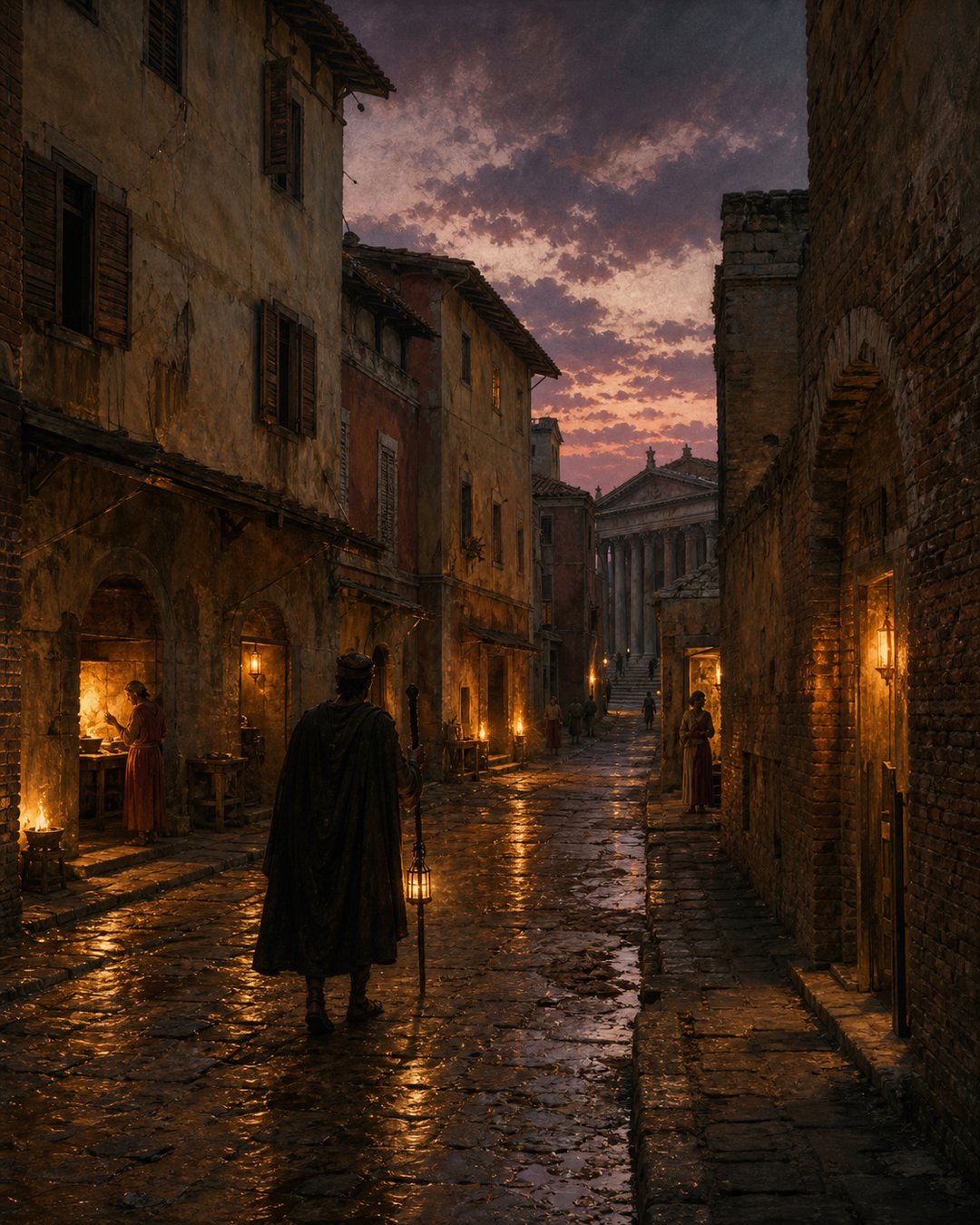
A Roman oil lamp was small enough to fit in a hand, but it changed the social meaning of night. Once flame could be carried, set on a table, hung near a doorway, or placed on a counter, darkness became less like a wall and more like a condition people managed together.
Roman oil lamps made night a public routine because light depended on objects, fuel, craft, supervision, and risk. The lucerna did not erase darkness. It made the work of resisting darkness visible.
The lamp made light portable
Lucerna names the lamp, and the word matters because it points to a portable technology of confidence. A room did not have to surrender the moment daylight vanished. A person could bring a flame close to a task, a face, a threshold, or a sale.
Picture the mini-scene: a clay lamp warming a palm, oil dark in the reservoir, a wick catching, smoke curling toward a plaster wall. The object is modest, but the result is a new relationship with time.
Manufactured light required daily labor
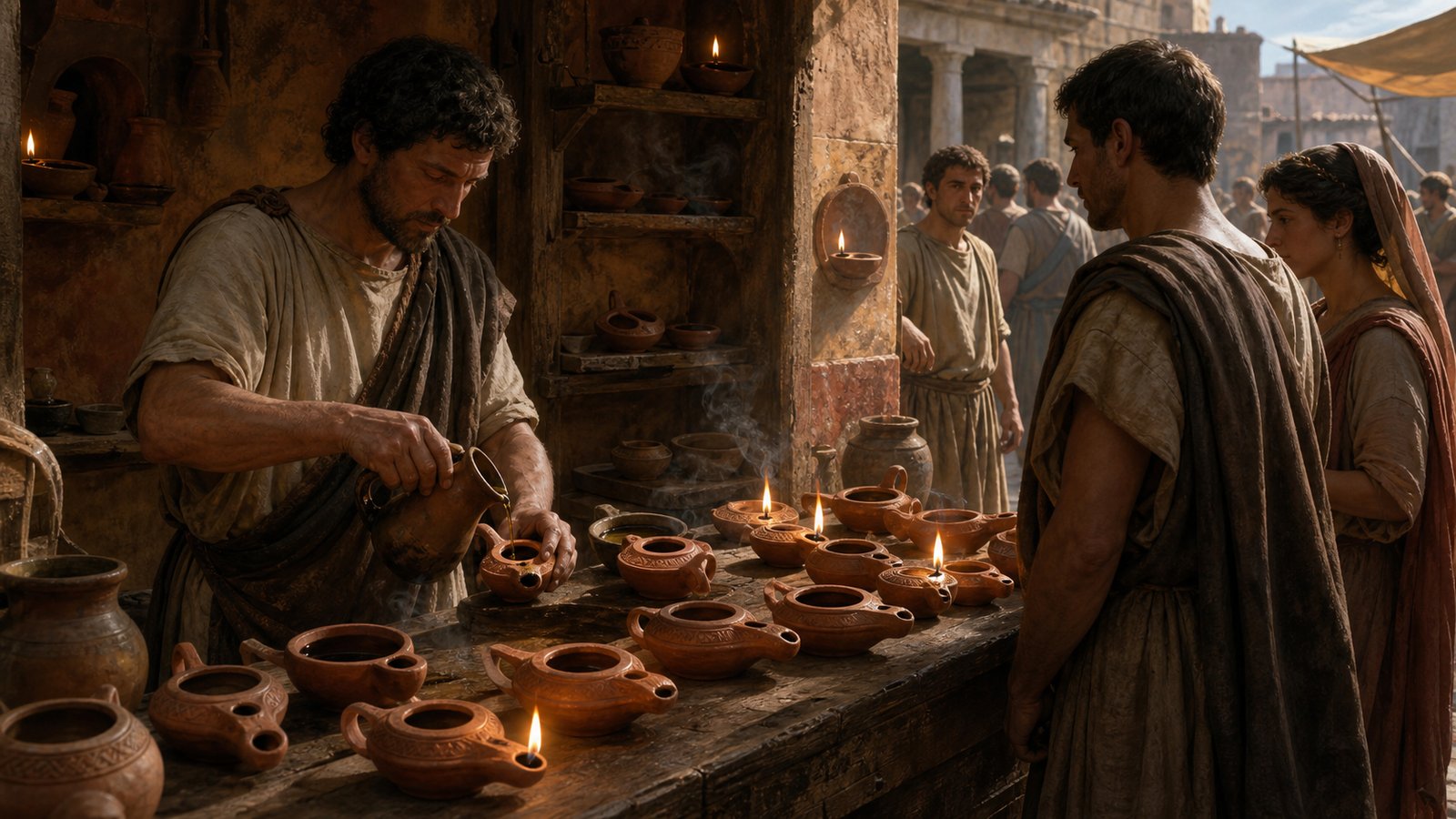
A lamp was not magic. Terracotta or bronze had to be made, oil had to be supplied, wicks needed attention, and soot reminded everyone that light was a process. Candles, candelabra, and lamps all show the same truth: illumination consumed material.
That consumption made night part of the economy. A brighter room meant someone had acquired fuel, tended the flame, cleaned the smoke, and accepted the cost. The dark hours could be used, but they were never free.
Shopfronts pushed night into the street
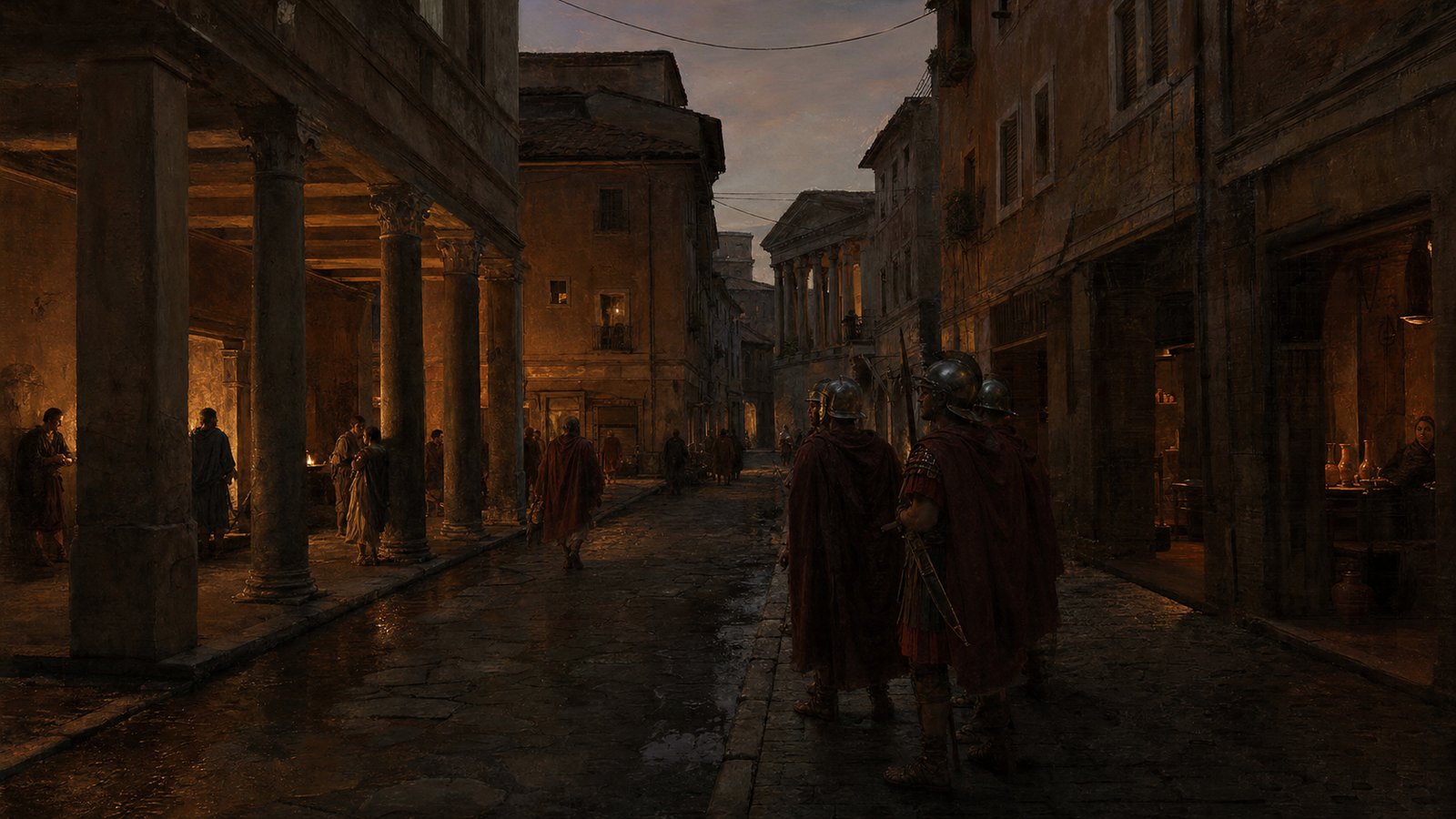
The taberna helps explain why lamps mattered beyond the house. A street-facing shop could make a small island of visibility after sunset, turning a counter, doorway, or workbench into a public signal. People could see where business, talk, and movement remained possible.
This did not create a modern city of electric brightness. It created scattered points of amber confidence: a doorway here, a table there, a counter with clay lamps and tired customers leaning toward the flame.
Every useful flame carried danger
Incendium, destructive fire, is the shadow behind every lamp. The same flame that made a room usable could also begin a disaster if neglected near cloth, wood, oil, or crowded housing. Roman night was therefore governed by care as much as by light.
This makes the oil lamp historically revealing. It solved one problem by sharpening another. People wanted visibility, work, prayer, conversation, and trade after dusk, but each flame asked to be watched.
Night became a shared urban practice
The deeper change was social. Once lamps appeared in rooms, shops, streets, and doorways, night became a pattern of repeated choices rather than a simple natural fact. Who lit a lamp, where it was placed, how long it burned, and who watched it all mattered.
A Roman street after sunset was not empty darkness. It was a patchwork of decisions made by households, shopkeepers, workers, travelers, and guards. The lamp made those decisions visible.
The focus, the hearth, reminds us that Romans already understood flame as a practical center of domestic life. The lamp miniaturized that power and made it movable. Instead of gathering only around one fixed fire, people could place smaller flames where work and attention required them.
That mobility changed the body. A reader, craftsperson, cook, guard, or seller could lean toward a little pool of light. Faces appeared and disappeared at the edge of the flame. Darkness still ruled the corners, but the lamp carved out a temporary room inside it.
The lamp also made inequality visible. A wealthy house could afford more light, better holders, more oil, and servants to tend the evening. A poorer room might burn one small lamp carefully, measuring the night by the fuel left in it. Illumination was comfort, but it was also expense.
Street lamps and shop lamps created another kind of memory. Neighbors learned which doorways glowed late, which counters stayed active, and where the safest route seemed to pass. Light became a map made fresh each evening.
That map could be deceptive. A lit doorway did not make a street safe, and a dark alley did not prove danger. Yet in a city without modern lighting, even a small flame could change how people judged distance, trust, and risk.
Smoke and smell were part of the experience. The ancient night was not a clean black curtain lifted by pure light. It was oil, wick, clay, heat, soot, and the human habit of moving close to what could be seen.
This is why the lamp belongs in public history rather than only archaeology. It shows how ordinary objects organized behavior. A clay lamp decided where hands worked, where customers waited, where conversations continued, and where anxiety gathered.
The fear of fire also turned private negligence into a public problem. One careless flame could threaten more than one household. Dense urban life made each useful light part of a larger agreement: we will burn flame because we need it, but we must also watch it because others live nearby.
A Roman oil lamp therefore reveals a city negotiating with darkness by small repeated acts. It did not conquer night like an army taking a wall. It placed fragile circles of light into the hours after sunset and trusted people to maintain them.
The result was a public routine made from tiny flames. Every evening, the city had to be lit again. Every wick had to be coaxed, every counter given visibility, every household measured against fuel and fear. Night was natural; Roman night was organized.
That organization was humble but powerful. Lamps did not announce law, victory, or imperial command. They made continuity possible after daylight failed, and continuity is one of the quiet forms of order that lets a city feel livable.
Seen that way, the lucerna is more than a household artifact. It is evidence that Rome’s public life extended into the dark through craft, oil, caution, and memory. A small lamp could not make the night safe, but it could make the next step visible enough to take.
The workshop and counter also mattered because lamps entered circulation before they entered memory. A potter, seller, buyer, and user all handled the same problem from different sides: how to make darkness useful without letting fire escape control. The lamp was therefore an object of trade and discipline at once.
Even the placement of light could carry judgment. A lamp near a threshold welcomed, warned, or exposed; a lamp on a table focused attention on hands, coins, food, or faces; a lamp in an upper room announced that someone was still awake. These small choices made the night socially readable.
Roman night was consequently not one experience. It differed by wealth, neighborhood, season, fuel supply, architecture, and fear. But the repeated appearance of lamps gave those differences a common form. People recognized the fragile amber circle and knew what it promised: not daylight, only enough order to continue.
Sources & Further Reading
- Smith Dictionary, Lucerna
- Smith Dictionary, Candela
- Smith Dictionary, Candelabrum
- Smith Dictionary, Taberna
- Smith Dictionary, Domus
- Smith Dictionary, Focus
- Smith Dictionary, Incendium