
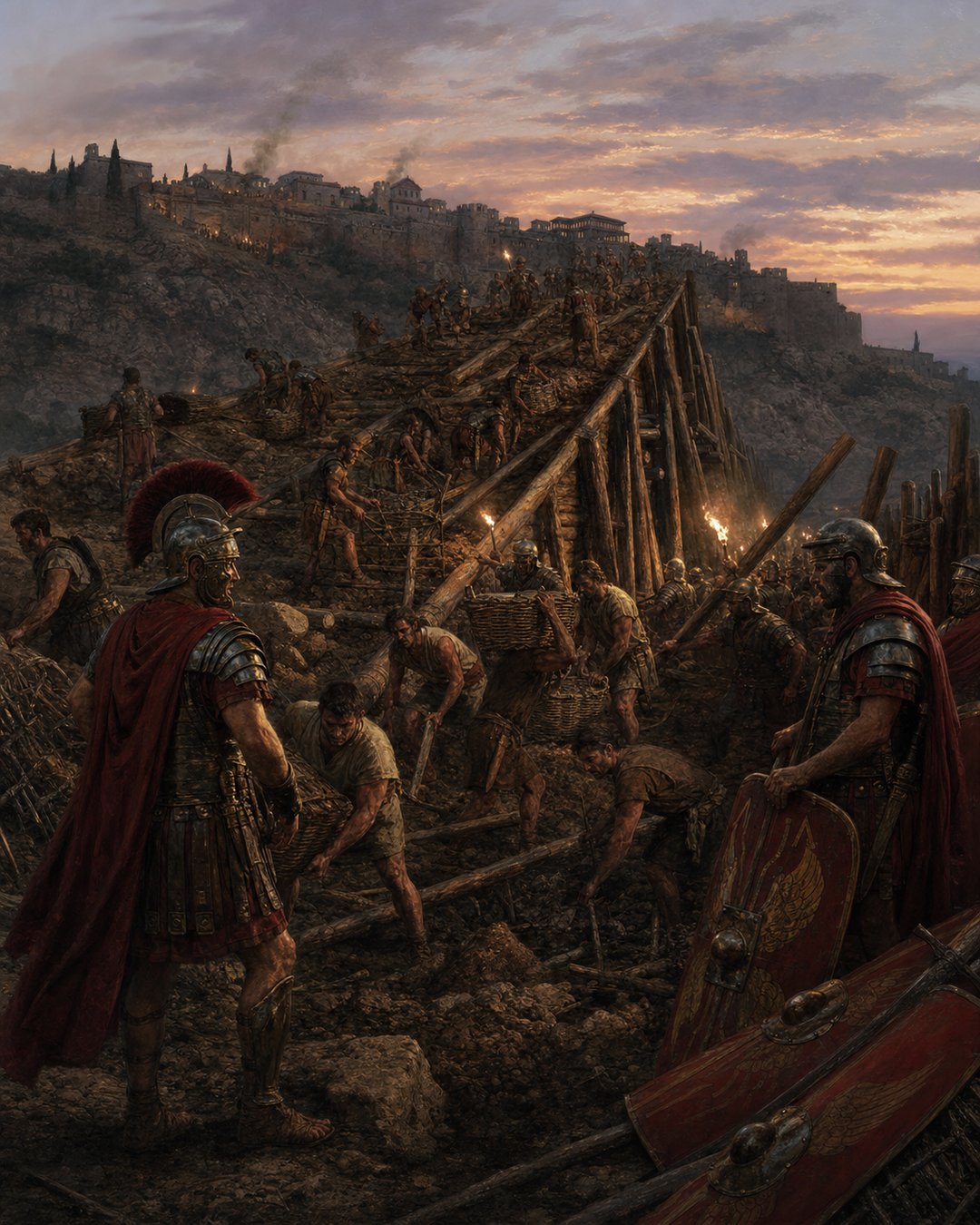
A siege ramp is not the most glamorous part of Roman war. It has no single hero, no clean trumpet note, and no instant decision. It is earth moved by tired hands, timber hauled into place, shields lifted against missiles, and officers measuring how much distance remains.
Roman siege ramps made conquest visible because they turned waiting into construction. The wall still stood, but every basket of soil announced that the distance between army and city was shrinking. The attack arrived before the breach, as a shape the defenders could watch.
The ramp made persistence measurable
Agger could mean a mound, bank, or ramp, and that ordinary word helps explain the military effect. The Romans did not only attack walls; they built a new piece of ground against them. Height became something manufactured.
Picture the mini-scene from the fact sheet: soldiers bend under wicker baskets of soil, engineers mark the line, timber braces the slope, and a wall that looked permanent yesterday now has a Roman answer rising toward it.
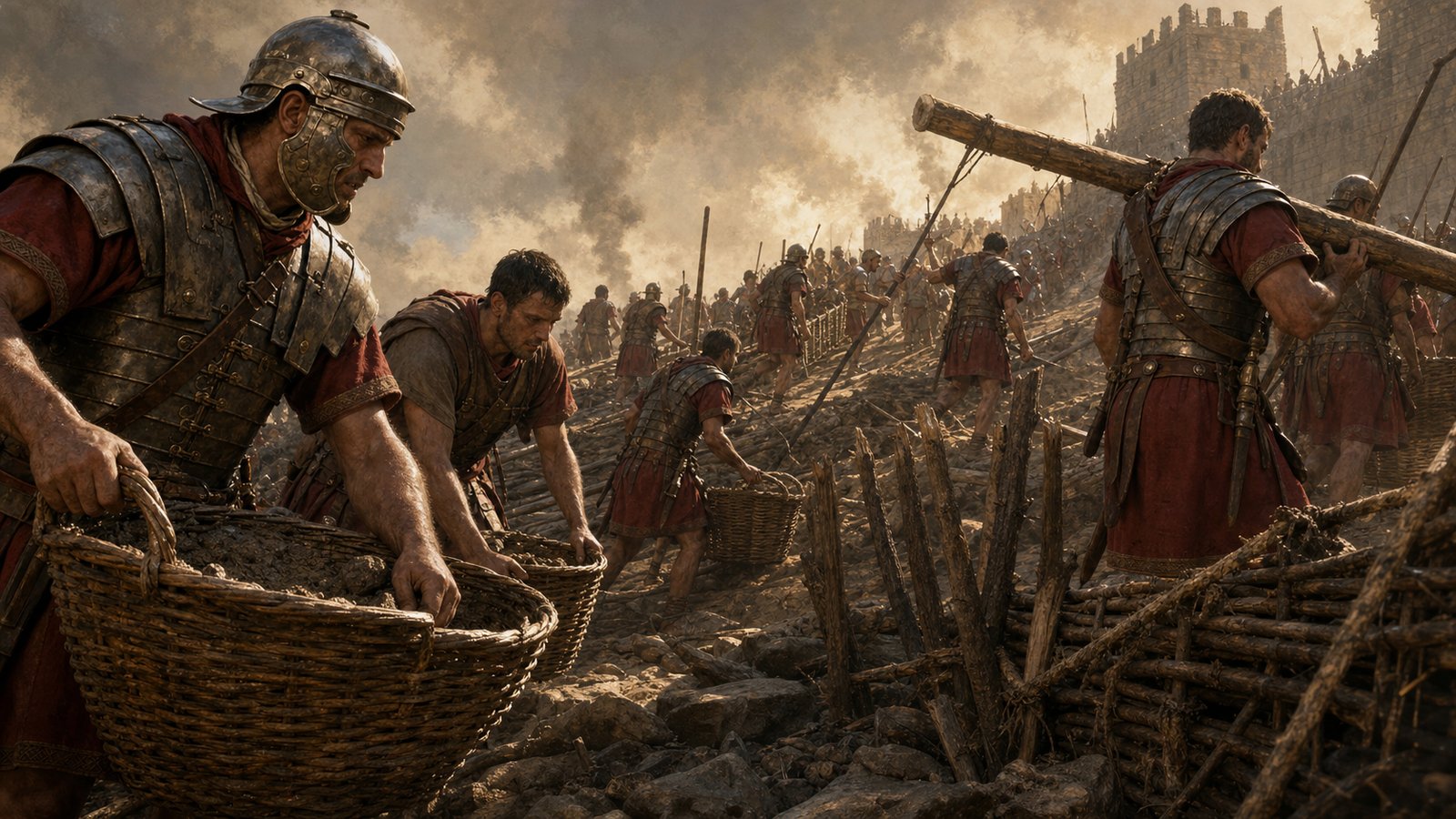
Engineering changed the psychology of a siege
A wall gives defenders a simple hope: distance. The ramp attacked that hope without needing the gate to open. Day after day, the work made the outside army feel closer, heavier, and harder to dismiss.
This was pressure in public form. Defenders could see the Roman calculation. They could count the progress, hear the tools, smell smoke and fresh-cut timber, and understand that courage alone would not make the earthwork stop.
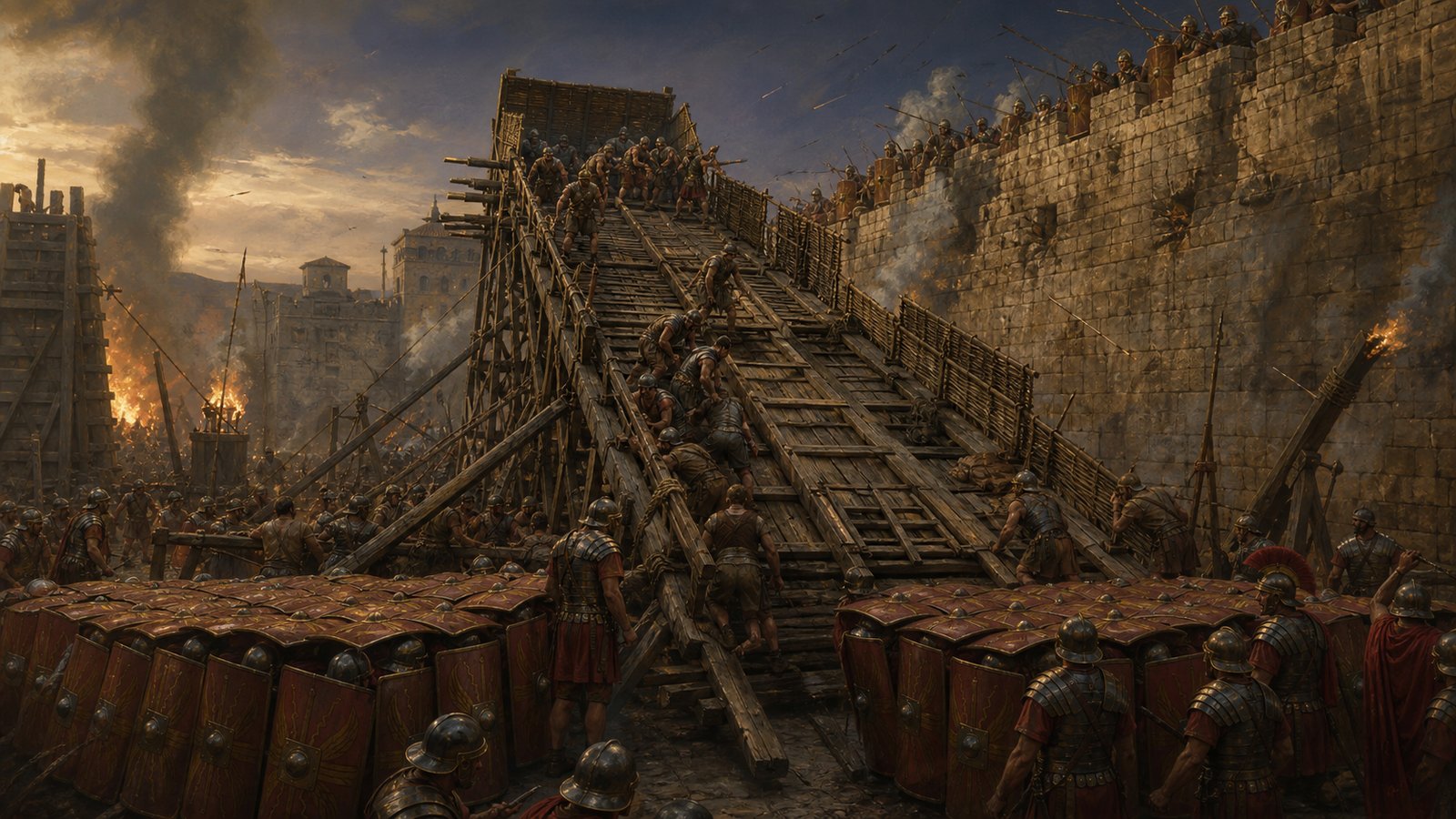
Protection was part of the machine
Testudo reminds us that siege labor needed protection as much as ambition. Workers and soldiers had to move under thrown stones, arrows, fire, and fear. Shields, screens, and formations made the ramp possible by keeping bodies at the task.
The ramp therefore was not a pile of soil. It was a coordinated system: baskets, timber, guards, engineers, shield roofs, commands, and repeated replacement of exhausted men. Roman order was visible in the way the work continued.
The camp and ramp belonged to the same habit
Castra shows a wider Roman instinct. The army liked space that could be measured, laid out, defended, repeated, and improved. A camp made movement temporary but orderly; a siege ramp made attack slow but organized.
This habit mattered because it turned military confidence into routine. The army did not have to invent discipline at the wall. It brought a culture of ditches, ramparts, stakes, watches, and measured labor with it.
The breach began before the wall fell
The most important moment in a siege ramp may come before the assault. The defenders look down and realize that the wall is no longer only stone. It is now part of a contest with Roman labor, Roman time, and Roman memory.
A ramp made conquest visible by giving victory a body before victory was achieved. The city could still resist, but the Roman answer had already entered the landscape.
The word vallum, a rampart or palisaded line, adds another detail. Roman military power often appeared as earth and timber before it appeared as sword work. Lines, banks, stakes, mounds, and platforms changed how people moved and what people feared.
That is why siege engineering belongs in political history, not only military history. A city wall represents confidence: we are inside, you are outside. A ramp replies by changing the grammar of the place. Outside becomes higher. Distance becomes shorter. Safety becomes temporary.
The labor also distributed responsibility. No single soldier could carry the ramp into being. Hundreds of small acts had to be repeated: cutting, carrying, dumping, bracing, guarding, clearing, and starting again when missiles or fire damaged the work.
The defenders saw not only Roman strength but Roman patience. A charge could fail in an afternoon. A ramp announced a more unsettling promise: we can keep coming tomorrow, and the work will still be here when dawn returns.
This kind of pressure did not require perfect technology. It required enough organization to make many imperfect actions accumulate. Soil spilled, beams shifted, shields broke, men tired, but the line of work remained intelligible.
A siege ramp also changed sound. The city heard tools, shouted orders, creaking timber, and the muffled rhythm of labor under shields. Those noises mattered because they replaced uncertainty with evidence. The Romans were not merely waiting outside the wall. They were building toward it.
The ramp exposed Roman war as a contest over surfaces. Walls, slopes, roads, ditches, towers, and camps all made violence spatial. To control the ground was to control the terms on which courage could operate.
Defenders could answer with fire, sorties, counterworks, and missiles. The ramp was never inevitable. But its visibility made it dangerous even before completion, because it forced the defenders to respond to Roman time rather than their own.
The image is almost bureaucratic in its brutality: a wall converted into a problem, a problem converted into tasks, tasks converted into daily progress. The ramp made conquest look less like a sudden miracle and more like an administered decision.
The ramp also made command visible to Roman soldiers themselves. A man carrying soil could see that his effort belonged to a larger shape. He was not simply enduring danger; he was helping the army manufacture a route where no route had existed.
For the defenders, that same clarity was corrosive. A failed assault might be cheered from the wall, but a half-finished ramp remained after the shouting stopped. It made success and failure less dramatic, because the work could simply resume.
Even the materials had meaning. Earth, timber, brushwood, stakes, and shields were ordinary things, yet in Roman hands they became an approaching argument. The city had stone; Rome answered with accumulation.
That slow accumulation made the final assault feel almost procedural. When soldiers eventually moved up the finished work, the decisive moment rested on many earlier hours of anonymous labor. The breach was spectacular, but the ramp had prepared the imagination for it.
The strange power of the agger is that humble material could make a city feel the future approaching. The breach had not opened yet. The enemy had not entered yet. Still, the ground itself had begun to change sides.
The ramp also exposed the defenders to a particular kind of time. They did not face one terrifying hour; they faced a schedule imposed by the besieging army. Each morning could reveal more height, more timber, more protection, and less uncertainty about Roman intentions.
That rhythm made fear cumulative. A stone wall asks people to believe in permanence, but a visible earthwork asks them to imagine the day permanence fails. Roman siege ramps worked on that imagination before they worked on the masonry.
Seen from the Roman side, the ramp converted discipline into landscape. It was the army’s habits made visible: measure, assign, protect, repeat, and return. The city was not only being attacked. It was being answered by a structure that grew out of Roman routine.
Sources & Further Reading
- Smith Dictionary, Agger
- Smith Dictionary, Vallum
- Smith Dictionary, Testudo
- Smith Dictionary, Castra