
A Roman soldier could look most loyal when he stood beneath a standard, but loyalty was not made by spectacle alone. It also passed through pay tables, coin bags, rolls, tablets, and the repeated expectation that service would be recognized in material form.
Roman stipendium made soldier loyalty countable because it translated military obligation into a visible transaction. The army was still a machine of discipline, honor, fear, comradeship, and ambition, but the pay scene made one part of that machine measurable.
The pay table gave service a number
Stipendium names the world of military pay and service, and that double meaning is useful. A soldier did not merely receive money as a bonus after courage. Payment helped define the relationship between his body, his time, and the state that claimed both.
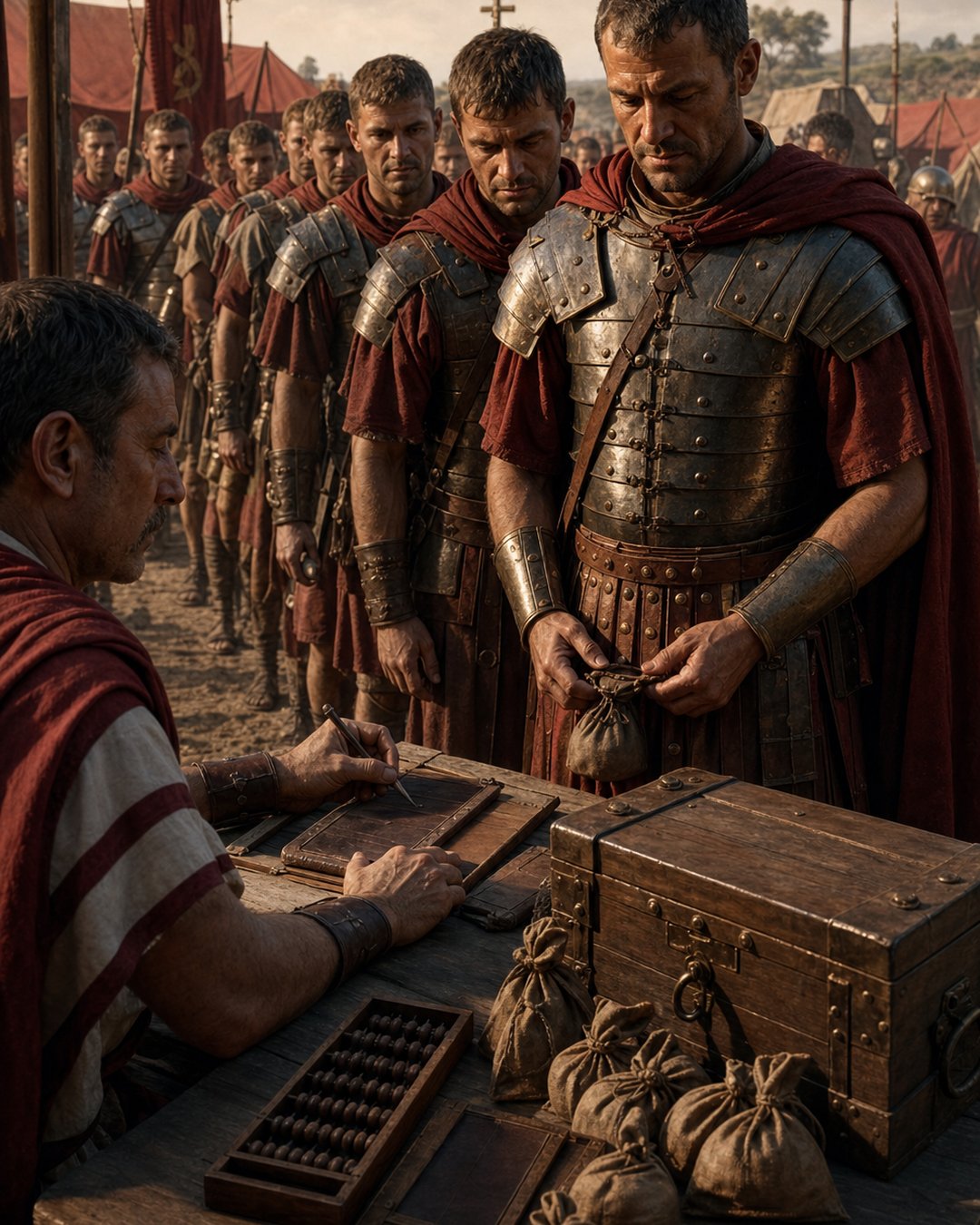
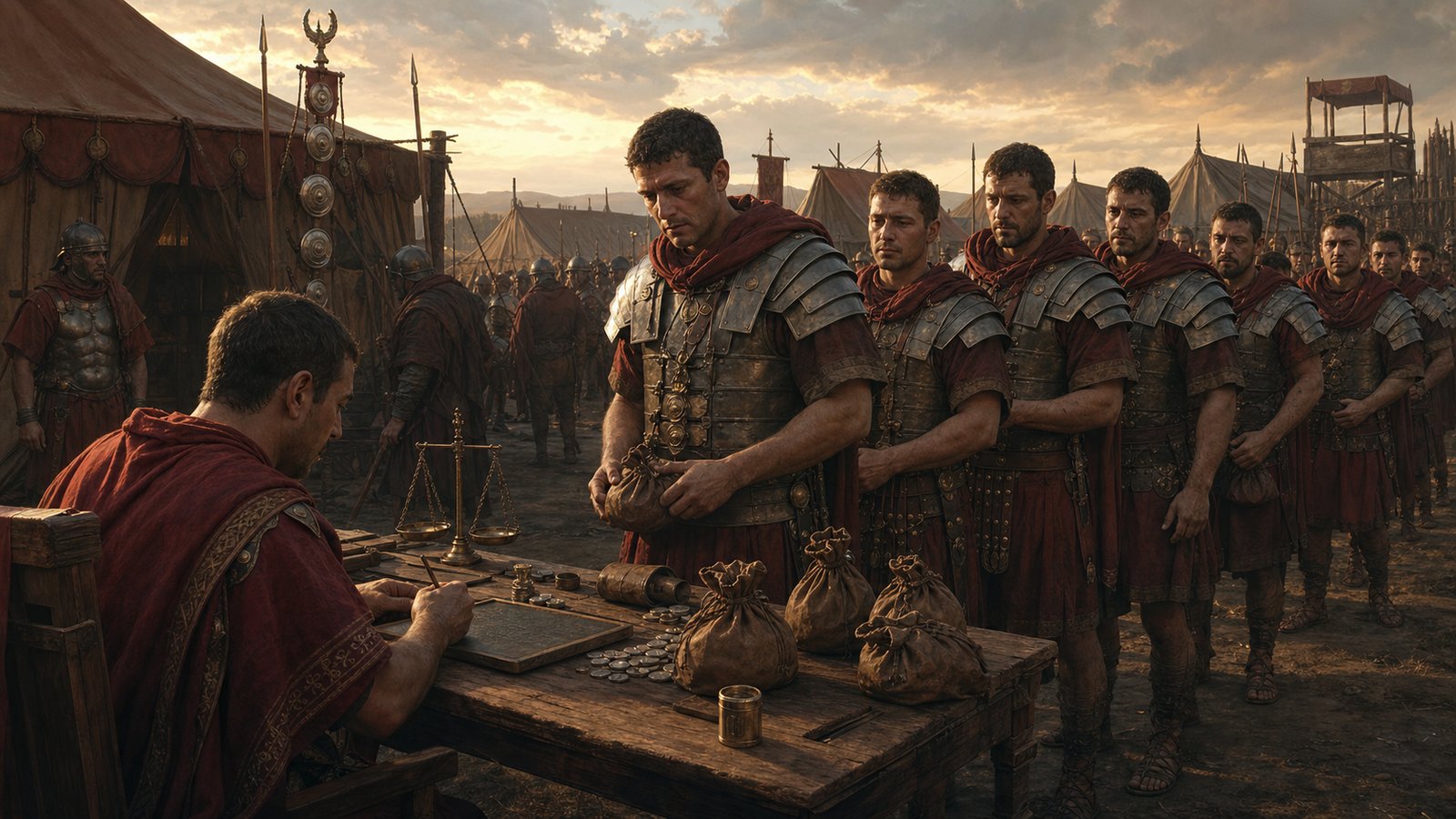
Picture the concrete scene: a line of men in dusty armor, a clerk bending over wax tablets, coin bags slumped beside a wooden chest, and a standard rising over the queue. The scene made obligation visible one name at a time.
The treasury turned courage into accounting
Aerarium, the treasury, reminds us that armies do not live on glory. They require stores, accounts, officials, and flows of money. A legion could win honor in the field while still depending on the dry machinery of payment.
This connects with Roman treasury ledgers. War became more durable when the state could count what it owed, what it spent, and which men had entered the bargain.
Records made the soldier individual again
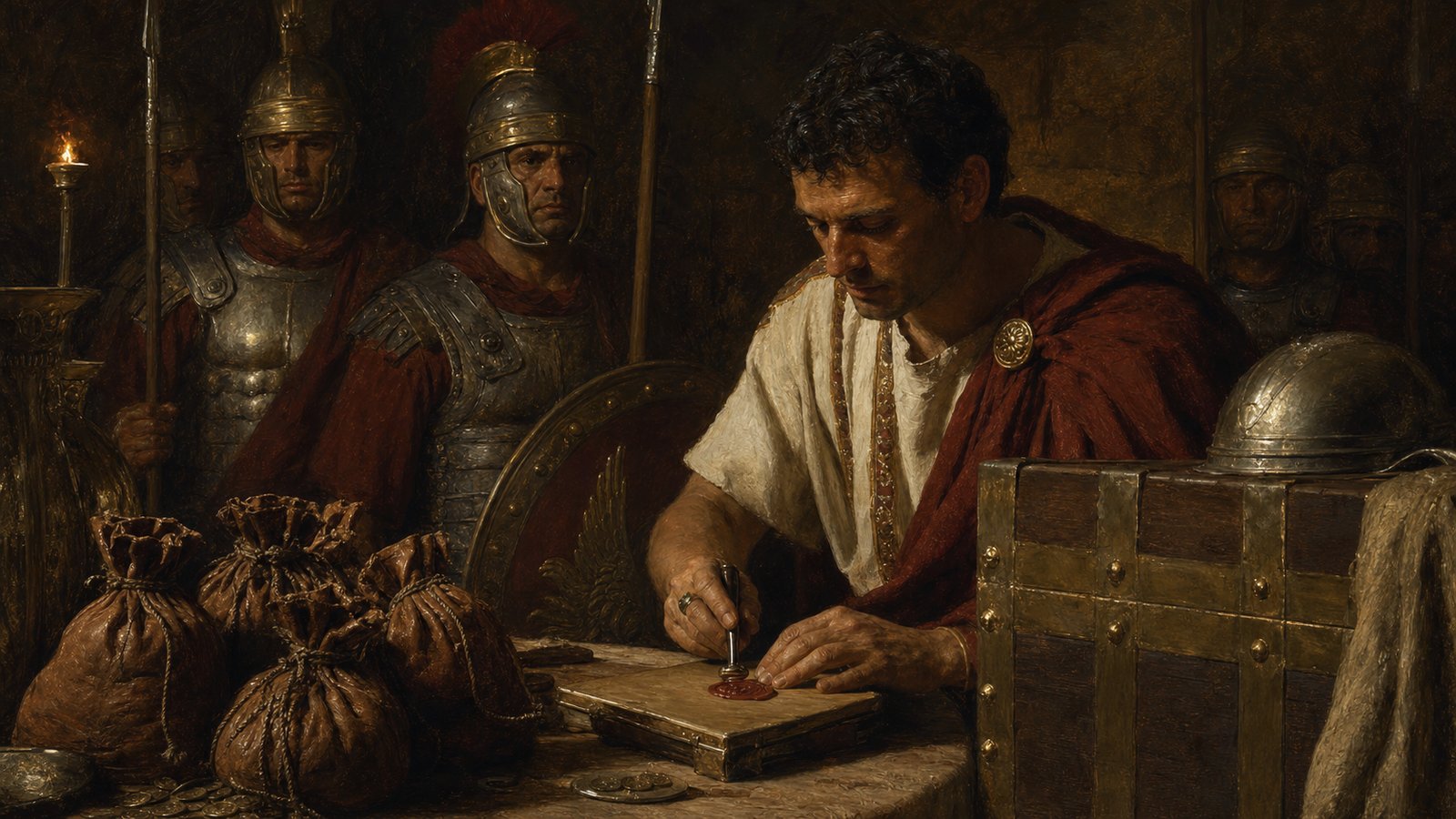
A legion could appear as a mass from the outside. At the pay table, however, the soldier became a name, a sum, a status, and a remembered obligation. Tabulae turned the crowd of armed men into countable entries.
That mattered emotionally as well as administratively. A soldier who served under a standard wanted recognition that attached to him, not only to the unit. The tablet and coin made that recognition tangible.
Standards and coin spoke different languages
Signa, the standards, made collective identity visible. They gathered men around the honor of the unit. Pay spoke a quieter language: it reminded each man that service also had terms, arrears, deductions, and expectations.
The two languages worked together. The standard told the soldier where he belonged. The pay table told him that belonging had been entered into a system that could reward, remember, or fail him.
Delayed payment could turn accounting into danger
Counting loyalty never made loyalty simple. If pay was late, unfair, or disputed, the same records that stabilized service could become evidence of grievance. A soldier could measure not only what he had received, but what he believed was owed.
Stipendium made soldier loyalty countable by giving military service a repeated material test. Rome could ask men to endure hardship, but the pay table reminded everyone that discipline and obligation also had a price.
The scene should not be reduced to greed. Soldiers fought for comrades, fear, advancement, citizenship, booty, settlement, habit, and reputation. Pay did not replace those motives. It gave one crucial motive a form that administrators and soldiers could both recognize.
A coin in the hand had a different force from a promise spoken in camp. The coin could be weighed, spent, hidden, sent home, or compared with another man’s share. Payment created small private calculations inside a public military machine.
The pay chest also made absence visible. When money was expected and not present, the missing coins could gather more anger than an abstract insult. Material loyalty can become material resentment.
Roman officers understood that armies needed ritual as well as supply. A pay distribution was not just bookkeeping in a corner. It could stage order, hierarchy, trust, and the idea that the state saw the men who carried its weapons.
The quaestor-like figure at the table matters because he shows another face of war. Not every important military actor swung a sword. Some made war possible by recording names, guarding funds, checking sums, and answering when accounts did not balance.
The routine also taught soldiers how to imagine the state. Rome was not only a city far away or an emperor on a coin. Rome was the official who called a name, the tablet that held a record, the chest that opened, and the standard under which the queue formed.
That mixture could be powerful. The soldier felt himself both part of a collective and a person whose claim could be counted. The army used both feelings: pride in the unit and attention to the individual obligation.
Pay also tied the present to the future. A man who expected regular stipendium could plan, owe, gamble, save, or support a household. Military loyalty reached beyond the camp because the pay table affected lives outside the ranks.
The scene was public enough to create comparison. Men could watch order, delays, favoritism, or correction. If a clerk made a mistake, the error belonged not only to the record but to the camp’s memory.
This is why small objects matter: tablets, styluses, scales, bags, seals, and chests made military obligation concrete. Without them, loyalty would float as rhetoric. With them, loyalty became something handled.
The standard above the pay table also sharpened the moral message. A soldier received money not as a detached laborer, but as a man enrolled in a body with honors and dangers. The payment recognized service under a sign larger than himself.
Roman stipendium made soldier loyalty countable because it brought heroic language down to a table where names, coins, and records met. The army still needed courage. It also needed accounts that made courage sustainable.
The pay scene further exposed how much military power depended on trust. A soldier had to trust the record, the official, the scale, and the promise that future service would not vanish into silence. The state had to trust that payment would buy discipline rather than merely postpone complaint.
That trust was never automatic. It had to be renewed in repeated scenes where soldiers saw that the system still functioned. Each distribution became a small proof that the relationship between service and reward had not broken.
In that sense, stipendium did the opposite of a triumph. A triumph displayed victory after it had been won; the pay table maintained the conditions that made future victories possible. It was less glorious, but far more regular.
The count also made command more honest in one narrow way. Officers could speak of honor, but the records showed how many men had entered the bargain and how much the bargain cost. Rhetoric met arithmetic beside the chest.
The soldier’s body completed the scene. He had marched, waited, stepped forward, listened for his name, and accepted the material sign that service had been acknowledged. Counting loyalty was therefore not cold abstraction. It was a physical encounter with the state.
Rome’s armies are often remembered through battles and emperors, but their durability rested on such repeated encounters. Loyalty survived when men could believe that sacrifice would be noticed, entered, and paid. The stipendium did not create devotion by itself, but it made devotion easier for both soldier and state to measure.
Sources & Further Reading
- Smith Dictionary, Stipendium
- Smith Dictionary, Aerarium
- Smith Dictionary, Quaestor
- Smith Dictionary, Tabulae
- Smith Dictionary, Signa