
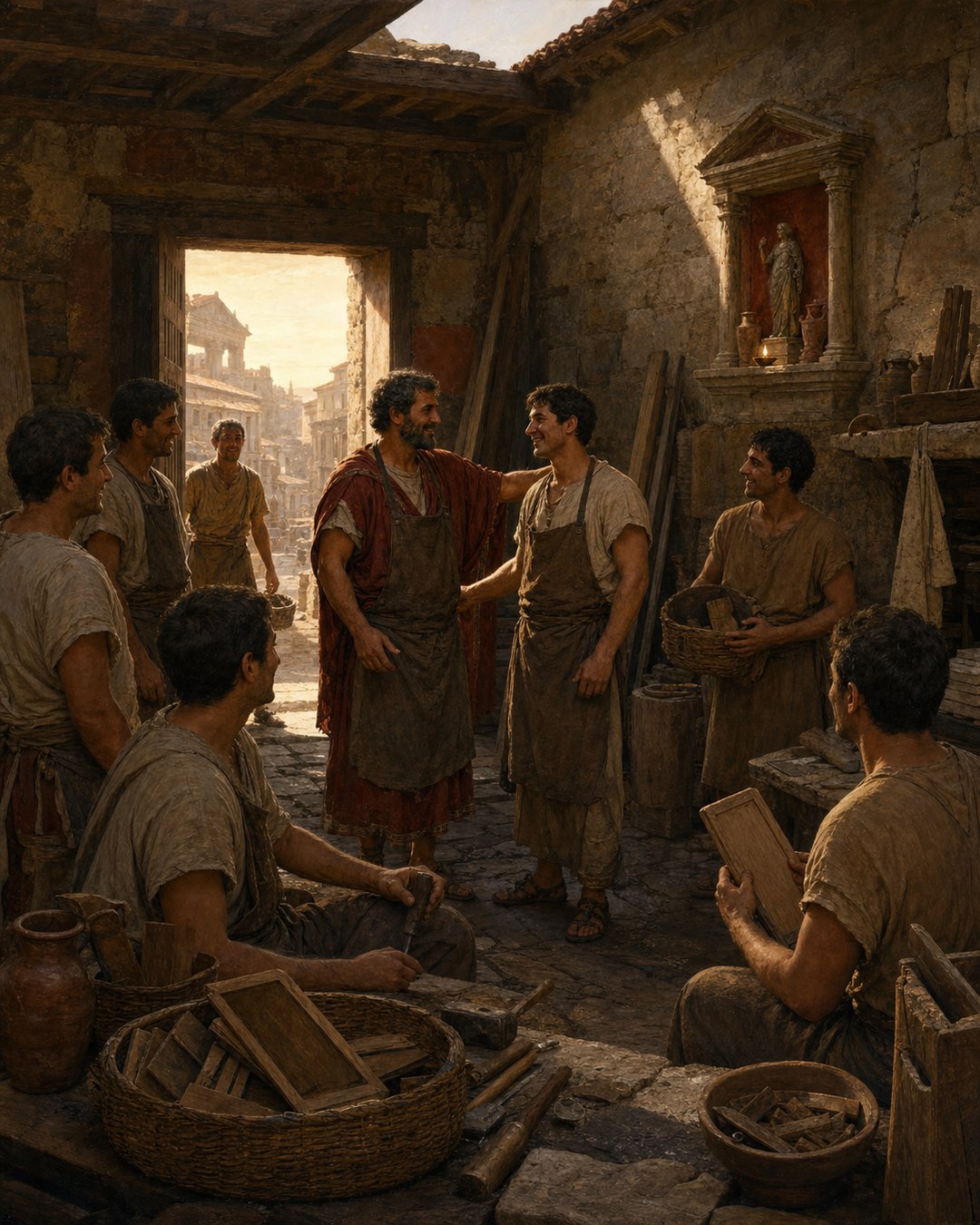
A worker alone can disappear into the background of a Roman street. A group with a name, a meeting place, records, patrons, and rituals is harder to ignore. It begins to look like a body.
Roman collegia made work public because they gave shared labor and shared identity recognizable forms. A craft, cult, neighborhood, or association could step out of private necessity and into civic visibility.
The collegium gave scattered people a name
Collegium describes an association, and the word matters because naming changes visibility. A named group can gather, be remembered, receive support, keep records, and appear as more than a handful of individuals.
Picture a modest hall at first light: tools stacked near a wall, lamps still burning, members arriving with dust on their tunics, and a small shrine or table marking the center of the room. Work has become organized presence.
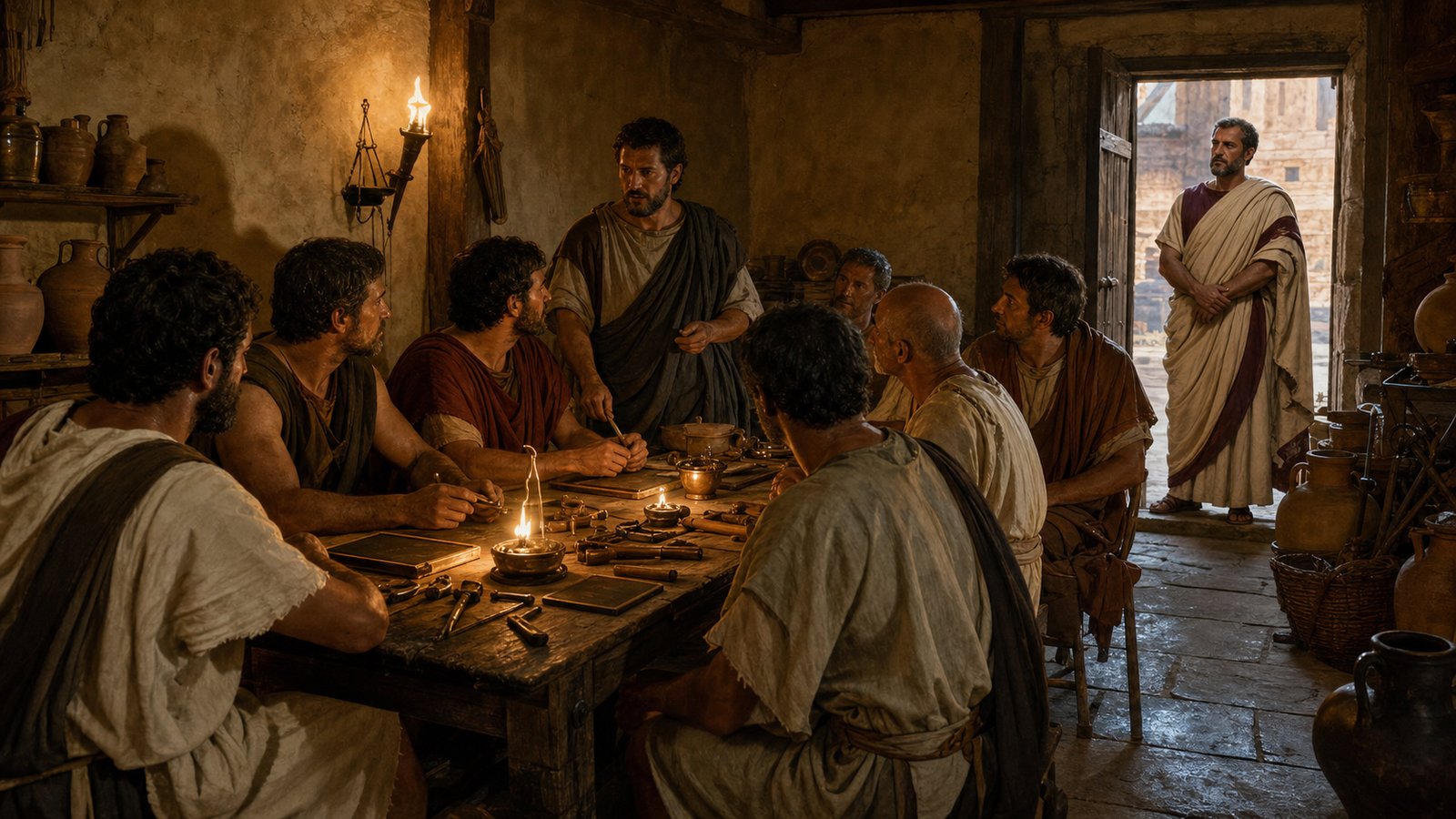
Association made cooperation durable
Societas shows that cooperation could use recognized forms rather than depend on a single casual promise. People who shared risk, work, dues, ceremony, or protection needed habits that lasted beyond one conversation.
That durability mattered in a city full of movement. A worker could be poor or vulnerable, but membership gave his activity a context others could recognize. The group gave continuity to lives otherwise read only by occupation or need.
Tablets made membership memorable
Tabulae helped convert association into memory. Names, obligations, decisions, accounts, and dues could be written down, checked, and carried forward. A group that records itself becomes less easy to treat as a passing crowd.
The tablet on the table is a small object with a large effect. It tells members that their gathering has a past and a future. It also tells outsiders that the group can speak with remembered decisions.
Patrons linked workers to influence
Patronus reminds us that associations could seek protection and status through powerful supporters. A patron did not make members equal, but he could give their collective presence a louder echo.
The relationship cut both ways. The group gained a protector; the patron gained visible dependents, allies, clients, or grateful participants. Association turned influence into a social arrangement with bodies attached.
The street completed the performance
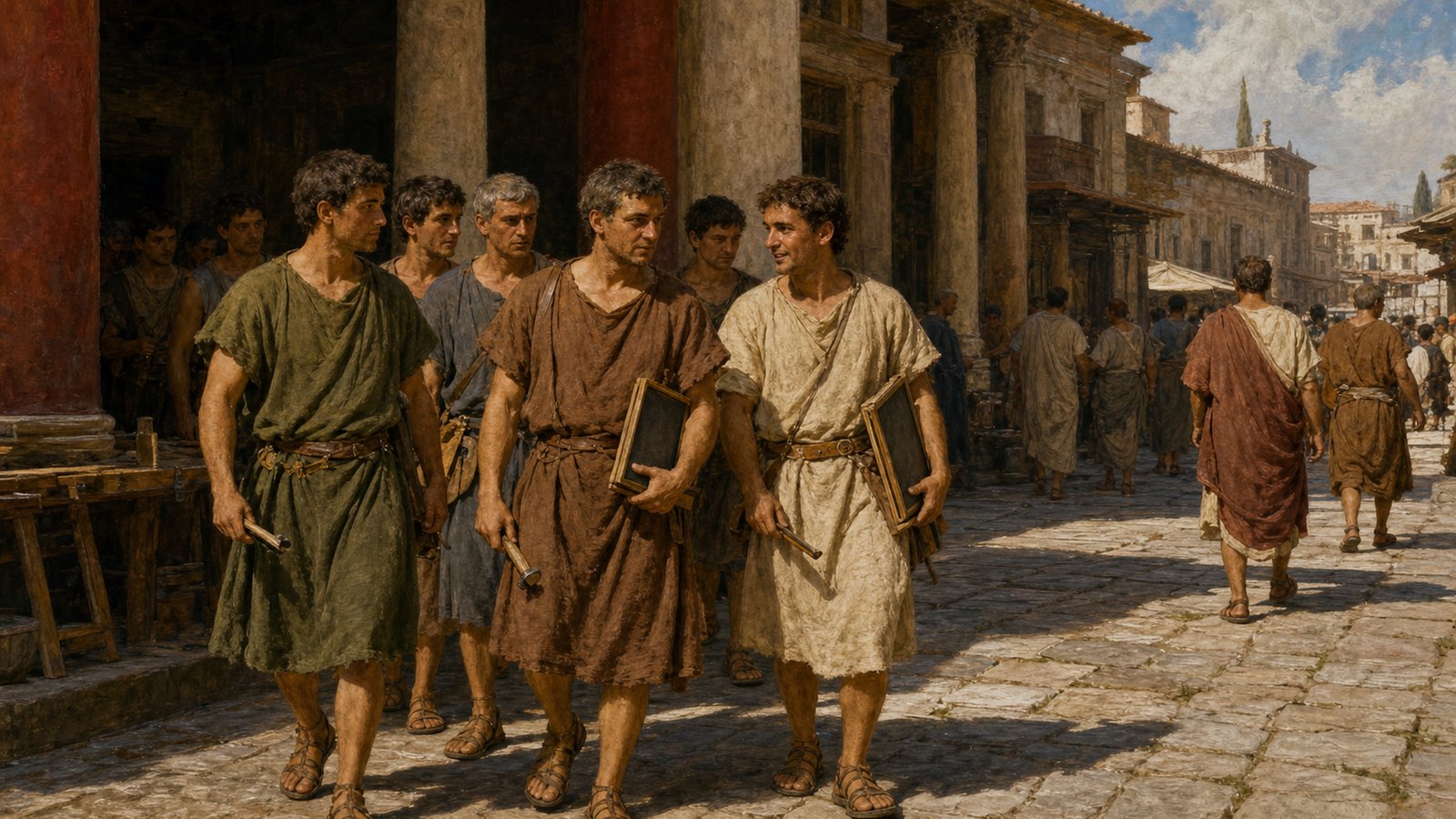
A collegium was not only what happened inside a room. When members moved into public space together, work became visible as a shared fact. Tools, clothing, greetings, routes, and reputation all carried the association outward.
The forum and street made the private economy readable. Rome saw work not only through goods produced, but through organized people who could gather, remember, and be seen.
This does not mean every collegium was a modern trade union. The forms varied, and Roman authorities could worry about associations when collective organization looked politically dangerous. The point is more basic: grouped people were harder to ignore than isolated workers.
A collegium could also make dignity visible. A craft that looked humble in a shop could acquire ceremony in a meeting. Shared meals, religious observance, records, and patronage gave ordinary labor a language of belonging.
The physical details mattered. Benches, lamps, tools, tablets, and a doorway to the street made the group a place as well as a label. Members could point to where they met and remember who was present.
Records also helped manage conflict. Dues unpaid, promises forgotten, decisions disputed, and honors claimed could all become less vague when a tablet preserved the earlier action. Writing did not remove argument, but it gave argument an object.
Patronage added another layer of visibility. A powerful supporter could lend prestige, but the association also advertised the patron’s reach. A hall full of members made influence tangible.
This is why work and politics quietly touched. A collegium gathered people who knew each other, had reasons to meet, and possessed a shared memory. In a city where crowds mattered, any organized body had potential importance.
Yet the everyday function may have been equally important. Workers needed help with recognition, ritual, mutual support, and the simple human need to belong somewhere larger than the day’s labor.
The collegium answered that need by turning repeated work into social form. It did for labor what other Roman institutions did for law, religion, and memory: it gave activity a place, a name, and a routine.
A passerby might not know every rule inside the hall, but he could understand the public signs. Men gathered there. Tools came and went. A patron visited. Records were kept. The group had a presence.
Association also made time visible. A single job ends; a group continues. Members could remember earlier decisions and prepare later ceremonies. Work became part of a chain rather than a series of disconnected tasks.
Roman collegia therefore made work public by organizing the social body behind production. The tool in the hand mattered, but so did the name on the group, the tablet on the table, the patron at the threshold, and the members stepping into the street together.
The group also protected memory from being scattered across too many individual lives. If one member died, moved, or lost favor, the association could still preserve habits, obligations, and status through the people who remained.
That continuity made collective identity useful. A craft did not need to reintroduce itself every morning when it had a body that could meet, keep accounts, honor patrons, and appear in recognizable ways.
The hall was therefore more than a roof. It was a machine for turning repeated labor into public form. Inside it, tools and tablets sat beside ritual, conversation, and remembered decisions.
Associations could also make ordinary workers visible to one another. A man who seemed weak alone might feel different when surrounded by people who shared his trade, dues, ceremonies, and expectations.
This does not romanticize the system. Hierarchy remained, patrons could dominate, and officials could fear organized groups. But the collegium still shows how Roman society made work legible by giving workers collective shape.
The association made ordinary dependence easier to see as well. A member might rely on a patron, a treasurer, fellow workers, ritual officers, or a shared fund. Those ties were not invisible when the group gathered in one place.
Collective visibility also affected outsiders. Customers, officials, landlords, and patrons could treat the group as something that had continuity. The collegium became an answer to the question of who stood behind a craft, a ceremony, or a shared obligation.
Roman public life was full of bodies that became meaningful by appearing together. Collegia belonged to that world: not spectacular like a triumph, but powerful in the quieter way they made organized work visible.
The most revealing detail is that collective work needed ordinary maintenance. Someone had to keep the room, remember the dues, arrange the meeting, preserve the tablet, and greet the patron. Public identity was built from repeated administrative acts.
Those acts made labor easier to recognize from outside. The city could see not only products on counters, but the organized people, records, rituals, and relationships that made production socially durable.
Sources & Further Reading
- Smith Dictionary, Collegium
- Smith Dictionary, Societas
- Smith Dictionary, Tabulae
- Smith Dictionary, Patronus
- Smith Dictionary, Forum