
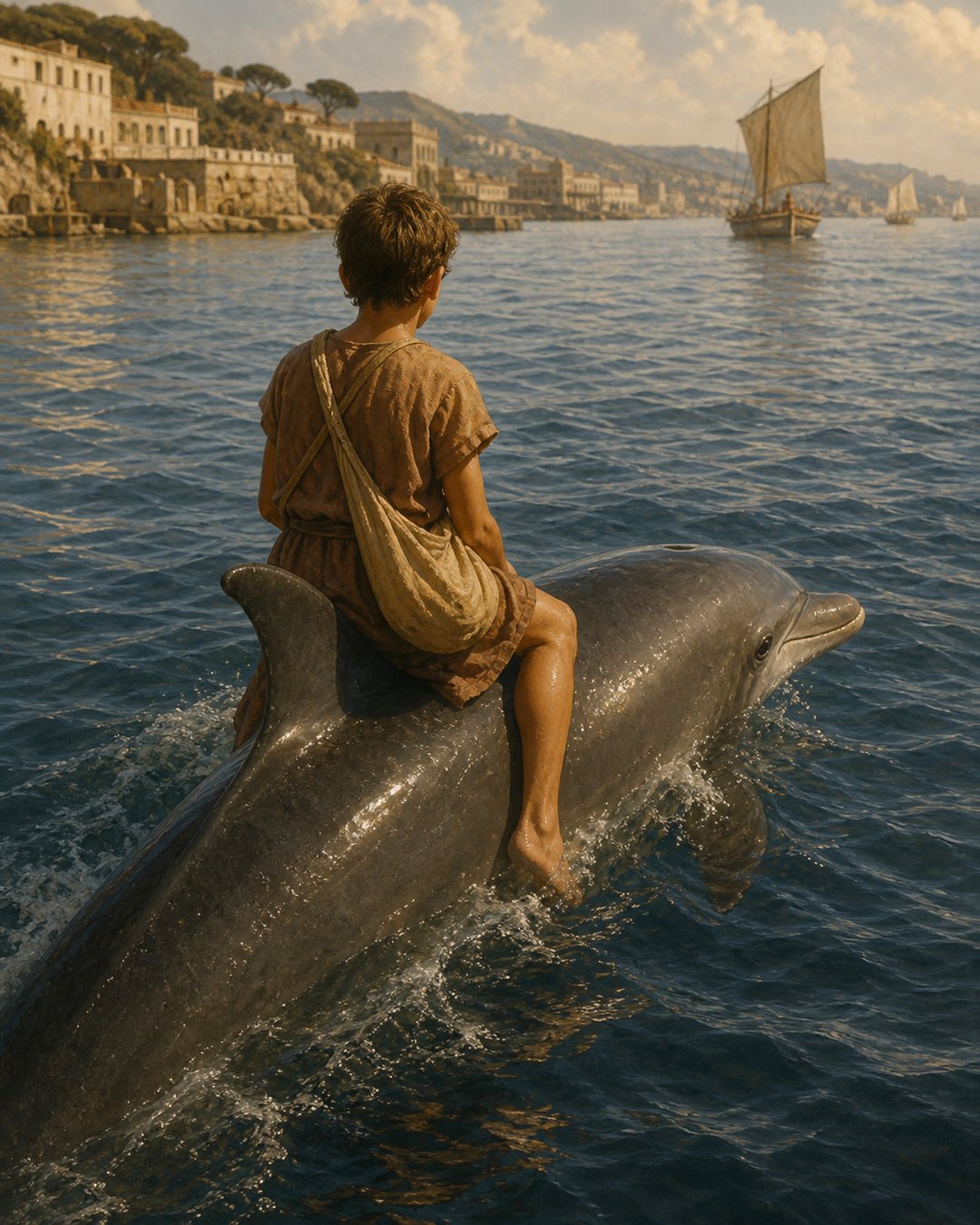
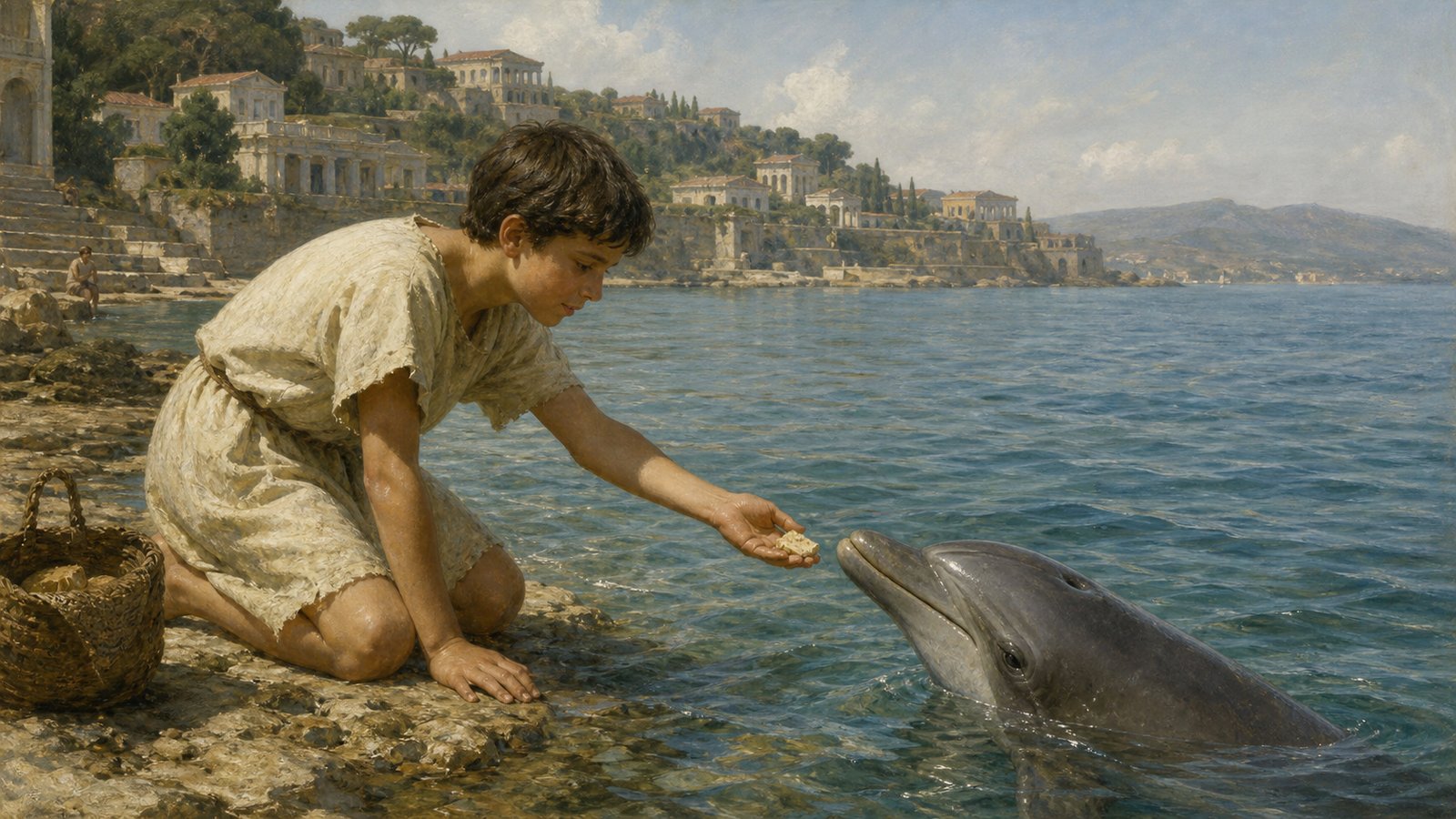
A poor boy travelling from the district of Baiae to school at Pozzuoli carried bread for the journey. At the Lucrine Lake he called a dolphin he had named Snub-nose and offered pieces from his meal.
Pliny the Elder says the dolphin came from the depth, ate from the boy’s hand and allowed him to climb onto its back. It carried him across the bay to school and brought him home again.
The marvel was not a single rescue. Pliny makes it a routine lasting several years. An extraordinary animal entered an ordinary timetable of lessons, bread and return journeys.
A School Route Gave the Story Its Shape
The boy is not introduced as a prince or hero. Pliny calls him a poor man’s son and defines his movement through school. He travelled between the Baiae district and Pozzuoli.
That geography matters because the dolphin does not carry him toward a mythical island. The destination is a real harbour town connected to work, traffic and education around the Bay of Naples.
The encounter began while the boy lingered at noon. He had bread for his journey and used pieces to coax the animal. The same object served as human food and the beginning of trust.
Pliny’s detail turns the meeting into a pattern that can be pictured. Time of day, route, call and reward recur. Repetition makes the animal’s response appear learned rather than accidental.
An article on Roman schoolrooms training public voices follows the discipline waiting at the destination. The dolphin story places that education inside a commute, reminding readers that reaching a teacher could be part of the day’s labour.
Snub-Nose Answered a Name and Bread
The boy called the dolphin Simo, rendered as Snub-nose. Naming changes the relationship from a sighting of wildlife into repeated recognition between two individuals.
Pliny says the dolphin could be concealed in the depth yet would rush out when called, whatever the time of day. It ate from the boy’s hand before allowing him to mount.
The sequence establishes a small ritual: voice, arrival, feeding and ride. Bread is not an incidental treat. It creates the pause in which the animal approaches and the boy can touch it safely.
Pliny adds that the dolphin sheathed, or lowered, the prickles of its fin while carrying the rider. The detail imagines the animal adjusting its body to the human passenger.
Modern readers should not convert literary confidence into a zoological record without qualification. The author is presenting a famous marvel. What can be analyzed securely is how he makes the marvel persuasive through specific repeated actions.
The Bay Turned Wonder into Transportation
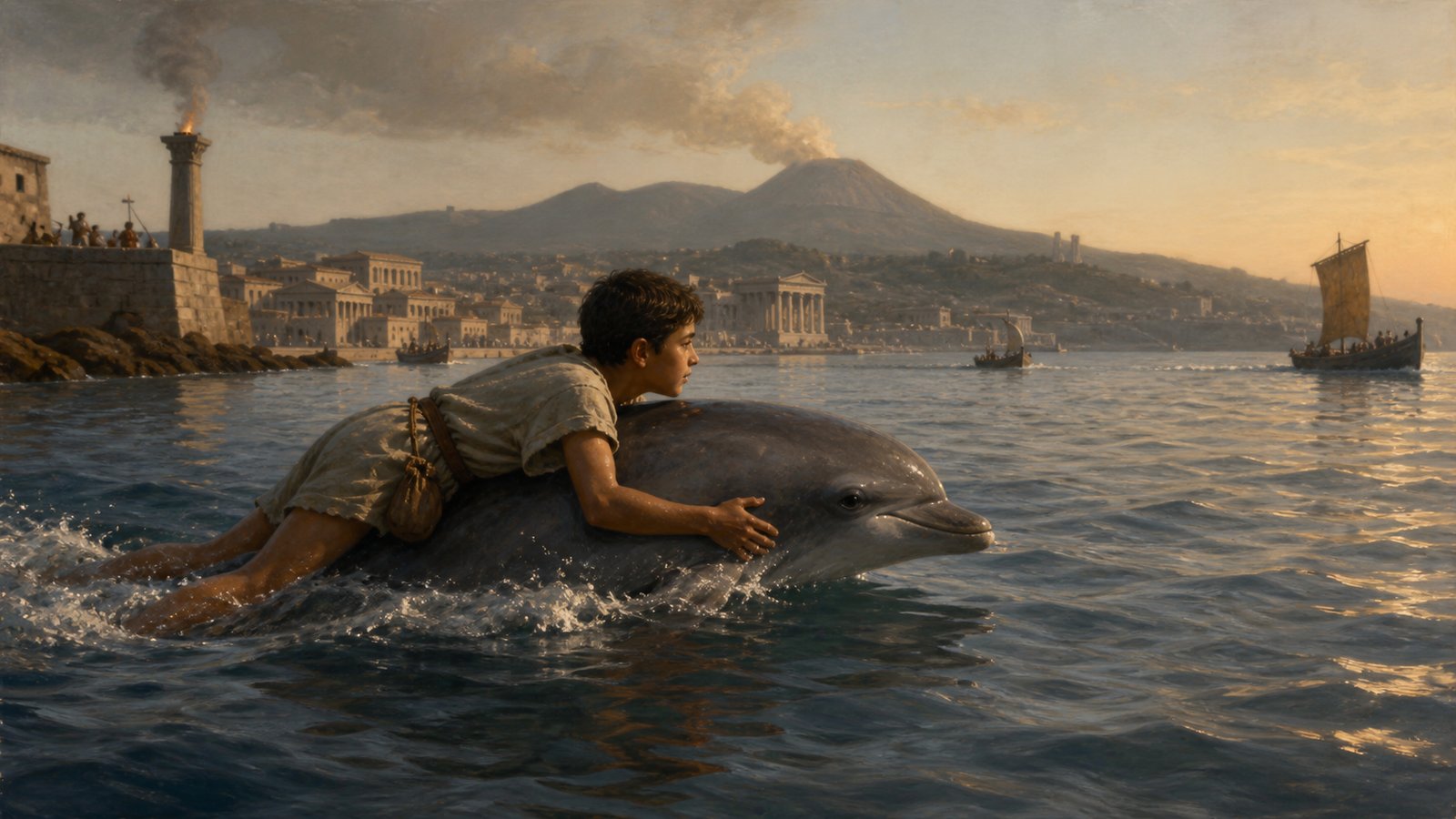
The dolphin carried the mounted boy across to Pozzuoli and brought him back in the same manner. The return journey is essential. It changes an adventure into transport.
A bay crossing also gives the animal an advantage over the land route. The dolphin moves through its own medium while the schoolboy avoids whatever distance lay around the shore.
Pliny says the arrangement continued for several years. Each repetition would have created possible observers among boat crews, fishermen, travellers and people near the shore, even though the source does not give their individual testimony.
The region was already full of elite villas, ports, fishponds and maritime movement. The tale inserts a poor child into that busy landscape through a form of travel no wealthy household could simply command.
The archive’s article on Vedius Pollio’s lamprey pool shows elite control turning fish into instruments of terror. Pliny’s dolphin story imagines the opposite relation: food initiates cooperation, but the animal keeps the freedom to answer the call.
Named Authorities Supported an Embarrassing Marvel
Pliny pauses to acknowledge that the story may sound shameful to repeat. He defends himself by naming earlier writers: Maecenas, Fabianus, Flavius Alfius and many others.
The list performs a source function inside the ancient text. Pliny does not ask readers to trust only his own wonder. He places the report in a chain of educated testimony.
Maecenas also anchors the story socially in the age of Augustus, the period in which Pliny places the dolphin. A familiar elite name lends weight to an otherwise improbable school commute.
That appeal does not prove every event. It shows how Roman natural history managed credibility. An extraordinary claim became more publishable when prior observers or authors could be attached to it.
Pliny’s method mixes animal description, hearsay, named authority and moral emotion. The boundaries between zoology, anecdote and literature are not the same as those of a modern field study.
Mourning Completed the Bond
The boy eventually died from disease. Pliny says the dolphin continued coming sorrowfully to the usual place, like a mourner, and then died from longing.
This ending makes the habitual meeting place visible by absence. The animal returns, but the call, bread and rider do not. Routine has trained expectation in both participants.
The claim about grief belongs to Pliny’s narrative and should remain attributed to him. Its literary purpose is clear: the relationship was not merely an exchange of food for transport.
The school route had joined two lives. Once one ended, the other could not resume its former pattern. The dolphin’s death converts repeated practical cooperation into reciprocal attachment.
Pliny follows the Lucrine account with other dolphin stories from different places. That wider collection presents dolphins as unusually responsive to human contact, but the schoolboy remains distinctive because the relationship is organized around a child’s calendar.
The strongest detail is still the bread. It is small enough to belong to a poor boy’s lunch and powerful enough, in the story, to begin years of crossings. Wonder grows from an object already present in daily life.
For Roman readers, the bay was not an empty blue stage. It held fisheries, villas, shipping and contested wealth. The dolphin’s route cut across those systems without becoming property, fare or official service.
The story survives as literature, not a timetable that can be independently checked. Pliny’s named witnesses, precise places and repeated motions reveal how he wanted readers to cross the gap between doubt and wonder.
By the final return to the empty shore, transportation has become memory. Snub-nose no longer carries the boy to school, but the routine carries both of them into natural history.
The unnamed boy and the named dolphin create another imbalance. Human social status gives the child only a family condition and route, while the affectionate name gives the animal a distinct presence. Pliny’s narrative remembers the pair through what they did together rather than through the boy’s ancestry.
No payment closes each crossing. Bread begins the contact, but years of repetition exceed a single exchange. The same call works because the earlier meeting has established an expectation that both participants renew.
Pozzuoli gives that expectation a clock. School provides a reason to cross and a reason to return, preventing the marvel from drifting into timeless folklore. Lessons on the far shore keep the animal encounter attached to the obligations of a human day.
Pliny’s hesitation before telling the story is part of its afterlife. By admitting that the report strains belief, he anticipates the reader’s objection and answers it with names. Doubt is not removed; it is staged and managed before the dolphin makes its first crossing.
Sources
Pliny the Elder, Natural History 9.8.